Pairs with the Asset-Light vs Asset-Heavy Comparator — a ready-to-use strategy tool, filled for Red Bull. Included in the Asset-Light Operator Casebook →
“Which parts of the business should you stop owning?”
On 14 October 2012, a man stepped off a capsule 39 kilometers above New Mexico and fell back to earth fast enough to break the sound barrier with his body — 1,357.6 km/h, verified by the world aviation federation.6 More than 8 million people watched it live on YouTube at the same moment, a concurrency record YouTube confirmed itself.9 Red Bull says three billion people have since seen the jump.5 It cost about $27 million, the figure Red Bull ultimately concluded for the total project.5 No can of energy drink appeared in the broadcast. The logo was everywhere. And this, the world decided, was proof of the most quoted idea in modern marketing: Red Bull is a media company that happens to sell drinks.
It is a wonderful line. It is also half false. The official story is that Red Bull built a media empire — a TV channel, a magazine, a film studio, a global content machine — that earns its own keep alongside the cans. The real story is plainer and stranger: Red Bull Media House has never published a single standalone audited number proving it earns anything at all.4 Every euro the company has ever disclosed came from selling a drink.
Follow the only revenue line that's ever been disclosed
Red Bull GmbH is private, founded in 1984 by Dietrich Mateschitz and Chaleo Yoovidhya — two men, two $500,000 stakes — three years before the product launched in Austria on 1 April 1987.2 As a private company it discloses almost nothing it isn't forced to. But what leaks out is unambiguous. In 2024 net sales rose 6.4% to €11.2 billion, on 12.7 billion cans sold.1 That is the entire reported business: cans, multiplied by price. There is no media segment in the figures, no 'content revenue' line, no breakout for the films and broadcasts. Red Bull Media House, registered in 2007 and wholly owned by the parent, files no independent audited financials.4 Third-party estimates of its revenue range so wildly — from roughly $47 million to $546 million — that they tell you nothing except that nobody outside Wals actually knows.10
| The beverage business | Red Bull Media House | |
|---|---|---|
| Revenue disclosed | €11.2 billion, 2024 | None ever published |
| Audited financials | Parent-level figures reported | Files none independently |
| What it sells | 12.7 billion cans | Content — to whom, for how much, unknown |
| Role in the model | The entire P&L | A wholly owned subsidiary of the can |
Put it plainly. The slogan describes the brand architecture beautifully and the business model not at all. Red Bull isn't a media company that sells drinks. It's a drinks company that spends like a media company — because, for this product, content is the cheapest way to move a can.
Why an energy drink needs a film studio in the first place
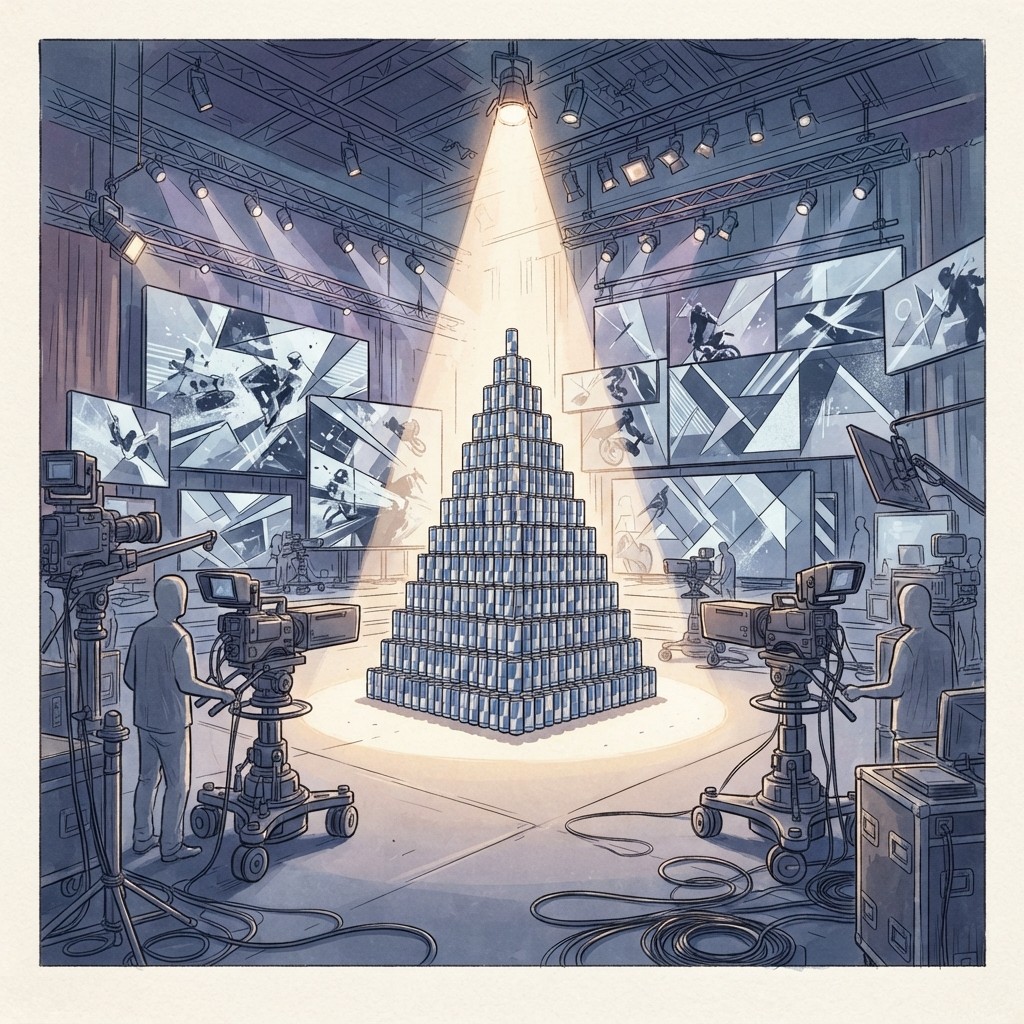
The mechanism is the interesting part, and it runs the opposite direction from the legend. A can of Red Bull is sugar, caffeine, and taurine — a commodity in a category where Red Bull holds about 13% of the global energy drink market.8 You cannot defend that with the liquid; a blind taste test won't save you. What you can defend is the meaning: energy, risk, the edge of human capability. So Red Bull doesn't buy thirty-second spots about its drink. It manufactures the feeling the drink is supposed to deliver, at a scale advertising can't touch, and then attaches its logo to it. Stratos wasn't an ad for an energy drink. It was a demonstration of the idea 'Red Bull gives you wings' performed by an actual human falling out of the sky — and it bought three billion impressions of that idea for a fraction of what a sustained national TV campaign would cost.5
This is why the media operation has to exist and why it doesn't need to be profitable. The films, the magazine, the TV channel, the owned events — they are not a second business hedging the first. They are the marketing machine, vertically integrated. Red Bull built ServusTV and Red Bulletin and a film studio not to sell content, but to control the supply of stories that make its brand mean something, so it never has to rent that meaning from someone else's media at someone else's price.4 The output looks exactly like a media company. The purpose is to make every can cheaper to sell.
“Red Bull marketing spend is widely estimated at 25–30% of revenue — but Red Bull has never disclosed it, and the figure traces to no primary statement.”7
Notice what just happened. Even the famous '30% of revenue on marketing, roughly $3 billion' stat — the one that makes the media-company story sound rigorous — has no primary source.7 It's an estimate that became a fact through repetition. Which is fitting, because so did the slogan it supports.
The honest objection: who cares whether the books separate it out?
The strongest counter is that this is a distinction without a difference. If Red Bull's content reaches billions and sells the brand, who cares whether the accountants file it as a media segment or a marketing line? Strategically, the company behaves like a media operation — it owns the means of production, it sets the editorial agenda, it distributes globally. Calling that 'just marketing' undersells how radical it is. That objection is fair, and the behavior is genuinely radical. But the distinction matters precisely because of what people draw from it. The seductive lesson is: 'become a media company, and the content will become its own profit center.' Red Bull is cited as the proof. Yet there's no disclosed evidence the content earns a profit independent of the cans — and a marketing cost that disappears the day you stop selling drinks is not a second business. It's a brilliant first one, fully loaded. Confuse the two and you'll build a film studio expecting it to pay for itself, when Red Bull's only ever paid for itself one way: 12.7 billion times a year, on the shelf.1
Red Bull's real move isn't 'become a media company.' It's: when your product is a commodity but your brand is the asset, own the machine that manufactures the brand's meaning instead of renting it from someone else's media. Stop paying for ad slots; produce the spectacle people actually want to watch, and stand next to it. The cost looks insane until you price it per impression — $27 million for three billion views is a fraction of what a sustained national TV campaign would cost. But keep the accounting honest: this is the marketing budget, vertically integrated, not a separate profit center. The day you mistake your owned content for a standalone business, you start measuring it as one — and you'll kill the one thing it was built to do, which is make the actual product impossible to commoditize.
Red Bull sells a feeling and ships a can. It learned, earlier and more completely than anyone, that the cheapest way to defend a commodity is to own the stories that make it mean something — and that owning those stories looks, from the outside, exactly like being a media company. The genius was never that the media replaced the drink. It was that the media made the drink un-poachable, three billion impressions at a time, while every euro on the books still arrived the same humble way: one can, one shelf, one buyer at a time. The slogan got the architecture right and the arithmetic backwards. The wings are real. They've just always been attached to the can.
When the visible business isn't the real one
Asset-Light vs Asset-Heavy Comparator
A side-by-side matrix that pits owning the assets against renting or orchestrating them, dimension by dimension. Blank to weigh your own model choice; filled as the worked example showing why the story's company went capital-light — or planted its money in concrete and steel.
Included, filled and blank, in the Asset-Light Operator Casebook. See the set → · Preview the blank →
Sources
Where this comes from — the filings, records, and reporting behind it.
- 1Red Bull GmbH net sales rose 6.4% in 2024 to €11.2 billion; it sold 12.7 billion cans, up 4.4% from 2023.
- 2Red Bull GmbH was founded in 1984 by Dietrich Mateschitz and Chaleo Yoovidhya; each invested US$500,000 and held a 49% stake; the remaining 2% went to Chaleo's son Chalerm; the product launched in Austria on 1 April 1987.
- 3Red Bull GmbH incorporated 1984; product launched 1987; 1500 employees; EUR 1.15 billion revenue in 2002 — corroborating the 1984 founding date from a contemporaneous company history.
- 4Red Bull Media House GmbH was registered on 08/08/2007, is wholly owned by Red Bull GmbH, and absorbed Red Bulletin GmbH and ServusTV Fernsehgesellschaft mbH via merger.
- 5Red Bull Stratos total project cost was $27 million according to Stratos Technical Director Art Thompson; Baumgartner's jump has been viewed by 3 billion people worldwide according to Red Bull.
- 6The Red Bull Stratos live broadcast set a YouTube record with 'over 9.5 million concurrent views' per YouTube's own statement; Baumgartner broke the sound barrier in freefall at 1,357.6 km/h, verified by the FAI.
- 7Red Bull's marketing spend is widely estimated at 25–30% of revenue (~$3 billion+), allocated to content production, event ownership, and athlete sponsorships rather than traditional advertising — but Red Bull does not disclose this figure; the estimate is unverified from any primary source.
- 8Red Bull had a global market share of 13% in the total energy drink market in 2023 and was the third most valuable soft drink brand in 2021, behind Coca-Cola and Pepsi.
- 9YouTube's official blog post states the Red Bull Stratos peak was 'more than 8 million concurrent livestreams'
- 10Third-party revenue estimates for Red Bull Media House range from roughly $47 million (Prospeo) to $546 million (RocketReach), illustrating that no verified external figure exists
Weighing outside help with a decision like this? Hiring a supply chain strategy consultant
More like this — beyond Red Bull
New Strategically analyses as they publish: the defining moves in business, checked against the record. No noise, and one click to leave.