Pairs with the Adjacency / Synergy Map — a ready-to-use strategy tool. Included in the Adjacency Expansion Casebook →
“When does the business next door belong to you?”
In October 2001 Apple put a white box in front of the press and called it 'a whole new category of digital music player' - $399, a 5GB drive, a thousand songs in your pocket.1 Everyone heard 'music player.' Almost nobody noticed what Apple was really doing, which was buying a seat in the pocket of a customer it had spent twenty years failing to reach: the person who owned a Windows PC and would never, ever buy a Mac. The iPod looked like the end of a story about music. It was the opening move of a story about phones.
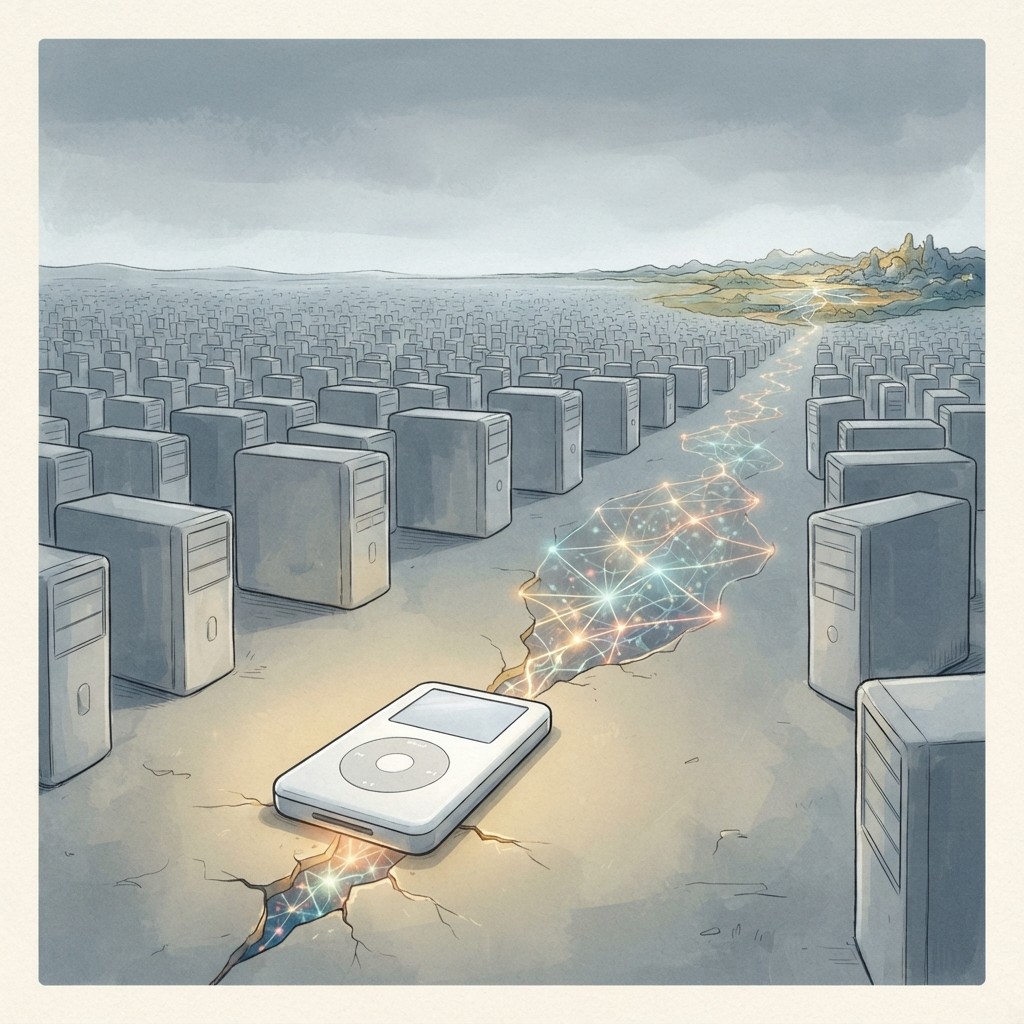
The official version is that the iPod was a brilliant music product whose 'halo effect' happily nudged some people toward Macs. The truer version is colder and more deliberate: the iPod was a beachhead. Apple used a mass-market gadget to plant its software, its store, and its taste on hundreds of millions of non-Apple machines - and that installed base, not the Mac, is what made the iPhone commercially launchable in 2007.
Why Apple opened its crown jewel to its enemy
Read the timeline and the strategy stops looking accidental. The first iPod was Mac-only - a loyalty reward for the faithful. Then, in July 2002, Jobs stood at Macworld and said the quiet part out loud: 'The biggest news is that we're bringing the iPod to Windows users.'2 Think about how unnatural that was. Apple's entire identity was that its hardware ran only on Apple's software. Pointing its best new product at the Windows world was heresy - unless the product was never really the point. The iPod on a Windows PC is a foot in a door Apple had no other way to open. You can't sell a Mac to someone who won't talk to you; you can sell a $399 music player to almost anyone, and then you have a relationship.
And notice that the opening was staged, not flipped. The Windows iPod in 2002 still leaned on third-party software like MusicMatch.2 The iTunes Music Store, when it arrived in April 2003 with over 200,000 songs at 99 cents each, was Mac-only too.3 Apple was so deliberate about the sequence that its own September 2003 press release - celebrating ten million songs sold - had to promise that the store 'will be available to Windows users by the end of this year.'4 The full machine for Windows users only clicked into place that October, with iTunes 4.1 - more than two years after the device first shipped.5 That is not a company that opened to Windows in a single bold pivot. That is a company laying a bridge plank by plank, watching it hold each time before laying the next.
“The biggest news is that we're bringing the iPod to Windows users.”2
The bridge was never really to the Mac
The famous justification for all this was the 'halo effect': buy an iPod, fall for Apple, eventually buy a Mac. There's real evidence it worked - a 2005 Morgan Stanley survey found nearly 90% of iPod-owning PC users who switched to Mac cited the iPod as a factor, more than half said it strongly influenced the decision, and the firm pegged the halo at roughly 19% of that year's earnings.7 But run the absolute numbers and the halo shrinks fast. In early 2008, around 22 million iPods sold in a single quarter translated into under 2.5 million Macs.7 The conversion to Macs was real, but it was a thin slice of an enormous base. If the only payoff was selling a few Macs, opening the crown jewel to Windows was a wildly inefficient way to do it.
| The 'halo to Mac' story | The bridge-to-iPhone story | |
|---|---|---|
| What the iPod sells | A few Macs, eventually | An Apple relationship on any computer |
| The Windows opening | A nice bonus for reach | The entire point |
| Payoff measured in | ~2.5M Macs per quarter | Tens of millions trained on iTunes and the store |
| The real harvest | 2005-2008 Mac sales | The 2007 iPhone launch |
Here's the mechanism the halo story misses. By opening the iPod and then iTunes to Windows, Apple did something far more valuable than convert a few PC owners into Mac owners. It installed iTunes on millions of Windows machines, taught those users to manage media in Apple's software, gave them an Apple account, a payment method, and a store full of 99-cent purchases - and a habit. None of that required a Mac. So when the iPhone arrived in 2007, its essential plumbing already lived on the world's PCs: every iPhone synced through iTunes, and a vast population already had the app, the account, and the muscle memory. The hardest part of launching a phone - building distribution and trust on machines you don't control - had been quietly solved by a music player years earlier. The iPod's job was never to make people Mac users. It was to make them Apple users while they kept their PC.
Wasn't this just hindsight dressed up as a plan?
The honest objection is that this reads too neatly - that nobody in 2002 was building a Windows bridge for a phone that didn't exist, and that calling the iPod a deliberate iPhone strategy is a story we tell because we know how it ended. Fair. Apple didn't even originate the iPod cleanly: the core concept - an MP3 player paired with a Napster-style music service - is attributed to contractor Tony Fadell, with Jon Rubinstein credited for finding the Toshiba 1.8-inch drive that made it possible.8 This was not one mastermind executing a decade-long script. But the bridge doesn't require foresight to be real - it requires only that Apple kept choosing reach over purity at every fork: Windows iPods, then a Windows store, then iTunes as the universal sync hub. Whether or not anyone named the iPhone in advance, the installed base those choices built was the precondition the iPhone needed. Strategy doesn't have to be prophetic to be structural.
The iPod's deepest move wasn't a click wheel - it was Apple swallowing its own dogma and shipping its best product onto its rival's platform. The lesson: a mass-market product is rarely just a product; it's a distribution channel for a relationship you can't otherwise reach. The question isn't 'how many of these can I sell?' but 'who does selling this put me in contact with - and what can I sell them next?' Two cautions, though. The bridge only works if the cheap thing genuinely earns trust on its own (a mediocre iPod builds nothing), and you must actually have a next act ready when the channel matures - because the channel itself eventually fades. The iPod's revenue share peaked, then fell hard. By then the bridge had already carried everyone across.
iPod revenue share peaked near half of Apple's business in early 2007 and then slid - by late 2008 it was a fraction of that.6 In most companies, watching your flagship's share collapse is a crisis. At Apple it was the plan working: the device was always a means, and the moment it had delivered hundreds of millions of trained, accounted, habituated users onto every kind of computer, its job was done. The iPod didn't decline into irrelevance. It dissolved into the iPhone it had been built, plank by plank, to reach.
Products that were really doorways to something else
Adjacency / Synergy Map
A one-page canvas for an adjacency play: the new business next door, the shared assets that justify entering it, the synergies that actually transfer versus the ones that evaporate on contact, and the dis-synergies nobody put on the deck. Blank to test your own expansion; filled as the worked example showing where the story's 'natural adjacency' was real and where it was wishful.
Included, filled and blank, in the Adjacency Expansion Casebook. See the set → · Preview the blank →
Sources
Where this comes from — the filings, records, and reporting behind it.
- 1Apple introduced the iPod on October 23, 2001 at $399 with a 5GB hard drive holding up to 1,000 songs; it went on sale November 10, 2001. Steve Jobs stated: 'With iPod, Apple has invented a whole new category of digital music player.'Apple Newsroom, Apple Presents iPod ↗ · 2001-10-23
- 2Windows-compatible iPods (2nd generation, using MusicMatch Jukebox) were announced July 17, 2002 at Macworld Expo New York; Jobs stated: 'The biggest news is that we're bringing the iPod to Windows users.' At that time iTunes remained Mac-only.Apple Newsroom, Apple Unveils New iPods ↗ · 2002-07-17
- 3The iTunes Music Store launched April 28, 2003 for Mac users only, offering over 200,000 songs at 99 cents per song with no subscription fees. Steve Jobs: 'The iTunes Music Store offers the revolutionary rights to burn an unlimited number of CDs for personal use and to put music on an unlimited number of iPods.'
- 4Apple announced the iTunes Music Store had sold its 10 millionth song on September 3, 2003; the press release states 'The iTunes Music Store will be available to Windows users by the end of this year,' confirming it was Mac-only at that point.
- 5iTunes 4.1, released October 16, 2003, was the first version to support Windows (Windows 2000 and Windows XP), making the iTunes Store and full iPod integration available to Windows users for the first time — more than two years after the iPod launched.
- 6In Q1 FY2007, iPod sales represented 48% of Apple's quarterly revenue of $7.1 billion — the high-water mark of iPod's revenue share. Annual iPod unit sales peaked around 2008 at approximately 55 million units. By Q4 FY2008, iPods had fallen to 14.21% of total revenue.Wikipedia / iPod, iPod ↗ · 2026
- 7A 2005 Morgan Stanley survey found nearly 90% of iPod-owning PC users who switched to Mac cited iPod experience as a factor; 52% said it 'strongly influenced' the decision. The firm estimated a ~19% halo effect on FY2005 earnings. However, in absolute terms, Q1 FY2008 saw 22 million quarterly iPod sales translate to under 2.5 million Mac sales — actual Mac conversion remained a small fraction of the iPod base.
- 8The concept for the iPod — 'an MP3 player, build a Napster music sale service to complement it, and build a company around it' — originated with Tony Fadell, a contractor/entrepreneur who had worked at General Magic and Philips, not with Steve Jobs. Jon Rubinstein sourced Toshiba's 1.8-inch miniature hard drives that made the device possible.
Weighing outside help with a decision like this? Hiring a commercial due diligence provider
More like this — beyond iPod
New Strategically analyses as they publish: the defining moves in business, checked against the record. No noise, and one click to leave.