Pairs with the Turnaround Diagnosis Worksheet — a ready-to-use strategy tool, filled for Hyundai. Included in the The Turnaround Casebook →
In the late 1990s, a Hyundai was the car you bought when you couldn't afford a real one and you knew it. Cheap to buy, cheap to mock, and quietly assumed to be cheap to bury within a few years. So when the company announced it would cover its powertrains for ten years or 100,000 miles - more than double what the giants of Detroit and Japan offered - the message wasn't subtle.4 A company that builds disposable cars does not promise to stand behind them for a decade. Either Hyundai had lost its mind, or it had just put a gun to its own head and told the factory to start aiming straight.
The official story is a quality miracle: a determined chairman willed Hyundai from punchline to podium through sheer obsession with engineering. That telling is flattering, repeated everywhere, and quietly wrong about the sequence. The quality came later. What came first was a country on the edge of default, a currency in free-fall, and a warranty designed not to reassure customers so much as to terrify Hyundai's own engineers.
The hole Hyundai was actually standing in
Start with the balance sheet, because that is where the desperation lived. In 1998, Hyundai Motor carried a debt-to-equity ratio above 5 to 1; the broader Hyundai group, financial subsidiaries included, sat near 6 to 1.2 That is not a company that hit a rough patch. That is a chaebol built on borrowed money as a matter of structure, and the structure predated the crisis by years. The 1997 collapse didn't create the leverage - it switched on the lights and showed everyone how much there was. And it was a sovereign emergency, not a Hyundai one: South Korea signed an IMF memorandum on December 3, 1997, anchoring a package of roughly $57 billion.1 Hyundai never received an IMF check. It was a private company that got to keep breathing because the banks it owed money to were the ones being rescued.
Then it did the thing that should have finished it. With that ratio already past breaking, Hyundai took over Kia Motors - which had gone bankrupt - and paid for it with additional debt.23 On paper, lunacy. In practice it was the move of a company that had decided survival meant scale and exports, not retreat. By 1999, Kia was back to profitability under the same management.3 The crisis had done what no boardroom memo had managed for years: it made discipline non-optional.
The warranty was a forcing function, not a feature
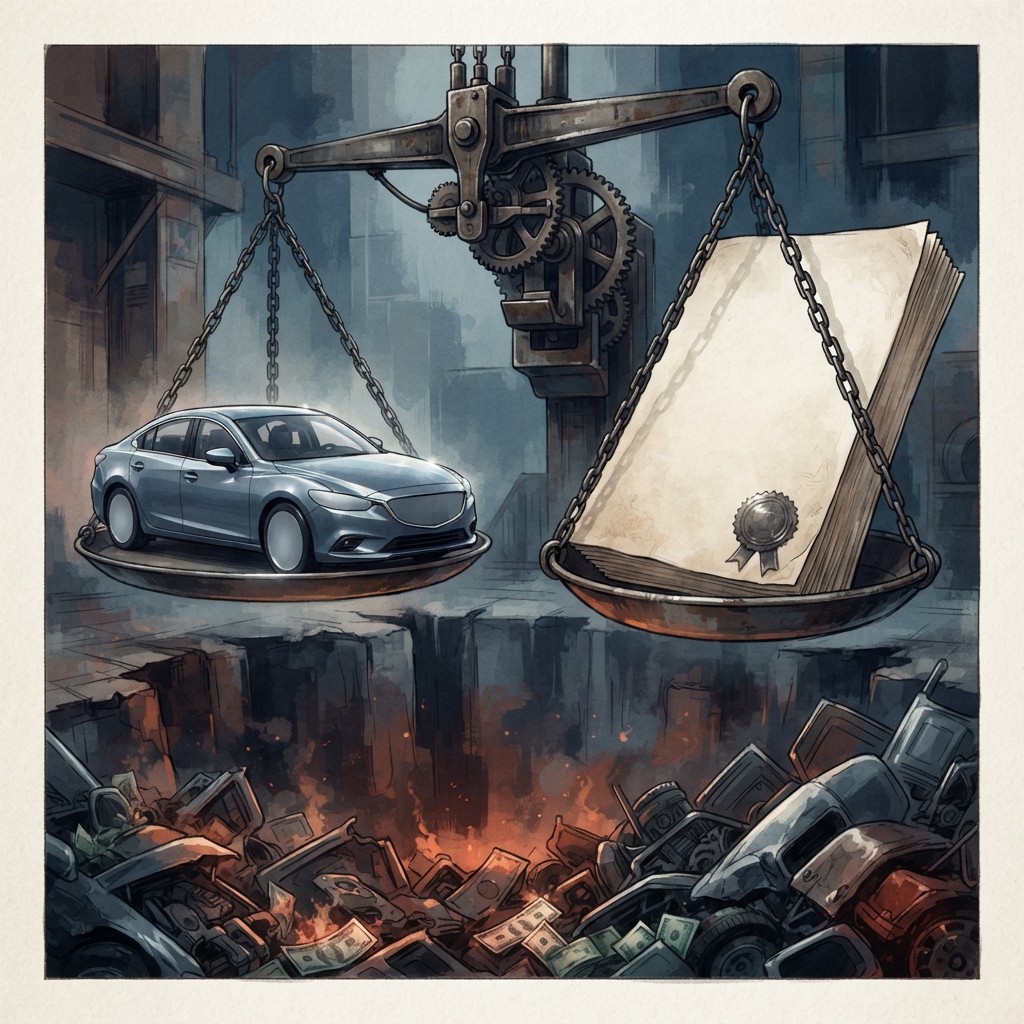
Here is the thesis, plainly. Hyundai's comeback wasn't a quality transformation that produced a bold warranty. It was a bold warranty that forced a quality transformation - by converting every future defect from someone else's problem into Hyundai's own ten-year liability. In 1998 the company launched 'America's Best Warranty,' 10 years or 100,000 miles on the powertrain, beginning with 1999 model-year cars.45 Read it as marketing and you miss the engineering of it. A long warranty on a car you actually build well costs little. A long warranty on a car you build badly is a slow-motion bankruptcy. By signing that promise to American buyers, management put the cost of its own sloppiness directly back on its own ledger, year after year, claim after claim.
“The 10-year/100,000-mile powertrain warranty applies to 1999 model year and newer; for 1999–2003 model years it extended to the original owner and immediate family members.”5
The internal machinery matched the bet. In 1999 Hyundai stood up a Global Quality Situation Room - the institutional spine of the obsession the legend remembers.7 But notice the order. The promise came first; the apparatus to keep from going broke on it came after. That is how forcing functions work. You make a commitment expensive enough to renege on that the whole organization reorganizes itself around honoring it. Hyundai didn't get religion and then issue the warranty. It issued the warranty and then had no choice but to get religion.
| The quality-miracle legend | What the sequence shows | |
|---|---|---|
| What came first | Engineering obsession | A 10-year warranty bet |
| Why quality improved | Pride and vision | Defects became Hyundai's own liability |
| Role of the crisis | Backdrop | Removed the option to stay undisciplined |
| Role of the won | Footnote | Made cheap cars cheaper to export |
| The Situation Room | The cause | The apparatus built to survive the promise |
If you want an organization to do something hard and it keeps not doing it, stop exhorting and start committing. Sign a public promise whose cost lands on you - and only you - whenever the work is shoddy. Hyundai didn't ask its plants to care about reliability; it made a decade of every plant's defects show up on Hyundai's own books. The trick isn't the warranty, it's the incentive geometry: move the cost of failure from the customer back to the decision-maker, and quality stops being a value and becomes self-defense. One caution: the bet only works if you can actually afford to lose it for a few years while the work catches up. A forcing function on a company that's already insolvent isn't discipline - it's a fuse.
Wasn't it just a cheap currency selling cheap cars?
The honest objection cuts the other way from the legend, and it lands. A collapsing won made already-inexpensive Korean cars dramatically cheaper to export, and a sovereign IMF program kept the lending taps from freezing entirely.1 You can build a respectable case that the early recovery was mostly a macro tailwind - a depreciation play - and that the warranty was a clever sticker on a car the exchange rate had already discounted into showrooms. There's truth in it. The currency and the bailout were real, and they were not Hyundai's doing. But macro tailwinds lift every Korean exporter equally; they don't explain why Hyundai specifically climbed to second among all brands in J.D. Power's North American Initial Quality Study by 2004, and tied for the top corporate ranking in the U.S. study two decades later.9 A cheap won gets you in the door. It does not get you trusted. The warranty - and the discipline it compelled - is what converted a price advantage into a reputation, and reputation is the only part of this story that survived the won recovering.
The hero, and the asterisk the legend leaves off
Credit lands on Chung Mong-koo, and not without reason - he took formal control of Hyundai Motor when the conglomerate split in 1999, ran it through the rebuild, and chaired the group for two decades.7 But the founding-genius framing flattens the timeline twice. He did not become consolidated Hyundai Motor Group chairman until 2000; through the crisis itself his title was narrower.7 And the celebrated turnaround carries a documented stain the brochures skip: he was arrested in April 2006 and convicted in February 2007 of embezzlement and breach of fiduciary duty, sentenced to three years before a suspension and later a pardon.8 The conduct sat inside the very years of the quality triumph. The point isn't to demolish the man - it's that great turnarounds are rarely the clean morality plays they're sold as. The mechanism worked. The mythology around it is doing extra labor.
Hyundai's escape from near-death was not a single act of vision. It was a structural debt trap exposed by a sovereign crisis, a currency that did the discounting, and one audacious promise that left the company no honorable way to keep building junk. The warranty's genius was never the reassurance it offered drivers. It was the hostage it took inside Hyundai's own factories - a ten-year debt the company owed to its own future, payable only in cars good enough to never come back. They learned to build those cars because they had already signed for the alternative.
Turnaround Diagnosis Worksheet
A worksheet that forces a turnaround down to first principles: is this a cash problem, a cost problem, or a strategy problem — and which one will kill you first. It separates the bleeding you must stop this week from the rebuild that takes years. Blank to triage your own situation; filled as the worked example tracing how the story's leader sequenced survival before revival.
Included, filled and blank, in the The Turnaround Casebook. See the set → · Preview the blank →
Sources
Where this comes from — the filings, records, and reporting behind it.
- 1South Korea signed an IMF bailout memorandum of understanding on December 3, 1997; the total package was approximately $57 billion including $21 billion standby credit from IMF, $10 billion from World Bank, and $4 billion from ADB.
- 2Hyundai Motor Company had a debt-to-equity ratio of more than 5.0 in 1998, and the whole Hyundai group (including financial subsidiaries) had a ratio of almost 6.0. Despite this, Hyundai financed the acquisition of Kia with additional debt.
- 3In 1998, Hyundai Motor Company took over Kia Motors, which had entered bankruptcy. By 1999 Chung had returned Kia to profitability.
- 4In 1998, Chung Mong-koo launched the 'Hyundai Advantage: America's Best Warranty,' covering all new Hyundai vehicles sold in the U.S. with 10-year/100,000-mile powertrain protection, starting with 1999–2003 model-year vehicles.
- 5Hyundai's own warranty portal confirms the 10-year/100,000-mile powertrain warranty applies to 1999 model year and newer; coverage for 1999–2003 model years extended to original owner and immediate family members.
- 6In January 2009, Hyundai marked the '10-year anniversary' of America's Best Warranty with the launch of the Hyundai Assurance Program, confirming the warranty had been in force for a decade (i.e., since 1999).
- 7Chung Mong-koo took formal control of Hyundai Motor as part of the Hyundai Group split in 1999. He served as CEO & Chairman of Hyundai Motor Co. & Kia Motors Corp. from 1999–2000, then as Chairman of Hyundai Motor Group from 2000–2020. In 1999 Hyundai established a Global Quality Situation Room.
- 8Chung Mong-koo was arrested April 28, 2006, convicted February 5, 2007 of embezzlement and breach of fiduciary duty for selling securities to his son at below-market prices, sentenced to three years in prison, later suspended. He was fully pardoned by President Lee Myung-bak.
- 9In 2004, Hyundai was ranked second in 'initial quality' in the J.D. Power and Associates Initial Quality Study in North America. In 2025, Hyundai Motor Group tied for the highest overall ranking among all corporations in the J.D. Power U.S. IQS.
More like this — beyond Hyundai
New Strategically analyses as they publish: the defining moves in business, checked against the record. No noise, and one click to leave.