Pairs with the Turnaround Diagnosis Worksheet — a ready-to-use strategy tool, filled for General Motors. Included in the The Turnaround Casebook →
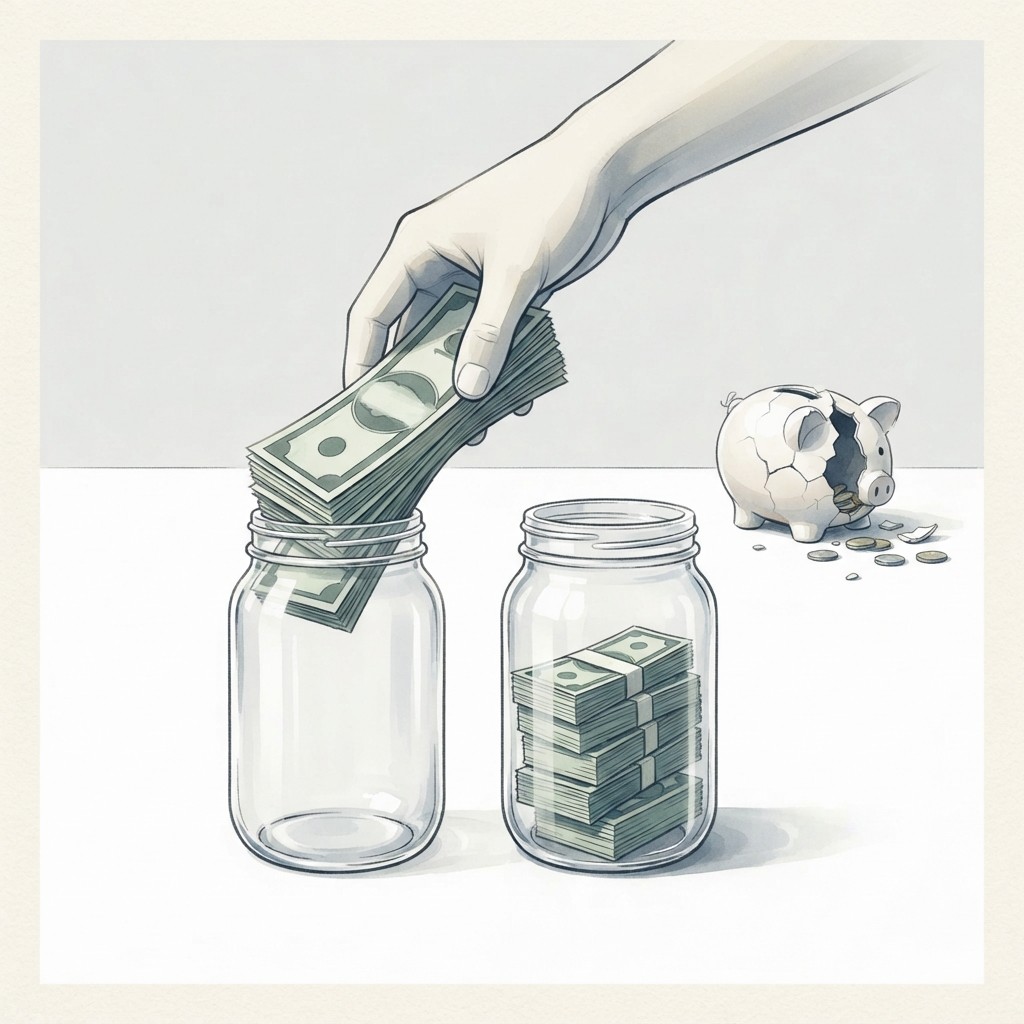
On April 21, 2010, the U.S. Treasury put out a press release with a headline America wanted to read: GM had 'fully repaid its debt under TARP,' the last $4.7B of $6.7B, and done it five years ahead of schedule.4 GM's own ads said the same, with the CEO on camera and a tidy moral attached — more people are buying our cars, so we paid the taxpayer back. It was a great story. It was also, in the only sense that matters, a transfer between two pockets of the same coat. The money came out of a Treasury escrow account that already held GM's bailout funds.3 GM paid back the government with the government's money — and called it a comeback.
The story everyone tells is that GM went bankrupt, got rescued, sold a lot of cars, and paid the public back with interest. Paid the public back with interest. The debt tranche was repaid out of leftover bailout cash, and the much bigger bet — the equity Treasury took in exchange for tens of billions — was sold years later at a loss of about $11.2B.6 The turnaround was real. The repayment story was theater.
The fall, and the surgical bankruptcy that saved the patient
On June 1, 2009, General Motors Corporation filed for Chapter 11 in the Southern District of New York.1 Retellings reach for the word 'largest,' and it's nearly right — it was the largest industrial bankruptcy in U.S. history. By total assets it actually ranked fourth, behind Lehman Brothers, Washington Mutual, and WorldCom.8 The distinction matters because it tells you what kind of failure this was: not a financial house of cards, but a real manufacturer with plants, dealers, pensions, and a balance sheet that had simply stopped working.
The clever part wasn't the filing — it was the structure. Rather than let the whole company drown in a years-long reorganization, the government engineered a Section 363 sale: the good assets of Old GM were sold, fast, into a clean new entity, New GM, leaving the toxic liabilities behind in what became Motors Liquidation Company. The sale order closed on July 5, 2009, built on a credit bid of $19,760,624,198 in principal debt the U.S. government already held against Old GM.2 Bankruptcy was the operating table. The taxpayer was the surgeon, the anesthesiologist, and the one paying for the hospital.
The money shuffle hiding inside the victory lap
Here is the mechanism the ads skipped. When the bailout was structured, $16.4B of the government's credit-agreement proceeds were deposited into an escrow account at Treasury — GM's money to draw down as needed, but still TARP money sitting in a Treasury account.3 So when GM 'repaid' the $6.7B debt tranche in April 2010, it didn't write a check from a glove compartment stuffed with car-sale profits. It drew the cash from that escrow account.3 Treasury handed GM its own unspent bailout funds, GM handed them back as 'repayment,' and a press release announced a triumph.4
Senator Chuck Grassley's Finance Committee staff caught it almost immediately, and Treasury's own written response confirmed the escrow source. Grassley's word for it was unsentimental: 'an elaborate TARP money shuffle.'5 The repayment was technically true and rhetorically false — the debt was extinguished, but the cash that extinguished it was the public's, not the customer's.
“An elaborate TARP money shuffle.”5
| The debt tranche | The equity stake | |
|---|---|---|
| Size | $6.7B in TARP loans | ~$40B converted to 60.8% equity |
| How it was settled | Drawn from a Treasury escrow account | Shares sold on the open market |
| Source of the money | Other TARP funds (taxpayer) | Buyers, at prices below break-even |
| The headline | 'Fully repaid, five years early' | Quietly closed at an ~$11.2B loss |
The number the ads never mentioned lives in the equity, not the debt. Of roughly $50.2B in total loans to New GM, about $40B was converted into a 60.8% common-equity stake.9 That was the real taxpayer bet — not a loan to be repaid but an ownership position to be sold. Treasury sold it down between December 2010 and December 2013, and when the last shares cleared, the books showed a loss on the GM investment widely reported in the range of $10.5B–$11.2B.9 The debt tranche was the part GM could photograph for a commercial. The equity was the part that came out of the public's wallet and never fully came back.
The IPO that was the biggest — if you measured it the flattering way
The comeback's crowning event came on November 17, 2010, when GM went public again at $33 a share, raising $20.1B. After the underwriters exercised their full overallotment, total proceeds hit $23.1B — enough to edge Agricultural Bank of China's $22.1B and claim the title of world's largest IPO by combined proceeds.7 Note the qualifier doing the work in that sentence: combined proceeds, common and preferred together, overallotment included. Stack the chips a particular way and you get a record. It's the same instinct as the repayment headline — the achievement is real, but the framing is chosen to make it look bigger than the strictest measure would allow.
And the IPO is exactly where the equity story starts to close. Those public-market sales were how Treasury began unwinding the 60.8% stake — selling ownership back to investors at prices that, in the end, didn't recover what was put in.6 The IPO was the comeback's most photogenic moment and, simultaneously, the first installment of the loss.
Isn't a subsidized rescue still a rescue?
The fair objection is that picking apart the repayment misses the point — the bailout worked. GM survived, hundreds of thousands of jobs across the supplier base survived, and the company was profitable and public again within eighteen months of the lowest moment in its history. A loss of roughly $10.5B–$11.2B on a roughly $50B intervention9 is, by the standard of catastrophe avoided, a cheap insurance premium. All true, and worth saying plainly: as industrial policy, the GM rescue is defensible and arguably succeeded.
But that is precisely why the marketing was a mistake. A genuine, qualified, taxpayer-subsidized restructuring success did not need to be dressed up as a debt repaid 'because more customers are buying GM vehicles.' The honest version — we lost roughly $10–11B and saved an industry — is a story a citizen can respect. The escrow shuffle and the 'fully repaid' headline traded that respect for a quarter's worth of good press, and handed every critic a permanent, true talking point in exchange. When you have a real win, gilding it is how you turn it into a scandal.
GM's turnaround was genuine — a clean 363 sale, a fast return to profitability, a public company within eighteen months. But the 'fully repaid, ahead of schedule' framing was funded from a Treasury escrow account, and the much larger equity stake closed at a roughly $10.5B–$11.2B loss. The instinct to round a qualified success up to an unqualified one is almost always a self-inflicted wound: it converts a defensible story into a debunkable claim, and gives skeptics a permanent, accurate rebuttal. If your win needs a money shuffle to look like a win, tell the smaller true story instead. It ages better than the bigger false one.
GM came back. That part is not in dispute — the surgery worked, the patient walked out, and the brand is still on the road. What didn't survive contact with the record was the slogan. The debt was paid with the lender's own money,5 the 'largest bankruptcy' was the largest only with a missing adjective,8 and the 'world's largest IPO' was the largest only if you counted it the generous way.7 The comeback was real and the headlines were embroidered, and the strange lesson of the whole episode is this: a company can rebuild its factories, its finances, and its future — and still not be able to resist rebuilding the truth a little while it's at it.
When the official story and the real one diverge
Turnaround Diagnosis Worksheet
A worksheet that forces a turnaround down to first principles: is this a cash problem, a cost problem, or a strategy problem — and which one will kill you first. It separates the bleeding you must stop this week from the rebuild that takes years. Blank to triage your own situation; filled as the worked example tracing how the story's leader sequenced survival before revival.
Included, filled and blank, in the The Turnaround Casebook. See the set → · Preview the blank →
Sources
Where this comes from — the filings, records, and reporting behind it.
- 1General Motors Corporation filed a voluntary petition for Chapter 11 bankruptcy protection on June 1, 2009, in the U.S. Bankruptcy Court for the Southern District of New York; the lead case is In re Motors Liquidation Company, 09-50026.
- 2On July 5, 2009, the Bankruptcy Court issued a sale order completing the Section 363 sale of Old GM's assets to New GM; the credit bid equaled $19,760,624,198 in principal debt under Old GM's existing credit agreement with the U.S. government.
- 3GM's April 2010 'loan repayment' of $6.7B in TARP debt was made using funds drawn from a TARP escrow account at Treasury—not from car-sale revenues—as confirmed by Treasury's own response to Sen. Grassley; the $16.4B in UST Credit Agreement proceeds were deposited in escrow at closing per the GM 8-K.
- 4The U.S. Treasury announced on April 21, 2010 that GM had 'fully repaid its debt under TARP,' paying the remaining $4.7B of a total $6.7B in debt, five years ahead of the loan maturity date.
- 5Sen. Chuck Grassley's Senate Finance Committee record confirms Treasury allowed GM to use TARP escrow funds—not car revenues—to repay TARP debt, calling it 'an elaborate TARP money shuffle'; Treasury's own response to Grassley acknowledged the escrow source.
- 6Through TARP, approximately $40B of a total $50.2B in loans to New GM was converted into 60.8% common equity; the Treasury sold those shares between December 2010 and December 2013, realizing an $11.2B loss on the GM investment.
- 7The GM IPO on November 17, 2010, raised $20.1B at $33/share (common and preferred combined); after underwriters exercised the full overallotment option, total proceeds reached $23.1B, edging Agricultural Bank of China's $22.1B to become the world's largest IPO by combined proceeds.
- 8GM's bankruptcy ranked fourth-largest in U.S. history by total assets, behind Lehman Brothers, Washington Mutual, and WorldCom—not the largest overall; it is accurately the largest *industrial* bankruptcy in U.S. history.
- 9CRS Report R41978, 'The Role of TARP Assistance in the Restructuring of General Motors,' confirms that the majority of TARP loans to GM were converted into an initial 60.8% government ownership stake in New GM, and that the U.S. government's ownership stake was sold between December 2010 and December 2013.
- 10Agricultural Bank of China completed the world's largest IPO at $22.1 billion after overallotment options were exercised in August 2010, a record later surpassed by GM's November 2010 IPO.
More like this — beyond General Motors
New Strategically analyses as they publish: the defining moves in business, checked against the record. No noise, and one click to leave.