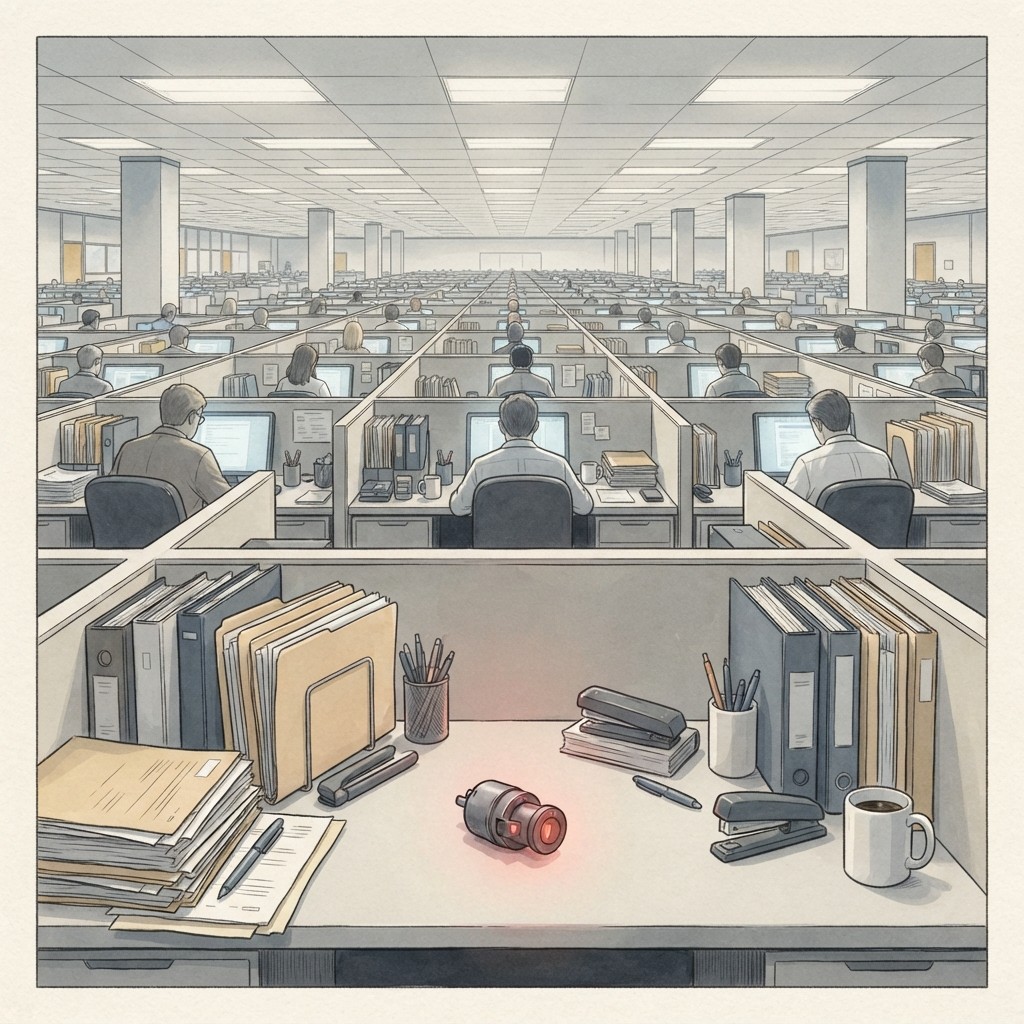
Pairs with the Crisis Response Playbook — a ready-to-use strategy tool, filled for General Motors. Included in the The Crisis Response Casebook →
Around 2001, deep in the development of the Saturn Ion, a GM engineer found that the ignition switch could rotate too easily — a torque problem. A fix already existed: a switch with a larger detent spring that would hold the key in place. GM had it on the table. It cost more. GM did not pick it.7 That single decision — a few cents per switch, made in an engineering meeting nobody outside GM would remember — sat quietly inside hundreds of thousands of cars for more than a decade. When the key slipped out of the 'run' position, the engine cut. Power steering died. The airbags went to sleep. People drove into trees with no airbag, in cars that had simply turned themselves off.
The story everyone tells is that GM ran a cover-up — a corporation that knew it was killing customers and buried the bodies. That is the satisfying version, and it is wrong. GM's own investigators, after reading 41 million documents, concluded there was 'no cover-up.'4 The truth is stranger and, in a way, more damning: nobody hid the defect because, organizationally, nobody ever fully held it.
GM's ignition-switch crisis wasn't a conspiracy. It was a governance machine working exactly as designed — designed so that no single person ever had to own a problem that everyone could see.
The fix that cost a few cents and never shipped
Start with the engineering, because the engineering is where the moral weight sits. The defect was not exotic. The switch's detent torque was too low; a redesigned spring solved it; the redesign existed in 2001 and was set aside on cost.7 This is the part that resists every excuse. It was not a flaw nobody understood. It was a flaw GM understood early, and a remedy GM declined to buy. The decade that followed wasn't a search for the cause — the cause was on file. It was a decade of the problem failing to climb the organizational chart to anyone empowered to spend the money.
Watch how the official numbers grew, because the growth is the story. The first recall on February 7, 2014 covered 619,122 Cobalts and Pontiac G5s, with GM citing 6 deaths.3 Within weeks the acknowledged toll was 13 and coverage had jumped to 1.6 million vehicles.3 By the time Kenneth Feinberg finished administering GM's compensation fund, it had paid for 124 deaths — nearly ten times the figure GM executives reported in April 2014 — while denying about 91% of the claims that came in.5 The '13 deaths' that lodged in the public memory was never the count. It was the first guess of a company that had spent years not counting.
| The popular version | The documented record | |
|---|---|---|
| The death toll | 13 deaths | 124 deaths paid by the compensation fund |
| The wrongdoing | A deliberate cover-up | GM's own report found 'no cover-up' |
| The $900 million | A criminal conviction fine | A forfeiture under a deferred-prosecution deal; no conviction |
| The scale | 2.6 million cars | The first notice covered 619,122; toll and scope grew from there |
The salute and the nod: how a company forgets to be responsible
Here is the mechanism, the why beneath the why. When GM hired Anton Valukas to investigate, his team read 41 million documents and conducted 350 interviews and came back not with a villain but with a vocabulary.4 They described the 'GM salute' — an employee crossing their arms and pointing outward, the gesture for 'not my responsibility.' And the 'GM nod' — everyone in a meeting agreeing a problem should be fixed, then leaving the room and doing nothing.4 These are not metaphors. They were named rituals inside a real company, and together they form a perfect engine for non-accountability: every signal of agreement, every appearance of action, with the ownership quietly passed sideways until it evaporated. The defect never reached senior management not because anyone blocked it, but because the organization was built so that bad news had no upward path.4
“Everyone had responsibility to fix the problem, nobody took responsibility.”4
This is why 'cover-up' is the wrong frame. A cover-up requires someone with the full picture choosing to hide it. The whole point of the GM salute is that nobody ever assembled the full picture. The torque complaints, the airbag non-deployments, the fatal crashes — they lived in separate departments speaking separate languages, each one individually deniable. The system didn't conceal the defect from regulators so much as conceal it from GM itself.
What the law could and couldn't reach
The diffusion of responsibility didn't just kill people; it shaped the punishment. On September 16, 2015, GM entered a Deferred Prosecution Agreement, agreeing to forfeit $900 million and admitting it had failed to disclose the defect from the spring of 2012 through February 2014.1 Read that date range carefully. The Justice Department did not charge GM with a decade of concealment. It charged a roughly two-year window — the period it could prove someone knew and stayed silent. The earlier years, stretching back to that 2001 design choice, were negligence the law couldn't easily prosecute. There was no conviction; the charges were deferred. NHTSA separately imposed the then-maximum $35 million civil penalty, and the SEC later took $1 million.26 For a body count that the company's own fund put at 124, the legal machinery reached a forfeiture, two civil penalties, and not a single charged executive.
Isn't 'no cover-up' just GM letting itself off the hook?
The honest objection is obvious: Valukas was hired and paid by GM, so of course he found 'no cover-up.' A commissioned investigation that exonerates the new CEO and converts a moral catastrophe into a tidy lesson about org charts deserves a hard look. And it's true that the report served GM's interests — it gave the company a frame in which the failure was systemic rather than personal, which is far more comfortable. But notice that the alternative frame is actually less flattering, not more. 'A cover-up' implies competence aimed in the wrong direction — bad people who at least understood the danger. 'No cover-up' means the danger was understood by no one with the power to act, for years, inside a Fortune-50 company, because the company had built itself to dissolve accountability. The exoneration of Mary Barra cuts the same way: the report found no evidence she knew before December 2013, which is genuinely exculpatory for her — and a devastating indictment of a company where the CEO could be the last to learn its cars were killing people.8 The self-serving frame still describes something worse than the conspiracy theory it replaced.
Most crisis post-mortems hunt for the bad actor — the executive who knew and lied. But the more dangerous failure mode in a large organization isn't malice; it's the structure that lets everyone agree a problem is real while no one is required to own it. The 'GM nod' is not a quirk of one company. It is the default state of any system where information flows freely but accountability does not — where signaling concern is rewarded and forcing a costly decision is not. The defense isn't more meetings or more dashboards; bad news already reaches those. It's a single named owner for every life-or-death problem, with the authority to spend money and the duty to escalate, so that the question 'whose job was this?' always has an answer before the lawsuit asks it.
The deepest cost of GM's crisis was never the $900 million it forfeited or the $35 million NHTSA capped out at.12 It was the thirteen years between the meeting where a cheaper switch won and the recall where the bodies were finally counted — years in which a known, fixable, fatal flaw simply could not find its way to a person obligated to stop it. GM didn't hide the defect. It built an organization that hid responsibility, and then discovered that a company which cannot locate its own accountability cannot locate its own dead. The cover-up would have been easier to fix. You can fire the people who lie. You cannot fire a culture that taught everyone the truth was someone else's job.
When the system, not the villain, is the story
Crisis Response Playbook
A playbook for a crisis already in motion: who decides, which plays fire on which trigger, and what gets said to whom. It replaces panic and the all-hands meeting with a pre-agreed sequence each person can run alone. Blank to pre-load before a crisis hits; filled as the worked example reconstructing the plays the story's team ran — and the ones they should have.
Included, filled and blank, in the The Crisis Response Casebook. See the set → · Preview the blank →
Sources
Where this comes from — the filings, records, and reporting behind it.
- 1On September 16, 2015, GM entered a Deferred Prosecution Agreement with the DOJ, agreeing to forfeit $900 million; GM was charged with one count of concealing material facts from NHTSA and one count of wire fraud, and admitted it failed to disclose a deadly ignition switch defect from spring 2012 through February 2014.
- 2On May 16, 2014, NHTSA fined GM the then-statutory maximum $35 million civil penalty for failure to report the ignition switch safety defect in a timely manner; GM also agreed to monthly meetings with NHTSA for one year and improved internal reporting procedures.
- 3The initial February 7, 2014 recall notice covered 619,122 vehicles (2005–07 Chevrolet Cobalts and 2007 Pontiac G5s); GM cited 6 deaths and 17 injuries at that moment. By February 24 GM had acknowledged 13 deaths and expanded coverage to 1.6 million vehicles.
- 4The Valukas investigation reviewed 41 million documents and 350 interviews, concluded there was 'no cover-up' but found a corporate culture of responsibility diffusion — the 'GM salute' (arms crossed, pointing outward) and the 'GM nod' (agreeing in meetings then doing nothing) — and that no one elevated the ignition switch problem to senior management.
- 5GM's compensation fund, administered by Kenneth Feinberg, ultimately paid compensation for 124 deaths — nearly 10 times the 13 deaths GM executives reported in April 2014. About 91% of those who sought compensation were denied, including 349 death claims ruled ineligible.CNN Money, Death toll for GM ignition switch: 124 ↗ · 2015-12-10
- 6GM resolved a separate SEC investigation arising from the 2014 ignition switch recalls by consenting to a Cease and Desist Order without admitting wrongdoing and paying a $1 million civil penalty; the SEC found no material weakness or significant deficiency in GM's financial statements.
- 7GM learned of a torque problem in the ignition switch as early as 2001 during the Saturn Ion's development; a redesigned switch with a larger detent spring existed at that time but was not selected for production vehicles due to higher cost.
- 8Mary Barra became GM CEO on January 15, 2014; according to GM, she learned of the ignition switch defect on January 31, 2014. The Valukas report exonerated Barra, finding no evidence she knew of the problem earlier than December 2013.
More like this — beyond General Motors
New Strategically analyses as they publish: the defining moves in business, checked against the record. No noise, and one click to leave.