Pairs with the Turnaround Diagnosis Worksheet — a ready-to-use strategy tool, filled for Chipotle. Included in the The Turnaround Casebook →
By late 2015, Chipotle had done the obvious thing. It had blanketed its kitchens in new food-safety procedures after a string of outbreaks — E. coli, norovirus, salmonella — that sickened a combined 514 reported people across 14 states.6 The supply chain was scrubbed. The protocols were in place. And then the company waited for customers to come back. They didn't. Nearly three years after the crisis broke, the brand was still losing — comparable restaurant sales fell 21.9% in the third quarter of 2016 alone, and 24.9% across the first nine months of that year.2 The kitchen was clean. The recovery was not happening.
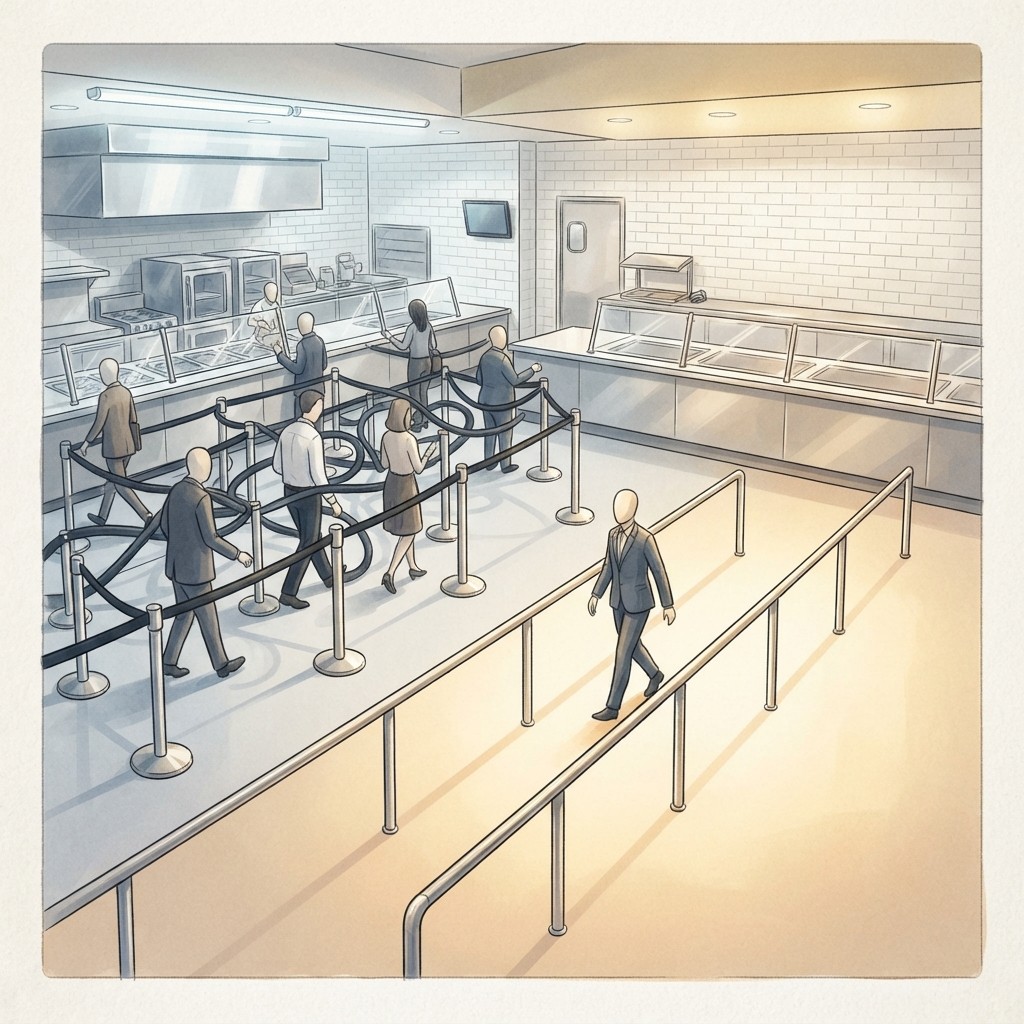
The story everyone tells about Chipotle is a food-safety redemption arc: it poisoned people, it cleaned up, it came back. Almost every part of that sequence is real except the causal link in the middle. Cleaning up stopped the harm. It did not restart the business. The thing that actually broke during the crisis — and the thing that finally got fixed — was never the food. It was the customer's ability to get to it.
The clean kitchen that nobody would visit
Run the numbers and the lag is impossible to miss. Going into the crisis, Chipotle was a juggernaut: full-year 2015 revenue of $4.5 billion, up nearly 10%, with net income still rising.1 Then the outbreaks hit. December 2015 same-store sales fell roughly 30%, the stock dropped about 40% peak to trough, and the company shed something like $6 billion of market value at one point.5 A normal crisis recovery would show the wound, then the healing. Chipotle showed the wound, then the food-safety overhaul — and then it kept bleeding for years.2 That is the diagnostic tell. If the problem had truly been contamination, fixing contamination would have fixed the business. It didn't, because contamination was the trigger, not the disease.
Worse, the safety overhaul made the underlying problem heavier. The new procedures drove food costs up through added waste and handling.2 So Chipotle was now slower and more expensive to operate, in a business whose entire model rested on moving a line of people quickly past a counter. The founder-led company had spent its energy on the one thing it could see — the contamination — and had no answer for the thing it couldn't: a customer-access model that was already strained before the outbreaks and was now degrading.
What Niccol actually walked in and found
Brian Niccol became CEO in March 2018, arriving from Taco Bell as Steve Ells moved up to executive chairman.4 The convenient narrative is that the board brought in a fixer to finish the food-safety job. But by Niccol's own account, the safety protocols were already done. The gaps he identified were entirely operational: slow customer lines, undertrained staff, and almost no digital or marketing infrastructure.8 He didn't reach for a sanitation playbook. He reconfigured restaurants for digital pickup lanes and moved the brand's marketing onto social media and television.8 In other words, the new CEO looked at a company that everyone said had a food problem and decided its problem was throughput.
| The food-safety story | The access story | |
|---|---|---|
| The real wound | Contaminated supply chain | Customers can't get the food easily |
| The fix applied | New safety protocols, cleanup | Faster lines, digital pickup, marketing |
| Did it restart growth? | No — sales still down ~25% in 2016 | Yes — digital became the new front door |
| Who owned it | The founder-led era | Niccol's operations rebuild |
“The core problems on arrival were slow customer lines, undertrained staff, and weak digital and marketing — not food safety per se.”8
The infrastructure that was waiting for a reason to exist
Here is where the story gets honest about luck. Niccol built the digital rails — the pickup lanes, the app, the second 'digital make line' running parallel to the in-store counter. And for a while, it barely mattered. Digital was just 10.9% of sales in 2019, his second full year.3 The strategic vision was real, but the customer adoption was a trickle. The rails were laid; the trains were mostly empty.
Then 2020 happened. With dining rooms closed, the world was forced onto exactly the infrastructure Chipotle had already built. Digital sales hit 46.2% of total sales — $2.8 billion, up 174.1% in a single year.3 By the first quarter of 2021, digital crossed half of all sales for the first time, at 50.1%.7 This is the load-bearing fact of the whole turnaround, and it cuts both ways: the surge was real, but it was COVID that drove the traffic onto rails that strategy had merely built. The genius wasn't predicting the pandemic. It was having finished building the digital front door before the only door anyone could use was the digital one.
Wasn't this just a CEO getting lucky with a pandemic?
The honest objection is that the whole digital story is a COVID accident dressed up as foresight. There's force to it. Digital was stuck near 11% of sales right up until the world locked down, and the leap to 46% the next year is plainly a pandemic curve, not a strategy curve.3 Attribute the surge purely to management vision and you flatter the agency of a team that got handed an enormous tailwind. Fair. But the steelman cuts the other way too. Plenty of restaurant chains faced the same 2020 and had nothing for customers to switch to — no pickup lanes, no second make line, no app worth opening. The tailwind was free to everyone. Only the companies that had already built the sail caught it. Chipotle's contribution wasn't conjuring demand; it was spending three slow years building capacity that paid almost nothing until the one quarter it suddenly paid everything. Foresight in turnarounds rarely looks like prediction. It looks like building the thing before there's a reason to.
Chipotle's first leadership did the visible thing — fix the contamination — and was genuinely shocked when the business kept shrinking. The trap is that a loud crisis defines the diagnosis for you: it poisoned people, so the problem must be safety. But the recovery's failure was the real data. When you've fixed the obvious cause and the numbers still won't move, the obvious cause was never the disease. Read the lag. A turnaround that stalls after the cleanup is telling you the broken thing is somewhere you haven't looked — usually in how customers actually reach the product, not in the product itself.
Chipotle is filed in memory as the company that poisoned its customers and earned its way back by getting clean. That version is tidy and wrong. The cleanup stopped the harm and changed nothing about the slide. What turned the company around was a belated admission that the crisis had exposed an older, quieter failure — that the line was slow, the staff thin, and the only way in was a single counter that the brand had outgrown. The food was never the moat, and fixing the food was never the comeback. The comeback was building a second door, and then waiting, almost too patiently, for the day the whole world had to walk through it.
When the real problem isn't the obvious one
Turnaround Diagnosis Worksheet
A worksheet that forces a turnaround down to first principles: is this a cash problem, a cost problem, or a strategy problem — and which one will kill you first. It separates the bleeding you must stop this week from the rebuild that takes years. Blank to triage your own situation; filled as the worked example tracing how the story's leader sequenced survival before revival.
Included, filled and blank, in the The Turnaround Casebook. See the set → · Preview the blank →
Sources
Where this comes from — the filings, records, and reporting behind it.
- 1Chipotle's full-year 2015 revenue was $4.5 billion (up 9.6%), net income $475.6 million (up 6.8%), and comparable restaurant sales up 0.2% — the company was profitable for the full year despite Q4 crisis impact.
- 2Chipotle's comparable restaurant sales fell 21.9% in Q3 2016, 24.9% for the first nine months of 2016, and food costs rose due to increased waste and new food-safety procedures — per SEC quarterly earnings release.
- 3Digital sales accounted for 46.2% of Chipotle's total sales in 2020, versus 10.9% in 2019 — a jump driven by COVID-19 adoption of pre-built digital infrastructure. Full-year 2020 digital sales were $2.8 billion, up 174.1% year over year.
- 4Brian Niccol was named Chipotle CEO effective March 5, 2018, coming from Yum! Brands' Taco Bell Division; Steve Ells became executive chairman.
- 5Same-store sales were down 30% in December 2015 according to an SEC filing, and Chipotle's stock dropped approximately 40% in the wake of the outbreaks, with market value down about $6 billion at one point in late 2015.
- 6The E. coli O26 outbreak at Chipotle resulted in 55 reported illnesses and 21 hospitalizations; cases were found across 11 states, with the majority in Washington and Oregon. Six separate foodborne illness incidents (E. coli strains, norovirus, salmonella) sickened a combined 514 reported people across 14 states.
- 7Chipotle's digital sales in Q1 2021 grew 133.9% year over year to $869.8 million and represented 50.1% of sales — the first time digital crossed the 50% threshold.
- 8Niccol, in his own account, identified slow customer lines, undertrained staff, and weak digital/marketing as the core problems on arrival in 2018 — not food safety per se. He and his team reconfigured restaurants for digital pickup lanes and shifted marketing to social media and television.
More like this — beyond Chipotle
New Strategically analyses as they publish: the defining moves in business, checked against the record. No noise, and one click to leave.