Pairs with the Turnaround Diagnosis Worksheet — a ready-to-use strategy tool. Included in the Turnaround Casebook →
“Is this plan a turnaround, and can it be finished?”
In January 2016, a customer could walk into a Chipotle, order a burrito, and watch it built in front of them on a line that hadn't changed in twenty years. Almost no one did. That month, comparable-restaurant sales fell 36.4% — more than a third of the business simply did not show up.23 The stock that had touched an all-time high of $757.77 the previous August would, by those winter lows, be down roughly 43% from the peak.5 A brand that had built itself on the promise that its food was cleaner than fast food's had become the place people were afraid to eat.
The story everyone tells is that Chipotle survived an E. coli outbreak, cleaned up its kitchens, apologized, and won people back. Almost every beat of that is wrong. It wasn't one outbreak — it was a cascade across multiple pathogens that ran for years. The cleanup did not bring the customers back. And the people who designed the actual recovery had not yet been hired.
The halo is what made the fall so far
Here is the part the crisis-comms version misses. Chipotle was not a cheap brand that got sick. It was a premium brand whose entire price premium rested on a single idea: that its food was more trustworthy than the drive-through next door. When that food started making people ill, the damage wasn't a temporary scare — it was the collapse of the one thing customers were paying extra for. A McDonald's outbreak is a bad week. A Chipotle outbreak attacks the reason Chipotle exists. That is why the bottom was so deep: full-year 2016 revenue fell 13.3%, from $4.50B to $3.90B, the lowest annual total the company would post for the next decade.4 The brand built on integrity had the most integrity to lose.
And contrary to the tidy narrative, the company could not even point to the culprit and remove it. In the first, larger 2015 E. coli O26 outbreak, 55 people in 11 states were infected and 21 were hospitalized — and neither the CDC nor the FDA was ever able to identify the specific ingredient responsible.1 You cannot reassure a customer by ripping out the bad component when no one can find the bad component. The trust did not come back on its own. It had to be re-earned from a different direction entirely.
The fix arrived three years late, with a new CEO
The crisis peaked in 2015 and 2016. The turnaround started in 2018. That gap is the whole point. On March 5, 2018, Brian Niccol became Chipotle's CEO, with founder Steve Ells stepping aside to executive chairman.7 Niccol came from Taco Bell — not exactly the temple of food integrity — and he did not try to win the food-safety argument back. He changed what the company sold and how it reached people. Under his watch Chipotle built what it called a second 'digital kitchen' running parallel to the front line, launched a loyalty program in 2019, and rolled out Chipotlane pickup-only drive-throughs.8 Digital sales had been just 8.8% of revenue in 2018; the new architecture treated online orders not as an afterthought but as a second restaurant operating inside the first.8
“Chipotle named Brian Niccol Chief Executive Officer, effective March 5, 2018.”7
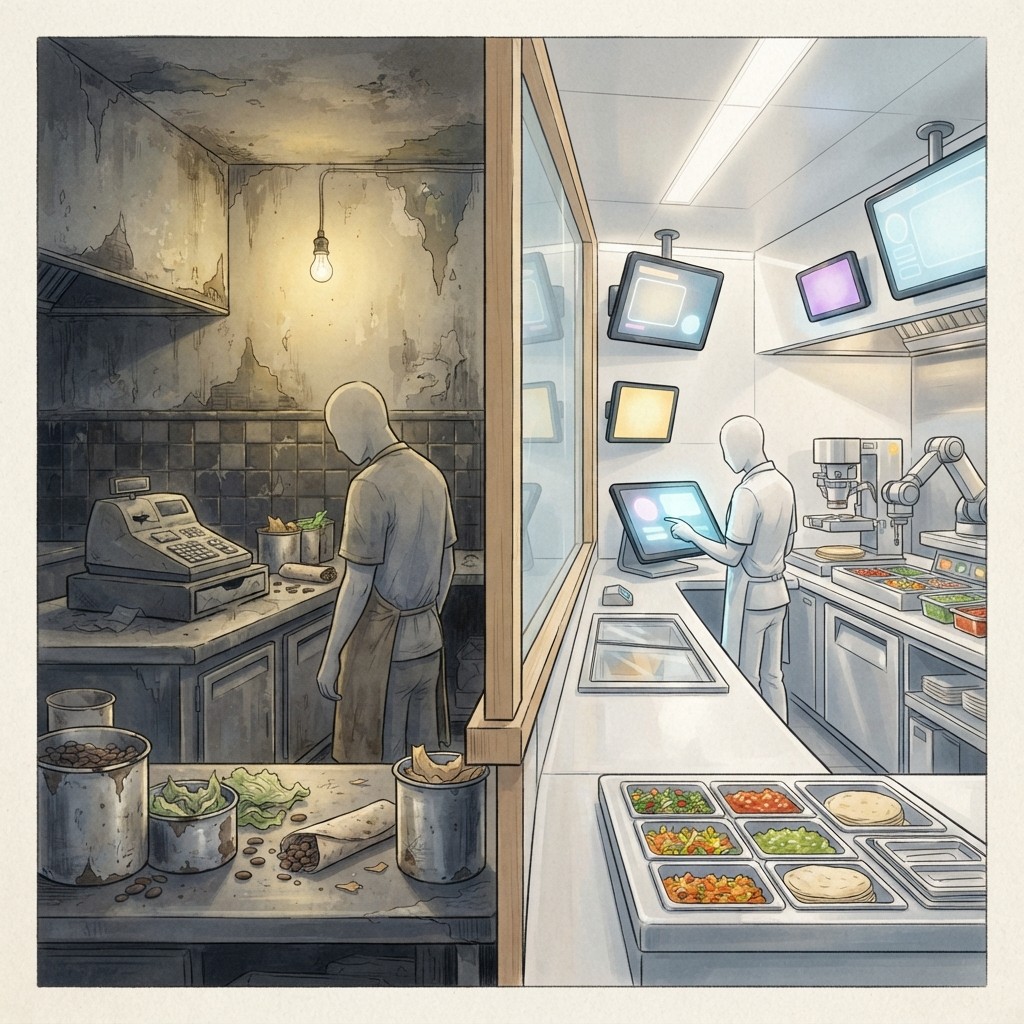
Why did a digital kitchen do what an apology couldn't? Because it sidestepped the trust problem instead of arguing with it. A skittish customer doesn't have to be persuaded the line is safe again if they're ordering through an app and grabbing a sealed bag from a Chipotlane window. The new channel converted the brand's biggest weakness — a damaged in-store experience — into demand it could fulfill without the friction of the thing that scared people. The result: revenue roughly doubled from $4.8B in 2018 to $9.9B in 2023.8 The comeback wasn't reputational repair. It was a delayed operational transformation that happened to land while the wound was healing.
| The popular story | The record | |
|---|---|---|
| The crisis | One E. coli outbreak | A cascade across multiple pathogens, 2015–2018 |
| The source | Found and removed | Never identified by CDC or FDA |
| Who fixed it | Founder Steve Ells | A new CEO hired in 2018 |
| The fix | Cleaner kitchens, apology | A second digital kitchen and new channels |
| The legal end | A criminal conviction | A deferred prosecution agreement |
Didn't the food-safety overhaul fix the trust?
The fair objection is that none of this digital machinery would have worked if the food were still making people sick — so the safety work has to be the real story. It's a reasonable read, and it's incomplete. The clearest evidence that the safety crisis was still live well into the recovery is the legal coda: on April 21, 2020, the Department of Justice charged Chipotle and the company agreed to a $25 million fine, the largest in a U.S. food-safety case, covering outbreaks in which more than 1,100 people were sickened between 2015 and 2018.6 Notice the dates. The wrongdoing stretched two years past the crisis peak, and the bill came due two years after Niccol arrived. Safety was necessary but it was not the engine. And tellingly, the case ended not in conviction but in a three-year deferred prosecution agreement — comply, and the charges go away.6 The company didn't win the food-safety story so much as it built a new business model alongside it, one robust enough to grow even while the old liability was still being settled.
When a brand's core promise breaks, the instinct is to defend it harder — more apologies, more audits, more proof you've reformed. But trust is slow and stubborn, and a frightened customer rarely re-reads your safety report. Chipotle's recovery worked because it stopped trying to win the old argument and changed the terms instead: it built channels (app ordering, sealed pickup, drive-through windows) that let nervous customers buy without re-confronting the thing that scared them. The lesson for any turnaround: when you can't quickly rebuild the trust you lost, sometimes the faster path is to reduce how much trust the next purchase requires. One warning, though — this works only if the underlying problem is genuinely fixed. Routing around a hazard you haven't solved just buys you a worse outbreak with better logistics.
The convenient version of Chipotle's comeback is a redemption arc: sin, contrition, forgiveness. The real version is colder and more useful. The crisis ran for years across pathogens no one could fully trace; the founder didn't engineer the recovery; the recovery didn't even begin until three years after the worst month. What turned it around was a CEO who refused to fight the battle the brand was losing and instead built a second restaurant inside the first — one that customers could trust precisely because it asked less of them. Chipotle didn't come back by proving its food was clean again. It came back by changing what it was selling, and to whom, while the old wound quietly closed behind it.
When a company has to become something new to survive
Turnaround Diagnosis Worksheet
A worksheet that forces a turnaround down to first principles: is this a cash problem, a cost problem, or a strategy problem — and which one will kill you first. It separates the bleeding you must stop this week from the rebuild that takes years. Blank to triage your own situation; filled as the worked example tracing how the story's leader sequenced survival before revival.
Included, filled and blank, in the Turnaround Casebook. See the set → · Preview the blank →
Sources
Where this comes from — the filings, records, and reporting behind it.
- 1In the first, larger 2015 E. coli O26 outbreak, 55 people in 11 states were infected and 21 were hospitalized; no deaths were reported. Neither CDC nor FDA identified the specific source ingredient.
- 2Chipotle comparable-restaurant sales declined 36.4% in January 2016, 29.7% in Q1 2016, 23.6% in Q2 2016, and 21.9% in Q3 2016. The stock fell 21.4% over full-year 2016.
- 3Chipotle's 2015 Annual Report confirms comparable restaurant sales declined over 36% in January 2016.
- 4Chipotle's annual revenue fell 13.26% from $4.50B in 2015 to $3.90B in 2016 — the lowest revenue in the subsequent 10-year span.
- 5Chipotle's stock hit an all-time high of $757.77 in August 2015 and fell approximately 29% for full-year 2015; from the August peak to January 2016 lows the drawdown was approximately 43%.
- 6On April 21, 2020, the DOJ charged Chipotle with adulterating food and Chipotle agreed to a $25 million fine — the largest ever in a food safety case — via a three-year deferred prosecution agreement (not a conviction). More than 1,100 people were sickened in outbreaks between 2015 and 2018.
- 7Brian Niccol was appointed Chipotle CEO effective March 5, 2018, replacing founder Steve Ells (who became executive chairman), having previously served as CEO of Taco Bell.
- 8Under Niccol, Chipotle doubled revenue from $4.8B in 2018 to $9.9B in 2023 by building a second 'digital kitchen,' launching a loyalty program (2019), and rolling out Chipotlane pickup-only drive-throughs; digital sales were 8.8% of revenue in 2018.
Weighing outside help with a decision like this? Hiring a procurement transformation consultant
More like this — beyond Chipotle
New Strategically analyses as they publish: the defining moves in business, checked against the record. No noise, and one click to leave.