Pairs with the Disruption Vulnerability Assessment — a ready-to-use strategy tool. Included in the Fall Casebook →
“How much of your decline can the agreed explanation actually account for?”
In 2025, Lucid sold 15,841 cars and pulled in $1.35 billion in revenue.3 In the same year, it lit $3.8 billion of cash on fire and watched its shareholders' equity fall from $3.87 billion to $717 million — most of a balance sheet, gone in twelve months.8 By every rule a public-market investor lives by, that is a company in the last act of a fall. And yet a sovereign wealth fund keeps walking back into the building with a fresh check. The obvious question — when will Lucid stop losing money? — turns out to be the wrong one entirely.
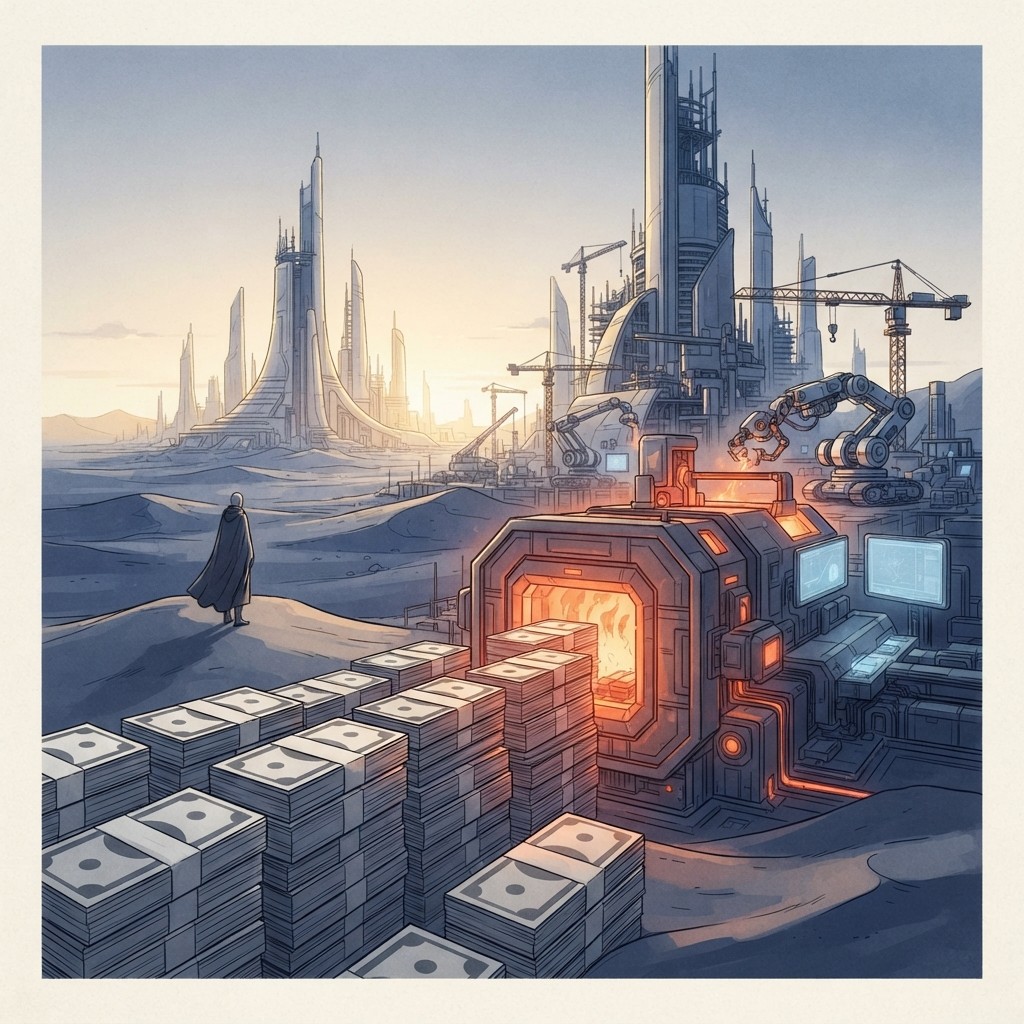
The story everyone tells is that Lucid is a once-hyped EV darling that overpromised, underdelivered, and is now slowly bleeding out. Almost every fact in that story is true. The conclusion drawn from it is not. Lucid is not a startup that ran out of road. It is a sovereign-funded industrial project that was never built to reach breakeven on its own — and that changes what the cash burn actually means.
The losses are real. The framing around them is the error.
Start with the numbers, because they are brutal and they are honest. Lucid's GAAP net loss was $2.71 billion in 2024, and its accumulated deficit climbed to $12.9 billion by the end of that year, up from $10.2 billion a year earlier.1 The mechanism behind that is not mystery or malpractice — it is arithmetic. A full automaker carries the fixed cost of a factory, a powertrain engineering team, a software stack, and a retail network whether it builds 9,000 cars or 900,000. Lucid built 9,029 in 2024.2 Spread a car company's cost base across that few units and each vehicle leaves the line priced far below what it cost to create. This is not waste. It is the toll every automaker pays on the climb up the volume curve — Tesla paid it for the better part of a decade. The difference is who is holding the bill at the bottom.
One caution before reading the loss as pure cash hemorrhage: the GAAP number and the cash number are not the same animal. Lucid's reported losses are swollen by non-cash items — warrant fair-value swings, derivative liabilities on its preferred stock, stock-based compensation — that hit the income statement without a dollar leaving the door.1 The $2.71 billion net loss overstates the cash actually consumed. The cleaner read is the free cash flow line: negative $3.8 billion in 2025.8 That is the real fire. Everything else is accounting smoke.
| As a startup chasing breakeven | As a sovereign industrial project | |
|---|---|---|
| The cash burn | A countdown to insolvency | A funded operating budget |
| The investor | Public shareholders demanding returns | A sovereign fund pursuing strategy |
| The deadline | Runway until the cash runs out | Until the owner changes its mind |
| Success looks like | Gross-margin breakeven, soon | Technology, jobs, and supply chains owned |
Who actually keeps writing the checks
Saudi Arabia's Public Investment Fund has been the majority owner of Lucid since 2019, and it has not behaved like an investor waiting nervously for a return.7 It has behaved like a patron. In 2024, PIF affiliates participated in three successive raises: $1.0 billion in the first quarter, a $1.5 billion commitment in the second, and a further ~$1.75 billion public offering in October — with PIF's own share of those transactions totalling approximately $2.5 billion across the year.47 By 2024 the fund's total outlay had reached about $8 billion,7 and after the October 2024 raise it owned about 58.8% of the common stock.10 And in April 2026, when liquidity was thinning again, PIF's vehicle came back with another $550 million — alongside Uber's $200 million and an expanded fleet commitment of at least 35,000 robotaxis.5 The pattern is the whole point: each time the runway shortens, the owner extends it.
Why would a state fund pour billions into a money-losing carmaker? Because the return it is buying is not on the income statement. A sovereign fund diversifying away from oil wants what an EV platform gives a nation: powertrain and battery engineering, advanced manufacturing know-how, a domestic plant, and a flagship for an industrial-policy story told to its own people. Read against that goal, Lucid's losses are a budget line, not a wound. The company is, in effect, a long-dated technology-and-geopolitics bet that happens to also sell sedans.
“We expect our existing liquidity to be sufficient to fund operations into the first half of 2027.”8
The number that started as a fairy tale
The mismatch between Lucid's reality and its reputation was baked in from the listing. The popular memory is that Lucid went public at a $24 billion valuation in 2021. The same SEC filing that produced that headline tells a quieter truth: the actual transaction equity value agreed in the SPAC merger was $11.75 billion. The $24 billion was a pro-forma figure implied by the PIPE offer price of $15 a share — a projection, not a price paid.6 The deal did raise about $4.4 billion in real cash and included the largest SPAC-related common-stock PIPE ever done — a characterization made in the merger announcement and widely reported at the time.69 But the round number people remember was always partly a story. Lucid has spent years being measured against a valuation that was, from day one, more aspiration than fact.
On its own, the math is grim: ~$4.6 billion of liquidity against $3.8 billion of annual free-cash outflow runs dry by the first half of 2027.83 But the second term is the one that matters. PIF has refilled the tank every time it neared empty — $2.5 billion in 2024, $550 million more in April 2026.57 For most companies that variable is fixed at zero. For Lucid it is the whole equation.
The honest counter: a patron is not a guarantee
The fair objection to all of this is that 'sovereign-backed' is a comforting label that has buried plenty of money before. Patience is not infinite, and the warning signs are not phantom. Free cash flow of negative $3.8 billion is enormous against $1.35 billion of revenue, shareholders' equity has nearly evaporated — from $3.87 billion to $717 million in a single year — and analysts openly question whether even more dilutive capital will be needed before Lucid reaches gross-margin breakeven, let alone net profit.8 A patron who tires of the project, or a Saudi budget squeezed by lower oil, could turn off the tap, and a company this dependent on one backer has no plan B. That is real. The point is not that Lucid is safe; it is that the danger lives in the owner's resolve, not in the company's quarterly cash burn. The right thing to watch is not the runway. It is whether PIF eventually absorbs the float and takes the whole thing private rather than wait for organic breakeven — the move that would confirm what the funding pattern already implies.
Before you call a cash-burning company a failure, find out who is funding the burn and what they actually want back. A startup answers to investors who need a return on a clock; a sovereign-backed industrial project answers to a state that may want jobs, technology, and supply-chain sovereignty — returns that never appear on a P&L. Applying the first scorecard to the second kind of company isn't tough analysis; it's a category error. The same $3.8 billion loss is a death rattle in one frame and a line item in the other. The number doesn't tell you which. The owner does.
Lucid keeps burning cash because it was never structured to stop on a market's timetable. It is a carmaker bolted to a sovereign-fund thesis, and as long as the thesis holds, the losses are simply the cost of holding the position. The honest verdict is not that Lucid is doomed or that it is saved — it is that the usual question is the wrong one. Don't ask when Lucid turns a profit. Ask how long Riyadh wants to own a car company. The answer to the second is the only one that has ever mattered to the first.
When the money story isn't the real story
Disruption Vulnerability Assessment
An assessment that rates a company across the dimensions that predict disruption: how cheaply a challenger can serve the unsexy bottom of the market, how trapped you are by margins and a satisfied core. Blank to score your own position before the cliff; filled as the worked example showing where the story's incumbent was already exposed while the numbers still looked great.
Included, filled and blank, in the Fall Casebook. See the set → · Preview the blank →
Sources
Where this comes from — the filings, records, and reporting behind it.
- 1Lucid's 2024 full-year GAAP net loss was $2,713,942 thousand (~$2.71 billion); the accumulated deficit stood at $12.9 billion as of December 31, 2024, versus $10.2 billion at end of 2023.
- 2Lucid delivered 10,241 vehicles in full-year 2024 (up 71% vs. 2023), produced 9,029 vehicles in line with ~9,000 guidance, reported annual revenue of $807.8 million, and ended the quarter with ~$6.13 billion in total liquidity.
- 3Lucid delivered 15,841 vehicles in full-year 2025 (up 55% vs. 2024), reported annual revenue of $1,353.8 million (up 68%), GAAP diluted net loss per share of $(12.09) for full year 2025, and ended with ~$4.6 billion in total liquidity; 2026 production guidance is 25,000–27,000 vehicles.
- 4In Q1 2024, Lucid raised $1.0 billion via private placement to a PIF affiliate; in Q2 2024, a further $1.5 billion commitment was announced (comprising $750 million convertible preferred stock and a $750 million unsecured delayed draw term loan); in October 2024, an additional ~$1.75 billion capital raise was completed.
- 5In April 2026, PIF affiliate Ayar Third Investment Company committed a further $550 million in convertible preferred stock; Uber simultaneously committed $200 million and expanded its fleet purchase commitment to at least 35,000 Lucid vehicles for a global robotaxi service.
- 6The CCIV/Lucid SPAC merger (announced February 22, 2021) combined at a transaction equity value of $11.75 billion; the pro-forma equity value at the PIPE offer price of $15.00/share was $24 billion; the deal raised approximately $4.4 billion in cash for Lucid and included the largest-ever SPAC-related common stock PIPE.
- 7PIF has been majority owner of Lucid since April 2019; the sovereign fund's total outlay reached approximately $8 billion for a 58.4% stake as of 2024, with a further $2.5 billion invested in 2024 alone.
- 8Lucid's full-year 2025 free cash flow was negative $3.8 billion; shareholders' equity collapsed from $3.87 billion to $717 million year-over-year; management guided that ~$4.6 billion in liquidity runs into the first half of 2027; analysts warn that more dilutive capital may be needed before gross-margin breakeven.
- 9The Lucid/CCIV SPAC deal included the largest PIPE investment on a SPAC deal in history, as reported contemporaneously in financial press.
- 10Following the sale in this offering and the sale in the Ayar Investment, PIF, both directly and indirectly through Ayar, is expected to continue to own approximately 58.8% of our outstanding common stock.
- 11The Ayar securities and the shares of Common Stock held directly by PIF represent approximately 56.85% of the Issuer's issued and outstanding shares Common Stock.
Weighing outside help with a decision like this? Hiring a turnaround or restructuring advisor
More like this — beyond Lucid
New Strategically analyses as they publish: the defining moves in business, checked against the record. No noise, and one click to leave.