Pairs with the Disruption Vulnerability Assessment — a ready-to-use strategy tool. Get it — included with a subscription, or $1.99 →
The Lucid Air is, by almost any engineering measure, one of the best electric cars ever built — longer range, faster charging, a more efficient drivetrain than the company it was built to beat. In 2024, Lucid managed to put 10,241 of them, plus the start of its new SUV, into customers' hands.5 That is not a typo. A full year of production from a company once valued in the tens of billions — 9,029 vehicles built5 — amounted to roughly the weekly output of a single ordinary car plant. The product wasn't the problem. The product was magnificent. That is exactly what makes the autopsy interesting.
The official story is that Lucid is a promising EV startup that missed a few production targets and ran into a tough market. The real story is colder: Lucid built a technology lead it cannot afford to sell, and the money that keeps it alive is the same money that keeps it captive.
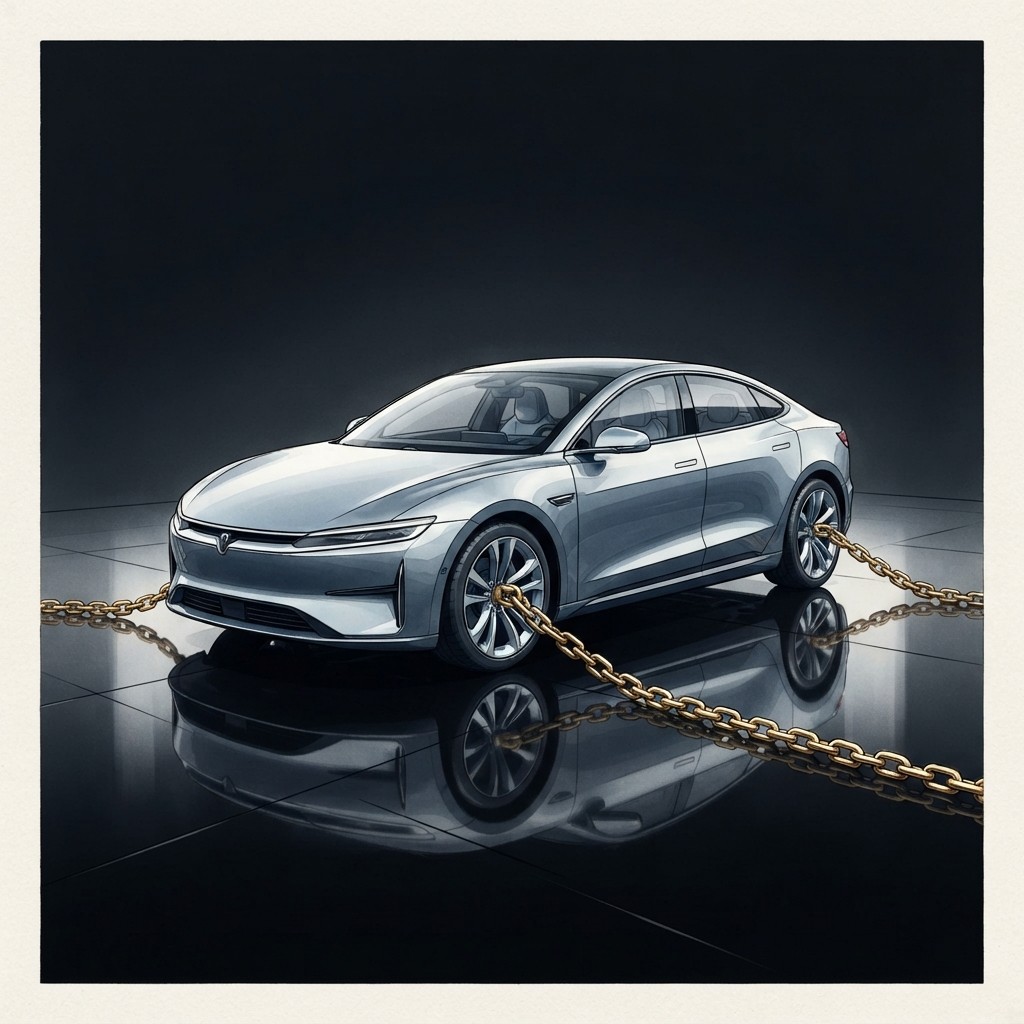
Here is the thesis a smart friend could repeat at dinner: Lucid did not fail at engineering — it failed at arithmetic, and a sovereign-wealth lifeline lets it keep failing. Its technology is genuinely ahead. But a technology lead is commercially worthless until you can manufacture at a cost your price point can carry, and Lucid's luxury price point cannot carry the cost of the volumes it actually builds. So it survives on capital, not commerce — and capital with that much control writes the strategy from then on.
The number on the marquee was never the number on the deal
Start with the founding myth, because it set the expectations everything later failed against. When Lucid merged with Churchill Capital Corp IV in February 2021, the press wrote it up as a $24 billion deal. That figure was the implied pro-forma equity value at the $15-per-share PIPE price — the dream number. The actual transaction equity value, what existing shareholders received, was $11.75 billion, and the deal delivered Lucid roughly $4.4 billion in cash.1 One number was a valuation; the other was a bank balance. The gap between them is the first quiet sign of a company sold on a story bigger than its mechanics.
The story got bigger still. Lucid's SPAC investor presentation projected the company would deliver 251,000 vehicles and generate about $2.9 billion of EBITDA in 2026, with its Gravity SUV reaching the North American market by the end of 2023.8 Hold those figures in your head, because the rest of this piece is the distance between them and what happened. The Gravity didn't begin production until December 2024 — roughly a year late.9 And the path to a quarter-million cars a year never got past five figures.
| Promised (Feb 2021 deck) | Delivered | |
|---|---|---|
| 2026 deliveries | 251,000 vehicles | Not on track |
| 2026 EBITDA | ~$2.9 billion | Not on track |
| Gravity SUV launch | North America by end-2023 | Production began Dec 2024 |
| FY2024 deliveries | — | 10,241 vehicles |
Even the famous failure is mis-told. The legend says Lucid promised 20,000 cars in the SPAC pitch and missed. It didn't. The 20,000-unit figure was Lucid's own 2022 production guidance, issued after the deal closed — and it was cut twice before year-end, finally landing at 7,180 vehicles produced.2 The SPAC promise was the quarter-million. The 20,000 was the first downward revision of many. The company's real problem isn't that it broke one promise. It's that the gap between ambition and output never closed.
Why a great car at low volume is a money-burning machine
This is the mechanism, and it is the whole story. A car company has enormous fixed costs — a factory, tooling, engineers, a supply chain, a service network — that exist whether you build ten cars or a million. The only thing that makes those costs survivable is volume: spread them across hundreds of thousands of units and each car carries a thin, bearable slice. Spread them across a few thousand and each car carries a crushing one. Lucid produced 8,428 vehicles in 2023 on annual revenue of $595.3 million, against a full-year operating loss of $3.099 billion.34 Read those two numbers together: Lucid lost more than five times what it earned. Every car it built deepened the hole.
The luxury positioning makes this worse, not better, and that is the cruel twist. A luxury price point sounds like protection — fat margins per car. But luxury also caps volume: there are only so many buyers for a $100,000 electric sedan, and you cannot manufacture your way down the cost curve on a car nobody wants at scale. So Lucid is trapped between two truths. To survive it needs the volume of a mass-market maker. To justify its price it needs the exclusivity of a luxury one. The technology lead — the range, the efficiency — is real and irrelevant, because a lead you can't manufacture cheaply is a trophy, not a moat.
On ~8,400 cars in 2023, Lucid earned $595M of revenue and posted a $3.1B operating loss.34 The fixed cost of being a car company is divided across far too few cars. The escape is volume — but volume at a luxury price has a ceiling, and below that ceiling every additional car still loses money. That is why even a 71% jump in deliveries in 20245 didn't change the verdict.
The lifeline that doubles as a leash
A company losing $3 billion a year on $600 million of revenue should already be gone. Lucid isn't, for one reason: Saudi Arabia's Public Investment Fund. Through an affiliate, the PIF put in $1 billion in early 2024 and another $1.5 billion that August, bringing its total to roughly $8 billion for about a 58% stake, even as Lucid's accumulated losses approached $13 billion by early 2025.7 That is the lifeline. It is also the trap. When a single owner holds the majority and the checkbook, the company's strategy stops being whatever the market rewards and becomes whatever that owner will keep funding. Lucid is alive — and it is not its own.
“After 12 years of daily grind...”6
Note the framing, because the popular version gets it wrong. Rawlinson is often described as a fired CEO and a Tesla co-founder. He was neither. He joined Lucid's predecessor in 2013 as CTO10 after serving as Vice President of Vehicle Engineering and Chief Engineer of the Model S at Tesla10, and his February 2025 exit was described as his own decision — a negotiated step-aside, with $120,000 a month for up to two years as a technical advisor.6 The man who built the technology left of his own accord. The technology stayed. The arithmetic stayed too.
Isn't this just a slow startup that needs more time?
The honest counter is the bull case, and it deserves a fair hearing. Deliveries rose 71% in 2024 to 10,241, the Gravity SUV finally entered production, and management guided to roughly 20,000 vehicles for 2025 — a doubling.5 Maybe Lucid is simply early on the same brutal curve Tesla once climbed: burn cash, build the brand, then ride volume into profitability. Tesla nearly died several times and emerged the most valuable automaker on earth. Why not Lucid?
Because the math has to actually arrive, and the comparison flatters the wrong variable. Tesla's salvation was the mass-market Model 3 — a deliberate march down-market to volume. Lucid's identity is the opposite: a luxury maker whose price point structurally caps the very volume it needs. Twenty thousand cars in 2025 would be a real achievement, and it would still be a rounding error against the 251,000 the deck once promised, and still nowhere near the scale at which the fixed costs stop crushing each unit.8 The bull case isn't impossible. It's just a bet that an owner with $8 billion already sunk will keep writing checks for years while the gap closes.7 That bet might pay. But it is a bet on a financier's patience, not on a business that pays for itself — and those are not the same company.
Lucid's autopsy carries a warning every deep-tech founder should tape to the wall: being best is not the same as being viable. Engineering superiority only converts into a moat when you can produce it at a cost your market will actually pay — and that conversion happens through volume and manufacturing discipline, not through specs. The trap is seductive because the early signs look like progress: prestige, awards, a believable story, and a backer willing to fund the gap. But patient capital can postpone the reckoning without changing its terms. If your unit economics only work at a scale your positioning forbids, more money buys time, not a turnaround. Solve the arithmetic first, or you are building a trophy someone else owns.
Lucid built the better mousetrap and discovered the part the cliché leaves out: the world does not beat a path to your door if each trap costs more to make than anyone will pay, and you can only make a few thousand. The cars are extraordinary. The deficit is real. And the company survives not because the market chose it but because one owner won't yet let it fall. Lucid didn't lose the engineering race. It lost the only race that ends in profit — the one where you have to build the thing cheaply enough, often enough, that the money starts coming from customers instead of patrons. Until that day, every brilliant car it ships is proof of the talent and evidence of the trap.
When the product was never the problem
Disruption Vulnerability Assessment
An assessment that rates a company across the dimensions that predict disruption: how cheaply a challenger can serve the unsexy bottom of the market, how trapped you are by margins and a satisfied core. Blank to score your own position before the cliff; filled as the worked example showing where the story's incumbent was already exposed while the numbers still looked great.
Included with any subscription, or unlock this tool for $1.99. Get it → · See plans →
Sources
Where this comes from — the filings, records, and reporting behind it.
- 1The CCIV–Lucid merger was valued at a transaction equity value of $11.75 billion, with an implied pro-forma equity value of approximately $24 billion at the $15/share PIPE price, providing Lucid approximately $4.4 billion in cash.
- 2Lucid produced 7,180 vehicles in full-year 2022 (exceeding its revised guidance of 6,000–7,000 but far below the original 20,000-unit forecast), delivered 4,369, and generated annual revenue of $608.2 million; liquidity was approximately $4.9 billion expected to fund the company at least into Q1 2024.
- 3Lucid produced 8,428 vehicles in full-year 2023 (meeting the high end of its 8,000–8,500 guidance), delivered 6,001, and generated annual revenue of $595.3 million; it had approximately $4.78 billion in total liquidity at year-end.
- 4Lucid's 10-K for FY2023 shows an accumulated deficit of $10.198 billion at December 31, 2023 (up from $7.370 billion at end-2022), a full-year operating loss of $3.099 billion, and restructuring charges of $24.5 million (first-ever, none in prior years).
- 5Lucid produced 9,029 vehicles in full-year 2024 (in line with guidance of ~9,000) and delivered 10,241 (up 71% vs. 2023); Peter Rawlinson stepped down as CEO/CTO, with Marc Winterhoff taking over as interim CEO; 2025 production guidance was set at approximately 20,000 vehicles.
- 6Rawlinson's departure in February 2025 was described by incoming interim CEO Winterhoff as Rawlinson's own decision 'after 12 years of daily grind'; Rawlinson will be paid $120,000/month for up to two years as strategic technical advisor per an SEC filing.
- 7Saudi Arabia's Public Investment Fund (through Ayar Third Investment, a PIF affiliate) invested $1 billion in Q1 2024 and a further $1.5 billion in August 2024 ($750M convertible preferred stock + $750M credit line), bringing total PIF investment to approximately $8 billion for a ~58% stake; total accumulated losses had reached nearly $13 billion by February 2025.
- 8The SPAC investor presentation (February 2021) projected Lucid delivering 251,000 vehicles and generating approximately $2.9 billion EBITDA in 2026; the Gravity SUV was targeted for North American market entry by end-2023. Neither projection was met on schedule.
- 9Production of the Lucid Gravity SUV started in December 2024.Wikipedia, Lucid Motors ↗ · 2024
- 10Since joining Lucid in 2013, Rawlinson held the position of CTO; prior to Lucid he was Vice President of Vehicle Engineering and Chief Engineer of the Model S at Tesla.
More like this — beyond Lucid
New Strategically analyses as they publish: the defining moves in business, checked against the record. No noise, and one click to leave.