Pairs with the Disruption Vulnerability Assessment — a ready-to-use strategy tool. Included in the Fall Casebook →
“How much of your decline can the agreed explanation actually account for?”
On August 9, 2022, a rival mobile-ad company called AppLovin offered to buy Unity outright at $58.85 a share — roughly a 48% premium over Unity's price the day before its ironSource deal had been unveiled.6 It was a door, swung wide open, marked exit. Six days later, Unity's board walked past it. Unanimously. The board's stated reason, in an email the CEO sent to staff, was that the ironSource merger it was already pursuing was 'more compelling' for shareholders.7 The thing Unity rejected the premium to keep buying was an advertising business that had fallen from a peak near $11 billion to roughly $2.3 billion.9
The official story is that this was platform strategy: a game-engine giant buying the ad tools its developers needed to make money, a vertical stack from creation to monetization. The real story is plainer and harsher. It was a capital-allocation decision — and a bad one — made at the precise moment Unity had the least leverage to make it.
A great debut that hid a growing hole
Unity, founded in Copenhagen in 2004 as Over the Edge I/S before it became the San Francisco engine company most people know,8 went public in September 2020 about as well as a company can. It priced at $52 a share — above a range it had already raised twice, from $34–$42 up to $44–$48 — opened at $75, and closed its first day at $68.35, a 31% pop, raising about $1.3 billion.2 The market loved the story: the software powering the largest share of the world's games, going public into a pandemic gaming boom.
But the engine was never the money. Revenue grew handsomely — $541.8 million in 2019, $772.4 million in 2020, then past $1.1 billion in 2021 — while net losses grew faster, from $163.2 million to $282.3 million to $532.6 million over the same years.3 The growth engine inside the game engine was advertising: Unity helped developers acquire and monetize players, and that ad machine, not the creation tools, was the part Wall Street was paying up for. Which is exactly why the next thing mattered so much.
The day the ad machine ate bad data
In the first quarter of 2022, Unity told investors its advertising algorithm had been fed bad data — a problem it estimated had cost roughly $110 million in lost revenue and would take up to two quarters to fix.4 The stock fell nearly 30% in a single day.4 This is the hinge of the whole story, so it's worth being precise about what it was and wasn't. It is often filed under Apple's privacy crackdown, but Unity's own framing was narrower and more damning: not that the world changed around its model, but that its model had quietly poisoned itself. The most valuable part of the business — the part the IPO was really priced on — had just been revealed to be fragile in a way nobody outside had modeled.
Now hold the timeline in your head. The ad business stumbles. The stock craters. And it is from inside that crater — with its own currency, its shares, trading at a fraction of where it had been — that Unity went shopping for the largest acquisition in its history.
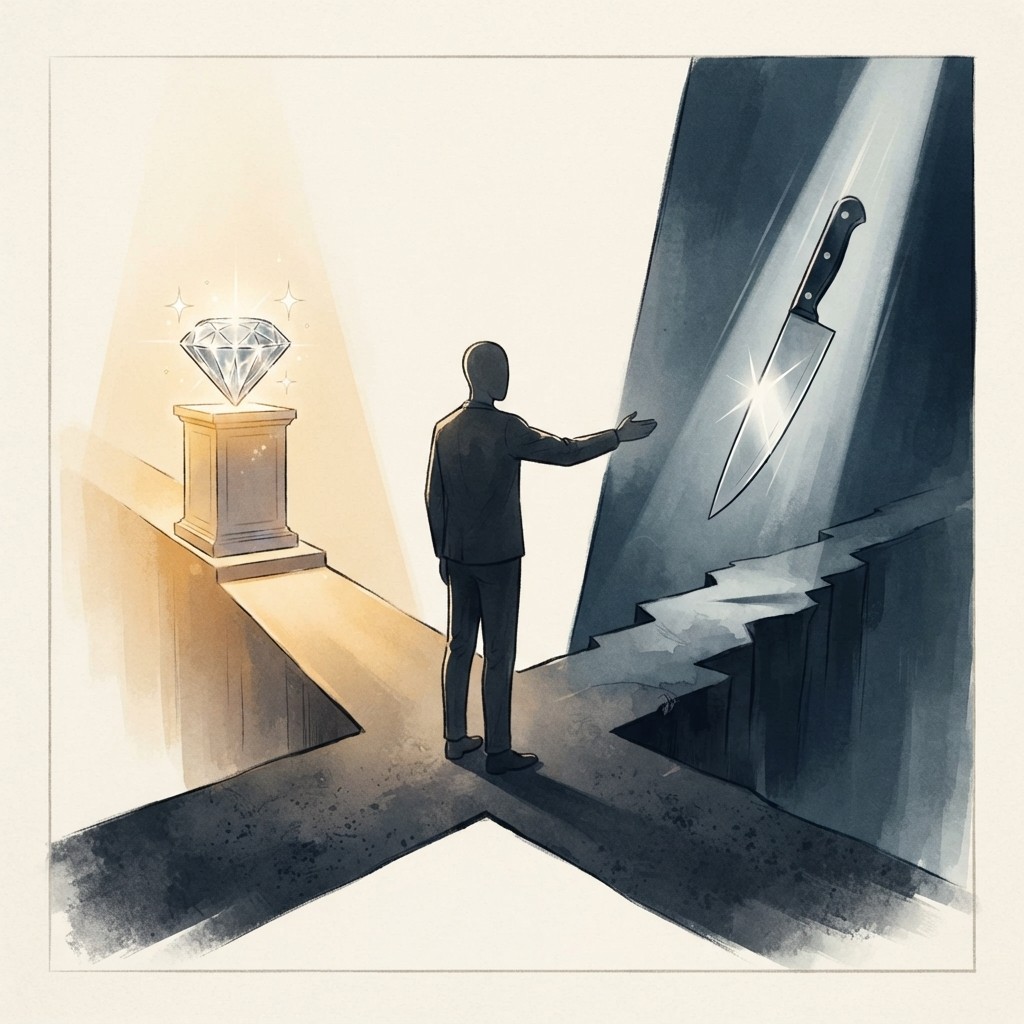
Buying a falling knife with a discounted currency
In July 2022, Unity announced it would merge with ironSource, a mobile-monetization company, in an all-stock deal valuing ironSource at about $4.4 billion, with ironSource holders set to own 26.5% of the combined company.5 Management's logic was a stack: Unity makes the game, ironSource helps the game make money, one roof, fewer leaks. On a whiteboard, it's tidy.
On a balance sheet, it's two compounding mistakes at once. First, the asset. ironSource was a mobile-ad business priced at $4.4 billion — a premium to its then-beaten-down market price of roughly $2.3 billion, but a fraction of the near-$11 billion it had once commanded.9 Unity was paying up for a category that had just demonstrated, in Unity's own ad results, how cyclical and fragile it could be. Second, the currency. Because the deal was all stock, Unity was spending the very shares that the bad-data disclosure had just marked down by a third.4 You do not want to pay with cheap dollars. Unity paid for a discounted asset with a discounted currency, and convinced itself the discounts canceled out. They don't. They stack.
| Keep buying ironSource | Take the AppLovin offer | |
|---|---|---|
| What Unity does | Pays with its own marked-down stock | Sells itself at a ~48% premium |
| The asset involved | Ad business down ~$11B → ~$2.3B | Cash-out for Unity holders |
| Who decides Unity's fate | Unity management | The market, at a premium |
| The board's verdict | 'More compelling' | Rejected, unanimously |
The door Unity rejected the premium to close
Then AppLovin knocked. Its August 9 proposal valued Unity at $58.85 a share — about a 48% premium to where Unity traded the day before the ironSource news — but it came with a condition: kill the ironSource deal.6 So the board faced a clean fork. Take a large, immediate, market-validated premium for Unity's own shareholders, or proceed with spending those shareholders' diluted stock to absorb a shrinking ad business. On August 15 it chose the second, unanimously, and the ironSource merger closed that November.7
“The board decided the ironSource deal was 'more compelling' for shareholders.”7
Read that word — 'more compelling' — against the structure of the two offers. One handed Unity's owners a 48% premium and let someone else carry the integration risk. The other asked them to dilute themselves to buy a business at four times its bottom. 'Compelling' is doing a great deal of work in that sentence, and most of it is the work of a management team that wanted to keep being a management team rather than a line item in someone else's deal.
Wasn't the vertical stack the right long-term bet?
The honest counter deserves a fair hearing, because the strategic logic isn't crazy. A premium is a one-time event; an integrated create-to-monetize platform is, in theory, a durable franchise. AppLovin's offer was all-stock too, so 'a 48% premium' was itself a fluctuating market value, not a check. And a board's job is to maximize long-run value, not to flinch at the first attractive exit. If the combined Unity–ironSource had become the default monetization layer for mobile gaming, the few billion of premium foregone would look like rounding error against the franchise built.
But strategy and capital allocation are different disciplines, and this is where the steelman breaks. Even granting that owning the ad stack is the right destination, the question is whether mid-2022 — your stock freshly halved, your ad algorithm freshly broken, a declining target dressed as a bargain — was the right time and price to buy your way there. A correct destination reached with the wrong currency at the wrong moment is still a wealth-destroying trip. The market gave Unity a way to realize the value of its franchise immediately and at a premium; Unity instead spent its cheapest-ever shares to deepen its exposure to the exact business that had just blown up. That isn't conviction. It's averaging down on your own mistake with someone else's chips.
The most dangerous time to make a big all-stock acquisition is right after your own stock has been punished, because your currency is at its weakest exactly when you feel most compelled to act. Two disciplines should never be confused: 'is this the right asset to own eventually?' and 'is this the right price and currency to buy it with today?' A correct strategy executed at the wrong moment, with marked-down stock, against a declining target, destroys value just as efficiently as a wrong strategy — and it does so wearing the respectable costume of long-term vision. When the market hands you a premium exit while you're underwater, treat it as information, not as an insult to ignore.
Unity went public on the promise of an engine that powered the world's games and an ad machine that printed the growth. By 2022 the ad machine had stalled, the stock had been cut, and the market — through AppLovin — offered to pay a 48% premium to take the whole thing off shareholders' hands. The board declined, to keep spending its weakest currency on a business at a fraction of its former worth. The 'platform strategy' was real on the whiteboard. But the decision underneath it wasn't about platforms at all. It was a company that had just been taught how fragile its best business was — and chose, at the bottom, to buy more of it.
Disruption Vulnerability Assessment
An assessment that rates a company across the dimensions that predict disruption: how cheaply a challenger can serve the unsexy bottom of the market, how trapped you are by margins and a satisfied core. Blank to score your own position before the cliff; filled as the worked example showing where the story's incumbent was already exposed while the numbers still looked great.
Included, filled and blank, in the Fall Casebook. See the set → · Preview the blank →
Sources
Where this comes from — the filings, records, and reporting behind it.
- 1Unity Software Inc. filed its Form S-1 with the SEC on August 24, 2020, announcing its intent to go public on the NYSE under ticker 'U'; Goldman Sachs and Credit Suisse were lead underwriters.
- 2Unity priced its IPO at $52 per share (above the raised $44–$48 range, itself above the original $34–$42 range); shares began trading September 18, 2020, opened at $75, and closed at $68.35, a 31% first-day gain; the company raised approximately $1.3 billion.
- 3Unity's revenue for fiscal years 2019, 2020, and 2021 was $541.8M, $772.4M, and $1.1B respectively; net losses were $163.2M, $282.3M, and $532.6M for those same years, per the 10-K filed with the SEC.
- 4In Q1 2022, Unity disclosed its advertising algorithm had been fed bad data, costing it approximately $110 million in lost revenue and requiring up to two quarters to remediate; Unity stock fell nearly 30% in a single day on this disclosure.
- 5Unity announced a merger with ironSource in an all-stock deal valuing ironSource at approximately $4.4 billion; upon completion, ironSource shareholders would own 26.5% of the combined company; the deal was approved by both boards and expected to close Q4 2022.
- 6On August 9, 2022, AppLovin made an unsolicited bid to acquire Unity in an all-stock deal valuing Unity at $58.85/share (a ~48% premium to Unity's July 12 price, the day before the ironSource announcement was made), contingent on Unity terminating its ironSource merger agreement.
- 7Unity's board unanimously rejected AppLovin's proposal on August 15, 2022, with CEO John Riccitiello emailing employees that the board decided the ironSource deal was 'more compelling' for shareholders; the ironSource merger was completed November 7, 2022.
- 8Unity was founded in Copenhagen, Denmark, in August 2004 as Over the Edge I/S by David Helgason, Nicholas Francis, and Joachim Ante; the company changed its name to Unity Technologies in 2007 and later relocated its headquarters to San Francisco.CNBC, Unity S-1 IPO filing drops ↗ · 2020-08-24
- 9ironSource went public in June 2021 at a valuation of $11 billion via SPAC merger, and its value dropped from $11 billion to just $2.3 billion before the Unity merger was announced at $4.4 billion
Weighing outside help with a decision like this? Hiring a turnaround or restructuring advisor
More like this — beyond Unity
New Strategically analyses as they publish: the defining moves in business, checked against the record. No noise, and one click to leave.