Pairs with the Disruption Vulnerability Assessment — a ready-to-use strategy tool, filled for Pan Am. Included in the The Fall Casebook →
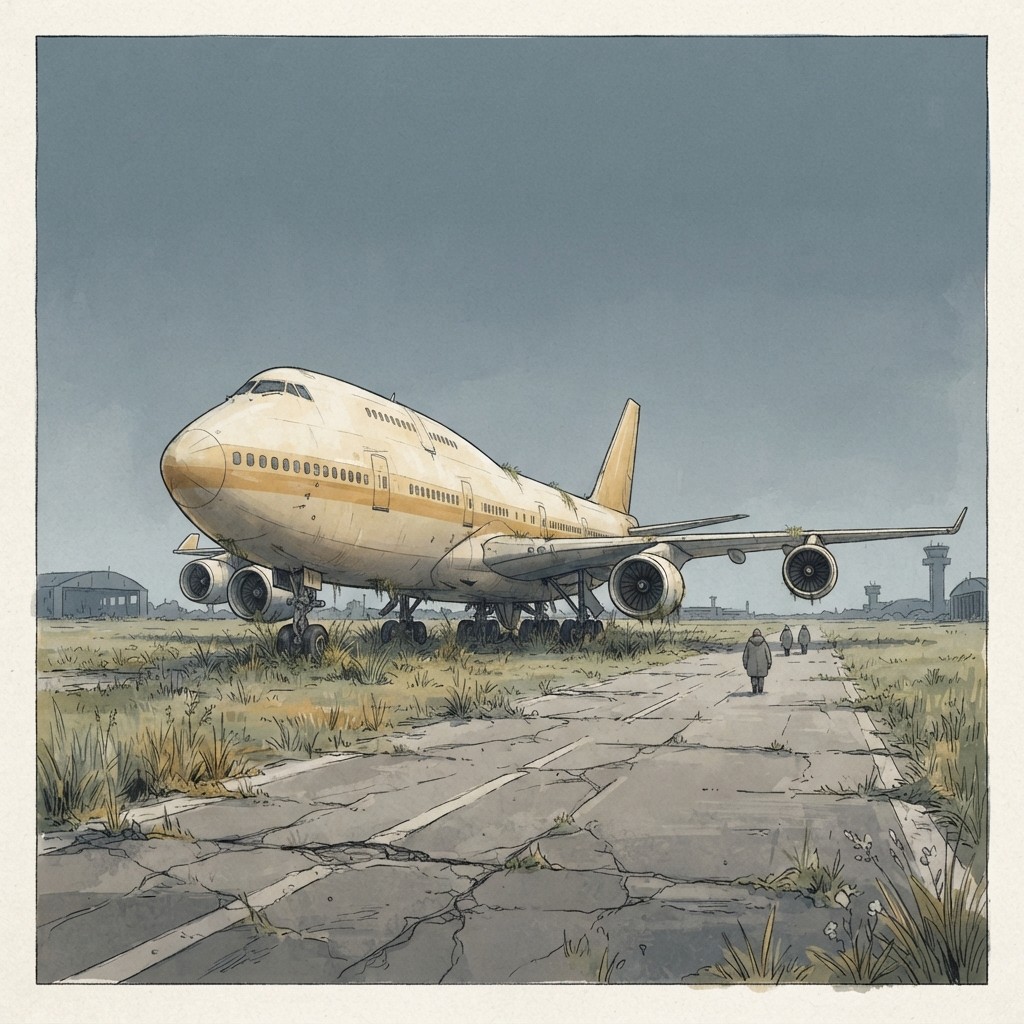
In April 1966, Pan Am signed an order for 25 Boeing 747s — the biggest passenger plane ever built, a jet that did not yet exist — for $525 million, a sum worth roughly $3.9 billion today.4 It was the launch customer; it shaped the design; the airplane was practically built to Pan Am's specification. For a moment it looked like the boldest bet in aviation history. It was. It was also the beginning of a twenty-five-year fall that ended in a Manhattan bankruptcy court with $2.6 billion in liabilities against $1.6 billion in assets.1 The plane that was supposed to crown an empire was the first turn of the screw.
The story everyone tells is that deregulation killed Pan Am — that a noble international flag carrier was thrown to the wolves when Washington opened the skies in 1978. It is a tidy story, and it is mostly wrong. Pan Am was not a healthy giant ambushed by policy. It was a patient already dying of its own decisions, and deregulation simply removed the regulatory oxygen mask that had been hiding the symptoms.
An airline with the whole world and none of America
Here is the structural flaw that everything else compounds: Pan Am was an international-only carrier. For decades, regulation had handed it the glamorous overseas routes — Europe, Asia, the Pacific — while keeping it out of the lucrative domestic American market. That arrangement worked beautifully as long as the government drew the maps. It was a death sentence the moment the government stopped. Every domestic passenger an American carrier flew across the country could be funneled, or 'fed,' onto that carrier's own international flights. Pan Am had no feed. It owned the long-haul trunk and none of the roots, and when the soil opened to everyone, it had no way to capture the traffic that filled its rivals' widebodies.
So in 1966 it had bought 25 of the largest aircraft in the world — built to fill seats it would increasingly struggle to fill — and it had taken on the debt to do it. Then came the 1973 oil shock, fuel prices, and losses. By the time President Carter signed the Airline Deregulation Act on October 24, 1978, dissolving the Civil Aeronautics Board and removing federal control over fares and routes,3 the patient was already bleeding. Deregulation did not open the wound. It pulled off the bandage.
The cure that made the disease worse
Pan Am knew it needed a domestic network. So it bought one. On December 22, 1979, the U.S. government approved its $437 million acquisition of National Airlines, and the deal closed on January 7, 1980, creating the country's fourth-largest carrier.5 On paper, finally, the feed problem was solved. In practice, it was the most expensive way to make the problem worse. Pan Am agreed to raise National's union wages to its own, higher levels — and National's routes, profitable under National's cost structure, turned unprofitable under Pan Am's.5 It had paid $437 million to import revenue and ended up importing losses. The integration was a lesson every acquirer relearns the hard way: you cannot bolt a low-cost operation onto a high-cost body and keep the low cost. The body wins.
| Decision | What it was supposed to do | What it actually did |
|---|---|---|
| 1966: order 25 Boeing 747s | Crown the world's leading airline | Load it with debt for seats it couldn't fill |
| 1980: buy National Airlines | Add the domestic feed it lacked | Import losses by raising National's wages to Pan Am's |
| 1985: sell the Pacific Division | Raise cash to survive | Hand a profitable corridor to a direct rival |
Selling the only thing that worked
By the mid-1980s, Pan Am was raising cash the only way a cornered company can: by selling the assets that still earned. In April 1985 it sold its entire Pacific Division — fully 25% of its route system, including the prized Tokyo-Narita hub — to United Airlines for $750 million.6 Read that twice. It surrendered a quarter of its network, and one of its genuinely profitable corridors, to a direct competitor, to fund its own survival. This is the move that exposes the whole pattern. A company selling its best business to pay for its worst is not restructuring; it is liquidating in slow motion, one crown jewel at a time. The $750 million bought time. It did not buy a future, because the future had just been sold to United.
The cruelest trap in a corporate decline is that the assets easiest to sell are usually the good ones — they have buyers precisely because they earn. So a cash-starved company sells what works to subsidize what doesn't, and each sale leaves it smaller, weaker, and more dependent on the next sale. Watch for the tell: a struggling firm divesting its highest-margin business 'to focus' or 'to strengthen the balance sheet.' That is rarely strategy. It is the sound of a company eating its own seed corn — and handing the harvest to the competitor across the table.
The bomb that everyone remembers as the cause
On December 21, 1988, a plastic explosive detonated in the forward cargo hold of Pan Am Flight 103 over Lockerbie, Scotland, killing all 259 people aboard and 11 on the ground — 270 in all.7 It was a catastrophe in every human sense, and it became, in the company's own telling, a cause of the end. When Pan Am filed for Chapter 11 on January 8–9, 1991, securing a $150 million debtor-in-possession loan — $50 million of it from United Airlines — CEO Thomas Plaskett pointed to Lockerbie, soaring fuel prices, and a deteriorating economy.2 All three were real. None of them was the disease. They were the final blows landed on a structure that had been hollowed out for two decades. Lockerbie crushed the brand of safety that an international carrier sells above all else — but it crushed it in a company that had already sold its Pacific routes, mishandled National, and carried 747 debt since the Johnson administration.
But wasn't deregulation genuinely brutal?
The fair objection is that this is too neat — that deregulation really did slaughter the legacy carriers, not just Pan Am. And the record backs the objection partway: between 1978 and 2001, eight major carriers went bankrupt, Pan Am among them.3 Open competition was a meat grinder, and pretending Pan Am's wounds were purely self-inflicted would be its own kind of myth. But notice what the steelman concedes. Eight carriers failed across more than two decades; most of the industry survived, consolidated, and adapted. Deregulation was the environment, not the verdict. The carriers that died were, almost without exception, the ones that entered the new world already mis-structured — and Pan Am entered it the most mis-structured of all: maximum debt, zero domestic feed, and a habit of selling its best assets to cover its worst. Deregulation set the test. Pan Am had failed the preparation years before the exam began.
The end came in pieces, the way the whole decline had. Delta bought the European routes, the Frankfurt hub, the Shuttle, 45 jets, and the great Worldport at JFK for $416 million, then put in $100 million more for 45% of a smaller, reorganized Pan Am. That carrier lost roughly $3 million a day and stopped flying on December 4, 1991.8 The airline that had ordered the jumbo jet into existence, that had carried the American century across every ocean, ended as a handful of routes sold off to the rivals it had once defined the sky above. It did not die because the rules changed. It died because, for twenty-five years, it answered every problem by mortgaging the future — and one day there was no future left to sell.
When a giant runs out of future to sell
Disruption Vulnerability Assessment
An assessment that rates a company across the dimensions that predict disruption: how cheaply a challenger can serve the unsexy bottom of the market, how trapped you are by margins and a satisfied core. Blank to score your own position before the cliff; filled as the worked example showing where the story's incumbent was already exposed while the numbers still looked great.
Included, filled and blank, in the The Fall Casebook. See the set → · Preview the blank →
Sources
Where this comes from — the filings, records, and reporting behind it.
- 1Pan Am Corporation filed a petition for reorganization under Chapter 11 of the Bankruptcy Code on January 8, 1991, in the U.S. Bankruptcy Court for the Southern District of New York; Pan American World Airways listed $2.6 billion in liabilities and $1.6 billion in assets.
- 2Pan Am filed for Chapter 11 on January 8-9, 1991, securing a $150 million debtor-in-possession loan from Bankers Trust (including $50 million from United Airlines); CEO Thomas Plaskett cited the 1988 Lockerbie bombing, soaring fuel prices, and a deteriorating economy as precipitating factors.
- 3President Jimmy Carter signed the Airline Deregulation Act into law on October 24, 1978, dissolving the Civil Aeronautics Board and removing federal control over airline fares, routes, and market entry; between 1978 and mid-2001, eight major carriers including Pan Am went bankrupt.
- 4In April 1966, Pan Am ordered 25 Boeing 747-100 aircraft for $525 million (equivalent to approximately $3.9 billion in 2024), making Pan Am the 747 launch customer and enabling Pan Am to influence the aircraft's design to an extent unmatched by any single airline before or since.
- 5The U.S. government approved Pan Am's $437 million acquisition of National Airlines on December 22, 1979; the deal closed January 7, 1980, making the combined carrier the country's fourth-largest airline, but the integration proved costly — Pan Am agreed to raise National's union wages to Pan Am's higher levels, turning formerly profitable National routes unprofitable.
- 6In April 1985, Pan Am sold its entire Pacific Division — representing 25% of its route system including the Tokyo-Narita hub — to United Airlines for $750 million, permanently surrendering a major revenue corridor to a direct competitor.
- 7On December 21, 1988, a bomb destroyed Pan Am Flight 103 over Lockerbie, Scotland, killing all 259 passengers and crew and 11 people on the ground — 270 total fatalities; the bomb was a plastic explosive detonated in the forward cargo hold.
- 8Delta Air Lines purchased Pan Am's remaining European routes, Frankfurt mini-hub, Shuttle operation, 45 jets, and the Pan Am Worldport at JFK for $416 million, then injected $100 million for a 45% stake in a reorganized, smaller Pan Am; the reorganized carrier lost approximately $3 million per day and ceased all operations December 4, 1991.
More like this — beyond Pan Am
New Strategically analyses as they publish: the defining moves in business, checked against the record. No noise, and one click to leave.