Pairs with the Crisis Response Playbook — a ready-to-use strategy tool, filled for Pan Am. Included in the The Crisis Response Casebook →
At 7:03 in the evening on 21 December 1988, thirty-eight minutes after takeoff, a bomb in the forward cargo hold of a Boeing 747 named Clipper Maid of the Seas exploded at 31,000 feet, and the wreckage fell across 845 square miles of southern Scotland.3 Two hundred and seventy people died — 259 in the air and 11 on the ground in the town of Lockerbie, citizens of 21 countries.1 It is one of the defining horrors of the late twentieth century, and it is remembered, almost universally, as the night a terrorist killed an airline.
Here is the inconvenient fact that ruins the tidy story. The quarter immediately before the bomb — Q3 1988 — was the most profitable quarter Pan Am ever recorded.8 And the most profitable quarter in a company's history is not, as a rule, the financial shape of a company about to be killed by anything. It is the shape of a company that was already dying for entirely different reasons, and happened to be having a good few months on the way out.
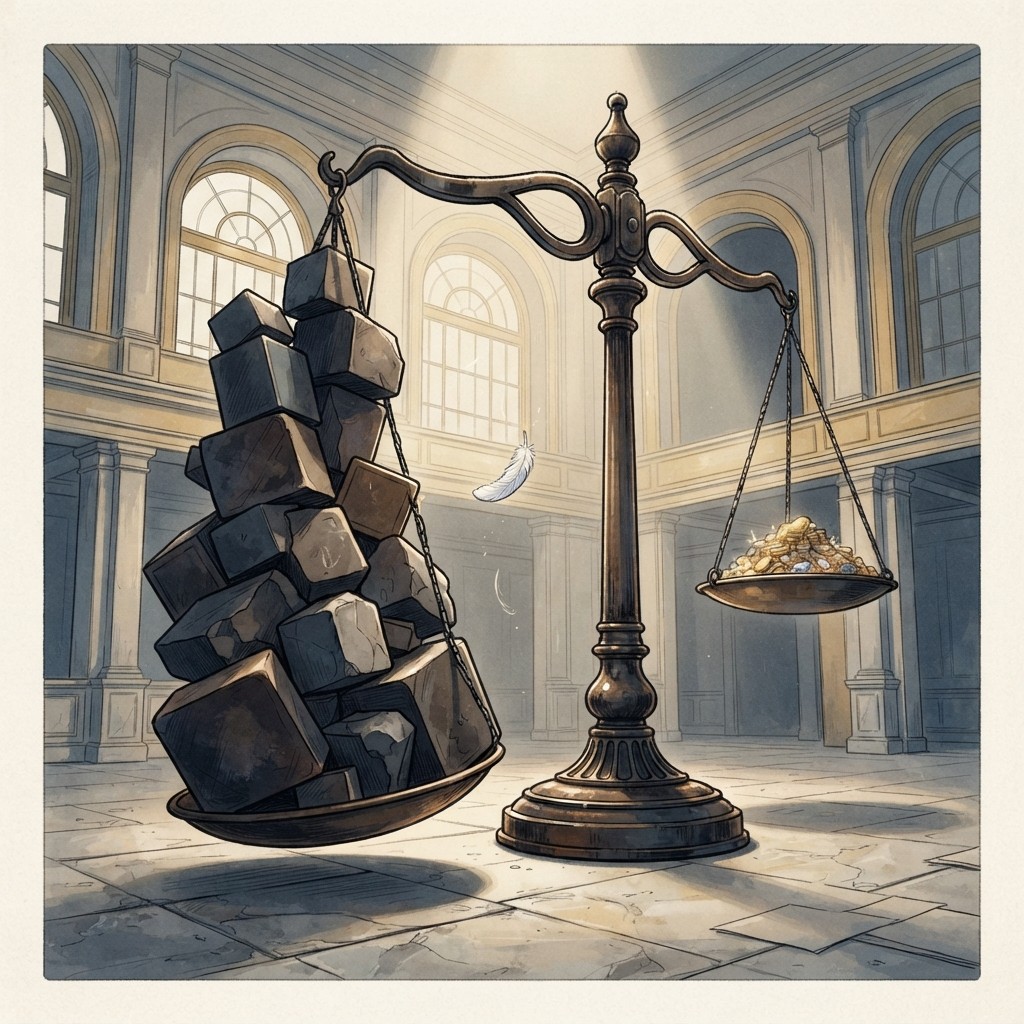
The thesis, plainly: Lockerbie didn't write Pan Am's death warrant. It cashed a check the airline had already written across a decade of self-inflicted wounds — and then handed the courts a $500 million bill on top.
An airline that had been selling itself for parts
To see why the bomb was an accelerant and not a cause, follow the money backwards. Pan Am's whole business model had been built on a thing the U.S. government no longer guaranteed: protected international routes. When deregulation arrived in 1978, the moat drained overnight — its rivals could now fly the lucrative routes Pan Am had treated as a birthright.10 Then came the strategic blunder that put a number on the panic: in 1980 it paid $437 million for National Airlines to graft on a domestic network, and bought debt without ever solving the problem it was meant to solve.10 By 1985 and 1986 the company was selling off its prized Pacific Division to United just to raise survival cash.10 You do not sell your best routes for cash unless you are out of cash.
| The story everyone tells | What the record shows | |
|---|---|---|
| What killed Pan Am | A bomb over Lockerbie | A decade of structural insolvency |
| The decisive date | December 21, 1988 | 1978 deregulation onward |
| The smoking gun | Libyan intelligence | A $437M acquisition and asset fire-sale |
| Lockerbie's role | The cause | The accelerant |
So the company that the bomb hit in December 1988 was already a balance sheet with a billion-dollar hole, propped up on the proceeds of selling its own future. That is the crucial thing about the famous Q3 1988 profit: it was a passenger airline still capable of a good quarter, sitting on a capital structure that could not survive a bad one. The genius of a healthy company is that it absorbs shocks. Pan Am had spent ten years dismantling exactly that capacity — and then a once-in-a-generation shock arrived.
Why the bomb cost so much more than the bomb
Lockerbie did real economic damage, but not in the way people assume. The fare loss from frightened passengers was the smallest part. The larger blow was legal. More than 100 victim families filed suit, and the headline figure that circulates — $300 million — was only the opening demand.8 Pan Am was found liable for willful misconduct, and the total payout exceeded $500 million, described as the largest in commercial aviation history at the time.9 A willful-misconduct finding is the difference between an accident and a failure: it meant the security lapse that let the bomb aboard was not bad luck but a breach the airline owned. For a carrier already underwater, half a billion dollars of liability isn't a wound. It's an anchor tied to a drowning man.
“We simply did not have the underlying financial strength to absorb the enormously adverse impact of these external events.”6
Read the CEO's own words carefully, because they are an unintentional confession. He blamed Lockerbie, fuel prices, and the economy — the external events. But the operative phrase is the one before it: 'we did not have the underlying financial strength.' That weakness was not external. It was a decade of decisions made in boardrooms, not over Scotland. The bomb supplied the shock. The fragility was homemade.
Three years, three more shocks, then the lights went out
If Lockerbie had truly killed Pan Am, the airline would have died in 1989. Instead it staggered on for three more years, and the actual cause of death has a different name and a different date. The 1990–91 Gulf War depressed travel demand and drove fuel prices up just as Pan Am was trying to restructure.8 In January 1991 it filed for Chapter 11.5 By late 1991 it was bleeding roughly $3 million a day, and its survival depended entirely on Delta Air Lines, which had agreed to buy its European routes and Northeast Shuttle and inject equity. When Delta withdrew that funding commitment, the restructuring plan had no oxygen left — and on December 4, 1991, Pan Am ceased all operations.7
Notice the chain. Lockerbie to bankruptcy runs through the Gulf War, through a fuel-price surge, through a court verdict, and through a single financing partner walking away. Remove the bomb from that sequence and you still have a carrier that sold its Pacific routes, overpaid for National, lost its regulatory moat, and entered the 1990s a billion dollars underwater. The bomb made the ending faster and more dramatic. It did not make the ending.
But surely a $500 million bill kills any airline?
The fair objection is that this is too neat — that you can rationalize any death as 'structural' after the fact, and that a half-billion-dollar liability plus the reputational hit of a terrorist atrocity would have sunk a far healthier company too. There is real force here, and it deserves an honest answer. The willful-misconduct judgment was genuinely catastrophic; a stronger balance sheet would still have buckled under it. But that is precisely the point, not a refutation of it. A solvent airline with diversified, profitable routes and headroom on its debt absorbs a shock the way a healthy body absorbs a fever. Pan Am had spent a decade selling off the very organs — the Pacific, the moat, the cash cushion — that would have let it survive one. The honest version isn't that Lockerbie was harmless. It's that the same blow that staggered a healthy carrier proved lethal only because Pan Am had pre-arranged its own fragility. The bomb found the weakest possible airline to hit, and the weakness was the story.
When a company dies after a dramatic shock — a recall, a scandal, a disaster — the temptation is to name the shock as the cause and stop investigating. Resist it. A crisis is an invoice, and only firms that are already insolvent in some structural sense can't pay it. The diagnostic question is never 'what was the final blow?' It's 'why did this particular blow land fatally when the same company had survived others?' Pan Am's most profitable quarter was the one right before the bomb — which tells you the operating business still worked and the capital structure didn't. Look past the headline event to the balance sheet it landed on. The shock you can see is rarely the weakness that mattered.
There is a grim symmetry in how the costs settled. Pan Am paid more than $500 million for the failure that let the bomb aboard.9 Libya, the state whose intelligence operatives planned and executed the attack3, later paid more than $2.7 billion to the families — $10 million per victim.4 The murderer paid five times what the airline did, and the airline still didn't survive the difference. Because the airline was never really being charged for the bomb. It was being charged, at last and all at once, for a decade of decisions it had hoped no one would ever audit. Lockerbie was the accelerant. The accelerant only matters when the building is already soaked in fuel — and Pan Am had been pouring it on itself since 1978.
When the headline event isn't the real cause
Crisis Response Playbook
A playbook for a crisis already in motion: who decides, which plays fire on which trigger, and what gets said to whom. It replaces panic and the all-hands meeting with a pre-agreed sequence each person can run alone. Blank to pre-load before a crisis hits; filled as the worked example reconstructing the plays the story's team ran — and the ones they should have.
Included, filled and blank, in the The Crisis Response Casebook. See the set → · Preview the blank →
Sources
Where this comes from — the filings, records, and reporting behind it.
- 1Pan Am Flight 103 was a regularly scheduled transatlantic flight from Frankfurt to Detroit via London and New York; the Boeing 747 Clipper Maid of the Seas was destroyed by a bomb at 19:03 on 21 December 1988 over Lockerbie, killing 243 passengers, 16 crew, and 11 Lockerbie residents—270 total from 21 countries.Wikipedia, Pan Am Flight 103 ↗ · 2025-06
- 2Pan Am Flight 103 took off from Heathrow on 21 December 1988; 190 Americans were among the 259 passengers and crew; the explosion at approximately 31,000 feet rained debris over 845 square miles; 11 Lockerbie residents were killed on the ground.
- 3At 7:03 pm GMT on 21 December 1988, Pan Am Flight 103 was destroyed 38 minutes after takeoff when a bomb in the forward cargo area exploded at 31,000 feet over Lockerbie; citizens from 21 countries were killed; 35 of the 190 American victims were Syracuse University students; the attack was 'planned and executed by Libyan intelligence operatives.'
- 4Abdelbaset al-Megrahi was found guilty of 270 counts of murder in 2001 and sentenced to life imprisonment; he was released in 2009 on compassionate grounds after a cancer diagnosis and died in 2012 as the only person convicted for the attack; Libya paid more than $2.7 billion in compensation to victims' families.
- 5Pan Am Corporation filed a petition for reorganization under Chapter 11 on January 8, 1991, in the US Bankruptcy Court for the Southern District of New York.
- 6Pan Am filed for Chapter 11 on January 8, 1991; CEO Thomas Plaskett attributed the filing to the 1988 Lockerbie bombing, soaring jet fuel prices, and the deteriorating economy, stating 'We simply did not have the underlying financial strength to absorb the enormously adverse impact of these external events.' Pan American World Airways listed $2.6 billion in liabilities and $1.6 billion in assets at filing.
- 7Pan Am ceased all operations on December 4, 1991, after Delta Air Lines withdrew a funding commitment it had made as part of its purchase of Pan Am's European routes and Northeast Shuttle; Delta's deal was valued at $416 million plus a $100 million equity injection for 45%; Pan Am was losing approximately $3 million per day in October–November 1991.Wikipedia, Pan Am ↗ · 2025-06
- 8Pan Am's most profitable quarter ever was Q3 1988—immediately before the Lockerbie bombing on December 21, 1988. The airline subpoenaed records of six US government agencies after facing a $300 million lawsuit filed by more than 100 victim families; the 1990–91 Gulf War sharply depressed air travel demand and drove fuel prices higher, constituting a further major blow to an airline already reeling from Lockerbie.Wikipedia, Pan Am ↗ · 2025-06
- 9The Lockerbie litigation against Pan Am resulted in a finding of willful misconduct and a total payout exceeding $500 million—the largest in commercial aviation history at that time. Libya subsequently settled with victims' families for over $2.7 billion ($10 million per victim), marking the first time a foreign state accepted responsibility and paid damages for a terrorist act in a US court context.
- 10Pan Am's decline was structural and preceded Lockerbie: deregulation in 1978 destroyed its protected international route monopoly; the $437 million acquisition of National Airlines in 1980 added debt without solving the domestic feed problem; Pan Am sold its Pacific Division to United Airlines in 1985–1986 for survival cash; and higher fuel costs added nearly $200 million to the balance sheet in the year following the 1973 oil embargo alone.
More like this — beyond Pan Am
New Strategically analyses as they publish: the defining moves in business, checked against the record. No noise, and one click to leave.