Pairs with the Disruption Vulnerability Assessment — a ready-to-use strategy tool, filled for Enron. Included in the The Fall Casebook →
Picture a company booking the profit on a deal before the deal makes a cent - signing a twenty-year contract, running it through its own spreadsheet, and recording two decades of imagined earnings as today's income. Now picture what happens when the contract underperforms. The profit was already spent, already in the share price, already in the bonuses. The loss has nowhere to go. So you build somewhere for it to go: a partnership you control but don't have to consolidate, propped up partly by your own soaring stock. That, not a fancy spreadsheet, is the engine that ran Enron into the ground.
The official story is that Enron invented mark-to-market accounting and used it to fabricate profits. Almost every clause of that is wrong. Mark-to-market wasn't invented at Enron - it was already standard practice in trading firms, and the SEC simply blessed its use for Enron's natural gas contracts on January 30, 1992.1 MTM was the symptom, and later the cover story. The disease was elsewhere.
What mark-to-market actually did - and what it couldn't
Mark-to-market is a defensible idea: for a contract with an observable price, record what it's worth today rather than what you paid. In a liquid futures market, that's honest. Enron's abuse was not the rule but its reach - extending fair-value booking to long-term, illiquid contracts where no market price existed, so the 'value' came from Enron's own internal models. A contract estimated to throw off profits over twenty years could be recognized now, in a single quarter, on a number nobody outside the building could check.
Here is the trap that framing misses. Mark-to-market is only an income-recognition trick. It pulls future profit forward; it does not make the underlying bet good. When a contract priced on a hopeful model later disappointed, the gap between the booked profit and the cash that never arrived had to live somewhere on the balance sheet. MTM created the hole. It could not fill it. Something else had to.
| Mark-to-market (the symptom) | The SPE ring (the disease) | |
|---|---|---|
| What it did | Recognized speculative future profit today | Hid the resulting losses and debt off the books |
| Where the number came from | Enron's own internal models | Partnerships backed partly by Enron stock |
| Visible to outsiders? | Booked openly in the filings | Structured to escape consolidation |
| Could one rule change stop it? | Possibly - tighten MTM scope | No - it spanned auditing, governance, banking |
The real machine: a ring built to swallow losses
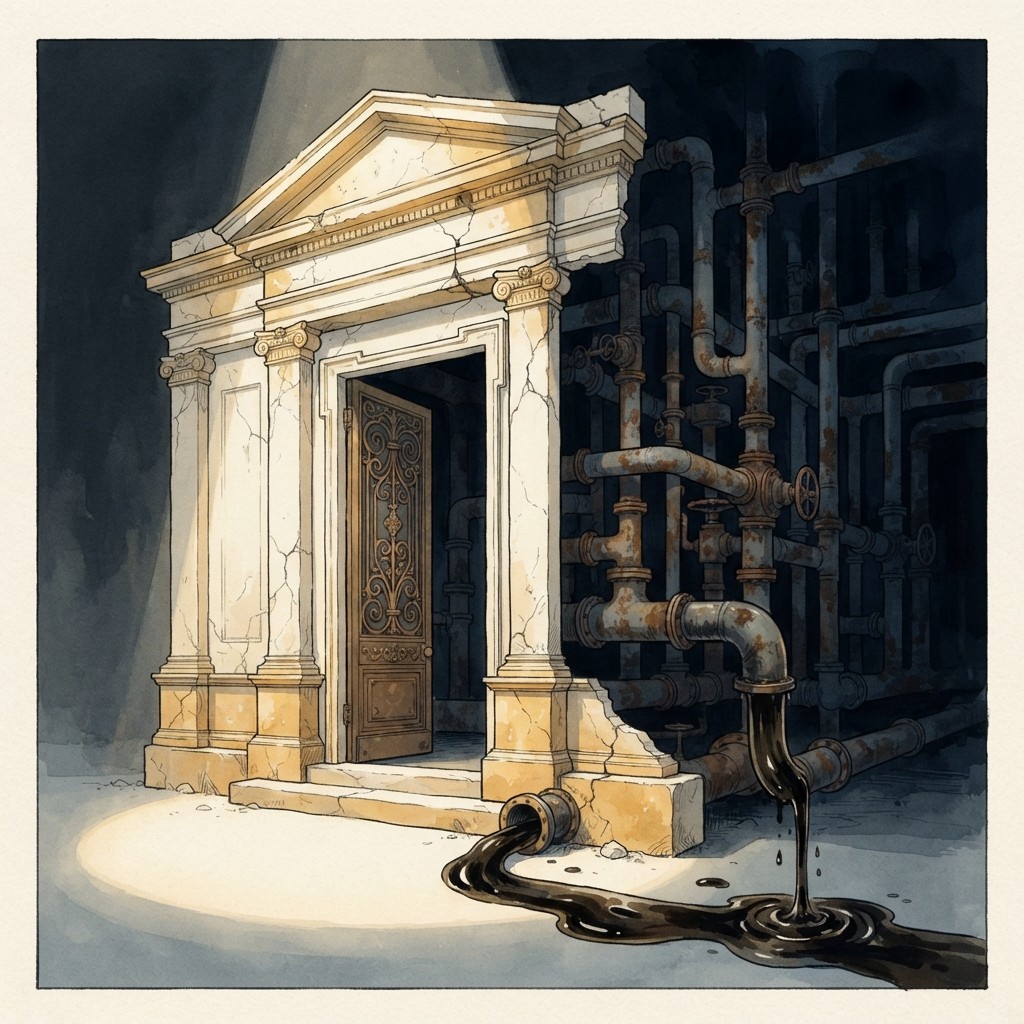
The thing to understand about Enron is that the accounting wasn't a one-time lie; it was a self-reinforcing loop. Special-purpose entities absorbed the assets that had soured and the debt Enron didn't want on its books. The Senate's investigators later mapped a roster of these vehicles - Fishtail, Bacchus, Sundance, Slapshot - and what they found was not aggressive accounting but engineering: inflated asset values, hidden Enron guarantees, sham third-party investments, even a fake $1 billion loan routed through major banks to manufacture phony tax deductions.8 The same structures inflated income on the way in and dodged tax on the way out. This is the part a single rule change could never have caught, because it wasn't an accounting choice. It was a fraud distributed across the auditor, the board, the banks, and the law firms.
Crucially, many of these partnerships were collateralized in part by Enron's own stock. That is the load-bearing detail. As long as the share price climbed, the structures held. The moment it fell, the collateral fell with it - and the losses the SPEs were built to hide came roaring back onto the parent. The hedge was the company hedging against itself. Enron's own 8-K filings began admitting the consequences: a single accounting error overstated notes receivable and shareholders' equity by roughly $172 million, and the Raptor partnerships could obligate Enron to issue common stock in exchange for notes receivable.4 A company promising to print shares to plug holes is a company already circling the drain.
“Arthur Andersen did not fulfill its professional responsibilities in connection with its audits of Enron's financial statements, or its obligation to bring to the attention of Enron's Board concerns about Enron's internal contracts over the related-party transactions.”7
Read that quote again and notice who said it: not a prosecutor, not a short-seller, but the committee Enron's own board hired. The auditor was supposed to be the outside check; instead Arthur Andersen signed the FY2000 10-K and waved through the related-party machinery.27 When the people paid to catch the fraud are the people enabling it, the rule on the page is irrelevant. The watchdog was inside the house.
Why the numbers looked spectacular right up to the end
The most disorienting fact about Enron is how healthy it looked. Its FY2000 filing reported natural gas and other products revenue of $50.5 billion, with total revenues near $100 billion across all segments.2 By the restated Q3 2001 filing, nine-month revenues had ballooned to $138.7 billion against $59.9 billion a year earlier - more than doubling.3 Trading-volume accounting let revenue explode even as cash quietly drained. The same filing carried the tell: Enron would not amend its 10-Ks for 1997 through 2000 until a special committee finished investigating.3 A company that won't stand behind four years of its own audited numbers is a company telling you the numbers were never real.
But wasn't mark-to-market the original sin?
The fair objection is that without aggressive mark-to-market, there'd have been no phantom profits to hide, so MTM really was the root. There's truth in it - MTM lit the fuse. But the steelman cuts the other way. Plenty of firms use fair-value accounting without collapsing, because honest MTM forces you to mark losses too. Enron's distinguishing move was building an off-balance-sheet apparatus precisely so it never had to recognize the downside. Tighten the MTM rules and a company determined to defraud simply books the optimistic value somewhere else and ships the losses to a partnership in the Caymans. The fraud was structural and circular - it needed a complicit auditor, an asleep board, and willing banks, and it had all three.78 No single accounting rule was ever going to stop a conspiracy that large. That's the uncomfortable lesson: the failure was governance, not arithmetic.
Aggressive revenue recognition is loud and easy to spot - everyone fixates on how a company books its gains. The real tell is quieter: where does it put the losses? A business that recognizes profit early but has nowhere honest to record the eventual disappointment will build somewhere dishonest. Enron's mark-to-market drew all the attention; the off-balance-sheet partnerships, collateralized by its own stock, did the killing. When a company's hedges are backed by its own shares, it isn't hedging risk - it's hiding it, and betting the share price never falls. It always does.
When the stock cracked, the math reversed all at once. The partnerships couldn't hold the losses they were built to absorb, the losses flooded back onto the parent, and on December 2, 2001 Enron filed for bankruptcy with $63.4 billion in assets.5 Roughly 4,000 people lost their jobs, and nearly two-thirds of 15,000 employees' retirement savings - parked in Enron stock bought at $83 at the start of that year - evaporated.5 Mark-to-market is what the textbooks blame, because a rule is easy to name and a culture is not. But the rule was never the rot. The rot was a company that learned to recognize the future and hide the present, watched over by everyone paid to stop it - and discovered, all in one quarter, that you cannot collateralize your lies with your own falling stock.
Disruption Vulnerability Assessment
An assessment that rates a company across the dimensions that predict disruption: how cheaply a challenger can serve the unsexy bottom of the market, how trapped you are by margins and a satisfied core. Blank to score your own position before the cliff; filled as the worked example showing where the story's incumbent was already exposed while the numbers still looked great.
Included, filled and blank, in the The Fall Casebook. See the set → · Preview the blank →
Sources
Where this comes from — the filings, records, and reporting behind it.
- 1The SEC approved mark-to-market accounting for Enron's natural gas futures contracts on January 30, 1992, per the U.S. Senate staff report on financial oversight of Enron.
- 2Enron Corp. 10-K for FY2000, filed with the SEC, shows consolidated revenues from 'Natural gas and other products' of $50,500 million for the year ended December 31, 2000, with total reported revenues reaching approximately $100 billion when all segments are included; the filing is signed by Arthur Andersen LLP on February 23, 2001.
- 3Enron's SEC-filed 10-Q for Q3 2001 (restated) shows nine-month revenues of $138,718 million versus $59,887 million for the same period in 2000, and discloses that Enron will not file amendments to its 10-K forms for 1997–2000 until the Special Committee investigation is complete.
- 4An Enron 8-K filed with the SEC discloses that a specific accounting error overstated notes receivable and shareholders' equity by approximately $172 million in Q2, Q3, and year-end 2000 financial statements, and that Enron entered into Raptor partnership contracts in Q1 2001 that could obligate it to issue common stock in exchange for notes receivable.
- 5Enron filed for Chapter 11 bankruptcy on December 2, 2001; at $63.4 billion in assets it was the largest corporate bankruptcy in U.S. history at that time, surpassed the following year by WorldCom; approximately 4,000 jobs were lost and nearly two-thirds of 15,000 employees' savings plans, which had been invested in Enron stock purchased at $83 at the start of 2001, became worthless.International Banker, The Enron Scandal (2001) ↗ · 2021-09-29
- 6Enron's stock price peaked at $90.75 per share on August 23, 2000, giving the company a market capitalization of approximately $70 billion and ranking it the seventh-largest publicly traded company in the United States.
- 7The Powers Committee — appointed by Enron's own board — found that Arthur Andersen 'did not fulfill its professional responsibilities in connection with its audits of Enron's financial statements, or its obligation to bring to the attention of Enron's Board concerns about Enron's internal contracts over the related-party transactions.'
- 8The Senate Permanent Subcommittee on Investigations detailed Enron transactions (Fishtail, Bacchus, Sundance, Slapshot) showing inflated asset values, hidden Enron guarantees, sham third-party investments, and a fake $1 billion loan facilitated by JPMorgan Chase and Citigroup to generate phony tax deductions; the SPEs were used both to inflate income and to dodge millions in tax liabilities.
More like this — beyond Enron
New Strategically analyses as they publish: the defining moves in business, checked against the record. No noise, and one click to leave.