Pairs with the Crisis Response Playbook — a ready-to-use strategy tool. Included in the The Crisis Response Casebook →
Three years after a jury convicted Arthur Andersen of obstruction of justice, the Supreme Court of the United States looked at the same case and ruled, nine to zero, that the conviction could not stand.2 The verdict that ended an 89-year-old firm13 and put 85,000 people out of work was thrown out for a flaw in how the jury had been told to think.5 By then it didn't matter. Andersen had already handed in its license to practice accounting, and a license you've surrendered does not come back because the law later agrees with you.5 The firm was acquitted of the crime it died for.
The story everyone remembers is clean: a crooked company, a corrupt auditor that shredded the evidence, swift justice, lessons learned. Almost every beam in that frame is bent. The auditor's conviction was erased. The villain-in-chief served most of his reduced sentence. And the accounting tricks that sank Enron weren't secret inventions—they were published rules that regulators and analysts had stared at for years and waved through.
What Enron actually built, and what it actually hid
Enron was a real company. Formed in 1985 when Kenneth Lay merged Houston Natural Gas with InterNorth, it became a genuine energy trader with real revenues moving through it.6 The fraud wasn't that the business was fake. It was in two accounting machines bolted onto a real business. The first was mark-to-market: book the projected lifetime profit of a long deal today, as if it had already arrived. The second was the special purpose entity—a separate legal vehicle you can park debt and bad assets in, and keep off your own balance sheet, so long as it clears a threshold of independent outside capital.6 Both were legal. Both were sanctioned by the rulebook. That is precisely what made them dangerous.
The SEC's own complaint against Enron's chief accounting officer lays out the mechanism in detail: off-balance-sheet entities—LJM Cayman and LJM2, run by CFO Andrew Fastow—used to manipulate the earnings the public saw, including the now-infamous 'Raptor' transactions.4 The partnerships were not hidden in a vault. Enron disclosed their existence in its filings—naming Fastow as manager and describing the transactions in its annual reports and quarterly filings.14 The crime was subtler and worse: the supposedly independent capital that let these vehicles stay off the books was, in part, controlled by Fastow himself—an auditor's nightmare wearing a regulator's blessing.
The Senate Permanent Subcommittee on Investigations later found that by the time Enron collapsed, it had pushed at least $27 billion—close to half its assets—into related entities to bury weak holdings and pump reported income.8 And here is the detail that breaks the tidy story: the same Senate panel found the board had been told, by Arthur Andersen, that Enron was using high-risk accounting.8 The watchdog hadn't simply failed to bark. It had described the danger out loud—and the system kept moving.
The thesis: a system failed, then chose a body
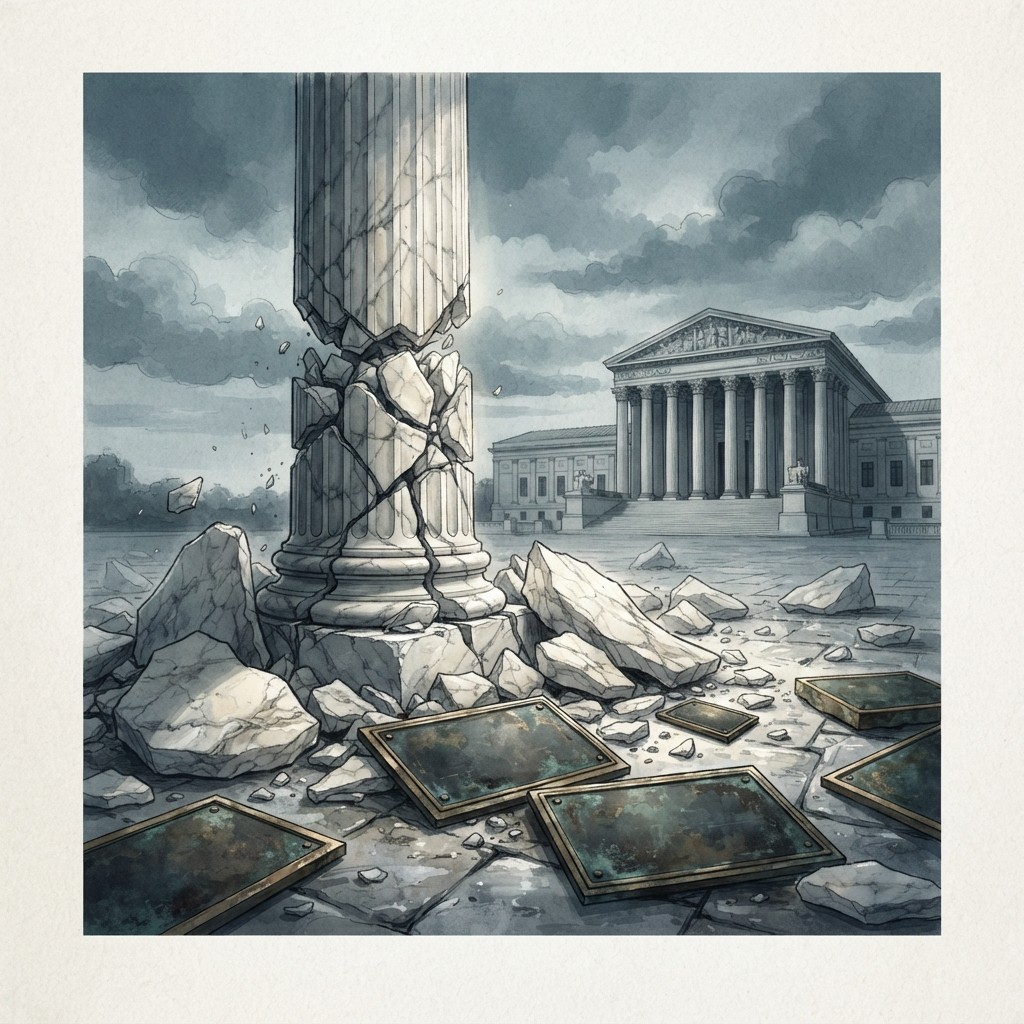
Here is the read worth arguing for. The Enron–Andersen collapse is taught as a morality play—bad actors, just punishment—when it was closer to a regulatory failure that needed a defendant. The rules that let Enron hide $27 billion were published rules. The conflicts were partly disclosed: Enron's board granted Fastow an ethics waiver acknowledging his dual role, though the SEC later charged company lawyers with failing to reveal the full extent of his personal earnings from the partnerships.15 The auditor warned the board. The fraud was real and individuals were guilty, but the structure that made the fraud possible was a regime everyone had agreed to live inside. When it detonated, the response wasn't to fix the regime first. It was to find a corpse the public could understand. Andersen became that corpse, and the criminal case against it turned out to be too thin to survive review.
“Following a document-retention policy, without knowledge of a pending proceeding, is not criminal; the jury instructions failed to require any finding that Andersen acted with consciousness of wrongdoing.”2
Look at the timing. On November 8, 2001, the SEC subpoenaed Andersen; the very same day, Enron filed a restatement that cut its earnings by $1.2 billion.5 Three weeks later the company filed for Chapter 11.1 Andersen was found guilty in June 2002 and surrendered its CPA license that August—and only in 2005 did the Supreme Court rule, unanimously, that the conviction had asked the wrong question of the jury.25 The institutional death was instant. The legal exoneration was glacial. By the time the law caught up, there was nothing left to exonerate.
| What people remember | What the record shows | |
|---|---|---|
| Andersen's guilt | Convicted, justly destroyed | Conviction overturned 9–0 in 2005[[cite:s2]] |
| Skilling's sentence | 24 years, served | Cut to 14 years via 2013 DOJ deal[[cite:s3]]; moved to halfway house 2018, released from custody February 2019[[cite:s10]] |
| The SPEs | Secret hidden inventions | Disclosed in filings; built on published rules[[cite:s4]] |
| Largest bankruptcy ever | Enron, forever | Surpassed by WorldCom a year later[[cite:s6]] |
| Andersen's first scandal | Enron | Waste Management cease-and-desist, June 2001[[cite:s7]] |
Andersen was already dying before Enron arrived
The cleanest evidence that this was a systemic rot, not a single rogue client, is that Enron was not Andersen's first body. In June 2001—months before Enron's name became a synonym for fraud—the SEC issued a cease-and-desist order against Andersen for its role in a $1.43 billion accounting fraud at Waste Management.7 The pattern was established before the marquee disaster. And the firm's largest catastrophe may not even have been Enron: WorldCom's 2002 collapse—also an Andersen audit11—surpassed Enron to become the largest corporate bankruptcy in U.S. history—relegating Enron, briefly the record-holder, to second place.6 The firm that 'Enron destroyed' was already failing across multiple clients. Enron was the trigger, not the disease.
Doesn't the punishment, however clumsy, fit the crime?
The honest objection is that none of this makes Enron's leadership innocent, and it doesn't. Fastow's self-dealing was real fraud. The earnings were manipulated. The restatement and the bankruptcy were not paperwork errors—they wiped out shareholders, pensions, jobs. A reader can fairly say: the law got the wrong technical answer on Andersen, but the firm had earned its end through Waste Management, Sunbeam12, and a culture of looking away. Fair. The point is not that everyone was blameless—it is that the official story confuses moral failure with the failure that actually mattered. The deepest lesson of Enron is not 'punish the auditor.' It is that a rule can be followed to the letter and still let a company hide half its assets, and that when the inevitable explosion comes, the instinct to find one villain is exactly what lets the broken structure survive intact. Skilling's sentence drifting from 24 years to 14 via a negotiated 2013 agreement3 is the same instinct in reverse: justice that bends to process long after the public narrative has hardened.
The Enron failure mode is the most dangerous kind because nothing in it is illegal until it suddenly is. The accounting was sanctioned. The conflicts were disclosed. The auditor told the board the accounting was high-risk—and the board, having been told, kept going. A documented warning that nobody is empowered to act on is not a control; it is a paper trail for the post-mortem. If a structure can pass every rule and still hide half a balance sheet, the rule is the exposure—and the moment to fix it is before there's a body to blame, not after. Crisis response that ends with a single defendant has usually mistaken catharsis for repair.
Andersen surrendered its license in August 2002. The Supreme Court cleared its name in May 2005. The gap between those two dates is the whole tragedy, and the whole lesson: a system that could not regulate Enron in time could still convict its auditor in time—and then discover, years later, that the conviction was wrong. Enron didn't just expose a fraud. It exposed how a market that has watched the danger coming will still reach, when the smoke clears, for the single throat it can most easily wring. The molecule of guilt was real. The justice built around it was the part that never quite held up.
When the official story doesn't survive the record
Crisis Response Playbook
A playbook for a crisis already in motion: who decides, which plays fire on which trigger, and what gets said to whom. It replaces panic and the all-hands meeting with a pre-agreed sequence each person can run alone. Blank to pre-load before a crisis hits; filled as the worked example reconstructing the plays the story's team ran — and the ones they should have.
Included, filled and blank, in the The Crisis Response Casebook. See the set → · Preview the blank →
Sources
Where this comes from — the filings, records, and reporting behind it.
- 1Enron Corp. filed for Chapter 11 bankruptcy on December 2, 2001 in the U.S. Bankruptcy Court for the Southern District of New York before Judge Arthur J. Gonzalez.
- 2Arthur Andersen LLP v. United States, 544 U.S. 696 (2005): the Supreme Court unanimously overturned Andersen's obstruction-of-justice conviction because jury instructions did not require the jury to find conscious wrongdoing ('knowingly … corruptly persuade'), and held that following a document-retention policy without knowledge of a pending proceeding is not criminal.
- 3In May 2013 the DOJ and Skilling entered an agreement to recommend a sentence of 168–210 months; Skilling was resentenced to 168 months (14 years) and forfeited approximately $42 million to Enron victims, waiving all further appeals.
- 4The SEC's complaint against Enron chief accounting officer Richard Causey details the use of off-balance-sheet SPEs—specifically LJM Cayman and LJM2 Co-Investment managed by CFO Andrew Fastow—to manipulate publicly reported earnings, including the 'Raptor' transactions.
- 5On November 8, 2001, the SEC served Andersen with a subpoena; that same day Enron filed an 8-K restatement reducing its earnings by $1.2 billion. On December 2, 2001, Enron filed for Chapter 11 bankruptcy—the largest corporate bankruptcy in U.S. history at the time. Andersen was found guilty of obstruction of justice on June 15, 2002; it surrendered its CPA license on August 31, 2002, and 85,000 employees lost their jobs.
- 6Enron's $63.4 billion in assets made it the largest corporate bankruptcy in U.S. history at the time; WorldCom's bankruptcy the following year surpassed it. Enron was formed in 1985 by Kenneth Lay after merging Houston Natural Gas and InterNorth. Executives used mark-to-market accounting, special purpose entities, and poor financial reporting to hide billions in debt.
- 7The SEC issued a cease-and-desist order against Andersen in June 2001 for its role in a $1.43 billion accounting fraud at Waste Management Inc., predating the Enron collapse and establishing a prior pattern of audit failures at the firm.
- 8The Senate Permanent Subcommittee on Investigations found that at the time of Enron's bankruptcy, Enron had moved at least $27 billion—nearly 50% of its assets—off-book to related entities to hide poorly performing assets and inflate income; the Board of Directors had been informed by Arthur Andersen that Enron was using high-risk accounting.
- 9Jeffrey Skilling was sentenced to 24 years and four months in prison on October 23, 2006, on conspiracy, securities fraud and other charges related to the collapse of Enron.
- 10Skilling was moved to a halfway house in August 2018 and released from federal custody on February 21, 2019, after serving approximately 12 years.
- 11Arthur Andersen was WorldCom's external auditor during the fraud period; the SEC highlighted Arthur Andersen's grossly inadequate auditing and found clear flaws in Andersen's audit approach that limited its likelihood of detecting accounting irregularities.International Banker, The WorldCom Scandal (2002) ↗ · 2021-09-29
- 12Arthur Andersen was Sunbeam Corporation's outside auditing firm; an Andersen partner failed to comply with GAAS in auditing Sunbeam's 1996 and 1997 financial statements, resulting in audit reports that incorrectly stated the financials conformed to GAAP.
- 13Arthur Andersen was founded in 1913; by 2001 it had become one of the world's largest accounting firms and one of the Big Five.
- 14Enron disclosed the LJM partnerships in its SEC filings—including its 1999 and 2000 annual reports and a 10-Q—describing them as sources of capital and counterparties managed by CFO Fastow, while the Board waived ethics rules to permit Fastow's dual role and directed controls be put in place.
- 15The SEC charged Enron's in-house lawyers with failing to disclose in the 2000 Proxy Statement the full monetary amount of Fastow's earnings from LJM1 and LJM2 (more than $18 million), showing that while the partnerships' existence was disclosed, key conflict details were omitted.
More like this — beyond Enron
New Strategically analyses as they publish: the defining moves in business, checked against the record. No noise, and one click to leave.