Pairs with the Standards-War Battle Map — a ready-to-use strategy tool. Included in the Standards War Casebook →
“What can you charge for your standard without losing the war to win it?”
Take apart an iPhone, slide its main chip under a scanning electron microscope, and look for the five nanometers. You won't find them. The transistors on what the industry calls a '5 nm' chip sit about 51 nanometers apart - more than ten times the number on the box.6 The label is not a lie exactly. It's something stranger: a marketing convention that the entire global electronics industry has agreed to treat as real, because one company in Hsinchu decided when each number arrives. That company is TSMC, and the deepest thing it manufactures isn't the chip. It's the calendar.
The official story is that TSMC wins because it has the best transistors - the densest, fastest, most efficient silicon on earth. That's true, and it's the least interesting thing about the company. The best transistors are a result. The weapon underneath is that TSMC sets the pace everyone else is measured against, and then arms the whole industry to design to that pace before its rivals can answer.
First it earned the right to set the clock
When TSMC was incorporated in 1987 - government development fund holding 48.3%, Philips 27.5%, the rest private Taiwanese money1 - it invented a business model that sounded almost humble: it would build nobody's chip designs, only manufacture other people's. The pure-play foundry.2 No products of its own to defend, no in-house design team competing with customers. That humility was the trick. By refusing to compete with the people who designed chips, TSMC made itself the one fab they could all trust with their crown jewels. Then it spent a decade proving it could keep up. Between 1987 and 1999 it advanced its process technology nine generations, from 2.0-micron features down to 0.18 micron - matching the pace of Moore's Law in lockstep.3 A foundry that merely takes orders cannot set a roadmap. A foundry that hits a new node every year and never misses can.
Then it handed everyone the tools to design to its calendar
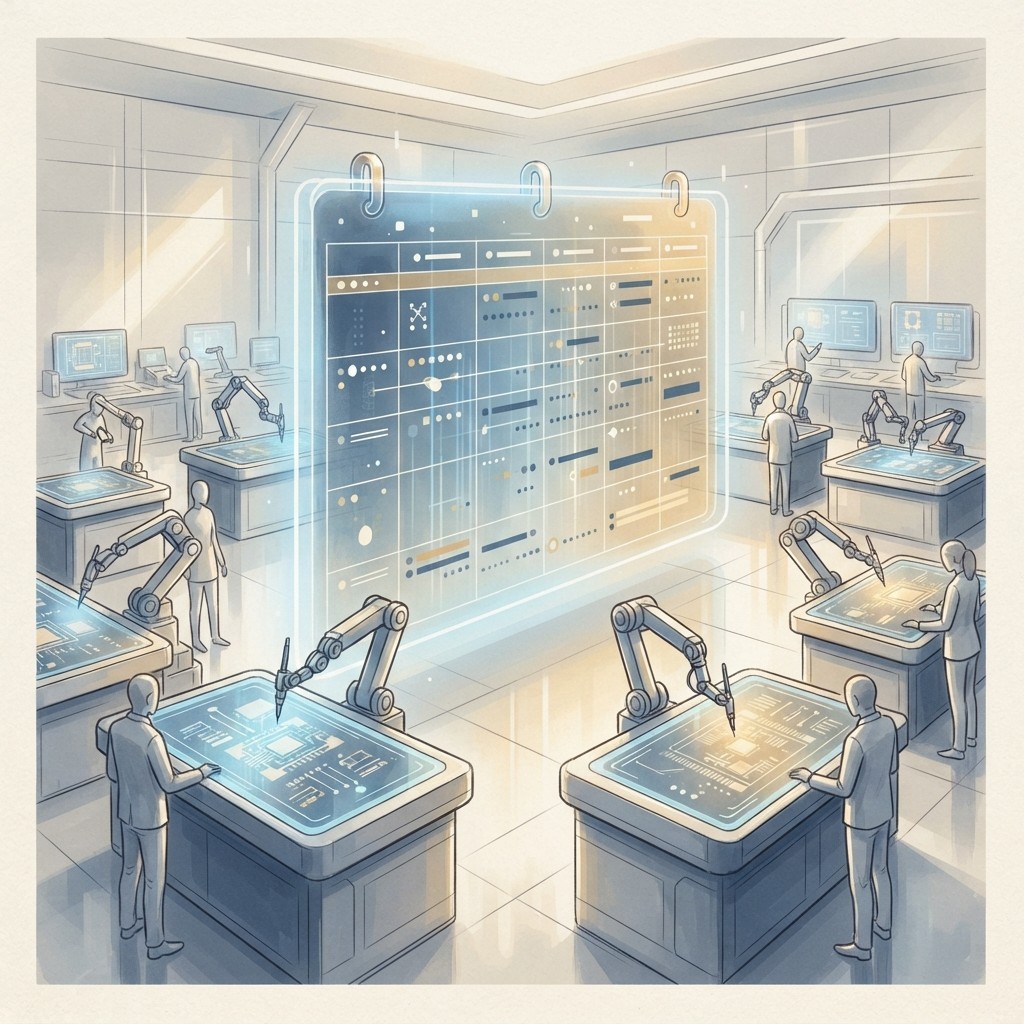
Here is the move that most coverage walks straight past. A new process node is useless to a chip designer until the design tools and the reusable building blocks - the EDA software, the verified IP libraries, the standard cells - all exist for that node. Historically those arrived late, scattered, and incompatible, so a leading-edge node could sit half-empty for a year while the ecosystem caught up. TSMC's answer was the Open Innovation Platform. Starting quietly at the 65 nm node and formally launched by Morris Chang in 2008, when 40 nm was the most advanced process on the market4, OIP did something deceptively simple: it pulled the EDA vendors and IP partners into co-development early in each node's life, so that design flows and critical IP were ready the moment the node ramped.5 The supply of manufacturing and the demand for designs were timed to land together. The effect was that TSMC's node schedule became the schedule the entire design world planned around.
Sit with the consequence. When you co-author the tools and the IP for your own cadence, every other foundry inherits a market already pointed at your clock. A designer who has built their flow, validated their IP, and trained their teams against TSMC's roadmap does not casually port to Samsung or Intel - the tools, the libraries, and the calendar are all bent toward Hsinchu. The standard isn't the silicon. The standard is the design environment, and TSMC writes the environment one node ahead of everyone trying to copy the node behind it.
| The popular read | The cadence read | |
|---|---|---|
| The asset | The best transistors | Owning the industry's design calendar |
| The mechanism | More R&D, better fabs | Co-built EDA + IP ready at node ramp |
| What a rival must beat | A process generation | An entire design ecosystem aimed elsewhere |
| Why it compounds | It doesn't, much | Every node deepens the lock |
In a standards war, the durable power is rarely the best version of the thing - it's owning the clock that everyone else has to keep. TSMC didn't just build a faster transistor; it made its own release schedule the calendar the whole industry designs to, then armed that industry with tools and IP timed to its nodes. The trap for challengers is that they're forced to win on a process generation while the incumbent is quietly winning on the ecosystem that surrounds every generation. If you can make your roadmap the market's roadmap, you stop competing on products and start competing on a clock only you can wind.
The number on the box stopped meaning anything - which is the point
Once you understand that the node name is a generational label rather than a physical measurement, the whole standards war comes into focus. The names stopped tracking real transistor dimensions around the 0.35-micron mark; '5 nm' describes a generation, not 5 nanometers of anything.6 So the question 'whose 7 nm is really better?' is partly a fight over branding, and TSMC won that fight by being the one whose names the market quotes. The proof is in the concentration of its lead. TSMC's global foundry share passed 60% in late 2023, and the advanced nodes - 7 nm and below - climbed from 67% of its own wafer revenue in that quarter to 74% by the end of 2024.7 The dominance isn't spread evenly; it's stacked at the leading edge, exactly where the cadence advantage bites hardest.
“TSMC pioneered the pure-play foundry business model when it was founded in 1987 and has been the world's leading dedicated semiconductor foundry ever since.”2
But isn't this just being good at making chips?
The fair objection is that the cadence story is too clever - that TSMC leads simply because it out-engineers and out-spends its rivals, and the ecosystem is a nice-to-have that follows from the lead rather than creating it. There's real weight here: you cannot set the industry's clock if you keep missing your own nodes, and TSMC's manufacturing execution is genuinely world-class. But the engineering-only read can't explain why the lead keeps compounding instead of being competed away. Intel has spent more on R&D in some years than TSMC and still found itself rebranding nodes to match TSMC's naming convention rather than dictating its own. Raw process skill alone wouldn't force that. What forces it is that the world's designers, tools, and IP are already calibrated to TSMC's calendar - so even a rival with comparable transistors arrives into a market pre-committed to someone else's schedule. The engineering is necessary. The cadence lock is what makes the engineering pay off twice.
And the clock keeps ticking forward on TSMC's terms. Its N2 node - the company's first to use gate-all-around transistors - was lined up for volume production in the second half of 2025, with a 1.6 nm node carrying backside power delivery slated for late 2026.8 Notice what those announcements really are: not just products, but dates the rest of the industry now has to plan against. TSMC will hand the EDA vendors and IP partners the tools to design for those nodes before its competitors have finished the last one. That's the whole machine. The transistors are the smallest thing TSMC builds. The largest is a calendar that everyone else agreed, one node at a time, to live by - and the genius was never the silicon. It was choosing to be the company that decides what time it is.
Standards-War Battle Map
A one-page canvas for a winner-take-most format war: who's fighting, which platforms and partners back each side, where the installed base sits today, and which forces will tip the market before it locks. Blank to map a standards fight you're entering; filled as the worked example charting the battle the story describes. Use it to spot which side has already won and which is still spending to lose.
Included, filled and blank, in the Standards War Casebook. See the set → · Preview the blank →
Sources
Where this comes from — the filings, records, and reporting behind it.
- 1TSMC was incorporated on February 21, 1987, in Hsinchu, Taiwan, with NT$1.3 billion (~US$45 million) in initial capital; the Taiwan government's Executive Yuan Development Fund held 48.3%, Philips 27.5%, and the remainder came from private Taiwanese investors.
- 2TSMC pioneered the pure-play foundry business model when it was founded in 1987 and has been the world's leading dedicated semiconductor foundry ever since — the company's own SEC filings use exactly this language.
- 3Between 1987 and 1999, TSMC advanced its process technology nine generations, from 2.0 µm to 0.18 µm nodes, matching Moore's Law pace in wafer fabrication — sourced from Morris Chang's autobiography as reported by CommonWealth Magazine.
- 4TSMC's Open Innovation Platform (OIP) was formally introduced to the world by founder Morris Chang in 2008, when 40 nm was the most advanced node on the market; OIP began at smaller scale at the 65 nm node.
- 5OIP actively collaborated with EDA and IP vendors early in each process life cycle to ensure design flows and critical IP were ready at node ramp, matching wafer demand with supply — effectively making TSMC's node cadence the industry's design calendar.
- 6Process node names have not corresponded to physical transistor dimensions since approximately 0.35 µm (350 nm); TSMC's own head of marketing Godfrey Cheng confirmed this publicly. The '5 nm' (N5) node has a contacted gate pitch of ~51 nm — more than 10× the marketed name — per SEM measurements of the Apple A15 chip.
- 7In Q4 2023, TSMC's global foundry market share exceeded 60%, with advanced technologies (7 nm and below) accounting for 67% of its own wafer revenue in that quarter, rising to 74% by Q4 2024 per TSMC's SEC filings.
- 8TSMC's N2 (2 nm) process technology — the company's first node using nanosheet/gate-all-around transistors — was on track for volume production in the second half of 2025, with A16 (1.6 nm, featuring backside power delivery) scheduled for volume production in the second half of 2026, per TSMC's own 2024 Annual Report.
More like this — beyond TSMC
New Strategically analyses as they publish: the defining moves in business, checked against the record. No noise, and one click to leave.