Pairs with the Reversal Readiness Checklist — a ready-to-use strategy tool. Included in the The Reversal Casebook →
On December 31, 2030, a piece of software that quietly runs the payroll, the supply chain, and the general ledger of an enormous slice of the global economy will stop receiving security patches.8 No new feature will break. The system will not switch off. It will simply become un-defendable - a building whose locks no one will fix anymore. That date is not a technical accident. It is the single most important strategic decision SAP has made in a decade, and it has nothing to do with the cloud being better. It has to do with making the alternative unsurvivable.
The official story is that SAP saw the future, embraced the cloud, and led its customers into it. The numbers seem to confirm a triumph: cloud revenue reached €17.14 billion in 2024, up 25%, while old-fashioned software licenses shrank to €1.40 billion, down 21%.4 But that is the result, not the method. SAP did not win this transition by persuasion. It won it by scheduling an end date for the software more than three in five of its customers were still running - and then renting them the bridge across.
The pivot is real - and slower than the press release
Start with what is genuinely true, because the financial case is strong and a fair reading has to concede it. SAP launched S/4HANA - its next-generation platform - on February 3, 2015, at the New York Stock Exchange, calling it the biggest product update in the company's history.1 For years it grew alongside the legacy business rather than replacing it. Then the curves crossed. Cloud revenue compounded - €13.664 billion in 2023, up 20% reported,3 then €17.14 billion in 2024.4 License revenue went the other way, falling 14% to €1.767 billion in 20233 and 21% to €1.40 billion in 2024.4 That is not a wobble. That is a business model dying on one side and being reborn on the other.
But notice the number that survives. License revenue is in freefall, and yet it is still €1.40 billion - because SAP never actually stopped selling on-premise software. S/4HANA remains available under perpetual licenses; ECC mainstream support, originally meant to end, was extended repeatedly — SAP set and then moved deadlines in 2017, 2019, and 2025 before finally landing at 2027, with paid maintenance available through 2030.108 The 'cloud-first overnight' narrative is the marketing. The reality is a company hedging carefully, keeping the legacy register open while it built the toll bridge customers would eventually have no choice but to cross.
| FY2023 | FY2024 | |
|---|---|---|
| Cloud revenue | €13.664B (+20%) | €17.14B (+25%) |
| Software licenses | €1.767B (−14%) | €1.40B (−21%) |
| Direction of travel | Crossover underway | Structural license decline |
The deadline is the product
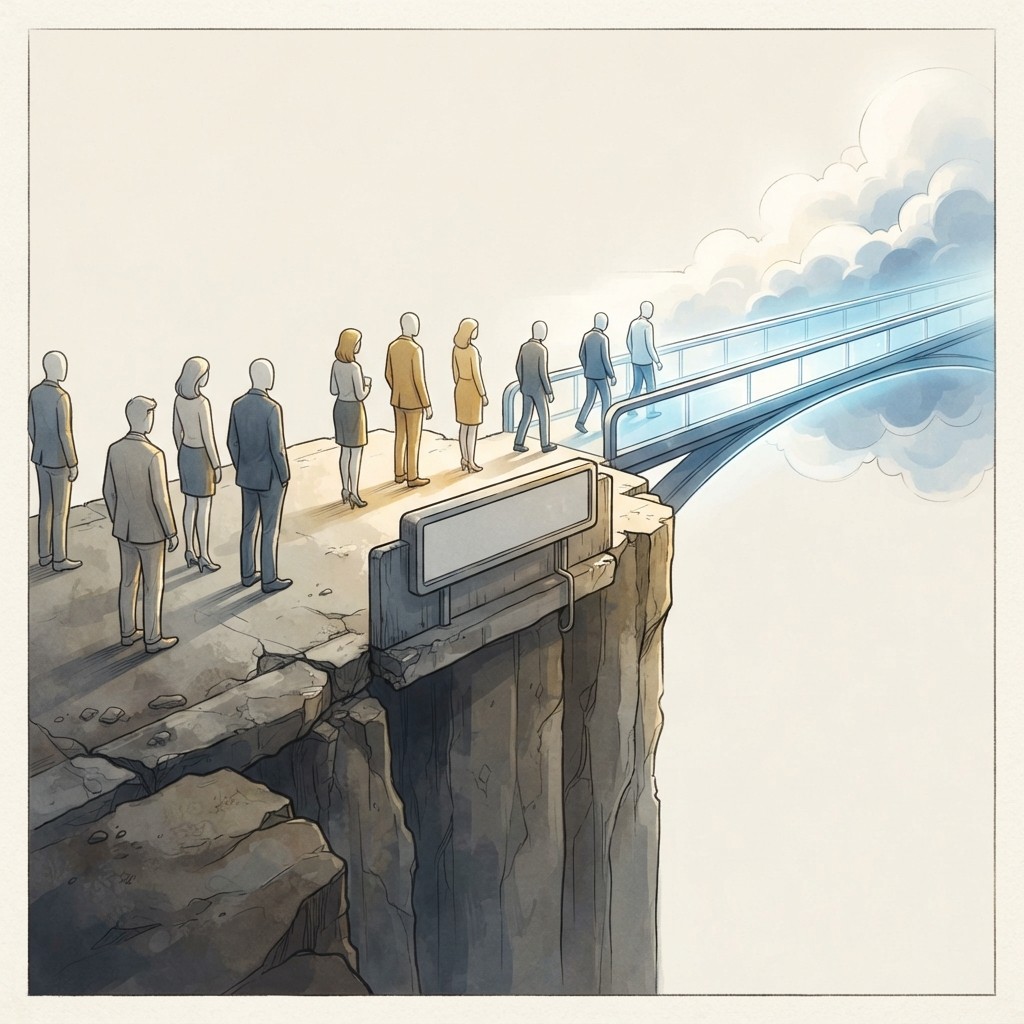
Here is the mechanism almost everyone misses. ERP software is the deepest switching-cost asset in enterprise technology. Once a company runs its finance and supply chain on SAP, ripping it out is a multi-year, eight-figure surgery on the organs of the business. That same depth that traps customers also traps the vendor: you cannot simply ask people to re-implement their entire backbone because you'd prefer a subscription. They will say no, for a decade, and keep paying maintenance on what already works. So SAP did the only thing that overcomes total inertia. It removed the option to stand still. After December 2030, running ECC means running un-patched software that handles your money - and running unpatched software that handles money creates security vulnerabilities, regulatory-compliance exposure, and insurability risks that most enterprises cannot absorb.8 The migration is not being sold on benefits. It is being enforced by a clock.
And RISE with SAP is the bridge across the chasm SAP itself dug. SAP announced it in January 2021 as 'business transformation as a service' - not a product, not a migration methodology, but a commercial bundle.2 The distinction matters more than it sounds: customers who treat RISE as a migration toolkit walk into serious difficulty, because it was never built to do the moving — independent studies find more than 60% of SAP migrations run over budget or schedule even with purpose-built tools.11 It was built to package the destination. The deadline creates the demand; RISE monetizes it; the recurring subscription replaces the one-time license that was dying anyway. The whole architecture is a single move seen from three angles.
“RISE with SAP: business transformation as a service.”2
What the victory cost, in people
A forced march has casualties, and SAP's were internal. In January 2024 the company announced a restructuring affecting roughly 8,000 positions, with preliminary costs around €2 billion, promising that voluntary leave and re-skilling would keep net headcount flat.5 By the third quarter, the scope had quietly swelled to 9,000–10,000 positions and the bill to about €3 billion - fifty percent over the original estimate - because more people took the voluntary exit than anyone modeled.6 When your own staff sprint for the door faster than your forecast, that is not a re-skilling program. That is an exodus. Employee engagement, by SAP's own projection, slid to 70–74%, down from a floor that had been around 80%.6
Then came the part that revealed how SAP now thinks about its own workforce. The one-time restructuring hardened into a permanent policy - 'continuous optimization,' annual cuts of roughly 1–2% of a workforce north of 100,000. The CFO described these recurring reductions as 'like brushing your teeth.'7 It is a chillingly honest image. The transformation that looks so clean in the revenue line was, inside the building, a machine that learned to shed people on a schedule.
Isn't a successful pivot just a successful pivot?
The fair objection is that this is sour grapes dressed as analysis. SAP read the future correctly, executed a genuinely hard transition, and the cloud line proves it - 25% growth three years running is not coercion, it is product-market fit. Fine. But two facts cut against the heroic version. First, the pace: Gartner projects that only about half of ECC customers will have migrated by 2027 — with roughly 17,000 of the original 35,000 still on legacy or extended-support software at the very deadline SAP set,9 meaning the majority of the installed base will still be on legacy or extended-support software at the very deadline SAP set - hardly the picture of customers eagerly choosing a better mousetrap. Second, the method: when a transition needs a hard end-of-support date to overcome customer reluctance, the demand it generates is captive, not won. SAP earns the revenue either way. But 'we built something customers chose' and 'we scheduled the obsolescence of what they already had' are different claims, and only the second one explains why the numbers move on SAP's timetable rather than its customers'.
The hardest businesses to transition are the ones with the deepest switching costs - the same moat that protects you also freezes your customers in place. Persuasion fails against total inertia; a feature comparison loses to 'but it already works.' The move that breaks the logjam is to remove the status quo as an option: set a date the old thing stops being safe to run, then sell the bridge across. It works - SAP's cloud line is the proof. But know what you're doing. Captive demand is not the same as a beloved product, the march will be slower than your press release, and the people who built the thing you're sunsetting often leave before you're ready. A deadline can manufacture revenue. It cannot manufacture enthusiasm - inside the company or out.
SAP's cloud transformation is real, and it is winning, and both of those things are true precisely because SAP never trusted the transformation to win on its own. It kept the old software for sale, extended its life again and again to soften the panic, and then drew a hard line in 2030 past which standing still becomes negligence. The genius was not a better product. It was understanding that when you own the foundation a company is built on, you do not have to convince anyone to renovate. You simply announce the day the roof stops being repaired - and let the calendar do the selling.
When a company changes its whole model in public
Reversal Readiness Checklist
Reversing a public commitment is the hardest decision a leader makes — and the easiest to botch by doing it too late or too messily. This checklist gates the U-turn: is the evidence in, is the old logic genuinely dead, can you absorb the credibility hit, and is the new path actually ready. Blank, it keeps you from flip-flopping on a whim; filled, it scores the story's reversal against what a clean one demands.
Included, filled and blank, in the The Reversal Casebook. See the set → · Preview the blank →
Sources
Where this comes from — the filings, records, and reporting behind it.
- 1SAP S/4HANA was officially launched on February 3, 2015, at the New York Stock Exchange — described internally as 'the biggest product update in the company's history.'
- 2RISE with SAP was announced in January 2021 as 'business transformation as a service,' not as a new product or a migration methodology.
- 3SAP FY2023: cloud revenue €13.664 billion (+20% reported, +23% constant currency); SAP S/4HANA Cloud revenue €3.495 billion (+67%); software licenses €1.767 billion (−14%); current cloud backlog €13.7 billion (+25%).
- 4SAP FY2024: full-year cloud revenue €17.14 billion (+25%); software licenses revenue down 21% to €1.40 billion — confirming structural license revenue decline.
- 5In January 2024 SAP announced a restructuring affecting approximately 8,000 positions, with preliminary restructuring expenses of ~€2 billion; the majority was to be covered by voluntary leave and re-skilling, with net headcount expected to remain flat.
- 6By Q3 2024, SAP disclosed the restructuring scope had expanded to 9,000–10,000 positions and total program cost to approximately €3 billion — up 50% from the January 2024 estimate — driven by stronger voluntary-leave uptake. Employee engagement fell to a projected 70–74%, down from a prior floor of ~80%.
- 7SAP shifted from a one-time restructuring to a permanent 'continuous optimization' policy of annual cuts of roughly 1–2% of its ~100,000-plus global workforce; CFO Dominik Asam described the annual reductions as 'like brushing your teeth.'
- 8SAP ECC mainstream support ends December 2027; paid extended maintenance is available through December 2030. After 2030, no security updates, patches, or technical support will be provided — creating the coercive migration deadline.
- 9At the end of 2024, only 39%, or about 14,000, of the 35,000 SAP ECC customers had migrated to S/4HANA according to Gartner; at the current rate of migration, Gartner projects there will still be roughly 17,000 holdouts — nearly half the ECC customer base — by 2027.
- 10SAP has established and then rearranged end-of-support deadlines multiple times since 2010, including dates set for 2017, 2019, and 2025, before the current 2027 mainstream-support end date was confirmed in 2020.
- 11A 2026 ISG study of 200 senior decision-makers found close to 60% of SAP migrations fell behind schedule and budget; separately, the Horváth study found more than 60% of migrations deviated significantly from planned budget, schedule, or quality targets, with only 8% finishing on schedule.
More like this — beyond SAP
New Strategically analyses as they publish: the defining moves in business, checked against the record. No noise, and one click to leave.