Pairs with the Adjacency / Synergy Map — a ready-to-use strategy tool, filled for SAP. Included in the The Adjacency Expansion Casebook →
On a Saturday in December 2011, SAP agreed to pay $40.00 a share for a company whose stock had closed the previous day around $26 — a 52% premium for a cloud HR firm called SuccessFactors, worth roughly $3.4 billion in enterprise value.3 Five months later it paid a 20% premium for Ariba, an e-procurement network.4 Two years after that, another 20% premium for Concur, the travel-and-expense company, at about $8.3 billion.5 Three deals, over $16 billion, every one done above the asking price the market had set. SAP wasn't bargain-hunting. It was paying whatever it took.
The official story is that this was a cloud strategy — a deliberate march into adjacent enterprise software. It was really a confession. SAP had built the most entrenched on-premise business software on earth and discovered, around 2010, that the same dominance gave it almost no head start in the cloud. So it stopped building and started buying. The premiums weren't a strategic flourish. They were the toll an incumbent pays when its moat doesn't extend into the next territory.
For forty years, SAP expanded by building
Five IBM engineers founded SAP in 1972 to write standard enterprise software for real-time data processing.1 What followed was textbook organic adjacency. The first product handled financial accounting. Then R/2, in 1979, pushed into materials management and production planning. Then R/3, in 1992, established the client-server ERP standard that the world's large companies ran their operations on.8 Each step was a logical extension built in-house, and each one reinforced the same moat: once a company runs its accounting, inventory, and production on SAP, ripping it out is unthinkable. By 2003 the company was so global it employed more people outside Germany than inside it — 17,000 to 13,000.8 For four decades, the pattern was invent, install, lock in, repeat.
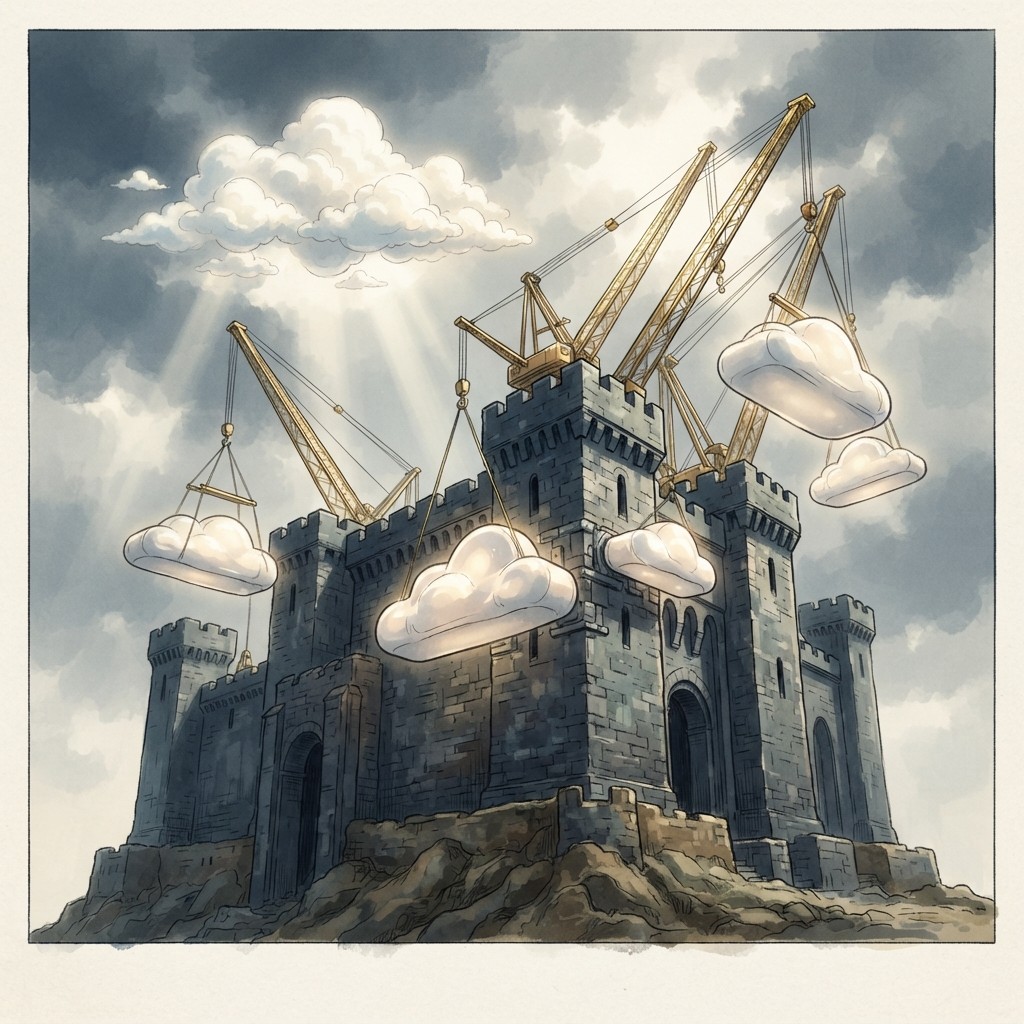
Then the ground moved. Software stopped being something you bought and installed and became something you rented over the internet. The new entrants — SuccessFactors in HR, Ariba in procurement, Concur in expenses — were born in the cloud, sold by subscription, and updated continuously. SAP's great strength, the deep on-premise installation, was suddenly the thing customers wanted to escape. The moat held the existing castle perfectly. It just didn't reach the new land.
Why the incumbent had to buy instead of build
Here is the mechanism most coverage skips. SAP's incumbency was a moat with a ceiling. The same architecture, sales motion, and on-premise mindset that made it dominant also made it slow to ship cloud-native products customers would actually switch to — and in a subscription market, the company that signs the contract first holds the customer for years. SAP couldn't out-build firms that had a half-decade head start and no legacy code to drag along. It could only out-spend them. A 52% premium for SuccessFactors isn't a price for a company; it's a price for time SAP could not manufacture itself. Buying the market leader was the only way to arrive in the adjacency already at scale rather than years behind.
| 1972–1992: organic | 2011–2014: acquired | |
|---|---|---|
| How it entered new turf | Built it (R/2, R/3) | Bought it (SuccessFactors, Ariba, Concur) |
| What incumbency provided | A foundation to build on | No usable head start |
| The cost of entry | R&D and time | Over $16 billion, at premiums |
| Premium paid over market | — | 52% / 20% / 20% |
Notice the language of the deals. SuccessFactors was bought to 'accelerate' the cloud strategy.3 Concur was framed as expanding the 'world's largest business network.'5 Acceleration is the word you use when you're behind. The pattern across all three is the same: not a company entering an adjacency from a position of strength, but one closing a gap with its checkbook because the clock was running and the moat wouldn't carry it across.
But it worked — so wasn't the premium worth it?
The fair objection is that this critique is sour about a strategy that plainly succeeded. Look at the numbers: in FY2024 SAP reported €34.18 billion in total revenue, with cloud revenue of €17.14 billion, up 25%, and a total cloud backlog of €63.3 billion.6 The cloud, which barely existed for SAP in 2010, is now its growth engine — and the year before, FY2023 cloud revenue had already grown 20% on a €13.7 billion current backlog.7 If overpaying by a few billion in 2011–2014 bought a business now generating €17 billion a year, that is one of the better trades in enterprise software. Premiums look expensive only until the asset compounds.
True — and it concedes the real point rather than refuting it. The cloud business is real and large, but SAP did not grow it from its ERP roots the way it grew R/2 and R/3 from financial accounting. It purchased it, fully formed, from companies that did the building. The premium proves the thesis instead of disproving it: an incumbent that could have extended its own moat into the cloud would not have needed to pay 52% over market to rent someone else's. Success at the cash register doesn't change where the engine was made. SAP's ERP dominance was a fortress, not a launch pad — and the bill for that distinction came to over $16 billion.
Incumbents love to believe their core strength is a springboard into adjacent markets. Sometimes it is. But the SAP pattern is the more common one: the very assets that make you dominant in the old game — deep installations, a legacy architecture, an enterprise sales motion built for big upfront deals — become dead weight when the rules change to subscription, cloud-native, continuous. When that happens, the honest question isn't 'how do we leverage our position?' It's 'can we build this fast enough, or do we have to buy it?' If the answer is buy, expect to pay a premium — because you're not purchasing a company, you're purchasing the time your moat couldn't give you. The danger is mistaking that premium for a strategic masterstroke. It's a measure of how far your moat fell short.
SAP spent its first forty years proving that a great enterprise platform expands by building outward from its core. It spent three years from 2011 to 2014 proving the limit of that idea. When the market shifted to the cloud, the most entrenched business software company on earth discovered that entrenchment doesn't travel. So it wrote checks — 52%, 20%, 20% over market — and bought the future it couldn't ship. The cloud revenue is real today. But the lesson is sharper than the success: incumbency is a wall, and a wall is wonderful for defending what you have and nearly useless for reaching what's next. SAP learned the difference at over $16 billion, premiums included.
Adjacency / Synergy Map
A one-page canvas for an adjacency play: the new business next door, the shared assets that justify entering it, the synergies that actually transfer versus the ones that evaporate on contact, and the dis-synergies nobody put on the deck. Blank to test your own expansion; filled as the worked example showing where the story's 'natural adjacency' was real and where it was wishful.
Included, filled and blank, in the The Adjacency Expansion Casebook. See the set → · Preview the blank →
Sources
Where this comes from — the filings, records, and reporting behind it.
- 1SAP was founded on April 1, 1972, by five former IBM employees—Dietmar Hopp, Hasso Plattner, Claus Wellenreuther, Klaus Tschira, and Hans-Werner Hector—as Systemanalyse Programmentwicklung, initially headquartered in Weinheim, Germany, with the goal of creating standard enterprise software for real-time data processing.
- 2SAP AG became a public company on November 4, 1988, with shares listed on the Frankfurt and Stuttgart stock exchanges; SAP was added to the DAX in 1995.Wikipedia, SAP ↗ · 2025
- 3On December 3, 2011, SAP AG announced it would acquire SuccessFactors for $40.00 per share in cash, representing an enterprise value of approximately $3.4 billion—a 52% premium over the December 2 closing price—to accelerate its cloud strategy in human capital management.
- 4On May 22, 2012, SAP America entered into an agreement to acquire Ariba for $45 per share, representing an enterprise value of approximately $4.3 billion (a 20% premium over the May 21 closing price), funded from SAP's free cash and a €2.4 billion term loan. The deal closed October 1, 2012 at $4.4 billion.
- 5On September 18, 2014, SAP SE announced it would acquire Concur Technologies for $129 per share, representing an enterprise value of approximately $8.3 billion (a 20% premium over the September 17 closing price), to expand its business network into corporate travel and expense management.
- 6For full-year 2024, SAP reported total revenue of €34.18 billion (up 10% YoY) with cloud revenue of €17.14 billion (up 25% YoY); current cloud backlog reached €18.1 billion (up 32%) and total cloud backlog reached €63.3 billion (up 43%).
- 7SAP's cloud revenue for FY2023 grew 20% (23% at constant currencies); current cloud backlog at year-end 2023 was €13.7 billion (up 25%). These figures are from SAP's own SEC-filed quarterly statement for Q4/FY2023.
- 8SAP launched SAP R/2 in 1979, expanding beyond financial accounting into materials management and production planning; SAP R/3 was released in 1992, establishing a client-server ERP standard; by 2003 SAP employed more people outside Germany than within it (17,000 vs 13,000).
More like this — beyond SAP
New Strategically analyses as they publish: the defining moves in business, checked against the record. No noise, and one click to leave.