Pairs with the Pricing Power Diagnostic — a ready-to-use strategy tool, filled for Alphabet (Google). Included in the The Hidden Price Casebook →
Open Safari on a brand-new iPhone, type a question, and the answer comes from Google. You never chose that. Apple did - and Apple was paid handsomely to choose it. In 2022, Alphabet paid Apple $20 billion for the privilege of being the search box that appears before anyone decides to want it.1 Not for ads. Not for a feature. For a setting. The single most valuable real estate in technology is the default, and Google rents the most important one in the world from a company that builds no search engine at all.
The official story is that this is a partnership - two giants splitting the spoils of mobile search. The real story, written into a federal court record, is that it is a $20-billion-a-year insurance premium against a competitor that doesn't exist yet, paid to the one company capable of creating one overnight. And the strangest part is what a judge did with it: he called the whole arrangement an illegal monopoly, and then let the payments continue.
The price of a setting nobody changes
Why would anyone pay $20 billion a year for a default that a user can change in three taps? Because almost no one does. The default is not a suggestion - it is the path of least resistance multiplied by a billion phones, and inertia at that scale is worth more than any feature. Google isn't buying better search results. It's buying the absence of a moment where the user pauses and reconsiders. Apple, for its part, isn't building a search engine; it's selling the most attention-rich starting line on earth and letting Google bid for the lane. The genius of the arrangement is that it began almost as an afterthought: trial testimony from Google's own witness established that the original Apple default deal, struck in 2002, involved no money changing hands at all.8 The cash came later - once both sides understood exactly how much a default was worth. By 2022 it was worth twenty billion dollars, and 36% of every dollar Google earned from Safari searches flowed straight back to Apple.3
| Google pays | Apple receives | |
|---|---|---|
| What changes hands | $20B (2022) + 36% of Safari search revenue | Pure margin - no engine to build or run |
| What it's really for | Inertia: the query nobody re-routes | Rent on the starting line of mobile search |
| The risk being insured | A rival default appearing on iPhones | — |
| What it costs to make a substitute | Years and a search index | A single line in iOS settings |
The proof of monopoly and the price of it are the same line item
Here is the trap Google built for itself. The payment is the clearest possible evidence that search is not won on merit. If Google genuinely believed Apple's users would choose Google anyway, it would never pay $20 billion to lock the choice. The size of the check is a confession: the company is buying the outcome it claims would happen naturally. That is precisely how the court read it. In August 2024, Judge Mehta ruled that 'Google is a monopolist, and it has acted as one to maintain its monopoly,' in violation of Section 2 of the Sherman Act - and the default-placement payments were central to how he found that monopoly was maintained.2 The thing that made Google money was the same thing that proved its guilt. You cannot deduct a $20 billion line item from your defense and call it a partnership.
“Google is a monopolist, and it has acted as one to maintain its monopoly.”2
The remedy that solved nothing
You'd expect the cure to be obvious: ban the payment, break the default, let search compete on its results. The DOJ asked for exactly that. The court said no. In its September 2025 remedies order, the court explicitly permitted Google to keep paying for default placement - on two conditions: the payments cannot be conditioned on exclusivity, and contracts are capped at one year.4 A full payment ban was rejected as posing too much risk of harm to Apple and other distributors who lean on that income.4 Then in April 2026, the court did prohibit Google from entering or maintaining exclusive contracts across Search, Chrome, Assistant, and Gemini, and ordered it to share search data with rivals.5 But notice what survived: the money. Google can still pay. It just can't lock the door. The remedy stripped the exclusivity and left the check intact - which means the relationship now gets renegotiated, in public, every single year.
An annual, non-exclusive, publicly scrutinized renegotiation is a worse position than it sounds. Exclusivity was the wall; remove it and Apple is free to entertain other bidders - or to build a default of its own and charge Google to displace it. Every twelve months, Google must re-purchase a setting it once owned for a decade at a stretch. The DOJ and several states, unsatisfied, appealed in 2026 precisely because the payments were not banned and Chrome was not divested.6 Both sides are now exposed to a slow-motion bidding war over the one piece of digital real estate Google cannot afford to lose.
Isn't a court the real threat here?
The fair objection is that the antitrust case is the danger, and that Google, having kept the payment alive, dodged the bullet. It's a reasonable read - and it misses where the gun actually points. Courts move in years and produce remedies that preserve the status quo more often than they shatter it; the September 2025 order is itself proof, leaving the cash flow intact. The real threat is structural and faster: AI is quietly changing what a 'default search' even means. When the box on the phone answers the question directly instead of routing to a results page, the default's value isn't transferred - it evaporates. Apple does not need to switch the default to a rival search engine to wound Google. It needs only to put an assistant in front of it, so the query is answered before it ever becomes a search. That is the diversion no antitrust remedy addresses, because it isn't a contract term - it's a change in the shape of the question. The court can cap the contract at one year. It cannot guarantee there will still be searches worth paying twenty billion dollars to capture.
The most dangerous line item on a balance sheet is the one you pay to suppress a choice. It looks like a moat and behaves like one - until a regulator, a partner, or a technology shift forces the choice back into the open, and now you're paying full price for something everyone can see you can't live without. Google's $20 billion bought inertia, and inertia is durable right up until the moment the underlying behavior changes. A default is only worth defending while the thing it defaults to is the thing people still want. The check Google writes to Apple is simultaneously its strongest distribution asset and a public estimate of exactly how much it would lose if Apple ever said no. Guard the choke point - but never forget that the size of the toll you pay is a map to your own throat.
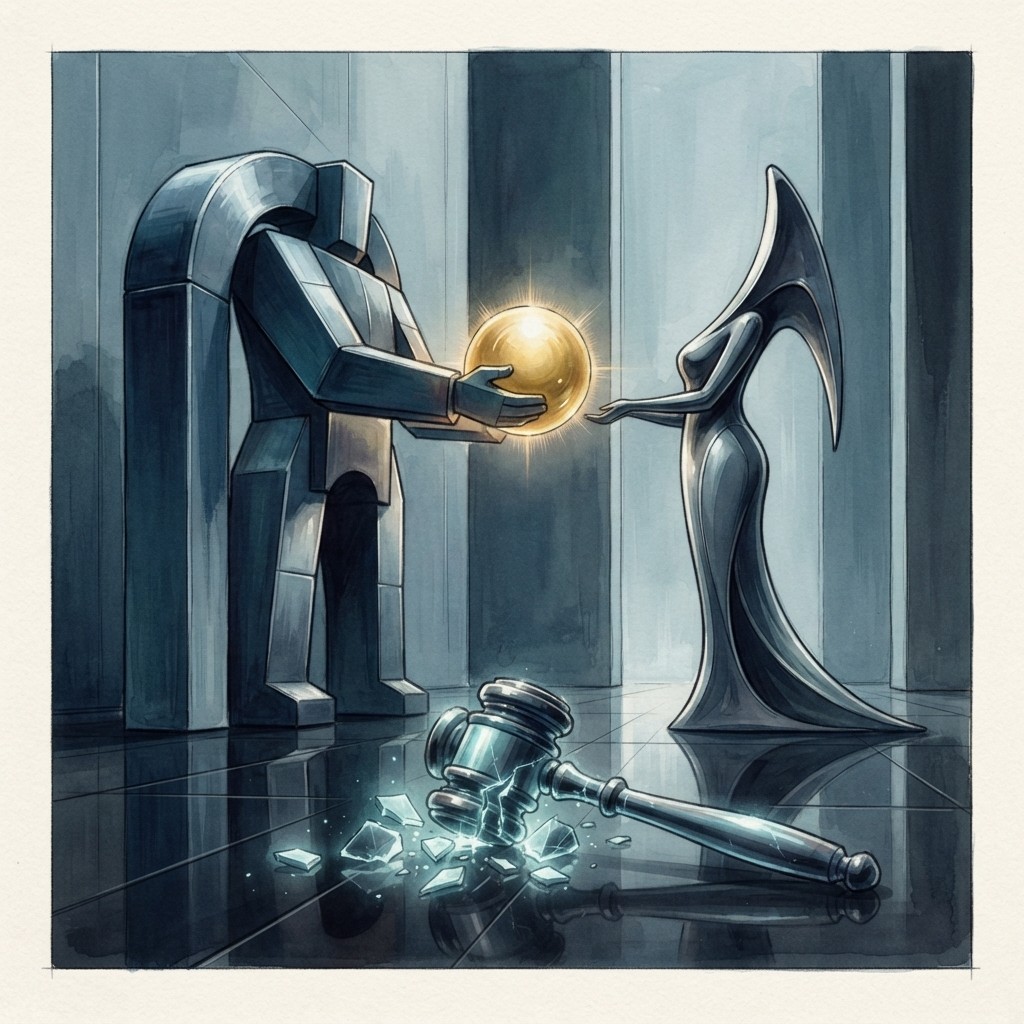
For two decades Google solved distribution by buying the only setting that mattered, and for two decades it worked so well that the company stopped having to win the choice - it just rented the absence of one. The court's verdict didn't take that away. It did something quieter and more dangerous: it turned a permanent arrangement into an annual auction, and handed the gavel to a partner who could, with a single software update, decide there's nothing left worth bidding on. Google didn't buy search dominance. It bought the moment before the question - and that moment is the first thing AI is coming for.
Pricing Power Diagnostic
A scored diagnostic of pricing power: brand pull, switching costs, substitutes, and how critical the product is to the buyer. Each dimension rated 1-5 so you can see, at a glance, whether a price rise sticks or sends customers running. Blank to grade your own offer; filled as the worked example scoring a story's business on its real ability to charge more.
Included, filled and blank, in the The Hidden Price Casebook. See the set → · Preview the blank →
Sources
Where this comes from — the filings, records, and reporting behind it.
- 1Alphabet paid Apple $20 billion in 2022 for Google to be the default search engine in Safari, as confirmed by Apple SVP Eddy Cue in unsealed court documents filed May 2024.
- 2Judge Mehta ruled on August 5, 2024 that 'Google is a monopolist, and it has acted as one to maintain its monopoly' in violation of Section 2 of the Sherman Act, in a 277-page opinion following a nine-week bench trial.
- 3Sundar Pichai confirmed under cross-examination at the Epic antitrust trial that Alphabet pays Apple 36% of its Safari search revenue; the figure was first accidentally disclosed by Google's own expert witness Kevin Murphy.
- 4Judge Mehta's September 2, 2025 remedies order permits Google to pay distributors for default placement as long as payments are not conditioned on exclusivity and agreements are capped at one year; it rejected the DOJ's proposed full payment ban.
- 5The DOJ won significant remedies on April 14–15, 2026: the court prohibited Google from entering or maintaining exclusive contracts for Google Search, Chrome, Google Assistant, and Gemini, and mandated search data sharing with rivals.
- 6The DOJ and state attorneys general filed notices of appeal in April 2026, challenging the remedies ruling for declining to ban default payments outright or divest Chrome, with D.C. Circuit arguments expected later in 2026.
- 7Alphabet's 10-K defines TAC as 'amounts paid to our distribution partners who make available our search access points and services,' including browser providers, mobile carriers, OEMs, and software developers; the specific Apple payment amount is not broken out in SEC filings.
- 8The Apple-Google default search agreement was first formed in 2002 with no exchange of money, according to trial testimony from Google's own witness Joanna Braddi; revenue sharing was added upon later renegotiation.
More like this — beyond Alphabet (Google)
New Strategically analyses as they publish: the defining moves in business, checked against the record. No noise, and one click to leave.