Pairs with the Pricing Power Diagnostic — a ready-to-use strategy tool. Included in the The Operating Model Casebook →
A new dress design lands on Shein's site, and the factory behind it makes almost none of them. Fifty units. Maybe a hundred. They go up, and the system watches: who clicks, who carts, who buys, in which size, in which country, at what hour. If the data sings, the order to make more goes back down the line and the dress scales overnight. If it dies, it quietly disappears, and Shein has lost the cost of a few dozen garments instead of a warehouse full.12 That is the whole machine. Not cheap hands stitching faster. A factory that refuses to guess.
The official story is that Shein is a tariff-arbitrage play—cheap Chinese goods that slip into America duty-free under a loophole, and a house of cards that collapses the moment the loophole closes. That story is comforting to its competitors and wrong about the load-bearing wall. The cheapness isn't smuggled in at the border. It's manufactured upstream, in inventory that never gets built.
“Our business model, focused on creating an on-demand production approach…is what drives our growth.”1
Traditional fashion bets first and learns last
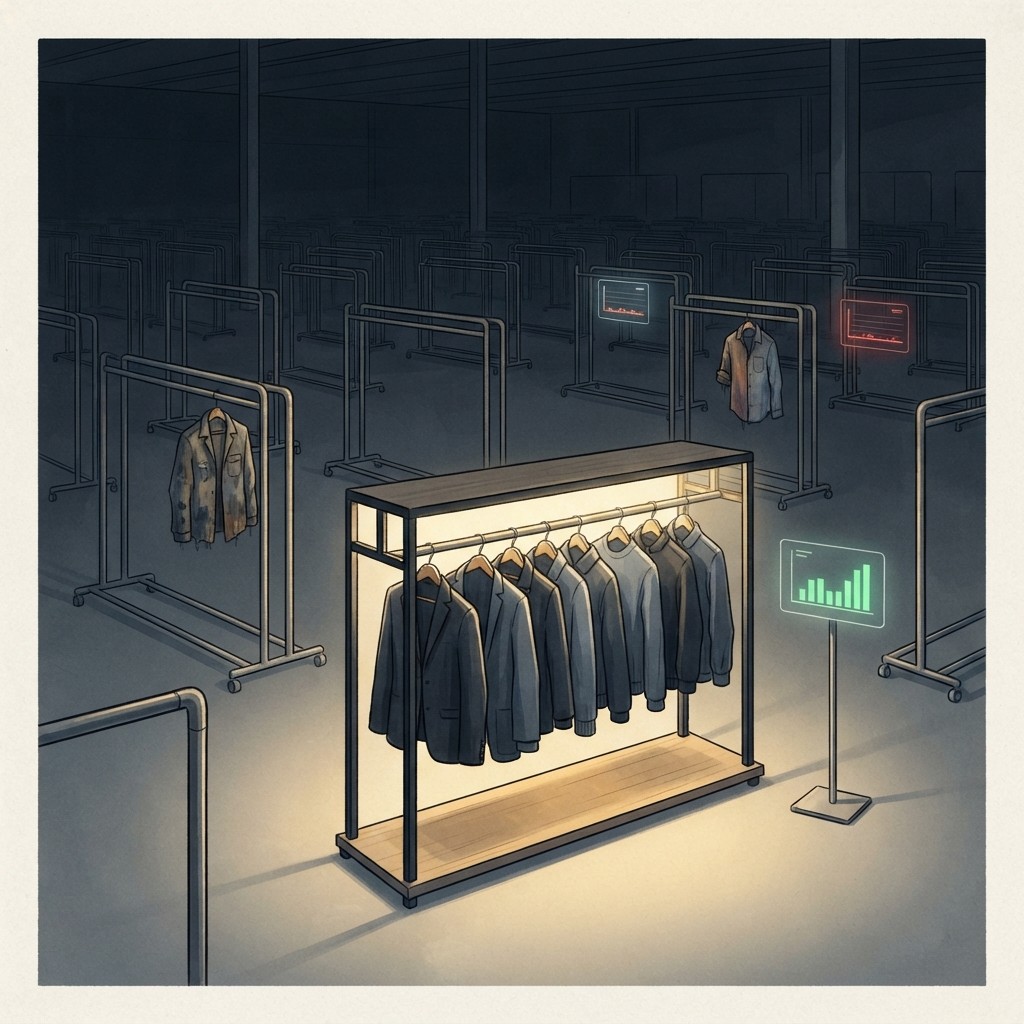
To see what Shein actually invented, look at the cost it deleted. A conventional retailer designs a season months ahead, commits to a buy of thousands of units per style, ships them, and then finds out whether anyone wanted them. Guess right and you profit. Guess wrong and the unsold pieces go to the markdown rack, then the outlet, then the landfill—and that waste is baked into the price of everything that did sell. The whole industry runs on a forecast it cannot verify until it's too late to act on it. Shein inverted the order. It produces almost nothing on a forecast and almost everything on a result. The test batch of 50 to 100 units isn't a marketing gimmick; it's the forecast, run in real money on the live market, with a sample size of one decision at a time.2 Demand stops being predicted and starts being measured.
The mechanism that makes this work is speed, and the speed is specific. Shein says it compressed manufacturing-to-fulfillment from three weeks to five days.1 That number is the engine. A five-day reorder loop means the gap between 'this is selling' and 'more of it exists for sale' is short enough that the trend hasn't moved by the time the restock arrives. Run that loop across a catalog refreshing by something like 2,000 to 6,000 new SKUs a day—Shein has never confirmed the figure, and the estimates vary widely—and you get a firehose of cheap experiments, each one resolved in days, each loser killed before it costs anything.5 The breadth isn't the point. The breadth is what you can afford once each bet is tiny.
| Traditional fast fashion | Shein's test-and-repeat | |
|---|---|---|
| Initial order per style | Thousands of units | 50–200 units |
| Demand is | Forecast months ahead | Measured live, then reordered |
| When a style flops | Markdowns, outlet, landfill | It quietly disappears at trivial cost |
| Reorder loop | Weeks to a new season | ~5 days |
| Who eats the bad guess | The retailer's margin | Almost no one |
The thesis: the moat is deferred risk, not a duty-free border
Here is the claim worth repeating at dinner. Shein's durable advantage is that it almost never owns inventory it hasn't already sold—and it defers cost at every link, from the test batch that replaces the forecast to the duties it pays only after a garment is bought. The de minimis exemption is a discount layered on top of that machine, not the machine itself. Strip the tariff break away entirely and the test-and-repeat loop still does the thing that actually wins: it removes the single largest hidden cost in apparel, which is the stuff nobody buys. Competitors keep attacking the tariff because it's visible. The real edge is invisible, sitting in the inventory that was never made.
The financial shape is consistent with this, even through the fog of a private company that publishes no audited global accounts. Reports citing people close to Shein put 2023 revenue near $32.2 billion and net profit near $2 billion—an attributed figure, not a filing, and worth holding at arm's length.4 But the one number that is a real filing tells the same story: Shein's Irish entity reported €7.684 billion in 2023 sales, up 68% in a single year.3 You do not grow a low-margin garment business that fast on labor arbitrage. You grow it that fast when each new style costs almost nothing to try and the winners scale themselves.
Doesn't the end of de minimis blow the whole thing up?
This is the strongest objection, and it deserves a straight answer. The U.S. has already killed the duty-free exemption for China-origin goods as of May 2025—dropping de minimis shipment volume roughly 85% overall—and the new law repeals the exemption entirely from July 2027.6 If Shein's price advantage were the loophole, this would be an extinction event. It isn't, for two reasons. First, as Portless CEO Izzy Rosenzweig argues, the structural edge was never the exemption but tariff deferral—paying duties post-sale rather than financing them upfront—which, perversely, helps Shein more as tariffs rise, because it never carries duty cost on goods that don't sell.7 Second, Shein has been behaving exactly like a company that knows this: it has expanded manufacturing into Turkey, Mexico, and Brazil and locked down 100,000-plus square meters of warehouse space in Vietnam as a U.S. distribution point through at least 2027.8 A firm whose survival depended on de minimis would be lobbying to save it. Shein is diversifying past it. The tariff fight will raise its prices. It will not break its model.
The most expensive line item in many businesses is the bet you placed before you had the data—the inventory built on a forecast, the feature shipped on a hunch, the campaign printed before the test. Shein's real innovation is procedural, not industrial: it shrank every bet small enough to be wrong cheaply, then made the reorder loop fast enough that being right pays off before the moment passes. The lesson generalizes far past clothes. Find the place where your organization is forced to commit capital before it knows the outcome, and ask whether you could run a 50-unit version instead—and whether you could read the result in five days, not five months. The waste you avoid is the margin nobody else can see.
The same opacity that hides the moat also hides the bodies
But the model that makes Shein hard to beat also makes one of its favorite claims hard to believe. Shein markets test-and-repeat as a sustainability story: small batches, less overproduction, near-zero waste. In theory, the logic holds—you can't dump what you never made. In practice, it is unverified at scale, and the scale is the problem. Shein runs more than 5,000 supplier factories, and as of its own 2021 disclosure it had audited only around 700 of them—of which 83% came in below Shein's own performance standard. There is no independent verification that the waste-reduction it advertises holds across a production network that vast and that lightly inspected. The very complexity that lets Shein defer inventory risk also lets it defer accountability: a web of 5,000 factories, a Singapore headquarters, a Dublin EMEA hub, and an ultimate parent in the Cayman Islands is not a structure built for anyone to easily audit.3 The test-and-repeat machine is real. The green halo bolted onto it is, at best, unproven—and the same opacity that protects the genius conveniently buries the question.
Shein didn't win because labor is cheap in China; plenty of rivals share the same factories. It won by refusing to do the one thing every other clothier still does—pour money into a guess about next season and pray. It builds almost nothing until the market has already voted, then makes the winners faster than the trend can fade. The tariff loophole was a tailwind, and tailwinds end. The machine underneath—learn small, lose cheap, scale only the hits—keeps turning whether or not the border stays open. The genius was never a discount at customs. It was deciding to find out what you want before making it, and to make almost nothing else.
More businesses that win on the part you don't see
Pricing Power Diagnostic
A scored diagnostic of pricing power: brand pull, switching costs, substitutes, and how critical the product is to the buyer. Each dimension rated 1-5 so you can see, at a glance, whether a price rise sticks or sends customers running. Blank to grade your own offer; filled as the worked example scoring a story's business on its real ability to charge more.
Included, filled and blank, in the The Operating Model Casebook. See the set → · Preview the blank →
Sources
Where this comes from — the filings, records, and reporting behind it.
- 1Shein confirmed to SupplyChainBrain that it tests new products in small batches of 100–200 items and cut manufacturing-to-fulfillment from three weeks to five days; its spokesperson stated: 'Our business model, focused on creating an on-demand production approach…is what drives our growth.'
- 2Shein operates a 'large-scale automated test and reorder (LATR) system' commissioning 50–100 units per style initially, then scaling hits; inventory turnover sits at 47 days.
- 3Shein's Ireland-registered entity Infinite Styles Ecommerce Co reported €7.684 billion in 2023 sales (+68% YoY) and €99.5 million after-tax profit; its ultimate controlling party is a Cayman Islands company called Elite Depot Limited.
- 4Shein's 2023 global revenue was approximately $32.2 billion and net profit approximately $2 billion (185% increase YoY), per reports citing people close to the company; Shein does not publicly disclose audited global financials.
- 5Shein added approximately 2,000 new SKUs per day on average in 2021; a separate 2024 industry analysis cites ~6,000 daily new products. Neither figure is confirmed by a primary Shein disclosure.
- 6The U.S. 'One Big Beautiful Bill Act,' signed by President Trump, will repeal the de minimis exemption (sub-$800 duty-free imports) effective July 1, 2027; de minimis for China-origin goods was already eliminated May 2, 2025, cutting daily volume ~85%.
- 7Logistics CEO Izzy Rosenzweig (Portless) argued 'tariffs were never Shein's primary advantage'—the real moat is tariff deferral (duties paid post-sale, not upfront) and agile inventory management, which actually advantages Shein more as tariffs rise.
- 8Shein has expanded manufacturing to Turkey, Mexico, and Brazil and secured 100,000+ sq m of warehouse space in Vietnam as a distribution point to the U.S. (at least through 2027), proactively hedging against de minimis and tariff changes.
More like this — beyond Shein
New Strategically analyses as they publish: the defining moves in business, checked against the record. No noise, and one click to leave.