Pairs with the Pricing Power Diagnostic — a ready-to-use strategy tool. Included in the The Pendulum Casebook →
In fiscal 2024, Procter & Gamble sold $84.0 billion worth of Tide, Charmin, Pampers and the rest of the cabinet under your sink, and grew organically by four points - every one of them from charging more, not selling more. Shipment volumes were flat. Mix was flat. The growth was, in plain language, a price increase the company successfully held.1 To a casual reader that looks like a company that has discovered pricing power and decided to use it. It is something stranger and more revealing: a company doing again, under a new name, what it has been doing for forty years.
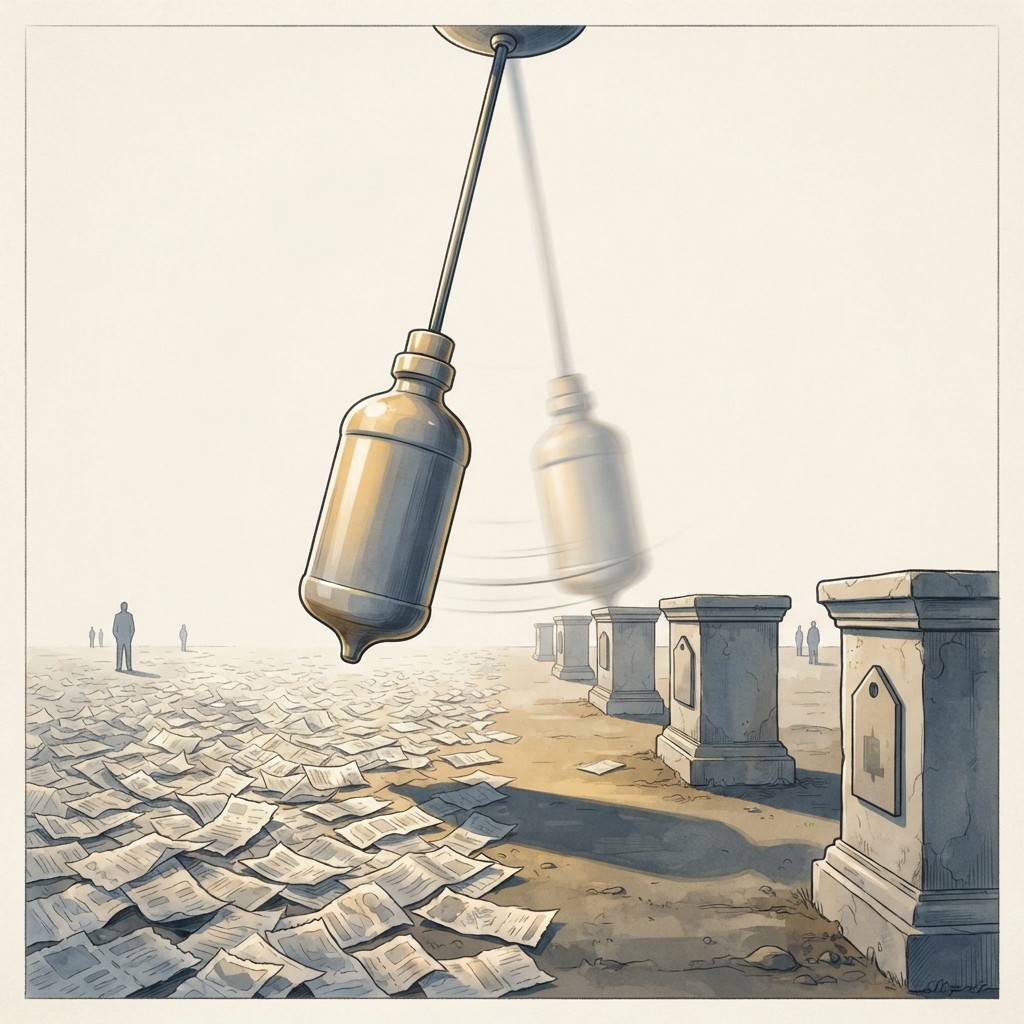
The official story is that P&G has a pricing strategy - a doctrine, a way of doing things. It does not. What it has is a pendulum. It swings between two poles, promotional high-low pricing on one side and stable 'value' list prices on the other, and every swing is triggered by the same kind of shock: a commodity spike, a competitor's gain, a retailer's complaint. The strategy isn't a destination. It's the swinging.
The first time P&G killed the coupon
Rewind to the early 1990s. P&G's pricing had become a circus of temporary deals, trade promotions and coupons - a system that let retailers play games, distorted demand into artificial spikes, and buried the real price of a product under a haystack of discounts. An executive vice president named Durk Jager became the internal champion for tearing it down. His pitch: stop the promotional churn, set consistent list prices with little or no deal spending, and let the product stand on a stable number.3 The company tested the idea on two unglamorous front lines - dishwashing liquid and Folgers coffee - before rolling it across the portfolio.3 Internally it was never called everyday low pricing. It was called value pricing, and the distinction matters: the savings from killing promotions were rolled into lower, steadier list prices rather than handed to a single retailer's model.
By the company's own accounting, it worked at the level it set out to work. P&G's fiscal-1995 annual report records that since 1992/93, list prices - excluding coffee - had declined by $1 billion, the direct result of stripping out inefficient promotion costs.2 That 'excluding coffee' is not a footnote; coffee prices were volatile enough that the company carved them out of its own success story, which tells you how carefully the number was framed. The pendulum had swung hard toward stability, and the filing read like vindication.
“Since 1992/93, list prices (excluding coffee) declined $1 billion, reflecting the move to value pricing by eliminating inefficient promotion costs.”2
What the cleaner number actually cost
Here is the part the tidy version leaves out. When researchers later examined what value pricing did across 24 P&G categories from 1990 to 1996 - the cuts in deals and coupons, the matching increases in advertising - they found that the switch from promotion to advertising cost P&G market share.4 The shelf got cleaner and the brand got smaller. The same study noted that the policy may also have lifted profitability over the same years, but treated that as a possibility rather than a proven result.4 So the honest scorecard on the famous 1990s reform is: a confirmed loss of share, and a profitability gain the evidence could only hint at. That ambiguity is the whole point. Value pricing was not a triumph the company locked in forever. It was one swing of the pendulum that bought stability at the price of presence - and a position you pay for in share is a position you eventually swing back from.
| Promotional high-low | Stable 'value' list prices | |
|---|---|---|
| The everyday price | High, with frequent deals | Lower, steady, deal-free |
| What it buys | Shelf presence, demand spikes | Clean economics, less retailer gaming |
| What it costs | Margin chaos, distorted demand | Market share[[cite:s4]] |
| What flips it | A commodity or cost shock | Lost share and retailer friction |
The same machine, thirty years later
Now run the tape to the post-pandemic cost shock, and watch the pendulum swing the other way. With input costs surging, P&G leaned on price the way it had once leaned on stability. In the quarter ended December 2022 it raised prices 10% year-over-year - and organic revenue grew 5%, driven entirely by pricing, even as volume fell 6%, the biggest quarterly volume drop in years.5 The headline wrote itself: shoppers were trading down under the weight of the hikes. But the CFO told a more careful story on the call. Strip out P&G's deliberate wind-down in Russia and its inventory cuts in China, and the volume decline that actually came from changing consumer behavior was roughly 3%, not 6% - about half the headline was structural and geographic, not price elasticity.6 The full-6%-is-trade-down reading is an overstatement. But even the real number was a warning shot.
And then the swing started to lose its arc - exactly as a pendulum does. By the quarter ended March 2024, volume had gone flat for the second straight quarter while pricing's contribution had narrowed to about three points, with the company openly struggling to bring shoppers back after two years of hikes across Tide, Charmin and others.7 By the quarter ended September 2024, pricing added just one point to organic growth and volume added one point - a clean, deliberate-looking handoff from a price-led story to a volume-led one.8 FY2024's four points of pricing-driven growth weren't the start of a new era of pricing power.1 They were the top of the swing, captured in an annual report, just before gravity took over.
Isn't this just normal pricing discipline?
The fair objection is that calling this a 'pendulum' romanticizes ordinary management. Of course a consumer-goods giant raises prices when costs rise and competes on deals when they don't - that's not a recurring identity crisis, that's just running the business. There's truth in that, and it's worth conceding: each individual move was rational on its own terms. But the pattern is the point. The 1990s swing toward stability was sold as a permanent doctrine and then quietly walked back; the 2020s swing toward aggressive pricing was read as new-found power and is already decelerating quarter by quarter.78 What looks like strategy at any single moment is, across decades, oscillation - and the tell is that each swing is presented as the answer, right up until the conditions that triggered it reverse. A company with a true pricing doctrine wouldn't need to keep rediscovering it. The honest read isn't that P&G is badly run. It's that there is no stable equilibrium here to be found - only a choice that keeps having to be re-made.
When a company posts growth driven 'entirely by pricing,' treat it as a measurement of where the pendulum is, not proof of a permanent advantage. Two tests separate durable pricing power from a swing near its top. First, check the volume: real pricing power lets you raise price AND hold units; a swing trades one for the other. Second, check the trajectory across quarters - a contribution that goes 10, then 3, then 1 isn't a strategy compounding, it's a cycle exhausting. The best time to doubt a pricing story is the quarter it looks most triumphant, because that is usually the quarter the conditions that powered it have already begun to reverse.
P&G's pricing has no north. It has a swing. In the 1990s it swung toward stability and paid in market share; in the 2020s it swung toward price and is paying now in stalled volume and tired shoppers. Each swing arrives dressed as the answer, sits at the top of the arc just long enough to make it into an annual report, and then begins the long fall back toward its opposite. The four points of growth in FY2024 were never the company finding pricing religion. They were the pendulum at the height of its travel - already, by the next filing, on the way down. The strategy was never a price. It was the willingness to keep changing it.
Pricing Power Diagnostic
A scored diagnostic of pricing power: brand pull, switching costs, substitutes, and how critical the product is to the buyer. Each dimension rated 1-5 so you can see, at a glance, whether a price rise sticks or sends customers running. Blank to grade your own offer; filled as the worked example scoring a story's business on its real ability to charge more.
Included, filled and blank, in the The Pendulum Casebook. See the set → · Preview the blank →
Sources
Where this comes from — the filings, records, and reporting behind it.
- 1P&G fiscal year 2024 net sales were $84.0 billion; higher pricing contributed four points of organic sales growth for the full year; shipment volumes and mix were unchanged versus prior year.
- 2Since 1992/93, P&G list prices (excluding coffee) declined $1 billion, reflecting the move to value pricing by eliminating inefficient promotion costs and rolling them into lower list prices.
- 3Executive Vice President Durk Jager was the internal champion for P&G's value-pricing overhaul in the early 1990s, pushing for consistent list prices with little or no promotional spending; two category managers for dishwashing liquids and Folgers coffee were the test cases.
- 4Across 24 P&G categories from 1990–1996, P&G instituted major cuts in deals and coupons and substantial increases in advertising; the switch from promotion to advertising cost P&G market share, though it may also have driven increased profitability over the same period.
- 5In Q2 FY2023 (quarter ended December 31, 2022), P&G raised prices 10% year-over-year while sales volume fell 6%, described as the biggest quarterly volume drop in years; organic revenues grew 5% driven entirely by pricing.
- 6P&G CFO Andre Schulten stated on the Q2 FY2023 earnings call that after stripping the impact from China and Russia, the volume decline from changing consumer behavior was approximately 3%, not 6% — roughly half the headline decline was structural/geographic, not demand-driven.
- 7By Q3 FY2024 (quarter ended March 2024), P&G's quarterly volume was flat for the second consecutive quarter; pricing contributed only +3% year-over-year; P&G struggled to bring back shoppers after two years of price hikes across Tide, Charmin, and other brands.
- 8In Q1 FY2025 (quarter ended September 2024), pricing contributed only 1 point to organic sales growth and organic volume grew 1 point — a sharp deceleration from the pricing-led growth of FY2022–FY2023.
More like this — beyond Procter & Gamble
New Strategically analyses as they publish: the defining moves in business, checked against the record. No noise, and one click to leave.