Pairs with the Pricing Power Diagnostic — a ready-to-use strategy tool, filled for Dow. Included in the The Cycle Casebook →
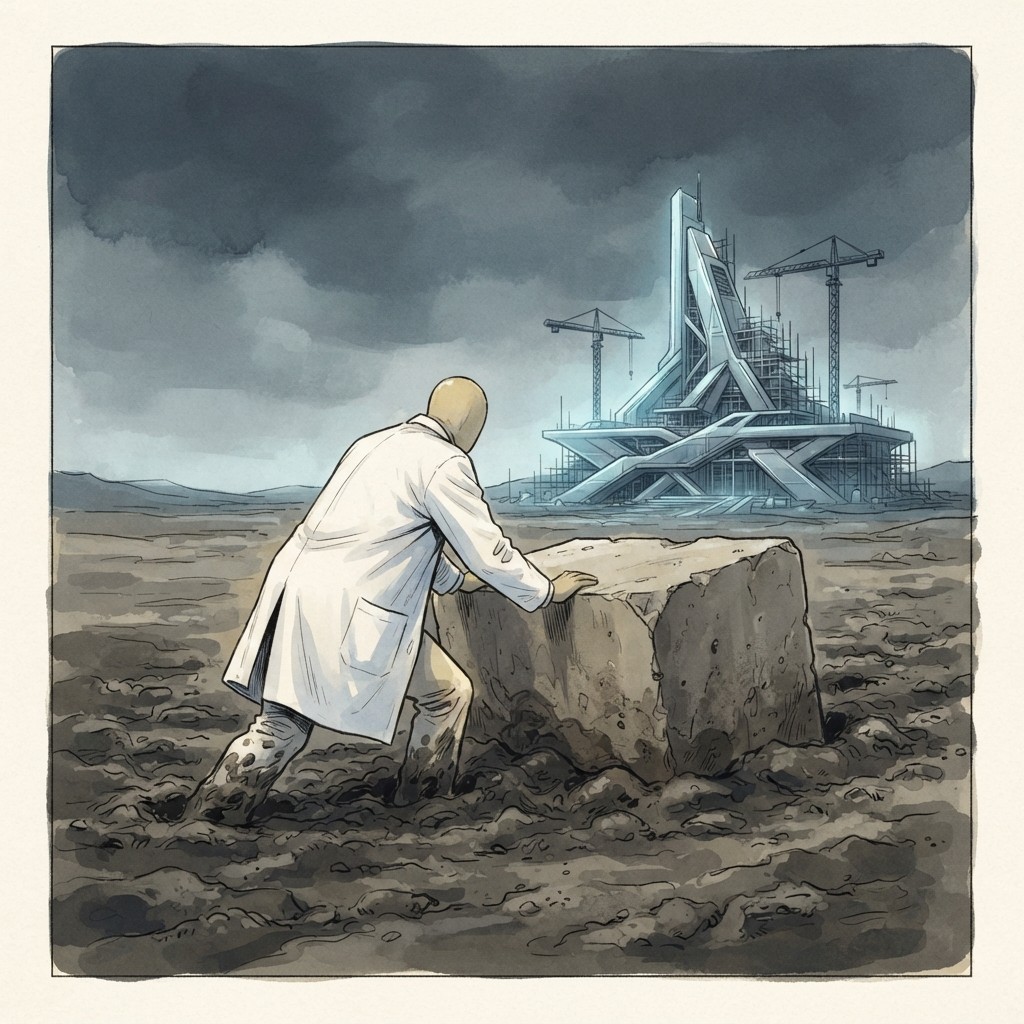
On April 24, 2025, Dow stopped building the future. The Path2Zero cracker in Alberta—pitched as the world's first net-zero integrated ethylene plant, a machine meant to decarbonize roughly a fifth of Dow's global ethylene capacity—had its construction paused, freeing up about $1 billion of cash for the year.68 Dow had already poured over a billion dollars into the site the year before.6 You do not halt your flagship clean-growth project halfway through because the vision changed. You halt it because the cash you needed to finish it stopped showing up. And the reason it stopped showing up tells you what Dow actually is.
The official story is that Dow is a diversified specialty chemical company—high-value molecules, sticky customers, insulated from the boom-and-bust of commodities. The record says otherwise. Dow's single largest segment by revenue, Packaging & Specialty Plastics, brought in roughly $23 billion in 2023, and its margins move almost entirely with one number: the spread between polyethylene and the ethylene it's made from.3 Strip away the word 'specialty' and what's left is the world's second-largest polyethylene producer, riding a commodity cycle it cannot control.
The largest segment is a price taker wearing a specialty badge
Here's the mechanism, worked down. Dow cracks ethane into ethylene, then polymerizes ethylene into polyethylene—the pellets that become film, packaging, and pipe. The profit isn't the product; it's the gap between what the finished polymer sells for and what the feedstock chain costs. That gap is the integrated spread, and it is set globally, by supply and demand, not by Dow. When China builds enough new cracking capacity to flood the market, the polymer price falls toward the floor, and Dow's largest business follows it down whether or not a single thing about Dow's plants has changed.
Watch the segment compress in real time. In the fourth quarter of 2024, Packaging & Specialty Plastics did $5.3 billion in sales, down 6% on the year, with polyethylene prices off as local pricing slipped; segment operating EBIT was $447 million, down $217 million.3 By the third quarter of 2025, segment sales had fallen to $4.9 billion, down 11%, local pricing down 10%, and operating EBIT had collapsed to $199 million—down $419 million year over year, explicitly because of lower integrated margins.4 Same plants. Same molecules. Opposite math, year after year, because the price was never Dow's to set.
| Q4 2024 | Q3 2025 | |
|---|---|---|
| Segment net sales | $5.3B | $4.9B |
| Year-over-year change | Down 6% | Down 11% |
| Local price move | Down 5% | Down 10% |
| Segment operating EBIT | $447M | $199M |
| EBIT change vs. prior year | Down $217M | Down $419M |
The integration hedge everyone trusts is already spent
The standard defense is that ethylene-to-polyethylene integration protects Dow: when polymer margins sag, the upstream ethylene margin makes it back, so the chain self-hedges. That used to be true. It isn't anymore. Wood Mackenzie's read on the cycle is blunt—integrated polyethylene cash margins have been largely negative since mid-2022, and the positive ethylene margins that once offset the polymer losses held up only until the second half of 2024. Since then, ethylene margins for higher-cost producers have also gone negative, forcing plant closures.5 When both halves of the chain are underwater at once, integration stops being a hedge. It becomes two leaks in the same boat.
Now read the consolidated numbers as the cycle, not the company. Dow's pre-tax income was $6.09 billion in 2022, then cratered to $656 million in 2023 and $1.60 billion in 2024.2 It is tempting to call 2024 a recovery off 2023. It wasn't. The 2022 figure was a post-COVID abnormality; 2023 and 2024 are both trough years, not the start of a climb. The fall continued: full-year 2025 net sales were $40.0 billion, down from $43.0 billion in 2024, and Dow swung to a GAAP net loss of $2.4 billion from net income of $1.2 billion the year before, with operating EBIT shrinking from $2.6 billion to $0.4 billion.1 This is not mean reversion. It is a company sinking with the spread.
The escape hatch closed at the exact moment Dow needed it
Path2Zero was supposed to be the way out—not just cleaner, but cheaper, sited in North America, one of the two lowest-cost regions on earth for ethylene alongside the Middle East.8 First phase would have added 1.3 million tons a year of ethylene and polyethylene; the second another 600,000 tons.8 The trouble is timing. Building low-cost capacity is the right move at the bottom of a cycle—if you can ride the trough to the recovery. But Dow can't see the recovery from here. CEO Jim Fitterling called the conditions 'one of the most protracted down-cycles in decades,' and ICIS analysis puts the global ethylene/polyethylene trough out at 2028 to 2029.6 Dow tied any restart to seeing supply and demand actually tighten—conditions that do not yet exist.6 So the one project that could turn Dow from a price taker into a low-cost survivor was frozen precisely because the cycle that justified it had drained the cash to finish it.
“One of the most protracted down-cycles in decades.”6
Isn't a deep trough just the setup for a snapback?
The honest counter is the bull case: commodity chemicals are cyclical, troughs always end, and Dow as the second-largest polyethylene producer—roughly 9.8 million tons a year of capacity—is exactly the kind of scaled, integrated operator that emerges stronger when the weak hands close.7 There's truth in that. Dow has done this before; in 2022 it deliberately cut global polyethylene rates by 15% to manage inventory through a logistics squeeze, the move of an operator that knows how to throttle a cycle.7 And Wood Mackenzie itself notes the negative margins are already forcing closures, which is how every glut eventually clears.5
But a cyclical recovery story and a value trap look identical at the bottom—until you check the clock and the cash. A snapback in twelve months is a buying opportunity. A trough that arrives in 2028-2029 is four more years of negative integrated margins, four more years of borrowing against a clean-growth project you've already paused, four more years before the supply gets cleared by closures.56 Dow doesn't get to choose when China stops adding capacity. The capacity decisions that set its largest segment's price are being made in a different hemisphere, and they are not done.2 That's the difference between a coiled spring and a slow leak.
A company's name tells you what it wants to be; its largest segment's margin driver tells you what it is. When the biggest revenue line moves with a globally set spread you don't control, you are a price taker no matter what the annual report calls you—and your cash flows belong to the cycle. The tell is always the same: watch what happens to the growth project when the cycle turns. A genuine specialty business funds its future through the dip; a commodity business pauses construction to make payroll. Dow paused Path2Zero. That single decision settled the argument about which kind of company it is more honestly than any segment-reporting footnote could.
Dow has spent years insisting it sits a notch above the commodity fray, selling specialty molecules to sticky customers. The petrochemical cycle never read the brochure. Its largest business is polyethylene, polyethylene's price is set in China, and when that price went negative the integration hedge emptied, the earnings sank, and the one project built to escape all of it got shelved for the conditions it was meant to outlast. The lesson isn't that Dow is badly run. It's that a company can carry the word 'specialty' on its biggest segment and still have its fate decided, quarter after quarter, by a spread it doesn't set and can't see the end of.
Pricing Power Diagnostic
A scored diagnostic of pricing power: brand pull, switching costs, substitutes, and how critical the product is to the buyer. Each dimension rated 1-5 so you can see, at a glance, whether a price rise sticks or sends customers running. Blank to grade your own offer; filled as the worked example scoring a story's business on its real ability to charge more.
Included, filled and blank, in the The Cycle Casebook. See the set → · Preview the blank →
Sources
Where this comes from — the filings, records, and reporting behind it.
- 1Dow Inc. FY2024 full-year net sales were $43.0 billion, down from $44.6 billion in 2023; full-year 2025 net sales were $40.0 billion; GAAP net loss in 2025 was $2.4 billion vs. net income of $1.2 billion in 2024; 2024 Operating EBIT was $2.6 billion, 2025 Operating EBIT was $0.4 billion.
- 2Dow Inc. FY2024 10-K (SEC filing): income before income taxes was $1.600B in 2024, $0.656B in 2023, and $6.090B in 2022, illustrating the severity of the multi-year earnings trough relative to the 2022 peak. The 10-K explicitly identifies supply/demand imbalance from new capacity additions—especially in EMEAI and Asia Pacific—as a key risk creating downward pressure on prices.
- 3Dow's Packaging & Specialty Plastics segment is the company's largest revenue segment. The segment's Q4 2024 net sales were $5.3 billion, down 6% year-over-year, driven by lower functional polymers and polyethylene prices (down 5% local price). Full-year 2024 net sales were approximately $43.0B total company; the P&SP segment generated ~$23.15B in 2023 per Dow's own filings. In Q4 2024, P&SP segment Operating EBIT was $447M, down $217M year-over-year.
- 4Dow's Packaging & Specialty Plastics segment Q3 2025 net sales were $4.9 billion, down 11% year-over-year; local pricing decreased 10% due to lower downstream polymer prices; Operating EBIT for the segment reached $199M, down $419M versus prior year due to lower integrated margins.
- 5Polyethylene cash margins on an integrated basis have largely been negative since mid-2022. Positive ethylene margins offset negative polymer margins only until the second half of 2024; since then, ethylene margins for higher-cost producers have also been largely negative, triggering multiple plant closures. Chinese capacity expansions are identified as the primary driver of margin pressure.
- 6Dow paused construction of its Path2Zero project in Fort Saskatchewan, Alberta on April 24, 2025, saving approximately $1 billion in 2025 CapEx. The project—originally announced in October 2021, financed in 2023, and valued at $10–$11.6 billion—had already consumed over $1 billion in Dow spending in 2024. CEO Fitterling described conditions as 'one of the most protracted down-cycles in decades.' Dow said it would revisit restart at end of 2025; ICIS analysis indicates global ethylene/PE cycle trough is expected in 2028–2029.
- 7Dow is the second-largest global polyethylene producer (not the largest), with approximately 9.8 million metric tons/year of nameplate capacity as of August 2022. The company temporarily cut global PE production rates by 15% in August 2022 due to US Gulf Coast and European logistics constraints and high port/warehouse inventories.
- 8Path2Zero is designed to be the world's first net-zero Scope 1 and 2 emissions integrated ethylene cracker and derivatives facility; it would decarbonize ~20% of Dow's global ethylene capacity and triple ethylene/PE capacity at the Fort Saskatchewan site. The first phase (2027 start-up) would have added 1.3 million mt/yr of ethane-derived ethylene and PE; second phase (2029) an additional 600,000 mt/yr. In 2025, the Middle East and North America remained the lowest-cost regions globally for ethylene production.
More like this — beyond Dow
New Strategically analyses as they publish: the defining moves in business, checked against the record. No noise, and one click to leave.