Pairs with the Pricing Power Diagnostic — a ready-to-use strategy tool, filled for Chevron. Included in the The Reputation Casebook →
In December 2024, Chevron did the thing that earns the applause. It announced it would spend less. The 2025 capital budget came in $2 billion below the prior year, and CEO Mike Wirth gave investors the line they wanted: the budget 'demonstrate[s] our commitment to cost and capital discipline.'1 Wall Street nodded. This is the Chevron story - the steady hand that won't chase a boom, won't overbuild, and hands the cash back to you instead. The discipline is real. But the word is doing more work than the numbers support.
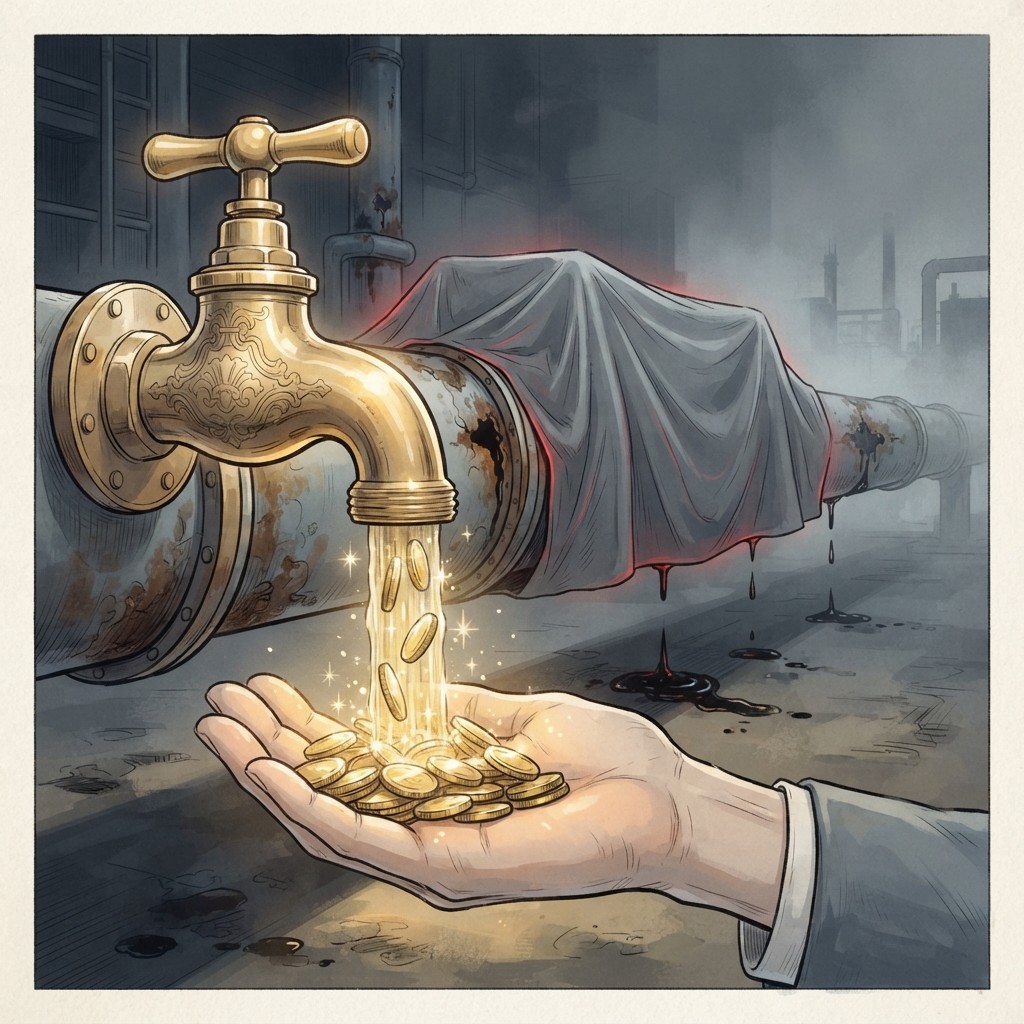
The official story is that Chevron's capital discipline produces industry-leading returns on capital. The truer story is that capital discipline is a promise to pay you - dividends and buybacks, year after year - and that promise has held even as the returns underneath it fell. Those are not the same thing, and conflating them is how a distribution policy gets mistaken for a competitive advantage.
The returns fell while the discipline held
Start with the number that the brand is supposed to be about. Return on capital employed - ROCE, the cleanest read on how productively a company deploys its money - did not climb under Chevron's discipline. It fell. From 20.3% in 2022 to 11.9% in 2023 to 10.1% reported in 2024.5 Three years, one direction, down. That decline tracks the broader fall in commodity prices from a 2022 peak — a sector-wide headwind, not a Chevron-specific failure — and no company controls Brent. But it makes the point precisely: when ROCE is mostly riding the commodity, restraining capex and buying back stock is not evidence that Chevron invests better than its peers. It's evidence that Chevron has decided to keep paying you regardless of how the cycle treats its returns.
Now the distributions, which are the genuinely impressive part. Chevron returned a record $27 billion to shareholders in 2024, repurchasing more than $15 billion of its own stock and extending a streak of buying back shares in 17 of the last 21 years.3 By the November 2025 Investor Day, that streak had ticked to 18 of the last 22, with management guiding to $10–$20 billion in annual repurchases through 2030 and citing 25 years of leading dividend-per-share growth.8 This is a structural commitment, engineered and defended for decades. It is the real product. The trouble is what funds it.
“We're maintaining capital discipline in both traditional and new energies.”2
A record return, partly paid by selling things
Here is the part the headline number quietly skips. The $27 billion was not all earnings. Chevron closed asset sales in Canada and Alaska in Q4 2024 — including a $6.5 billion sale of its Athabasca Oil Sands and Duvernay interests — with a Congo sale following shortly after, all part of a plan to divest $10–15 billion in assets by 2028.9 Divestiture proceeds entered the same cash pool the distributions were drawn from. A record return funded partly by asset sales is not the same animal as a record return funded purely by what the business earned. It is closer to a household that keeps its allowance constant by occasionally selling the furniture - admirable consistency, but the consistency is the point, not the income behind it. Set that against 2023, when Chevron returned $26.3 billion and stretched its run of higher dividends per share to 36 consecutive years, all while carrying a debt ratio of just 11.5%.4 That low leverage is the real engine. Discipline here means: keep the balance sheet pristine so the distributions never have to stop, even in a down year, even if you have to sell something to do it.
| The brand implies | The filings show | |
|---|---|---|
| Returns on capital | Industry-leading, rising | ROCE fell 20.3% → 11.9% → 10.1%, 2022–24 |
| Shareholder return | Earnings paid out | $27B, partly funded by asset sales |
| Capex vs. budget | Held to plan | ~$16.4B in 2024, above the budget midpoint |
| What's truly disciplined | Capital productivity | Distributions and balance-sheet strength |
Even the capex restraint, the most defensible piece of the story, has a soft edge. Chevron's announced 2024 organic budget was $15.5–$16.5 billion.2 Actual full-year spend came in around $16.4 billion - inside the range, but above the midpoint, not a beat against it.5 The company's own earnings call slides describe the spend as 'aligned with our announced $16 billion budget,'5 which rounds to the friendly number rather than the one that was actually hit. A minor nuance, but a telling one: even where the discipline is most real, the framing reaches for the more flattering reading.
The $53 billion bet that sat in limbo for 18 months
And then there is Hess - the fact that sits least comfortably inside a capital-discipline narrative. In October 2023, Chevron agreed to acquire Hess for roughly $53 billion, chasing Hess' ~30% stake in the Stabroek Block offshore Guyana, one of the most valuable oil discoveries of the era. That is not a disciplined trim of the cargo; that is the largest swing the company had taken in years. Then ExxonMobil filed ICC arbitration in March 2024, claiming a right of first refusal over the very Guyana stake Chevron was paying for.6 The deal that was supposed to close in the first half of 2024 sat in legal limbo for more than 18 months. The arbitration hearing slipped to May 2025. Chevron finally won and closed on July 18, 2025.7
It worked out. But 'it worked out' is the language of a bet, not of discipline. For a year and a half, a company famous for not over-committing had its single biggest strategic move hostage to a clause in a joint-operating agreement and a panel of arbitrators. The discipline brand and the Hess bet are not contradictory in hindsight - but they are different instincts, and the brand only ever advertises the cautious one.
Isn't a 36-year dividend streak the whole point?
The fair objection is that this is too cynical. Sustaining distributions through a down cycle, on a fortress balance sheet, while quietly winning a $53 billion arbitration and still cutting next year's budget - that is discipline, of the most valuable kind. And that's right. A 36-year run of rising dividends and an 18-of-22-year buyback record are not accidents; they are the output of a culture that genuinely refuses to over-extend.48 The honest version isn't that Chevron lacks discipline. It's that 'capital discipline' has come to mean two different things that investors quietly merge: discipline as restraint on spending and reliability of payouts (which Chevron has, demonstrably), and discipline as superior returns on the capital deployed (which the last three years of ROCE do not support). The brand sells the second by showing you the first. The reliability is real. The productivity claim is the one to check.
When a company's reputation is 'disciplined capital,' ask which discipline you're actually buying. Reliable distributions on a strong balance sheet are a structural commitment - valuable, durable, and worth paying for. Superior returns on capital are a competitive advantage - a different, harder thing entirely. The two get marketed as one word because the first is easy to prove (a dividend streak, a buyback count) and the second is easy to assume from it. They don't follow from each other. A firm can pay you faithfully for decades while its ROCE falls and it funds the cheque partly by selling assets. Read the payout record as a promise kept; read the return on capital as the test of whether the underlying business is actually getting better. Chevron passes the first cleanly. On the second, the last three years say: not yet.
Chevron is one of the most reliable payers in the energy business, and that reliability is engineered, not lucky - low leverage, a budget kept on a leash, a refusal to chase the last barrel of a boom. None of that is in dispute. What's in dispute is the inference investors draw from it: that a company so careful with the cash it returns must be equally superior with the cash it deploys. The filings don't show that. They show falling returns on capital, a record payout topped up by divestitures, and a $53 billion bet that spent 18 months in arbitration. The discipline is in the distribution, not in the productivity. Chevron promises to pay you through the cycle, and it keeps the promise. Just don't mistake a kept promise for proof that the money inside the company is working any harder than anyone else's.
Pricing Power Diagnostic
A scored diagnostic of pricing power: brand pull, switching costs, substitutes, and how critical the product is to the buyer. Each dimension rated 1-5 so you can see, at a glance, whether a price rise sticks or sends customers running. Blank to grade your own offer; filled as the worked example scoring a story's business on its real ability to charge more.
Included, filled and blank, in the The Reputation Casebook. See the set → · Preview the blank →
Sources
Where this comes from — the filings, records, and reporting behind it.
- 1Chevron announced a 2025 organic capex range of $14.5–$15.5 billion for consolidated subsidiaries plus $1.7–$2.0 billion affiliate capex, a $2 billion year-over-year reduction from 2024, with CEO Wirth stating: 'The 2025 capital budget along with our announced structural cost reductions demonstrate our commitment to cost and capital discipline.'
- 2Chevron's 2024 organic capex budget was $15.5–$16.5 billion for consolidated subsidiaries plus ~$3 billion affiliate capex, with ~$5 billion earmarked for Permian Basin development; CEO Wirth stated 'We're maintaining capital discipline in both traditional and new energies.'
- 3Chevron repurchased over $15 billion of its shares in 2024, extending its track record of repurchasing shares in 17 out of the last 21 years; returned a record $27 billion in cash to shareholders through dividends and buybacks in 2024; and targeted $2–3 billion of structural cost reductions by end of 2026.
- 4In 2023, Chevron returned a record $26.3 billion to stockholders through dividends and share repurchases, marking 36 consecutive years of higher annual dividend payout per share, and maintained a debt ratio of 11.5% and net debt ratio of 7.3%.
- 5Chevron's ROCE fell from 20.3% in 2022 to 11.9% in 2023 to 10.1% (reported) in 2024; adjusted ROCE for 2024 was 10.5%; full-year 2024 organic capex was ~$16.4 billion, above the midpoint of the $15.5–$16.5 billion budget range.
- 6ExxonMobil filed for ICC arbitration on March 6, 2024, claiming a right of first refusal over Hess' Stabroek Block stake; the hearing was delayed to May 2025; Chevron won the arbitration and closed the ~$53 billion Hess acquisition on July 18, 2025 — more than 18 months after the original H1 2024 target close.
- 7Chevron won its ICC arbitration against ExxonMobil and closed the Hess acquisition on July 18, 2025, gaining access to Hess' ~30% stake in the Stabroek Block offshore Guyana; ExxonMobil stated it disagreed with the panel's interpretation but respected the process.
- 8At Chevron's November 2025 Investor Day, the company stated it has repurchased shares in 18 of the last 22 years, expects $10–$20 billion in annual repurchases through 2030 at $60–$80 Brent, and has led peers in dividend-per-share growth over 25 years at an average annual increase of 7%.
- 9Chevron completed the sale of its interests in the Athabasca Oil Sands Project and Duvernay shale assets in Canada for $6.5 billion, and certain assets in Alaska, closing both in Q4 2024; the Republic of Congo sale closed in early 2025, all part of a $10–15 billion divestiture plan by 2028.
More like this — beyond Chevron
New Strategically analyses as they publish: the defining moves in business, checked against the record. No noise, and one click to leave.