Pairs with the Pricing Power Diagnostic — a ready-to-use strategy tool, filled for Chanel. Included in the The Veblen Play Casebook →
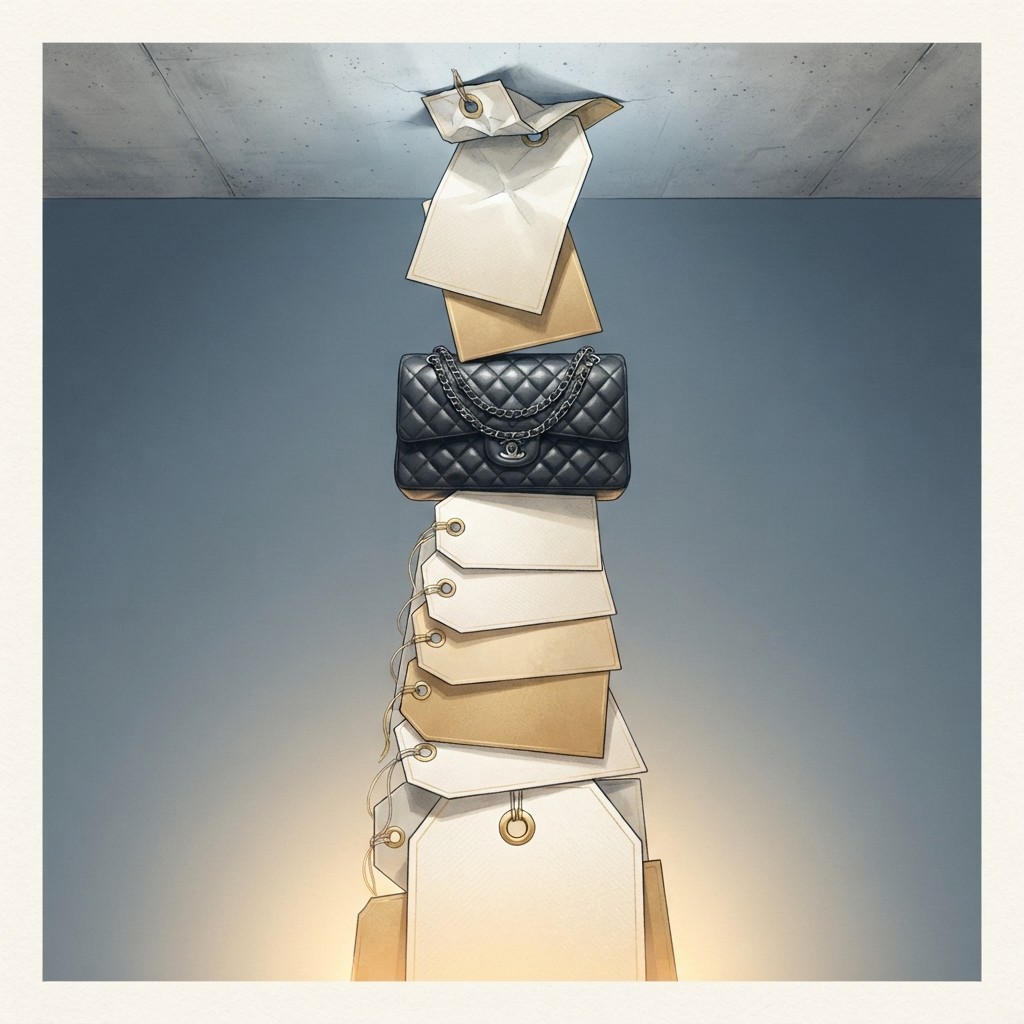
In 2019, a Medium Classic Flap cost $5,800. In August 2025, the same bag — same shape, same quilting, same interlocking CC lock — left the boutique at $11,300, after Chanel added $500 to every size in a single stroke.6 Nothing about the leather changed. Nothing about the stitching changed. What changed was a decision, made over and over, that this object should cost more this year than it did last year, almost regardless of what the world was doing. The bag did not get better. It got further away.
The official explanation is inflation and craftsmanship. Chanel's chief executive has said it plainly: exquisite raw materials, rigorous handmade production, prices raised 'according to the inflation that we see.'4 It is a tidy story, and it is mostly a cover. Inflation does not double a price in six years. Inflation does not run 59% in three. The real logic is the opposite of a cost pass-through — it is a strategy that uses the price itself as the product.
“We use exquisite raw materials and our production is very rigorous, laborious, handmade — so we raise our prices according to the inflation that we see.”4
The price isn't following the value. It's manufacturing it.
Most goods obey a simple law: raise the price and you sell fewer. A small set of luxury goods invert it. The higher the price climbs, the more the object signals — and the signal is the thing being bought. Economists call these Veblen goods, and for most of the last decade Chanel treated the Classic Flap as a textbook example. The bag is desirable in large part because it is expensive; lower the price and you would lower the meaning. So Chanel kept raising it, and each increase did double duty — more margin per unit, and a fresh push toward the only tier above it: Hermès, where a Birkin is rationed rather than sold and the waitlist is the whole point.
The numbers make the divergence from inflation impossible to wave away. The Medium Classic Flap was $2,850 in 2010, $4,400 in 2012, and around $4,900 by mid-2016.5 One study tracking the bag found Chanel's increases dramatically outran consumer prices — at the long-run inflation rate the bag would have sat under $2,000, not near $5,000.5 This is not a company defending its costs. It is a company moving a price like a lever, watching exclusivity rise on the other end.
| Year | Actual retail price | What inflation alone implied |
|---|---|---|
| 2010 | $2,850 | — |
| 2012 | $4,400 | — |
| 2016 | ~$4,900 | ~$1,967 (long-run CPI path from 1955) |
| 2019 | $5,800 | — |
| 2025 | $11,300 | far below actual |
How Chanel learned to control the price everywhere at once
A relentless price-hike machine only works if the price means one thing globally. If a bag is cheap in Seoul and dear in Paris, resellers arbitrage the gap, and the grey market sets the real price instead of the brand. So in 2015 Chanel did something it called an industry first: worldwide price harmonization.8 This is the most misunderstood move in its history. It was not a price cut. It raised prices in Europe and cut them in Mainland China, Hong Kong, and South Korea, while holding the US and Japan flat — an explicit campaign, in Chanel's own words, to 'fight against parallel resale markets.'9 By collapsing the geographic gaps, Chanel took back control of its own number. After that, when it pushed the price up, it pushed it up everywhere, and there was no cheaper door to slip through.
Before you can raise a price aggressively, you have to own it. Geographic price gaps hand pricing power to arbitrageurs and the resale market — the brand sets a number, the grey market sets the real one. Chanel's 2015 harmonization looked like a goodwill gesture to Asian customers; it was actually the foundation for a decade of unified, relentless increases. Close the gaps, kill the arbitrage, and the brand becomes the only one allowed to move the lever. The cut in Asia was the price of buying back control everywhere else.
Then the lever stopped working
A Veblen good has a quiet condition buried in the theory: the higher price has to keep finding buyers who can pay it. Push the number past the wallet of your aspirational base and you don't elevate them — you evict them. In 2024 the eviction showed up in the accounts. After a 2023 in which revenues hit $19.7 billion and operating profit rose to $6.4 billion,1 Chanel reported its first topline contraction since the pandemic: revenues down 4.3% to $18.7 billion, with operating profit falling to $4.5 billion — roughly a 30% collapse.2 The company that had been freezing nothing declared a hiring freeze and cut staff.3 Analysts estimated volumes had dropped around 7% in a year.7
Notice the tell in the timing. The aggressive years coincided with surging demand; the moderation came after volumes fell.7 If the increases were ever truly inflation pass-throughs, you would not see the brand throttle back to a modest 3% increase precisely as buyers pulled away. One analyst summed up the pivot: Chanel paused its pattern of aggressive hikes and shifted to 'more modest, inflation-based changes.'7 The inflation story, in other words, became true only after the strategy stopped working — repurposed from an excuse for elevation into a tool for defending margin on a shrinking base.
But didn't the price climb make Chanel richer for years?
The fair objection is that this all worked beautifully for a long time. Chanel rode the price machine to record revenues and a $6.4 billion operating profit in 2023, with billions plowed back into brand support.1 A Veblen play that compounds for a decade is not a failure; it is one of the best trades in luxury. True — and that is exactly why the 2024 reversal matters rather than disproving the strategy. The point is not that price elevation never works. It is that it has a ceiling, and the ceiling is structural: every increase that elevates the brand also thins the pool of people who can reach it, until one year the thinning outruns the elevation. Chanel didn't run into a recession so much as into itself. The same lever that built the moat eventually started draining it — and no change of creative director or campaign can re-widen a customer base that was priced out on purpose.
That is the trap of a price that becomes the product. You can ratchet exclusivity upward for years and call it craftsmanship, and the market will believe you while demand holds. The moment it doesn't, the strategy reveals its second face: the same increases now read as desperation, and a brand built on the idea that the price could only go up has to explain why it suddenly can't. Chanel spent a decade teaching the world that an $11,300 bag is what desire costs. In 2024 the world quietly answered that even desire has a budget — and the most expensive thing the price machine ever did was find out where it ends.
Pricing Power Diagnostic
A scored diagnostic of pricing power: brand pull, switching costs, substitutes, and how critical the product is to the buyer. Each dimension rated 1-5 so you can see, at a glance, whether a price rise sticks or sends customers running. Blank to grade your own offer; filled as the worked example scoring a story's business on its real ability to charge more.
Included, filled and blank, in the The Veblen Play Casebook. See the set → · Preview the blank →
Sources
Where this comes from — the filings, records, and reporting behind it.
- 1Chanel FY2023: revenues of $19.7 billion, up 16% on a comparable constant-currency basis vs. 2022; operating profit $6,407 million (+10.9%). Investment of $2,463 million in brand support activities.
- 2Chanel FY2024: revenues $18.7 billion, down 4.3% at comparable rates — first topline contraction since the pandemic. Operating profit fell to $4.5 billion from $6.4 billion (approx. –30%). Chanel declared a hiring freeze and cut ~70 US roles.
- 3Chanel's 2024 revenue and profit decline reported by WWD: revenues $18.7 billion, down 4.3%; operating profit fell to $4.5 billion from $6.4 billion; CEO Nair acknowledged 'very challenging environment'; Chanel declared a hiring freeze at 38,400 headcount.
- 4Chanel CEO Leena Nair publicly justified price hikes by citing inflation and craftsmanship: 'We use exquisite raw materials and our production is very rigorous, laborious, handmade — so we raise our prices according to the inflation that we see.' The brand also cited desire to avoid price gaps between countries.
- 5Baghunter's Values Research Study documented the Medium Classic Flap price history: $220 at 1955 launch, $1,150 by 1990, $1,650 by 2005, $2,850 by 2010, $4,400 by 2012, $4,900 by May 2016. The study also showed Chanel's price increases far outpaced CPI inflation (avg. 3.70%/yr 1955–2015), which would have put the bag at only ~$1,967 by 2015 vs. actual $4,900.
- 6In August 2025, Chanel implemented its most sweeping U.S. price increase since March 2024: Classic Flap up $500 across all sizes (~4.6% avg.), Medium Classic to $11,300; Boy Bag up 4–5% to $6,700–$7,600; Chanel 22 Small up 7.3% to $5,900. The Medium Classic Flap has nearly doubled from $5,800 in 2019 to $11,300 in 2025.
- 7After raising prices 59% between 2020 and 2023, Chanel moderated to a 3% increase in 2024 as volumes dropped ~7% year-over-year (per Bernstein estimates) and consumer pushback intensified. Glossy cited analyst Roth Mendez: 'They've just paused their pattern of aggressive hikes and shifted to more modest, inflation-based changes.'
- 8Chanel self-identified in its annual reports as 'the first in our industry sector to introduce worldwide price harmonization' beginning in 2015. The 2015 harmonization raised European prices and cut Mainland China/Hong Kong/South Korea prices by ~27%, per Chanel's own statement to Reuters/Global Times, while keeping US/Japan stable. This was explicitly intended to fight the grey market and parallel resale.
- 9The 2015 Chanel price harmonization confirmed by Chanel's own statement (emailed to Global Times): policy intended to 'fight against parallel resale markets' and extended 'across all product lines of the Fashion collection prices in 2015.' Prices rose in Europe, fell in China/HK/South Korea, held in Japan/US.
- 10The original 2.55 bag was sold for $220 at its February 1955 launch — widely repeated across resale and industry sources (Baghunter, WWD, Yoogi's Closet, PurseBlog) but no surviving Chanel-issued primary document has been independently located to verify the exact figure. In current CPI-adjusted dollars, $220 in 1955 is approximately $1,945–$2,000.
More like this — beyond Chanel
New Strategically analyses as they publish: the defining moves in business, checked against the record. No noise, and one click to leave.