Pairs with the Moat Anatomy Canvas — a ready-to-use strategy tool, filled for Diageo. Included in the The Moat Anatomy Casebook →
Pour a glass of Johnnie Walker anywhere on earth - it's enjoyed in over 180 countries4 - and you are holding the most visible asset of the world's largest international spirits company. Diageo is ranked first in international spirits by retail sales value and runs about 1.4 times larger than its nearest competitor.2 The easy story says the moat is the striding man on the label: a century of advertising, a name everyone knows. That story is half right and entirely misleading, because it credits the wrong thing for the protection.
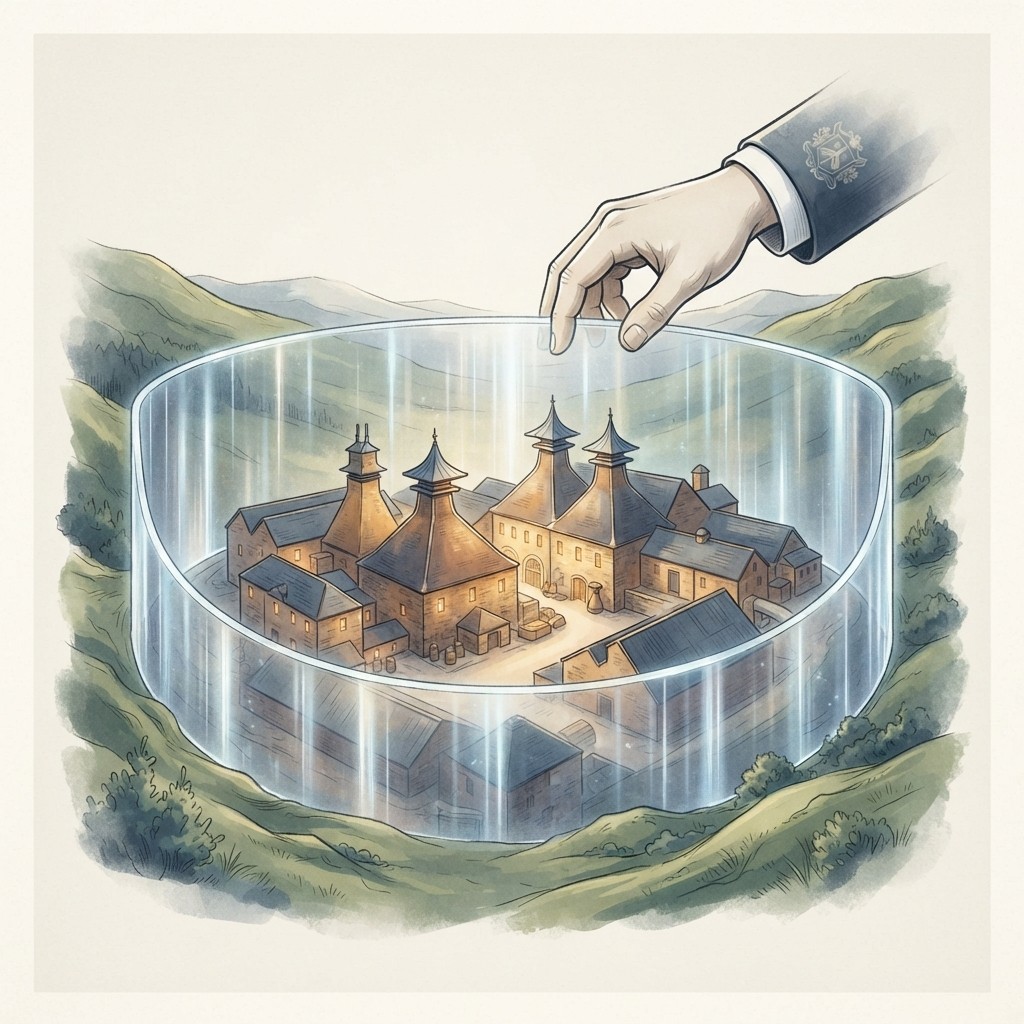
The official version: Diageo is an unassailable brand fortress, defended by marketing genius and shelf dominance. The truer version: Diageo's strongest defense is a barrier it did not build, cannot fully control, and which has occasionally been pointed straight back at Diageo itself. The moat is made of law and geography, not just goodwill.
Why a rival can copy the marketing but not the whisky
Brands can be out-spent. A competitor with deep pockets can buy attention, hire the agency, sponsor the festival. What it cannot buy is time and place. The Scotch Whisky Regulations 2009, a UK statutory instrument, require that anything labelled Scotch be matured exclusively in Scotland, in oak casks no larger than 700 litres, for a minimum of three years - and they define five legally protected geographical indications, enforced by the Scotch Whisky Association under civil law.6 That single sentence is the moat. To compete on Scotch you must own distilleries in Scotland and have laid down stock years before you need it. Diageo's distilleries already produce roughly 40% of all Scotch whisky by volume; Pernod Ricard makes another fifth.5 The two of them hold most of the only place on earth where the product can legally exist. You cannot start a Scotch brand this year and sell it this year. The law forbids it, and Diageo's warehouses already hold the head start.
| The brand fortress story | The real protection | |
|---|---|---|
| What it is | Logos, ads, shelf presence | Legally enforced scarcity of Scotch |
| Who controls it | Diageo | The UK government and the SWA |
| Can a rich rival copy it | Eventually, yes | Not without years of aged stock in Scotland |
| Cuts against Diageo | No | Yes - it has been refused by the SWA |
The barrier that told Diageo no
Here is the part the fortress narrative cannot absorb: the same rules that lock rivals out also lock Diageo in. The company formed an internal task force to study how the Scotch regulations constrained it, weighed launching 'scotch whisky infusions,' and asked the SWA for permission to finish single malts in Don Julio tequila barrels. The SWA declined.7 Read that again. The largest single producer of Scotch on earth asked the gatekeeper for room to innovate on its own product, and the gatekeeper said no. A moat you do not control is a moat that can be turned around on you. Diageo benefits enormously from the wall - and occasionally bruises itself against it. That is the difference between owning a barrier and merely standing behind one someone else built.
“Diageo formed an internal task force to explore how the regulations constrained it, and sought SWA permission to finish single malts in Don Julio tequila barrels - permission the SWA declined.”7
Isn't a 40% share and the world's top brand moat enough?
The fair objection is that this is splitting hairs: Diageo owns the rules' biggest beneficiary share, owns the number-one Scotch brand in the world4, and owns the warehouses full of maturing stock - so what does it matter who technically holds the pen? It matters because the protection is not permanent and not Diageo's to renew. Regulations can change; the GI framework dates to 2009, not antiquity. And brand strength is not the same as profit resilience: Diageo's reported operating profit fell to $4.335 billion in FY2025, a 28% reported decline from the prior year, dragged down in part by destocking in Latin America and the Caribbean.2 FY2024 had already shown organic operating profit slipping 4.8%, with the Latin America and Caribbean region alone accounting for $302 million of the decline.1 A fortress whose earnings can swing that hard on regional inventory is not invulnerable. The brand is a real asset; it just isn't the load-bearing wall. The wall is the law, and the law belongs to someone else.
When a company's strongest protection is a government-granted barrier - a geographical indication, a license regime, a patent pool - it gets two things at once: a defense rivals genuinely can't replicate, and a dependency it doesn't control. The barrier can be narrowed, reinterpreted, or pointed back at the incumbent, as the SWA did when it refused Diageo's tequila-barrel finish. So when you analyze a 'brand fortress,' ask who actually owns the wall. If the answer is a regulator or a trade body, the brand is renting its scarcity, not owning it - and rent terms can change.
Diageo itself is younger than its image suggests - the corporate entity was formed only in 1997, from the merger of Guinness and Grand Metropolitan, its name invented by a branding consultancy from Latin and Greek roots.3 The brands it inherited are centuries old; the company is not. That gap is the whole point. Diageo did not build the thing that protects it. It assembled the largest position behind a barrier that Britain wrote and the SWA enforces - a barrier of place and time that no marketing budget can shortcut. The moat is real. It is just not the one on the label, and Diageo doesn't hold the deed to it.
Moats that live somewhere other than the brand
Moat Anatomy Canvas
A one-page canvas that dissects a moat instead of asserting it: where the advantage comes from, how much of the market it covers, how long it would take to copy, and what keeps it from eroding. Blank to dissect your own claimed edge; filled as the worked example tracing the structure of the story's defensible advantage. Use it to tell a real moat from a head start.
Included, filled and blank, in the The Moat Anatomy Casebook. See the set → · Preview the blank →
Sources
Where this comes from — the filings, records, and reporting behind it.
- 1Diageo reported net sales of $20.3 billion in FY2024, with organic net sales declining 0.6% and organic operating profit declining 4.8%; $302 million of the operating profit decline was attributable to Latin America and Caribbean.
- 2Diageo's FY2025 net sales were $20.245 billion (flat vs. $20.269 billion in FY2024) and operating profit was $4.335 billion, a 28% reported decline from $6.001 billion in FY2024; Diageo is ranked #1 in international spirits by retail sales value and 1.4x larger than its nearest international spirits competitor.
- 3Diageo was formed on 17 December 1997 through the merger of Guinness plc and Grand Metropolitan plc; shares began trading on the London Stock Exchange on that date; the name Diageo was created by branding consultancy Wolff Olins, deriving from Latin 'dies' (day) and Greek 'geo' (earth).Wikipedia, Diageo ↗ · 2025
- 4Johnnie Walker is the world's number one Scotch whisky brand (IWSR 2024) and world's number one international spirits brand by relative market share (IWSR 2024), enjoyed in over 180 countries; together all Johnnie Walker variants account for over 22 million cases sold annually (IWSR 2023).
- 5Distilleries owned by Diageo produce approximately 40% of all Scotch whisky (by volume), with over 24 brands including Johnnie Walker, J&B, and Vat 69; Pernod Ricard produces another ~20%.Wikipedia, Scotch whisky ↗ · 2025
- 6The Scotch Whisky Regulations 2009 (SI 2009/2890) are a UK statutory instrument regulating production, labelling, advertising and packaging of Scotch whisky; they define five legally protected geographical indications and mandate maturation exclusively in Scotland in oak casks not exceeding 700 litres for a minimum of three years. The SWA has civil enforcement rights under the regulations.
- 7Diageo formed an internal 'secret task force' to explore how Scotch whisky regulations constrained the company, considered creating 'scotch whisky infusions' and sought SWA permission to finish single malts in Don Julio tequila barrels — permission the SWA declined. This shows the SWR acts as a constraint on Diageo's own innovation, not merely a barrier against rivals.
- 8In 2010, Diageo pledged up to 2 million barrels of maturing Scotch whisky — valued at roughly $645 million — as contingent collateral for pension fund obligations, not as direct payment to employees; Diageo retained control of the barrels and made annual cash payments to the pension fund.
More like this — beyond Diageo
New Strategically analyses as they publish: the defining moves in business, checked against the record. No noise, and one click to leave.