Pairs with the Moat Anatomy Canvas — a ready-to-use strategy tool. Included in the Moat Anatomy Casebook →
“What would it actually cost a challenger to take your customer?”
Walk into a bar in São Paulo, a duty-free hall in Singapore, or a corner shop in Lagos, and the same striding-man label is on the shelf. Johnnie Walker is sold almost everywhere a bottle of Scotch can legally change hands — and so are Guinness, Smirnoff, Captain Morgan, Baileys, Tanqueray and Don Julio, all under one roof, all reaching nearly 180 countries.4 That ubiquity is the thing people mean when they call Diageo's moat unassailable. It is real. It is also, right now, leaking at exactly the place the legend says it's deepest.
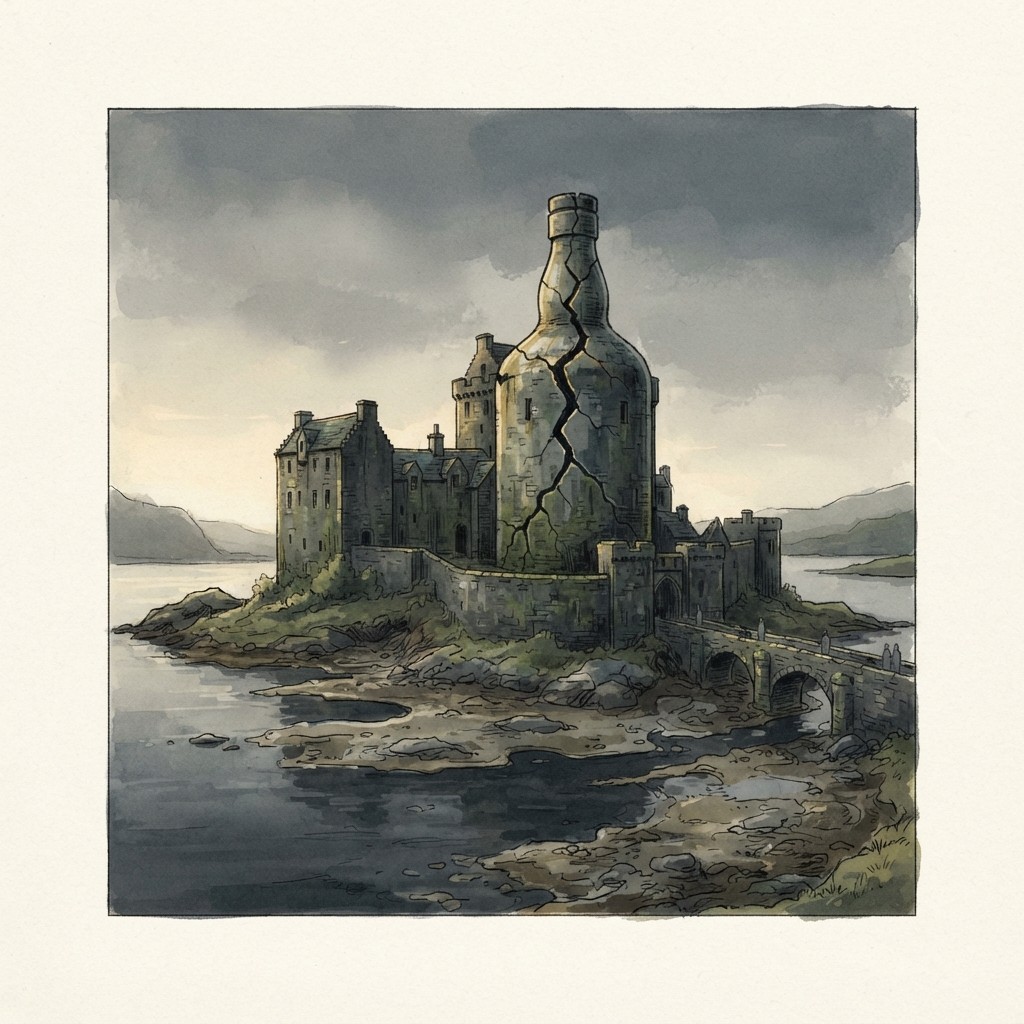
The official story is that Diageo is a fortress built on the world's best-selling Scotch — that Johnnie Walker is the keep and the rest of the portfolio is the curtain wall. The truer story is the reverse. The flagship is the weak point, and the moat is the breadth around it. In its single most important market, Johnnie Walker's net sales fell 10.6% in fiscal 2025.6 The brand isn't the moat. The portfolio is.
The moat was assembled in a single day, not brewed over centuries
Here is the first thing the heritage marketing hides: Diageo was not founded with Guinness at its heart in some misty 18th-century origin. It was assembled, in legal terms, on one specific day. On 17 December 1997, GrandMet PLC became a wholly owned subsidiary of Guinness PLC, and Guinness PLC was renamed Diageo plc.1 Read that carefully — Diageo is a renamed Guinness, with GrandMet the absorbed party. The brewery's company structure survived; the name on the door changed.
And it was no clean handshake. LVMH contested the deal for months and walked away with £250 million on its resolution, while US and European regulators forced the new company to divest Dewar's Scotch and Bombay Gin to Bacardi before they'd bless it.59 So the moat that looks like centuries of accumulated craft is, structurally, a corporate transaction — a portfolio bolted together under fire and trimmed by antitrust. That matters, because a moat built by acquisition can be eroded the same way it was built: brand by brand, market by market.
“The leading premium spirits business in the world by volume, by net sales and by operating profit... manages eight of the world's top 20 spirits brands.”8
Why owning many brands beats owning one great one
The mechanism of the moat is not the fame of any single label. It's the math of breadth feeding distribution. A retailer or distributor in any of those ~180 markets does not want to negotiate one brand at a time; they want a single supplier who can fill the whole back bar — Scotch, vodka, rum, gin, stout, tequila, liqueur.4 Diageo can offer that, and a single-brand challenger cannot. The portfolio buys shelf space, distributor attention, and bargaining leverage that no one bottle could earn alone. By the company's own FY2010 telling, eight global priority brands made up 54% of net sales8 — a concentration, whatever the precise figure today, that focuses marketing money while keeping any single stumble from sinking the ship.
That diversification is doing visible work right now. As Johnnie Walker, Buchanan's and Bulleit all fell in the US in fiscal 20256, other parts of the portfolio absorbed the blow. The moat, in other words, is not that any brand is invincible — it's that the company never has to bet on just one. Guinness, the only global stout brand by Diageo's own description8, plays a category nobody else owns at scale. Don Julio rides the tequila wave; Crown Royal covers the Canadian-whisky lane. The portfolio is a hedge as much as a hammer.
| The fortress story | What FY2024–25 shows | |
|---|---|---|
| The asset | Johnnie Walker, world's best-selling Scotch | The portfolio breadth, ~180 markets |
| The flagship in the US | Unassailable top seller | Net sales down 10.6% in FY2025 |
| Operating profit FY2024 | $6.0bn, up 8.2% — resilient | Organic operating profit down 4.8% |
| Operating margin FY2024 | Premium pricing holds | Contracted 130 basis points |
| Latin America / Caribbean | A growth theatre | Organic net sales down 23% in H1 FY2024 |
The number the moat narrative quietly skips
Pull the FY2024 results and you'll find the headline that gets quoted: $20.3 billion in net sales and a $6.0 billion operating profit, up 8.2%.2 A fortress, surely. But that operating-profit gain was inflated by exceptional items. Strip them out and the real picture appears: organic operating profit fell 4.8% and organic operating margin contracted 130 basis points.2 The pricing power that's supposed to be the moat's signature was, on an organic basis, going backwards.
Worse, the bleeding clusters in the growth theatres. In the first half of fiscal 2024, organic net sales fell 0.6% — driven by a $310 million, 23% collapse in Latin America and the Caribbean.7 A moat is supposed to be widest where you're expanding. Diageo's was thinnest exactly there. The breadth held the total together; the depth, in the places where recovery has been hardest, did not.
Isn't a portfolio this big simply too entrenched to crack?
The fair objection is that a single bad year proves nothing. Diageo still throws off cash — $4.1 billion from operations and $2.6 billion of free cash flow in FY20242 — and raised its dividend 5%.3 A portfolio spanning ~180 countries and eight of the world's top 20 spirits brands8 is not unwound by one soft quarter in Latin America. All true. The distribution moat is real, and it buys time most challengers never get.
But the honest counter cuts the other way. The whole point of a moat is that it protects pricing and volume through a downturn — and the organic numbers show pricing eroding (margin down 130bps) while the flagship loses volume share in the US and the company's expansion markets contract.267 A moat that holds the total revenue line steady while quietly thinning at the edges isn't broken. It's being tested at the exact frontier where future growth has to come from. Entrenchment buys patience, not immunity.
A portfolio moat is easy to over-trust, because the aggregate numbers stay handsome long after the underlying ones turn. Diageo's $20bn top line barely moved while its flagship fell double digits in its biggest market and its growth regions shrank by a fifth. The lesson for any company defending a wide moat: the durable signal isn't total revenue or a reported-profit headline padded with exceptional items — it's the organic trend in the markets you're counting on for the next decade. Breadth hides weakness; organic depth reveals it. Strip out the exceptional items and read the line that's supposed to be growing. That's where the moat is actually being attacked.
Diageo's moat was never the striding man on the Johnnie Walker label. It was the decision, made in a single contested merger in December 1997, to own the whole bar rather than the best bottle — and to carry it into nearly every market on earth.14 That breadth is genuine, and it's why the company can lose its flagship's volume in the US and still raise the dividend. But the same breadth is now doing double duty as camouflage: it's holding the headline steady while the organic engine sputters at the frontier. The fortress isn't falling. It's just discovering that a moat measured in countries can run shallow exactly where it needs to run deepest.
When the moat isn't what everyone thinks it is
Moat Anatomy Canvas
A one-page canvas that dissects a moat instead of asserting it: where the advantage comes from, how much of the market it covers, how long it would take to copy, and what keeps it from eroding. Blank to dissect your own claimed edge; filled as the worked example tracing the structure of the story's defensible advantage. Use it to tell a real moat from a head start.
Included, filled and blank, in the Moat Anatomy Casebook. See the set → · Preview the blank →
Sources
Where this comes from — the filings, records, and reporting behind it.
- 1Diageo plc was formed from the merger of GrandMet PLC and Guinness PLC on 17 December 1997; GrandMet became a wholly owned subsidiary of Guinness PLC, and Guinness PLC was renamed Diageo plc.
- 2Diageo FY2024 full-year: reported net sales of $20.3 billion (down 1.4%); reported operating profit of $6.0 billion (up 8.2% due to exceptional items); organic net sales declined 0.6%; organic operating profit declined 4.8%; organic operating margin contracted 130bps; net cash from operating activities $4.1 billion; free cash flow $2.6 billion.
- 3Diageo FY2024 Annual Report confirms: Volume EU230.5m, Net Sales $20,269m, Operating Profit $6,001m; EPS 173.2c; total recommended dividend per share 103.48c (up 5%); free cash flow $2,609m.
- 4Diageo's core brand portfolio includes Johnnie Walker, Crown Royal, J&B and Buchanan's whiskies, Smirnoff and Ketel One vodkas, Captain Morgan, Baileys, Don Julio, Tanqueray and Guinness; products sold in nearly 180 countries.
- 5The 1997 merger required Guinness and GrandMet to divest Dewar's Scotch and Bombay Gin to gain US and European regulatory approval; LVMH contested the merger and received £250 million upon its resolution; the merged entity retained Guinness's ~34% stake in Moët Hennessy while LVMH took ~11% of Diageo.
- 6In fiscal 2025 (year ended June 2025), Johnnie Walker net sales declined 10.6% in the US due to category weakness; Buchanan's declined 26% and Bulleit declined 7.3% in the same region.
- 7Diageo's Form 6-K (SEC-filed) for FY2024 H1 confirms: reported net sales of $11.0 billion declined 1.4%; organic net sales declined 0.6% driven by a $310 million / 23% decline in Latin America and Caribbean; reported operating profit declined 11.1% to $3.3 billion.
- 8Diageo's 2010 Form 20-F (SEC filing) states it was 'the leading premium spirits business in the world by volume, by net sales and by operating profit' and 'manages eight of the world's top 20 spirits brands'; Guinness is described as 'the only global stout brand'; the eight global priority brands comprised 54% of Diageo's net sales.
- 9The FTC approved the sale of Dewar's Scotch, Bombay Gin and Bombay Sapphire gin to Bacardi & Company Limited for $1.9 billion following the Guinness-GrandMet merger.
- 10Diageo's own brand page states Johnnie Walker is the world's best-selling Scotch whisky, enjoyed in over 180 countries.
Weighing outside help with a decision like this? Hiring a commercial due diligence provider
More like this — beyond Diageo
New Strategically analyses as they publish: the defining moves in business, checked against the record. No noise, and one click to leave.