Pairs with the Moat Anatomy Canvas — a ready-to-use strategy tool. Included in the The Moat Anatomy Casebook →
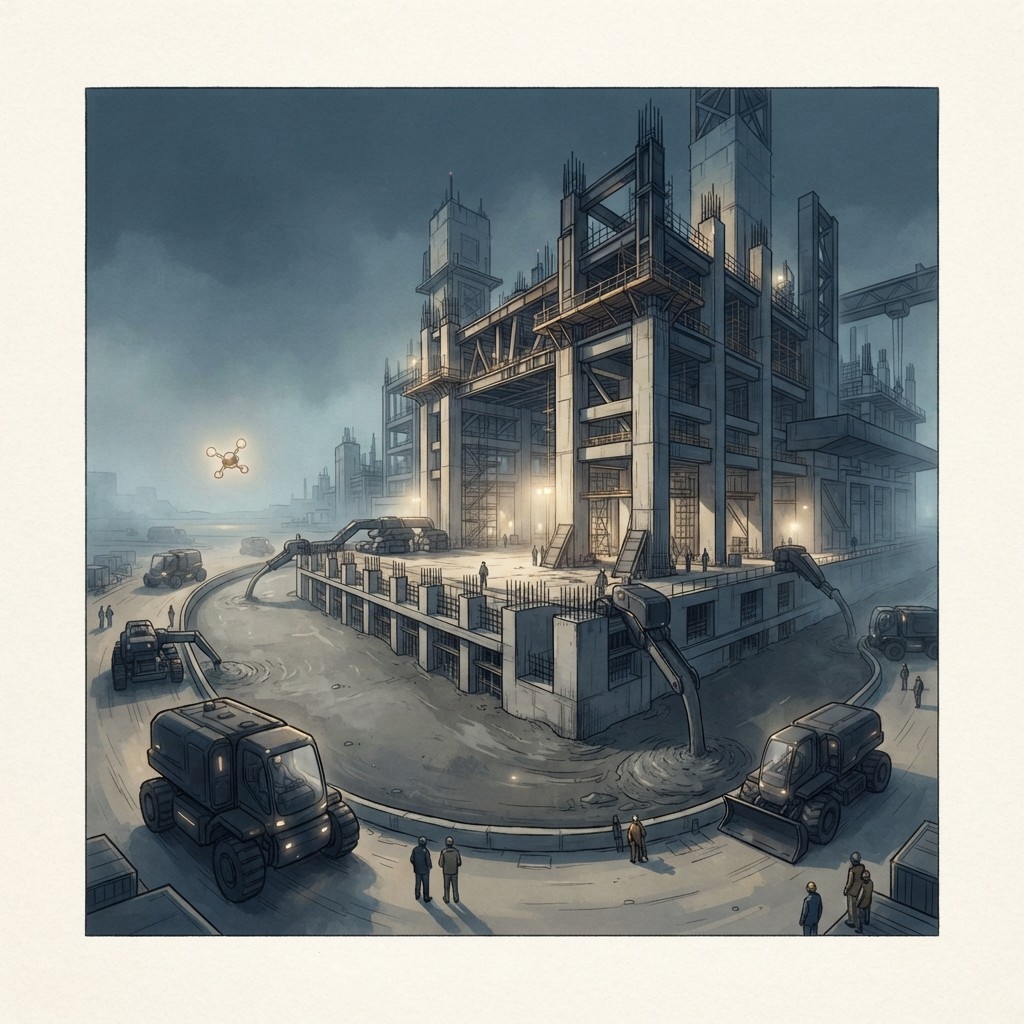
In 2020, Eli Lilly started pouring concrete for a drug nobody was allowed to sell yet. Tirzepatide had no FDA approval - Mounjaro wouldn't arrive until 2022, Zepbound until 2023. There was no market, no prescription, no demand to point to. There were only research results and a decision to spend billions on factories for a product the government had not cleared and patients could not buy. Lilly's own investors were told, in plain language, that the bet was made 'at risk.'1 It is the most important word in the entire GLP-1 story, and almost everyone telling that story has it backwards.
The official version is that Lilly built capacity in response to runaway obesity demand. That isn't what happened. Lilly committed the capital before the demand existed, before the approval existed, before anyone outside the company knew the molecule would change medicine.1 The factories didn't follow the wave. They were already there when the wave hit.
The patent everyone fixates on isn't the thing that's scarce
Ask which company wins the obesity-drug era and the instinct is to argue about molecules - whose GLP-1 is more potent, who has the better oral pill, whose patent runs longest. That is the wrong fight. The molecule is necessary but it is not scarce; competitors have their own. What is genuinely scarce is the ability to make the stuff at planetary scale, and that capacity cannot be conjured on the timeline of a competitive response. Lilly's own FY2024 10-K says so flatly: shifting or adding manufacturing capacity is a 'very lengthy process requiring significant capital expenditures, process modifications, and regulatory approvals.'3 Read that again as a competitor would. Every word is a year. The thesis here is simple: Lilly's moat is not the drug. It is the multi-year, multi-billion-dollar capital cycle that a rival cannot compress no matter how much money it has.
“...a very lengthy process requiring significant capital expenditures, process modifications, and regulatory approvals.”3
Why money can't buy back the years
Here is the mechanism, worked all the way down. A rival who decides today to match Lilly's output has to find a site, design a complex API and parenteral facility, build it, validate the process, and then win regulatory sign-off on the finished plant - each step gated by the one before it, none of them parallelizable past a point. The capital is the easy part. The time is the moat. By committing in 2020, Lilly spent its years before its competitors started spending theirs, and years are the one input that cannot be bought back at any price. So when the demand finally arrived, the question was never 'who can fund a factory?' It was 'whose factory is already running?' That asymmetry is why Lilly kept pressing the accelerator even after launch. In May 2024 it added $5.3 billion to its Lebanon, Indiana site, lifting the total commitment there from $3.7 billion to $9 billion2, and that same month it acquired a Wisconsin plant from Nexus Pharmaceuticals — a securities filing later revealed for approximately $925 million — to expand parenteral capacity.12 It was buying time it could no longer make.
The shortage that wasn't a supply problem
Proof of a moat usually hides in the moment a rival expects you to stumble. Through mid-2024, every dose of tirzepatide sat on the FDA shortage list - the kind of headline that signals a company drowning in its own success. Then, by August 2024, the FDA marked it available, and Lilly's CEO told investors on the Q2 2024 earnings call that the drug was available in all dosage forms in the U.S.6 The more revealing moment came that fall. When Q3 2024 tirzepatide sales came in soft - a combined $4.37 billion against an estimated $5.31 billion - analysts reached for the obvious story: still short on supply. Lilly's SEC filing said otherwise, attributing the miss to inventory decreases in the wholesaler channel, not factory output, and the CEO stated plainly the miss was not a function of supply.7 That distinction is the whole point. A company whose problem is wholesalers drawing down stock is a company that has solved the hard problem - the one its competitors haven't even reached.
| Buyable with capital | Not buyable - the moat | |
|---|---|---|
| What it is | Funding a new plant | The years to build and validate it |
| When Lilly paid for it | Continuously, 2020 onward | Starting in 2020, 'at risk' |
| Can a rival match it now? | Yes, with cash | No - cannot compress the timeline |
| The Q3 2024 'miss' | Read as a supply shortage | Was actually channel inventory |
Isn't this just a demand bet that happened to pay off?
The honest objection is that this is too clean a story, and there are three real complications. First, the giant February 2025 'Lilly in America' announcement - $27 billion for four new plants - wasn't purely an obesity bet; Ricks said the investment was driven by Lilly's optimism about its pipeline across therapeutic areas — cardiometabolic health, oncology, immunology, and neuroscience — and that the new investments are not solely dedicated to obesity and diabetes.13 Second, multiple reports noted those U.S. plants also looked like a response to threatened pharmaceutical import tariffs, which muddies any pure demand-driven narrative.11 Third, the obvious counter: it's easy to call a bet 'visionary' once it works - hindsight launders luck into genius. All fair. But the moat thesis survives each one. The point was never that Lilly perfectly forecast obesity demand. The point is that by building 'at risk' in 20201, Lilly burned the years its competitors still have to burn - and whether the later expansions were also about tariffs or oncology only reinforces that capacity, not any single molecule, is the asset it is racing to own. The bet paid off because it was made early, and early is the one thing money cannot retroactively purchase.
“I have zero doubt that we still have more building to do, and that the capacity we put in the ground so far is not sufficient to meet global demand.”8
The most defensible advantage is rarely the product everyone is comparing - it's the slow, expensive, un-compressible asset behind it that a rival can fund but cannot fast-forward. Lilly didn't win the GLP-1 race by having the only molecule; it won by spending its years before competitors started spending theirs, committing capital 'at risk' when there was no approval and no demand to justify it. Two cautions. First, this only works when the time-to-build is genuinely long and serial - if a rival can parallelize or rent the capacity, there's no moat, just a head start. Second, building before demand is a real bet, not a sure thing; Lilly happened to be right about tirzepatide, and the same move on a failed molecule would have been a multi-billion-dollar monument to nothing. The discipline isn't to always build early. It's to recognize the rare case where the scarce thing is time, and then refuse to wait for permission.
Lilly is still building, and that is the tell. With the shortage formally over and the drugs back on shelves, the CEO told investors there is no doubt more building to do, and that the capacity already in the ground is not enough to meet global demand8 - the company plans to produce 1.6 times the marketable incretin doses in the first half of 2025 that it made a year earlier. A company finished securing its lead would coast. Lilly is sprinting, because it understands what its rivals are only now discovering. The molecule was always copyable. The years were not. The moat was never in the vial. It was in the concrete - poured before anyone said yes.
When the real advantage hides where you'd never look
Moat Anatomy Canvas
A one-page canvas that dissects a moat instead of asserting it: where the advantage comes from, how much of the market it covers, how long it would take to copy, and what keeps it from eroding. Blank to dissect your own claimed edge; filled as the worked example tracing the structure of the story's defensible advantage. Use it to tell a real moat from a head start.
Included, filled and blank, in the The Moat Anatomy Casebook. See the set → · Preview the blank →
Sources
Where this comes from — the filings, records, and reporting behind it.
- 1Lilly began manufacturing expansion in 2020, driven by tirzepatide research results, and made that investment decision 'at risk' before FDA approvals of Mounjaro (2022) and Zepbound (2023).
- 2In May 2024, Lilly added $5.3 billion to its Lebanon, Indiana site, raising total investment at that site from $3.7 billion to $9 billion, to enhance API manufacturing capacity for Zepbound and Mounjaro.
- 3Lilly's FY2024 10-K confirms manufacturing expansion across sites in North Carolina, Wisconsin, Ireland, Germany, and two in Indiana, and acknowledges that shifting or adding manufacturing capacity is a 'very lengthy process requiring significant capital expenditures, process modifications, and regulatory approvals.'
- 4The FY2024 10-K (via TradingView summary of primary filing) reports Lilly acquired a Wisconsin manufacturing site in May 2024 for $947.7 million to expand global parenteral manufacturing capabilities, and FY2024 total revenue was $45.04 billion, up 32%[[cite:s10]], driven primarily by Mounjaro, Zepbound, and Verzenio.
- 5At a February 2025 'Lilly in America' press conference in Washington D.C., Lilly announced $27 billion in additional U.S. manufacturing investment — construction of four new facilities — more than doubling its domestic spend since 2020 to over $50 billion. CEO David Ricks called it 'the largest pharmaceutical expansion investment in U.S. history.'
- 6All doses of tirzepatide were listed in the FDA drug shortage database at various points through mid-2024; the FDA updated the shortage status to 'available' by August 5, 2024. Lilly CEO Ricks confirmed on the Q2 2024 earnings call: 'We're available in all dosage forms in the U.S.'
- 7Lilly's Q3 2024 SEC-filed 8-K attributed the tirzepatide sales miss ($4.37B combined vs. $5.31B estimated) to 'inventory decreases in the wholesaler channel' — not to manufacturing shortages. CEO Ricks explicitly stated the miss was not a function of supply.
- 8Despite the formal end of the U.S. tirzepatide shortage, Lilly stated it expects to produce 1.6x the marketable incretin doses in H1 2025 vs. H1 2024. CEO Ricks stated: 'I have zero doubt that we still have more building to do, and that the capacity we put in the ground so far is not sufficient to meet global demand.'
- 9CEO David Ricks called the February 2025 announcement 'the largest pharmaceutical expansion investment in U.S. history.'
- 10FY2024 total Lilly revenue was $45.04 billion, up 32%, driven primarily by Mounjaro, Zepbound, and Verzenio.
- 11Multiple reports noted Lilly's U.S. manufacturing plants also looked like a response to threatened pharmaceutical import tariffs.
- 12A securities filing revealed Lilly spent approximately $925 million to acquire the Wisconsin manufacturing facility from Nexus Pharmaceuticals.
- 13At the February 2025 'Lilly in America' announcement, CEO David Ricks said Lilly's optimism about its pipeline across therapeutic areas — cardiometabolic health, oncology, immunology, and neuroscience — drives its domestic manufacturing commitment, and that the new investments are not solely dedicated to obesity and diabetes treatments.
More like this — beyond Eli Lilly
New Strategically analyses as they publish: the defining moves in business, checked against the record. No noise, and one click to leave.