Pairs with the Distribution Channel Map — a ready-to-use strategy tool. Included in the Distribution Rebellion Casebook →
“How much of the channel's margin do you actually keep?”
On Black Friday in 2011 - the most aggressive selling day of the American calendar - Patagonia bought a full page in The New York Times and ran a photo of one of its best-selling fleeces under three words: Don't Buy This Jacket.1 The ad cost roughly $57,000. The company's then-CEO later said it threw off $40 to $50 million in free publicity.2 Read it once and it looks like a self-sabotaging stunt. Read it twice and you see the real move: a retailer asking you not to buy was, in fact, asking you to belong.
The official story is that Patagonia is staging a rebellion against consumerism and against the wholesale machine - cutting out the department store, telling you to consume less, selling you used clothes off its own shelves. That's the legend, and it's repeated everywhere. The truth underneath is stranger and more durable. The anti-consumption message and the repair counter aren't a protest against selling. They're a loyalty engine wearing a protest's clothes.
The repair counter is the real distribution channel
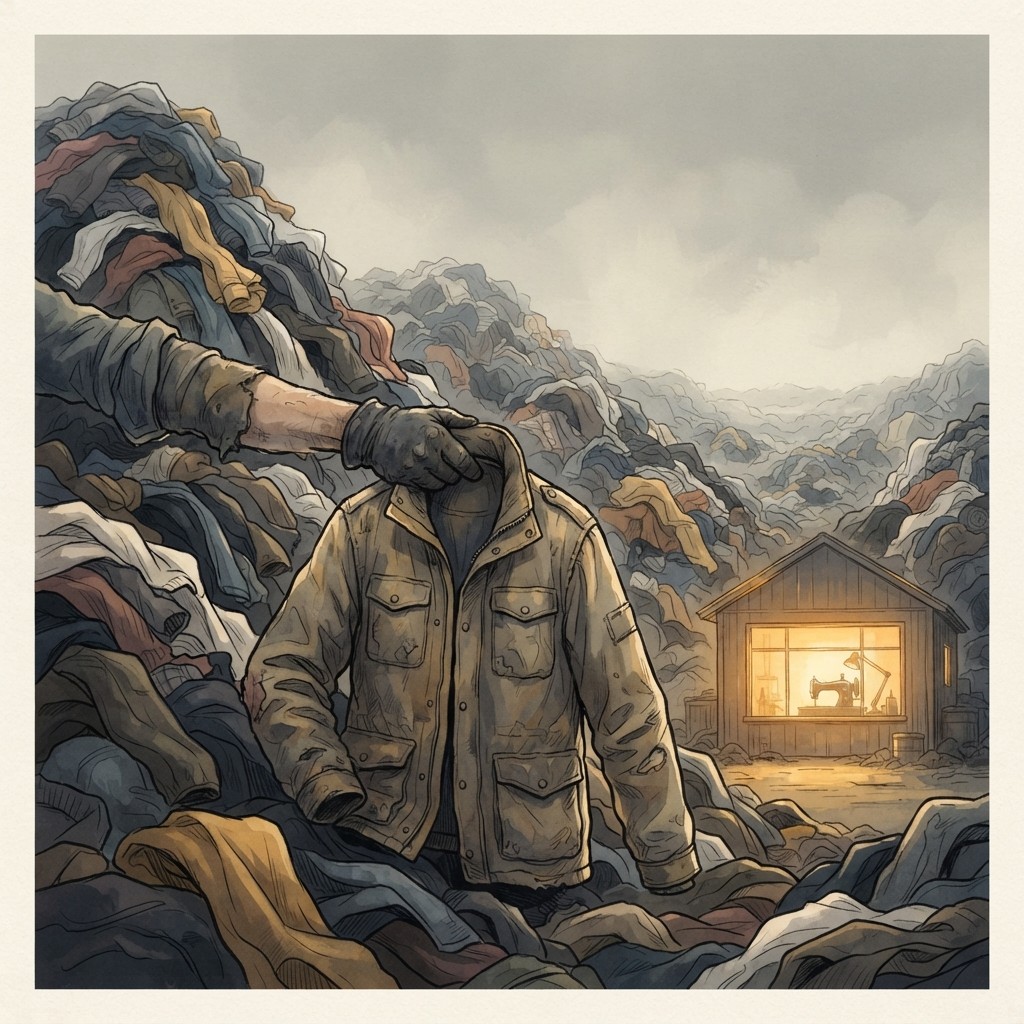
Most distribution rebellions are about who stands between the maker and the buyer - cut the middleman, sell direct, keep the margin. Patagonia did some of that. But the more interesting rebellion is against the moment the relationship is supposed to end. In ordinary retail, the sale is the finish line: money changes hands, the jacket leaves the building, and the next time the company hears from you is when you want a new one. Patagonia built infrastructure to make that ending never arrive. Worn Wear, created in 2013, opened used-clothing sections inside four U.S. stores on September 15 that year, with a buy-back desk for shells, fleece, down, and ski pants.8 The permanent online resale site followed in September 2017.4 And behind both sits the largest garment-repair facility in North America, in Reno, Nevada, mending roughly 50,000 pieces a year.5 The thesis in one line: Patagonia isn't selling you a jacket. It's enrolling you in the ongoing custody of one.
Why a free repair is the cheapest switching cost ever sold
Here's the mechanism, worked down. A switching cost is anything that makes leaving feel more expensive than staying. Most brands manufacture them with points, subscriptions, or lock-in - friction the customer resents. Patagonia inverts it. When you send a torn jacket to Reno and it comes back fixed, the company has spent money keeping you from needing to spend money. That generosity is the lock-in. Now your jacket carries history - the rip from the climbing trip, the patch from the repair team - and a garment with history is one you don't replace; you maintain. The act of repair quietly converts a product into a relationship, and relationships don't shop around. Patagonia's own people describe the function plainly: the repairs team feeds recurring failure patterns back to designers, and the company's global repair experience manager has described repair as a trust- and loyalty-building act, not a cost center.6 The repair desk does two jobs at once - it makes better products and it makes stickier customers - and both jobs run on the same torn seam.
| Ordinary retailer | Patagonia's repair model | |
|---|---|---|
| When the relationship ends | At the register | Never, by design |
| What a worn product signals | Time to buy a new one | Time to fix this one |
| The switching cost | Loyalty points, friction | Accumulated history + free repairs |
| What design learns from | Returns and complaints | Recurring repair patterns |
“Don't Buy This Jacket.”1
Notice what the ad actually does once you read it as strategy. It doesn't suppress demand - it filters it. A customer who buys after being told not to is a customer who has self-selected into the brand's values, and that customer is worth more, complains less, and stays longer than one chasing a discount. The $57,000 page bought far more than its $40-50 million in coverage suggested; it bought a screening test at the top of the funnel.12 Telling people to consume less is, for this particular audience, the single most effective way to make them consume Patagonia specifically.
The honest problem: a thesis built on numbers nobody can audit
The fair objection is that this is too tidy, and the harder objection is sharper still: how do we know any of it actually drives growth? Patagonia is private and has never published audited financials. Its closest primary disclosure, the FY2023-2024 Benefit Corporation Report, covers B Corp recertification - not revenue, not channel mix, not a dollar of Worn Wear sales.7 The widely repeated 'anti-consumerism made sales jump 30%' claim has no primary source behind it; the defensible version is the publicity figure the then-CEO gave, nothing more.2 The headline repair numbers are years old - the 50,000-a-year and 415,174-cumulative figures date to around 2021 - and circulate without update.5 So the steelman cuts both ways: the loyalty mechanism is real and observable, but the claim that it is a revenue engine rests on a legend laundered by repetition rather than disclosure. The model is genuinely smart. The financial proof is genuinely missing. An honest read holds both.
The most defensible customer relationship often isn't the one you create at the register - it's the one you create at the repair desk, the upgrade, the trade-in. Every time you spend money keeping a customer from needing to buy, you're buying something more valuable than the next transaction: their reason to never leave. But two cautions. First, this only works when the product is built to last long enough to repair - the model collapses on disposable goods. Second, beware your own legend: a story this good attracts unsourced numbers that flatter it. Patagonia's repair loyalty is real; the revenue figures attached to it mostly aren't. Run the strategy on the mechanism, not on the myth.
Patagonia's rebellion was never really against distribution. It was against the idea that a company's interest in you stops the moment you've paid. By standing at the repair counter instead of only the cash register, it made the worn, patched, history-carrying jacket the most powerful marketing asset it owns - one it can't manufacture, only earn, one seam at a time. The genius isn't telling you not to buy the jacket. It's making sure that once you do, you'll never have a reason to buy anyone else's.
When the business hides where you'd never look
Distribution Channel Map
A map of every hop between the company and the customer — each intermediary, who owns the relationship at each step, and where the company controls the channel versus where it's at the channel's mercy. Blank to chart your own route to market; filled as the worked example showing where the story's company went direct, fought its gatekeepers, or got disintermediated.
Included, filled and blank, in the Distribution Rebellion Casebook. See the set → · Preview the blank →
Sources
Where this comes from — the filings, records, and reporting behind it.
- 1The 'Don't Buy This Jacket' ad ran on Black Friday, November 25, 2011, in The New York Times, as part of Patagonia's Common Threads Initiative. The ad cost approximately $57,000 and then-CEO Casey Sheahan stated it generated '$40–$50 million of free publicity.'
- 2The $57,000 ad cost and the '$40–$50 million of free publicity' figure are attributed to Casey Sheahan, then-CEO of Patagonia, in an interview conducted for the book 'Dirtbag Billionaire' by David Gelles.
- 3Worn Wear was created in 2013 as a care/repair program. In-store used-clothing sections opened September 15, 2013, at Seattle, Palo Alto, Portland, and Chicago stores. The permanent Worn Wear online resale website launched in September 2017.
- 4Patagonia's Worn Wear online resale platform became a permanent fixture in September 2017, after years of pop-up events, allowing consumers to purchase, trade, and sell used Patagonia products.
- 5Patagonia operates the largest garment repair facility in North America, located in Reno, Nevada, repairing approximately 50,000 pieces per year. As of 2021, repair centers and roving tours had repaired a cumulative 415,174 items since 2005, and the Worn Wear vans had visited 1,354 locations in 14 countries.
- 6Patagonia's repair program feeds product design: the repairs team shares recurring failure patterns with designers. The company's global repair experience manager (Clara Redwood) confirmed the loyalty and trust-building function of repair as of February 2025.
- 7Patagonia published its Annual Benefit Corporation Report covering fiscal years 2023 and 2024 (FY2023 ended April 30, 2023). This is the closest available primary disclosure; it covers B Corp recertification but does not publish revenue, DTC mix, or Worn Wear revenue figures.
- 8Patagonia's Worn Wear program (September 2013 in-store launch) is confirmed on patagonia.com's own stories archive, establishing the program opened with used-clothing sections at four U.S. stores and a buy-back offering for shells, fleece, down, and ski pants.
Weighing outside help with a decision like this? Hiring a digital strategy consultant
More like this — beyond Patagonia
New Strategically analyses as they publish: the defining moves in business, checked against the record. No noise, and one click to leave.