Pairs with the Flywheel Designer Canvas — a ready-to-use strategy tool, filled for DoorDash. Included in the The Flywheel Casebook →
In 2013, the only Dashers in the world were four Stanford students with personal cars, a Google Voice number, and the 'Find my Friends' app to track each other across Palo Alto.7 The whole operation was a website called Palo Alto Delivery that displayed local restaurant menus, launched on January 12, 2013.2 The idea wasn't found in a flash of genius. It was confirmed in a macaroon shop on University Avenue, where co-founder Stanley Tang watched the owner flip through pages of delivery orders she'd had to cancel because she had no one to drive them.6 That stack of canceled orders is the whole thesis in one image: demand was already there, sitting idle, waiting for someone to move the food.
Seven years later, DoorDash filed to go public and told a much grander story. Its S-1 didn't describe a delivery company. It described a flywheel - three interlocking diagrams in which more consumers pulled in more merchants, more merchants improved selection and convenience, and the resulting scale drove down delivery cost and time, which pulled in still more consumers.1 It is a beautiful loop. It is also DoorDash's own marketing language, drawn by the company about itself, and the diagram leaves out the one number that makes the whole thing honest.
“In 2024, we grew revenue 24% year-over-year, generated our first full year of positive GAAP net income, and helped generate nearly $60 billion in sales for local merchants... and over $18 billion in earnings for Dashers.”4
The loop is real - but it's a density machine, not magic
Strip away the prospectus poetry and what DoorDash actually built is a logistics network whose unit economics improve with local density. This is the part that distinguishes it from a simple two-sided marketplace. The asset isn't just that lots of people use the app; it's that within a single zip code, the orders are dense enough that one Dasher can pick up two meals on one trip, that a courier is never more than a few minutes from the next ping, that idle driving time collapses. Density is what turns a money-losing errand into a profitable one. More orders in an area make each delivery cheaper and faster; cheaper and faster delivery makes the app more attractive, which produces more orders. That feedback is the engine - and it runs neighborhood by neighborhood, not nationally.
Which is why the flywheel doesn't spin on its own. A loop that depends on local density has to be force-started in every new market: you need enough consumers, merchants, and drivers in the same square mile before any of them benefit, and getting there means paying - in marketing to acquire eaters, in incentives to recruit Dashers, in fees waived to sign merchants. The company's own thesis is that scale eventually makes this self-funding. The record says the priming bill ran for over a decade.
| The S-1 diagram | The 10-K reality | |
|---|---|---|
| What spins it | Compounding network effects | Density bought market by market |
| Cost to keep spinning | Implied near-zero at scale | Sustained marketing and incentives |
| Cumulative result by end-2024 | A virtuous cycle | $5.3B accumulated deficit |
| Profitability | Assumed to follow scale | First GAAP profit only in 2024 |
Dominance arrived. Profit took eleven years.
By the time it filed to go public, DoorDash claimed roughly half of U.S. food delivery; by the end of 2024, Earnest Analytics measured its share at 60.7%, well ahead of Uber Eats at 26.1% and Grubhub at 6.3%.5 That is genuine dominance, and the density loop is a real reason for it - in a delivery market, the leader's cars are simply closer to your door. But notice the timeline. DoorDash launched in 2013, raised $3.37 billion in its December 2020 IPO,8 and did not post a full year of positive GAAP net income until 2024 - $123 million on $10.7 billion of revenue and $80.2 billion of marketplace order value.3 A $123 million profit against a $5.3 billion accumulated deficit is the financial signature of a flywheel that took a very long, very expensive push to get moving.3
There's a second, quieter mechanism the flywheel diagram understates: lock-in. The loop is reinforced not only by density but by a subscription - DashPass - that converts a price-sensitive, switch-happy consumer into a habitual one. A marketplace where the user pays a recurring fee for free delivery has every incentive to order from that marketplace again, which feeds the same density that lowers the cost of serving them. That's a stronger retention story than 'we have the most restaurants.' But it's also a tell: if the network effect alone were sufficient, you wouldn't need to fence the consumer in with a subscription. The flywheel is partly earned and partly purchased - and the purchasing never fully stopped.
Isn't a $5 billion deficit just the price of any network business?
The fair objection is that this is how every density-driven network gets built, and the deficit is an investment, not a verdict. There's truth in it. You cannot conjure local density politely; someone has to lose money in San Antonio for two years until the orders thicken enough to pay. And DoorDash's 2024 profit, modest as it is, suggests the underlying loop can in fact carry its own weight once a market matures - the engine does run. But that defense quietly concedes the real point. A self-reinforcing flywheel, by definition, accelerates on its own momentum; the more it spins, the less force you have to apply. DoorDash spent eleven years and over five billion dollars of cumulative losses applying force, and reached profitability only after it had already won 60% of the market.35 That's not a wheel that spun itself. It's a wheel that was pushed to dominance and only then began to coast. The honest read is that the network effect is real but local and fragile, strong enough to defend a market but not strong enough to have funded the taking of it.
When a company draws its own flywheel, it is making a claim about momentum: that growth funds growth, that the loop tightens for free. Test it against one number - cumulative profit or loss since founding. A true flywheel should show the force needed to spin it falling over time. If a company reaches market dominance while still posting losses, the loop didn't carry the cost of its own construction; capital did. That's not a worthless business - density-driven networks are genuinely hard to dislodge once built - but it is a different business than the diagram promises. A defended position bought with sustained spend is a moat. A loop that funds its own expansion is a flywheel. Don't pay flywheel prices for a moat.
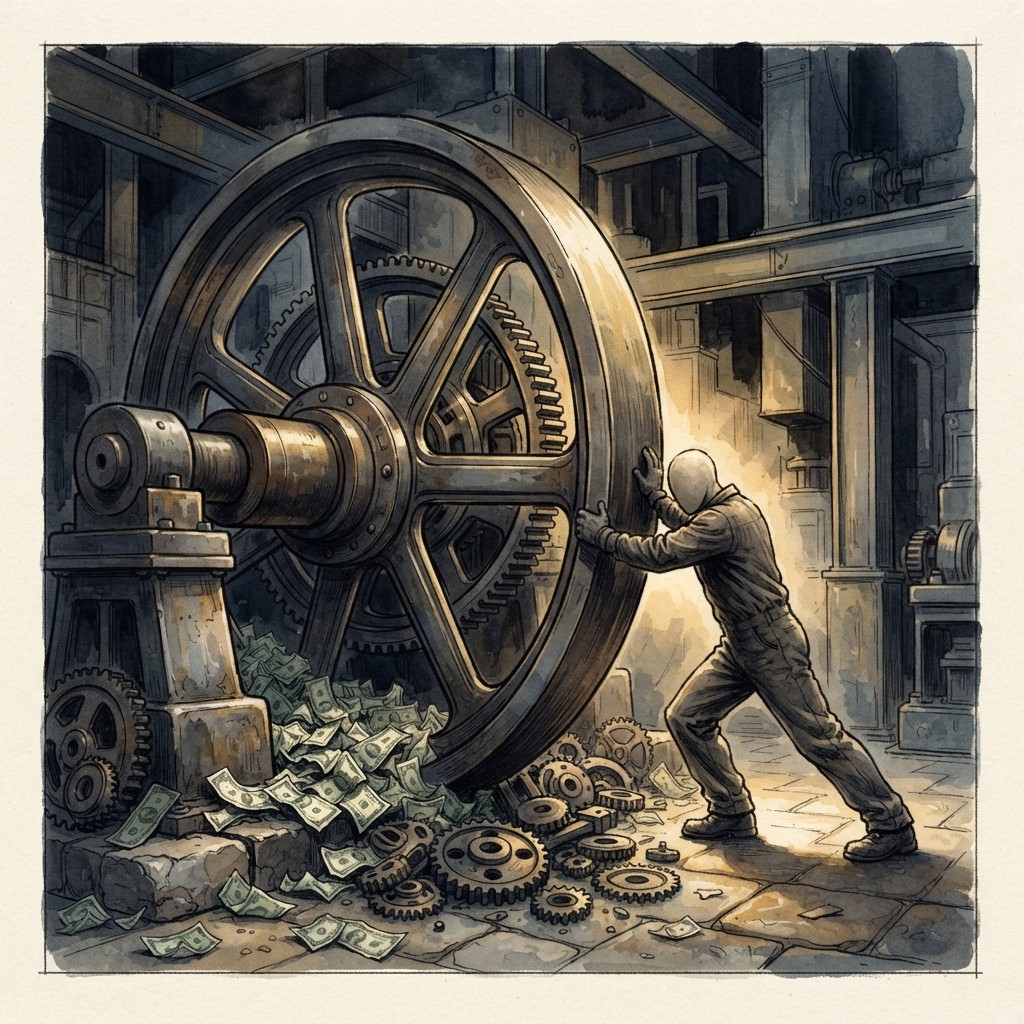
DoorDash's flywheel is not a fiction. The density loop is real, the lock-in is real, and 60% of a national market is the kind of position competitors spend a decade failing to crack. But the prospectus drew a wheel that spins itself, and the 10-K records a wheel that took $5.3 billion and eleven years of pushing before it would coast. The most honest version of the story is the macaroon shop, not the diagram: a stack of orders nobody could fulfill, and a very long, very expensive bet that if you moved enough food in enough neighborhoods, the math would eventually turn. It finally did - in 2024, by a sliver. The flywheel was always real. It was just never free.
When the loop is the whole story - or only part of it
Flywheel Designer Canvas
A one-page canvas for mapping a business's flywheel: the reinforcing loop, how it was started, the second-order loops it spins off, the moat it creates, and how it could spin backward. Use it to diagnose whether you have a real flywheel or a funnel drawn in a circle — and to design one of your own.
Included, filled and blank, in the The Flywheel Casebook. See the set → · Preview the blank →
Sources
Where this comes from — the filings, records, and reporting behind it.
- 1DoorDash's S-1 was filed with the SEC on November 13, 2020; the prospectus describes three interlocking flywheel diagrams anchored in local network effects, selection/convenience, and economies of scale as the company's core strategic narrative.
- 2DoorDash's journey began on January 12, 2013, when its founders launched a website displaying menus from local restaurants in Palo Alto, California. The company incorporated as DoorDash in June 2013.
- 3For FY2024, DoorDash reported GAAP net income of $123 million — its first full year of positive GAAP net income — on revenue of $10.722 billion and Marketplace GOV of $80.231 billion, while carrying an accumulated deficit of $5.3 billion as of December 31, 2024.
- 4DoorDash's FY2024 investor relations press release confirms: 'In 2024, we grew revenue 24% year-over-year, generated our first full year of positive GAAP net income, and helped generate nearly $60 billion in sales for local merchants in over 30 countries and over $18 billion in earnings for Dashers.'
- 5By the end of 2024, DoorDash led the national U.S. food delivery market with a 60.7% share, ahead of Uber Eats (26.1%) and Grubhub (6.3%), per Earnest Analytics consumer-spending data.
- 6The macaroon-shop origin story is corroborated in a contemporaneous primary account: in a 2014 Stanford speech, co-founder Stanley Tang described walking into a macaroon store on University Avenue in Palo Alto and observing pages of canceled delivery orders, which validated demand for third-party delivery. The store is identified in secondary sourcing as Chantal Guillon.
- 7DoorDash's own company blog (June 2017) confirms the original name was 'Palo Alto Delivery,' that the only Dashers were the co-founders, and that operations relied on Google Voice, the 'Find my Friends' app, and the founders' personal cars.
- 8DoorDash's own IPO registration announcement (November 13, 2020) confirmed Goldman Sachs and J.P. Morgan as lead book-running managers; the company raised $3.37 billion in its December 2020 IPO.
More like this — beyond DoorDash
New Strategically analyses as they publish: the defining moves in business, checked against the record. No noise, and one click to leave.