Pairs with the Switching-Cost Ledger — a ready-to-use strategy tool, filled for Hilton. Included in the The Ecosystem Lock-In Casebook →
You're standing on a corner with two hotels in view. The one across the street is a few dollars cheaper and looks identical. You walk into the Hilton anyway, because you have a balance of points sitting in an app, a status tier that gets you a better room, and a vague sense that staying anywhere else is leaving money on the table. Nothing about the room made the decision. The program did. Hilton has built something most guests never notice they've joined: a machine whose entire purpose is to make the cheaper room next door feel like the expensive one.
The official story is that Hilton Honors is a rewards program - a thank-you to loyal travelers in the form of free nights. That's the marketing. The strategy is the opposite: it isn't a reward you collect, it's a cost you'd pay to leave. Hilton Honors is the single most powerful piece of Hilton's business, and it has almost nothing to do with generosity.
The program isn't a perk. It's a way to dodge a tax.
Every reservation a hotel takes through an online travel agency comes with a toll - a commission skimmed off the top by the booking site that owns the customer. The defense against that toll is to own the customer yourself, and a loyalty program is how you do it. Get the traveler to book on your app, with their member number attached, and the middleman never enters the transaction. Hilton's CEO has put a number on how well this works: roughly 75% of the company's business comes from direct channels.8 That is the real product of Hilton Honors - not free nights, but a private road around the booking sites that tax everyone else.
And the scale is not slowing down. The program grew from 36 million members in 2012 to 203 million by late 2024 - compounding at around 16% a year for over a decade.7 By the close of 2024 the audited count had reached 211 million.1 Each new member is another traveler who has, quietly, agreed to bring their bookings home rather than shop the open market every trip.
The points you're owed are the leash
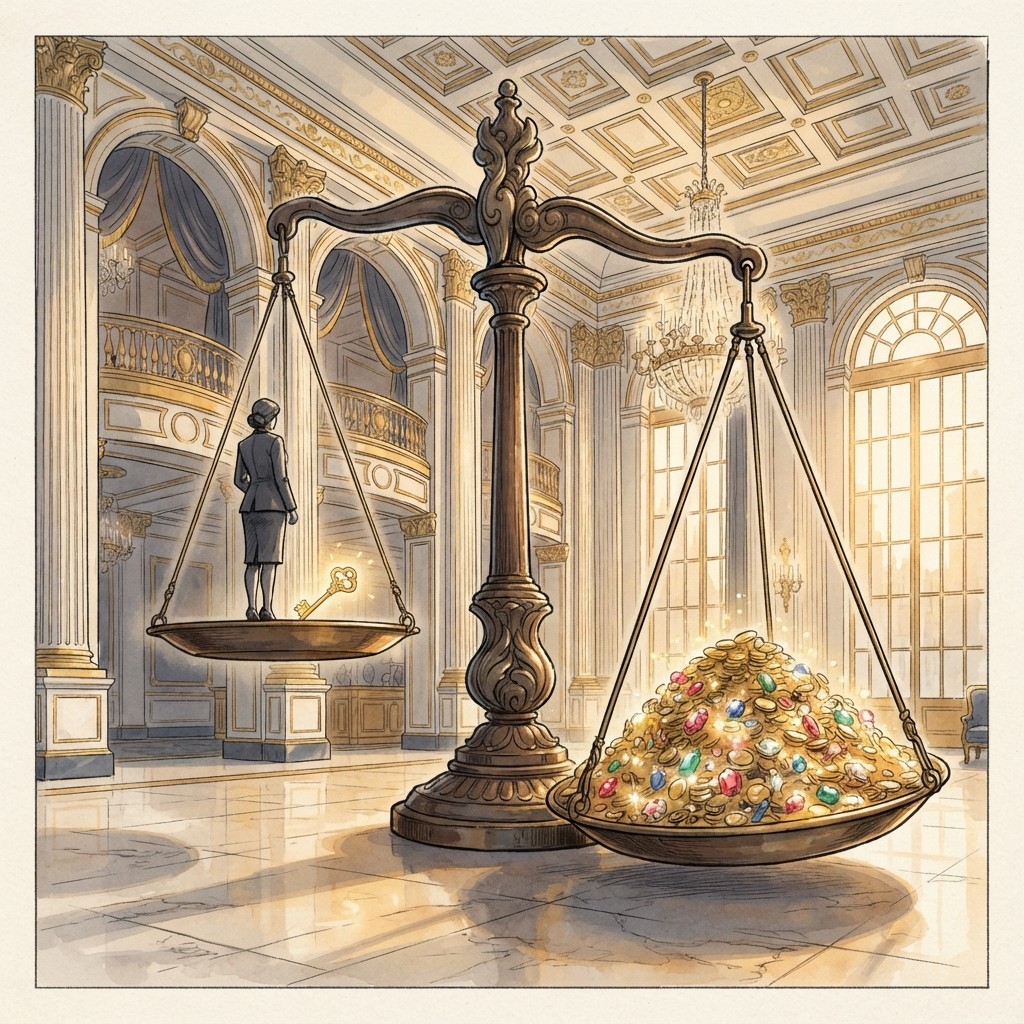
Here is the move most travelers miss. The points sitting in your account are not a gift from Hilton - they are a debt Hilton owes you, and Hilton books them as exactly that. At the end of 2023, the company carried a guest loyalty liability of about $1.2 billion in current obligations and another $1.5 billion long-term - roughly $2.7 billion of points it has promised to honor.3 On its own that's just accounting. The strategy is what the liability does to your behavior: a balance you've accumulated is only worth something if you redeem it inside the Hilton portfolio. The moment you book a rival, those points do nothing for you. The currency only spends in one store, and the bigger your balance grows, the more it costs - in foregone value - to shop anywhere else.
| The rewards-program story | The lock-in mechanism | |
|---|---|---|
| Points are | A reward you've earned | A debt Hilton owes, that only spends at Hilton |
| Membership means | A perk you opted into | A direct-booking relationship the OTAs no longer own |
| Expiration exists to | Tidy up dormant accounts | Keep you transacting before the clock runs out |
| The competitor next door | A simple price comparison | A choice that forfeits status and stranded points |
Then there's the clock. Hilton Honors points expire after 24 months of inactivity - and any activity, earning or redeeming, resets it.5 That sounds generous, and it's worth knowing it used to be far less so: the old policy wiped points after just 15 months of dormancy, and Hilton only extended the window to 24 months permanently in late 2021.6 Read it as a deadline and the design becomes obvious. The expiration rule doesn't punish you for leaving. It rewards you for coming back just often enough to keep the balance alive - which, conveniently, is exactly the behavior that keeps Hilton's distribution machine fed.
“75% of Hilton's overall business comes from direct channels.”8
Why the lock-in compounds while the rooms stay the same
A single program could be copied; what's hard to copy is the loop it runs. More members mean more direct bookings, which means fewer commissions paid away, which funds more properties and richer benefits, which attracts more members. You can see the engine in the numbers Hilton hands investors: 7.3% net unit growth and $3.4 billion in adjusted EBITDA in 2024, against $1.5 billion of net income.4 More rooms in more places make the points more useful, which makes leaving more expensive, which fills more of those rooms directly. The asset isn't any one hotel. It's the 211-million-person habit of starting the search inside Hilton's own front door.
Isn't this just a generous loyalty program that customers love?
The fair objection is that none of this is sinister - members join voluntarily, get real value, and a free night is a free night. True. The lock-in works precisely because it's a genuinely good deal at the individual level; switching costs that feel like a trap don't retain anyone. But notice what the structure quietly does even when everyone's happy. The points only spend in one place. The clock nudges you back before they vanish. The status you've banked evaporates the day you defect. Each is reasonable on its own, and together they convert a one-time rewards sign-up into a standing reason to stop comparison-shopping. The honest counter is that the moat is shallower than it looks: points programs across the industry now run nearly identical mechanics - the 24-month expiration window itself was Hilton matching its rivals.6 Lock-in that every competitor also offers isn't a moat against them; it's a moat the whole industry shares against the booking sites. Which is, in the end, exactly who it was built to keep out.
The trap to avoid is thinking a loyalty program is about giving customers things. The strategic version gives them a currency - points, credits, status - that only spends inside your own ecosystem, then adds a gentle clock so the balance has to be used before it's lost. Done right, the customer feels rewarded while behaving exactly the way you need: returning, transacting, and routing around the middlemen who'd otherwise own the relationship and tax the sale. The discipline is that the deal has to be genuinely good, or the lock-in reads as a cage and the whole loop collapses. The best switching cost is one the customer is glad to pay.
Walk back to that street corner. The cheaper room is still there, still nearly identical, still steps away. You'll book the Hilton - not because the bed is better, but because a balance, a tier, and a quietly ticking clock have all been arranged so that the rational move is to come home. That's the genius hiding inside a rewards program. Hilton never had to make its rooms impossible to leave. It only had to make leaving cost you something you'd rather not lose.
Other businesses that profit from where the value sits, not the obvious sale
Switching-Cost Ledger
A worksheet that prices the exit. It itemizes every cost a customer eats to switch away — the contract penalties, the re-training, the data migration, the muscle memory — so you can see whether lock-in is real or just inertia waiting to break. Blank to audit your own stickiness; filled as the worked example tallying the switching costs the story's customers face.
Included, filled and blank, in the The Ecosystem Lock-In Casebook. See the set → · Preview the blank →
Sources
Where this comes from — the filings, records, and reporting behind it.
- 1As of December 31, 2024, Hilton had 211 million Hilton Honors members, an increase of 17 percent year-over-year.
- 2Hilton's Q3 2024 10-Q (filed with the SEC) confirms 203 million Hilton Honors members as of September 30, 2024, up 17% YoY; and $916 million in deferred revenues related to Hilton Honors (including co-branded credit card arrangements) as of that date.
- 3Hilton's FY2023 10-K balance sheet shows a guest loyalty program liability of $1.202 billion (current) and $1.530 billion (long-term) as of December 31, 2023, reflecting the scale of outstanding points obligations.
- 4Hilton's Q4 and full-year 2024 earnings release (filed with the SEC February 6, 2025) reports net income of $1,539 million, Adjusted EBITDA of $3,429 million, and net unit growth of 7.3% for full-year 2024.
- 5Hilton Honors Points expire after 24 consecutive months of inactivity; the prior policy was 15 months, and the extension to 24 months was made permanent in late 2021.
- 6Hilton permanently extended its points expiration policy from 15 months to 24 months of inactivity, bringing it in line with Marriott Bonvoy and World of Hyatt. The prior 15-month window is confirmed by two independent sources.
- 7Hilton Honors membership grew at approximately 16% CAGR from 36 million members in 2012 to 203 million as of Q3 2024, per Hilton's own October 2024 investor presentation.
- 8Hilton CEO Christopher Nassetta stated that 75% of Hilton's overall business comes from direct channels and that approximately 50% of loyalty members (then ~42 million) were actively engaged with the brand.
More like this — beyond Hilton
New Strategically analyses as they publish: the defining moves in business, checked against the record. No noise, and one click to leave.