Pairs with the Distribution Channel Map — a ready-to-use strategy tool. Included in the Distribution Rebellion Casebook →
“How much of the channel's margin do you actually keep?”
In February 2020, Casper went public at $12 a share, selling the idea that a mattress was a lifestyle and the internet was the store. Two years later it was taken private at $6.90 — a 42.5% discount to that IPO price.1 The obituaries wrote themselves: another digitally-native brand that couldn't survive without a showroom. But look closer at the deal and the tidy story cracks. That $6.90 was a 94% premium to where the stock had actually closed the Friday before the offer — $3.55.1 The acquirer didn't loot a corpse. The market had already done that, marking the company down by two-thirds before anyone made an offer. The interesting question isn't who bought the body. It's what killed it.
The official story is that direct-to-consumer brands hit a wall — that consumers wanted to touch the product, that the internet-only model was always a mirage, that distribution was the missing piece. Almost every part of that is the wrong diagnosis. These companies didn't fail at distribution. They failed at arithmetic. And the arithmetic didn't break in a boardroom; it broke in April 2021, in a software update from a company that sells none of these products and competes with none of them.
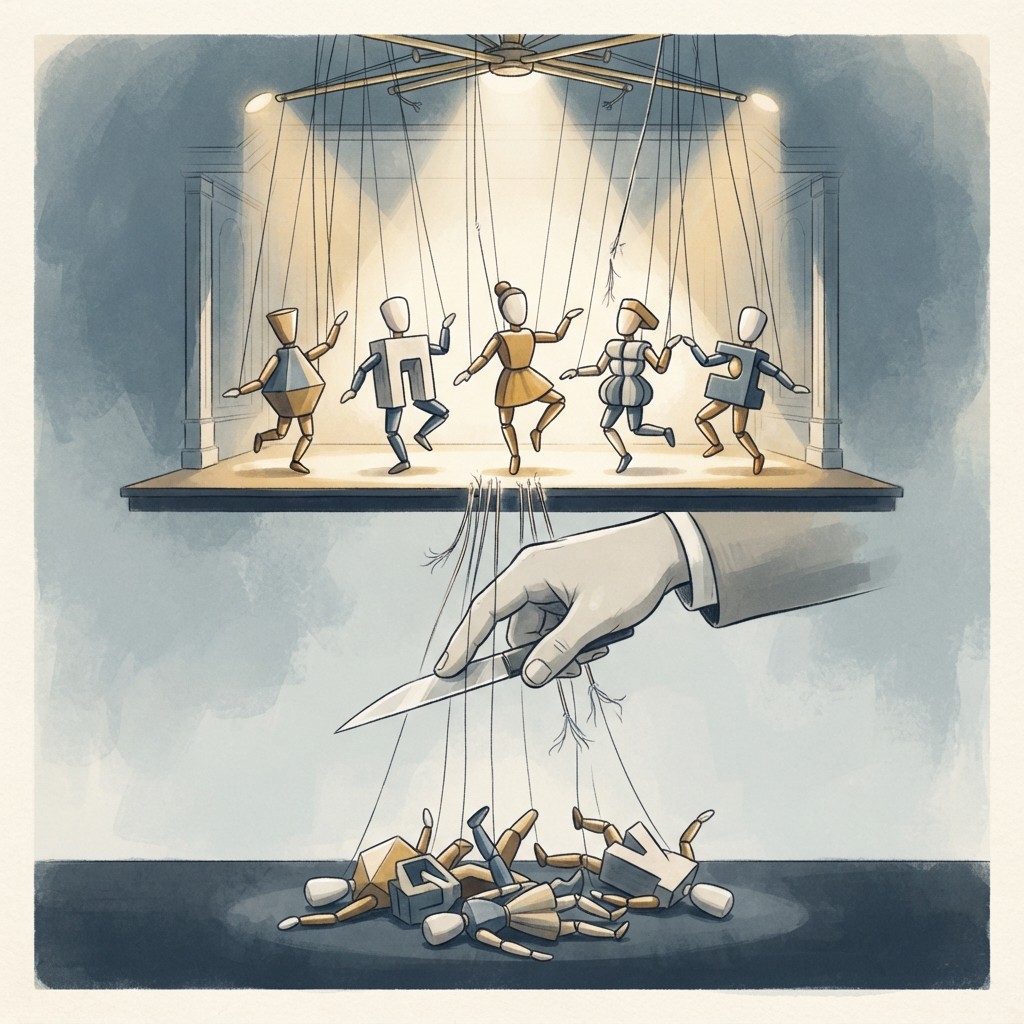
They were never direct-to-consumer. They were direct-to-Facebook.
Here is the part the label hides. 'Direct-to-consumer' implies the brand owns the relationship — it goes straight to the customer, no middleman taking a cut. But these brands had a middleman, and it was the most expensive one in commerce. They reached the consumer through a paid-acquisition engine they did not own: Facebook and Instagram, whose targeting could find a likely buyer and serve them an ad for a few dollars. All 50 brands in one post-mortem of failed DTC names relied on Facebook and Instagram for the majority of their customer acquisition during their growth years.7 The 'direct' in DTC was a marketing department's wish. The real relationship ran through a platform that could change the terms whenever it liked — and did.
“We expect to continue to incur significant losses in the future.”3
When you don't own your acquisition channel, your entire business is a bet that the channel stays cheap. While Facebook's targeting was sharp, that bet looked like genius: a sweet brown mattress-in-a-box or a wool sneaker could be sold profitably because the ad reliably found someone who wanted it. The brands raised on that arithmetic and went public on it. Warby Parker disclosed an accumulated deficit of $356.3 million as it filed to list, and warned outright that it might never turn a profit.2 Allbirds carried a $113.1 million accumulated deficit and the same warning, with digital sales making up 89% of its revenue in 2020.3 The market didn't care. Growth was cheap, and cheap growth was the whole show.
The day the targeting engine was repossessed
In April 2021, Apple began enforcing App Tracking Transparency in iOS 14.5 — a single dialog box asking iPhone users whether they'd let an app track them across the rest of their phone. Most said no. That box quietly severed the data flow that let Facebook know who you were and what you wanted, which was the entire basis of its targeting.6 The effect on the DTC economy was immediate and brutal in its plainness: Facebook's share of US DTC ad spending fell from 34.9% in the first quarter of 2021 to 27.0% a year later, and Meta's own CFO estimated the change would cost the company $10 billion in revenue in 2022 alone.6 If a $10 billion hole opened in the platform, it opened first in the budgets of the brands that lived on it.
The mechanism is worth following all the way down, because it explains why the wall felt like it appeared from nowhere. The ad still ran. The product was still good. But the engine could no longer tell a likely buyer from a stranger, so it served more ads to win the same number of customers — and the cost of acquiring one buyer climbed. Across the failed-brands sample, the average cost to acquire a customer rose from $34 in 2021 to $57 in 2024.7 A two-thirds increase in your single largest variable cost is not a bump. For a business already losing money to grow, it is the difference between a model and a fire.
| The DTC promise | The DTC reality | |
|---|---|---|
| The customer relationship | Owned, direct, no middleman | Rented through Facebook/Instagram7 |
| Cost of finding a buyer | Cheap and stable | $34 in 2021 → $57 in 20247 |
| Control of the channel | The brand's | Apple's and Meta's6 |
| What broke first | Stores, supply chain | Targeting, in April 20216 |
The reckoning landed in 2022 — a year before the legend says it did
Get the timing right and the cause becomes obvious. The common story dates the DTC bust to 2023, but the numbers put the floor a full year earlier. A pooled analysis of public DTC brands shows the median operating margin sank to its worst level — minus 0.9% — in 2022, with the widest gap between the strong and the struggling of any year in the sample, a P25-to-P75 spread running from -18.6% all the way to +7.9%.5 By 2023 the median had already clawed back to +2.1%.5 That sequence matters: a wall hit in 2022, exactly one fiscal year after Apple's box appeared in April 2021. The lag is the time it takes for a privacy setting to work its way through ad budgets, into quarterly results, and onto a market's spreadsheet.
The public flagships told the same story in their valuations. By the end of 2022, Warby Parker and Allbirds had each lost roughly fivefold of the value they carried at their 2021 debuts — Warby Parker from about $6.8 billion to $1.58 billion, Allbirds from $4.1 billion to about $345 million.4 The losses underneath were enormous for companies of their size: Warby Parker lost $110.4 million on $598.1 million of revenue that year; Allbirds lost $101 million on $298 million.4 The growth was still there. The cheap growth was gone, and cheap growth was the only kind the model could afford.
Wasn't it just a bubble, and didn't some brands prove the model works?
The honest objection is that this is too neat — that DTC was simply caught in a broad 2021–2022 valuation bubble, and any high-growth, unprofitable cohort would have cratered when cheap money ended. There's truth there, and the data won't let us pretend otherwise: the post-pandemic normalization of demand pushed ad costs up alongside Apple's change, and the pooled-margin and CAC figures both come with the caveat that no one can cleanly separate the two effects.57 So ATT was a primary cause of the targeting collapse, not a lone assassin. The stronger objection is the survivors. Warby Parker posted its first-ever annual net income in 2025, joining a small group of profitable DTC names.8 Doesn't that vindicate the model?
It vindicates the opposite. Read the survivor's own statement: in the very year Warby Parker reported net income, it still ran a $5.3 million operating loss — improved from -$30.1 million the prior year, but a loss all the same.8 The profit came from below the operating line, not from the core engine of selling glasses online finally working at scale. The brands that endured did not double down on the online-only thesis. They built stores, owned channels, and leverage the rented Facebook funnel never gave them. The lesson isn't 'DTC failed.' It's that the thing called DTC was never the durable asset everyone priced it as. The durable asset was owning the road to the customer — and almost none of them did.
A model built on a cheap, abundant input is only a model until that input gets priced. The DTC cohort treated Facebook's targeting like a permanent law of physics; it was a temporary arbitrage living inside a platform that could re-price it overnight — and in April 2021 a third party did exactly that. The question to ask of any 'direct' business: what happens to your unit economics if your largest variable cost rises 60%? If the answer is collapse, you are not direct to anyone. You are a tenant. Own the channel — owned email, repeat-purchase loyalty, physical shelf — or accept that your landlord sets your rent, and one day will.
The DTC bust wasn't consumers rediscovering they like to touch a mattress before they buy it. It was a generation of brands discovering that the word 'direct' in their name was the one part of the business they didn't control. They built beautiful products and rented the only thing that made them profitable from a platform that owed them nothing — and when a privacy toggle quietly repossessed it, the arithmetic that justified billions in valuation simply stopped computing. The mattress was always fine. The math was the mirage.
Distribution Channel Map
A map of every hop between the company and the customer — each intermediary, who owns the relationship at each step, and where the company controls the channel versus where it's at the channel's mercy. Blank to chart your own route to market; filled as the worked example showing where the story's company went direct, fought its gatekeepers, or got disintermediated.
Included, filled and blank, in the Distribution Rebellion Casebook. See the set → · Preview the blank →
Sources
Where this comes from — the filings, records, and reporting behind it.
- 1Casper Sleep Inc. was acquired by Durational Capital Management at $6.90 per share, completed January 25, 2022, with stock delisted from NYSE. The $6.90 price was a 94% premium to the pre-announcement closing price of $3.55, but a 42.5% discount to the $12 IPO price from February 2020.
- 2Warby Parker filed its S-1 to go public via direct listing on August 24, 2021. Its net revenues were $272.9M (2018), $370.5M (2019), and $393.7M (2020). Net loss was $22.9M in 2018, it broke even in 2019, and lost $55.9M in 2020. Accumulated deficit as of June 30, 2021 was $356.3M. The company warned it might never achieve profitability.
- 3Allbirds filed for IPO on Nasdaq on August 31, 2021 with an accumulated deficit of $113.1M as of end of June 2021. The company stated it expected 'to continue to incur significant losses in the future.' Digital sales were 89% of revenue in 2020, stores 11%. Net losses were $14.5M (2019) and $25.9M (2020).
- 4By end of 2022, Warby Parker and Allbirds saw their market valuations decline by roughly fivefold from their 2021 public debut levels. Warby Parker's valuation fell from ~$6.8B at listing debut to ~$1.58B; Allbirds fell from $4.1B to ~$345M. Allbirds lost $101M on $298M revenue in 2022. Warby Parker lost $110.4M on $598.1M revenue in 2022.
- 5Pooled median public DTC operating margin was 0.0% in 2021, -0.9% in 2022, +2.1% in 2023, +2.9% in 2024, and -0.6% in 2025 across 11-13 brands per year. The reckoning landed in 2022, not 2023. 2022 saw the widest P25-P75 spread (-18.6% to +7.9%) of any year in the sample.
- 6Apple's iOS 14.5 ATT enforcement launched April 2021, allowing iPhone users to opt-out of cross-app tracking via IDFA. Facebook's share of US DTC ad spending declined from 34.9% in Q1 2021 to 27.0% a year later. Meta's CFO estimated the company would lose $10B in 2022 revenue due to the privacy change.
- 75W's DTC Graveyard 2026 report catalogued 50 prominent DTC brand failures from 2022–2026. All 50 relied on Facebook/Instagram for majority of customer acquisition during growth. Average CAC rose from $34 in 2021 to $57 in 2024. 47 of 50 had no meaningful loyalty program. 31 of 50 experienced founder departure between Series B and C.
- 8Warby Parker posted its first-ever annual net income in FY2025, placing it among a small group of DTC brands to achieve profitability. However, the brand simultaneously posted a $5.3M operating loss for the full year (improved from -$30.1M the prior year), meaning net income was not driven by operating leverage.
Weighing outside help with a decision like this? Hiring a digital strategy consultant
More like this — beyond The DTC Bust
New Strategically analyses as they publish: the defining moves in business, checked against the record. No noise, and one click to leave.