Pairs with the Crisis Response Playbook — a ready-to-use strategy tool. Included in the Crisis Response Casebook →
“What is one more quarter of not acting worth?”
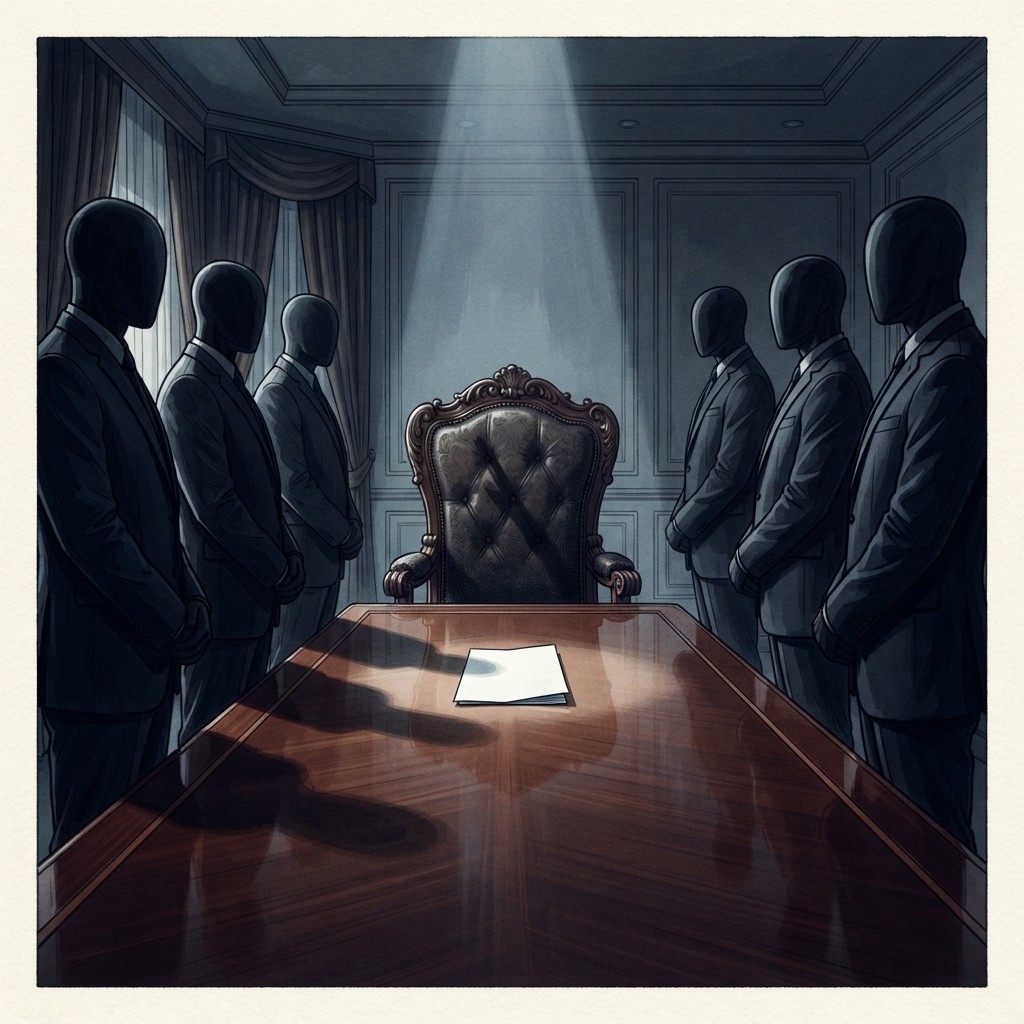
On June 20, 2017, two venture capitalists checked into the Ritz-Carlton Chicago, walked to Travis Kalanick's door uninvited, and handed him a letter. It was titled 'Moving Uber Forward,' it was signed by five of his largest investors, and it demanded his immediate resignation by the end of the day.5 He balked. He had built one of the most valuable startups on earth and was being asked to leave it in a hotel hallway. By the next day he was gone. His public statement said he had 'accepted the investors request to step aside.'6 That sentence is the most polished lie in the whole affair.
The story everyone remembers is clean: an engineer wrote a blog post, the world recoiled at Uber's culture, an investigation followed, and a disgraced CEO resigned. Almost every link in that chain is bent. The post was real and the culture was rotten — but the document that supposedly ended Kalanick never asked for him to go, and the man who 'resigned' had a resignation letter shoved into his hands. The crisis was the cover story. The decision was a coup.
The match was real. It just wasn't the fuel.
On February 19, 2017, Susan Fowler — a site reliability engineer who had joined Uber in November 2015 — published a blog post titled 'Reflecting on one very, very strange year at Uber.'1 It described being propositioned by a manager on her first day over company chat, and an HR department that declined to act because the manager was a 'high performer.'1 It was specific, calm, and devastating. It lit the fire. But a match needs something to burn, and the fuel was already stacked: a board that had lost trust in its founder, and a cap table holding a fortune it could no longer control. Notice the small flattening that crept into later coverage — Fowler was repeatedly described as a 'software engineer' rather than the reliability engineer she actually was. The details got smoothed because the narrative had already decided what it needed her to be: a symbol, not a person with a precise title.
“I love Uber more than anything in the world and at this difficult moment in my personal life I have accepted the investors request to step aside so that Uber can go back to building rather than be distracted with another fight.”6
The report that supposedly fired him asked the opposite
Here is the part the popular telling gets exactly backwards. Uber commissioned a culture investigation from Covington & Burling, led jointly by former U.S. Attorney General Eric Holder and his partner Tammy Albarran — a name almost always dropped from the story. They conducted more than 200 interviews, reviewed three million documents, and produced a 13-page report released on June 13, 2017, with 47 recommendations under four themes: Tone at the Top, Trust, Transformation, and Accountability.2 The board unanimously voted to adopt all of them.3 And the report's recommendation regarding Kalanick was to reallocate his responsibilities and hire a strong COO — not to remove him.2 The document that everyone credits with ending his career explicitly tried to keep him in the building, just with less of it under his control.
The firings are conflated too. More than 20 employees were terminated — but that came from a separate internal review that examined 215 HR complaints covering harassment, bullying, retaliation and discrimination, taking no action in roughly 100 of them.4 That review was announced on June 6, 2017. As of that date, Kalanick had not even seen the Holder report.4 Two investigations, two purposes: one produced terminations, the other produced governance recommendations. The public merged them into a single cleansing event because a single event is easier to remember than a tangle of overlapping legal processes.
| The popular narrative | What actually happened | |
|---|---|---|
| What ended Kalanick | The Holder report | An investor letter delivered at a hotel |
| What the Holder report said | Remove the CEO | Reallocate his job, hire a COO |
| Cause of the 20+ firings | The Holder investigation | A separate review of 215 HR complaints |
| The resignation | Voluntary | Demanded by five investors, initially resisted |
Why the board moved when the report didn't
If the official process recommended keeping Kalanick, why did he leave anyway? Because the people doing arithmetic on Uber's valuation were not the same people who wrote the report. The effort to remove him was led, per the Washington Post, by board member and Benchmark partner Bill Gurley.6 On June 20, Benchmark partners Matt Cohler and Peter Fenton physically delivered the demand, co-signed by five major investors including Benchmark and Fidelity.5 This is the mechanism: a culture scandal, on its own, embarrasses a company. What it does to a venture firm is convert a soft risk into a hard number. Every day of headlines made the next funding round harder, the eventual IPO riskier, and the entire stake more fragile. The investors did not move because the culture offended them in June when it had not offended them in the years prior. They moved because the culture had finally started pricing itself into the equity. The Holder report gave them institutional cover. The blog post gave them public legitimacy. But the trigger was a balance sheet that had stopped being theoretical.
Isn't this just a #MeToo story with extra steps?
The fair objection is that this reading is too cynical — that it drains the moral content out of a genuine reckoning and reduces real harm to a spreadsheet. The objection is partly right, and it deserves a straight answer. Fowler's account was true and brave, the culture it exposed was real, and the firings that followed addressed real misconduct. None of that was theater. But notice what the cynicism cuts against, not just what it cuts away. Fowler herself later described post-publication rumors — including a denied allegation that Lyft had paid her to write the post — that she traced to sources described as 'close to Uber' or 'close to the board.'8 The same board that would soon present itself as the conscience of the company was, by her account, a source of efforts to discredit her. The point is not that the outrage was fake. It is that the outrage and the ouster are two different events with two different causes, and treating them as one lets the board launder a financial decision as a moral one. The harm was real. The removal was governance. Pretending they are the same flatters everyone involved.
Boards rarely fire a founder for being wrong. They fire one for becoming expensive. Bad behavior gets tolerated for years as a cost of doing business — until a public crisis converts that behavior from a reputational footnote into a number that threatens the next round, the IPO multiple, or the whole stake. That is the moment governance moves, and it will arrive dressed as principle: an independent report, a unanimous vote, a statement about 'moving forward.' The tell is timing. If the values were violated for years but the action came in the weeks after the valuation got threatened, you are watching a financial decision wearing a moral costume. Useful in both directions: if you are a founder, your protection was never your cap table's affection — it was their math staying in your favor.
Two months later, in August 2017, the board landed Dara Khosrowshahi from Expedia — a steady operator brought in precisely because he was the opposite of the man they had pushed out a hotel-room door.7 The handoff was the proof of the whole thesis. Uber did not need a different conscience. It needed a CEO whose culture risk did not show up in the valuation. Kalanick was not fired for what he was; he had always been that. He was fired the moment what he was started costing more than what he built. The blog post lit the match. The investors, with a cap table to protect, simply decided when to let it burn.
When the official story isn't the real one
Crisis Response Playbook
A playbook for a crisis already in motion: who decides, which plays fire on which trigger, and what gets said to whom. It replaces panic and the all-hands meeting with a pre-agreed sequence each person can run alone. Blank to pre-load before a crisis hits; filled as the worked example reconstructing the plays the story's team ran — and the ones they should have.
Included, filled and blank, in the Crisis Response Casebook. See the set → · Preview the blank →
Sources
Where this comes from — the filings, records, and reporting behind it.
- 1Susan Fowler published her blog post 'Reflecting on one very, very strange year at Uber' on February 19, 2017, describing herself as a site reliability engineer (SRE) who joined in November 2015 and alleging sexual harassment on her first day via company chat, with HR dismissing her complaint because the manager was a 'high performer.'
- 2The Covington & Burling investigation — led by Eric Holder and Tammy Albarran — reviewed more than 200 interviews and 3 million documents, producing a 13-page report released June 13, 2017 with 47 recommendations organized under four themes: Tone at the Top, Trust, Transformation, and Accountability. It recommended reallocating Kalanick's responsibilities and hiring a COO, not his removal.
- 3Uber's board unanimously voted to adopt all of Holder's recommendations; the 13-page report recommended zero-tolerance for harassment regardless of whether an employee is a 'high performer,' pay-equity audits, mandatory leadership training, and enhanced board oversight — but did not call for Kalanick's resignation.CNBC, Eric Holder Uber report: full text ↗ · 2017-06-13
- 4More than 20 employees were terminated following a separate internal investigation (not the Holder/Covington report) that examined 215 HR complaints — covering sexual harassment, bullying, retaliation, and discrimination — and took no action in roughly 100 instances. An additional ~40 employees were reprimanded or referred to training. As of the announcement date (June 6, 2017), Kalanick had not yet seen the Holder report.
- 5On June 20, 2017, Benchmark partners Matt Cohler and Peter Fenton hand-delivered a letter to Kalanick at the Ritz-Carlton Chicago demanding his immediate resignation; the letter was signed by five major investors including Benchmark and Fidelity and titled 'Moving Uber Forward.' Kalanick initially resisted before agreeing to step down by end of day June 21.
- 6Kalanick's public resignation statement read: 'I love Uber more than anything in the world and at this difficult moment in my personal life I have accepted the investors request to step aside so that Uber can go back to building rather than be distracted with another fight.' The effort was described by the Washington Post as led by Uber board member and Benchmark partner Bill Gurley.
- 7Dara Khosrowshahi was confirmed as Uber's incoming CEO in August 2017; his prior employer Expedia confirmed his departure via an SEC Form 8-K press release dated August 30, 2017, naming Mark Okerstrom as his successor and noting Khosrowshahi 'will continue to be a member of Expedia's Board of Directors.'
- 8Fowler confirmed in a February 2020 TIME essay that the company hired former U.S. Attorney General Eric Holder to investigate its culture, which 'ultimately led to CEO Travis Kalanick's departure.' She also described post-publication rumors — including an allegation, which she denied, that Lyft had paid her to write the post — that originated from sources described as 'close to Uber' or 'close to the board.'
Weighing outside help with a decision like this? Hiring a supply chain strategy consultant
More like this — beyond Uber
New Strategically analyses as they publish: the defining moves in business, checked against the record. No noise, and one click to leave.