Pairs with the Adjacency / Synergy Map — a ready-to-use strategy tool. Included in the The Adjacency Expansion Casebook →
On a road in West Virginia, two researchers strapped emissions equipment to a Volkswagen Jetta and drove it the way people actually drive. The lab numbers were spotless. The road numbers were not: real-world NOx ran 15 to 35 times the legal limit, and on the Passat 5 to 20 times.6 That gap — between what the car claimed in the lab and what it did on the highway — was a piece of software designed to know when it was being tested. It is the perfect emblem for everything that came after. Volkswagen would spend the next decade telling regulators, drivers, and itself one story while a very different reality ran underneath.
The story everyone tells about Dieselgate has a neat moral: VW cheated, got caught, was shamed, and reinvented itself as a clean-energy company. The scandal forced VW to go electric. The truth is sharper and less flattering. The EV pivot was never the penance the legend imagines — it was a way to change the subject. And the subject it changed to turned into a crisis of its own.
The EPA didn't catch VW. VW turned itself in — quietly, it hoped
The popular image is of investigators kicking down a door. It didn't happen that way. The ICCT findings went to CARB and the EPA, the questions got harder, and on September 3, 2015, Volkswagen disclosed the defeat device to the regulators itself.62 VW's own 2015 annual report is unusually candid about what it expected next: the board thought the matter would be resolved quietly, without a public enforcement action. The public Notice of Violation that landed on September 18 'came as a surprise to the company.'2 That single line is the whole tell. VW's instinct, even after confessing, was containment — keep the story inside the building. The defeat device itself was a containment strategy: hide the emissions where no one looks. The reflex never changed; only the target did.
“This culminated in the disclosure of the defeat device to the EPA/CARB on September 3, 2015.”2
Then the surprise arrived. On September 21, 2015, VW stock fell about 23% in Frankfurt in a single session, more than €15 billion of market value gone in a day.5 (The often-repeated 'lost a third overnight' is a conflation — the one-day drop was 23%; the multi-month peak-to-trough slide was a separate, slower bleed.) The penalties followed for years: a DOJ civil complaint in January 2016, then in January 2017 a guilty plea to three criminal felony counts, a $2.8 billion criminal penalty and $1.5 billion in civil penalties — $4.3 billion to the U.S. government alone, before the consumer settlements stacked on top.43 This was the reputational fire VW needed to escape. And there happened to be an exit already half-built.
The pivot that looked like atonement was really a subject change
Here is the thesis, plainly: VW's electric pivot was not the crisis forcing it into EVs — it was a reputational escape hatch that generated a fresh strategic crisis of its own. The chronology that makes the pivot look like penance is misleading. The defeat-device decisions trace back to roughly 2006–2007 engineering choices, years before any EV strategy existed — per the DOJ plea of VW engineer James Liang, who admitted that "beginning in about 2006" he and co-conspirators began designing the EA 189 engine and, unable to meet US emissions standards legally, implemented the defeat-device software.9 The 'Together — Strategy 2025' electrification push, launched June 2016,10 came after the scandal broke — but the forces behind it weren't only the scandal. Europe's regulators were tightening, and post-2015 urban diesel bans were poisoning the well for the very engines VW had built its empire on. The pivot was over-determined. The scandal just gave it a redemption narrative to wear in public.
When a company in disgrace announces a bold new direction, watch what the new direction does for the story, not just for the customer. Going electric let VW stop being 'the company that cheated on emissions' and start being 'the company leading the transition.' That's a genuine business move and a brilliant act of narrative management at the same time. The danger is that the narrative does the deciding. A strategy chosen partly to change the subject inherits the original sin: it's built to satisfy regulators and onlookers rather than to be pulled into existence by people who actually want to buy the thing.
| The diesel defeat device | The EV pivot in the US | |
|---|---|---|
| Driven by | Beating an emissions test | Beating a reputational test |
| Demand source | Regulatory pass, not road performance | Tax credit and mandate, not consumer pull |
| What it hid | Real NOx on the road | Real US appetite for the car |
| How it ended | Disclosure, then global penalties | Production halted, line switched to gas |
The ID.4 proved the escape hatch had a trapdoor
For a while the numbers looked like vindication. In 2023, VW Group delivered 771,100 fully electric vehicles worldwide, up nearly 35%, and the ID.4/ID.5 were its best-selling BEVs globally at 223,100 units.8 The narrative was holding. But the U.S. story told the real one. American ID.4 sales peaked around 38,000 in 2023 — never a runaway hit for a market that size — then collapsed to roughly 11,857 in 2024 under a stop-sale recall,12 before rebounding sharply in early 2025 as the stop-sale lifted14 — only to face a new demand cliff when the federal $7,500 EV tax credit expired on September 30, 202515 — and never reached escape velocity.7 The car that was supposed to embody the clean reinvention couldn't generate the one thing the diesels never lacked: people lining up to buy it on its own merits.
Then the prop fell away. On September 30, 2025, the federal $7,500 EV tax credit disappeared, and the demand that had been propped up by subsidy went with it.7 In mid-April 2026, VW halted U.S. ID.4 production at Chattanooga and turned the plant over to the gas-powered 2027 Atlas SUV.7 Read it against the diesel story and the symmetry is brutal. The defeat device manufactured the appearance of clean emissions because the real engineering couldn't deliver them. The U.S. EV strategy ran on a tax credit because the real demand couldn't sustain it. Strip the artificial support in either case and the thing collapses. Same brittleness. Opposite badge.
Wasn't the pivot still the right call?
The fair objection is that this is too neat — and that going electric was simply correct, escape hatch or not. There's truth in it. Globally VW's BEV volumes are real and rising, Europe's accelerating diesel restrictions — with Paris, Madrid, and a wave of German cities announcing bans or access limits from late 2016 onward — made the old business a dead end11, and a company facing existential regulatory pressure should pivot toward the future even if the move also conveniently rehabilitates its image. Good strategy and good optics aren't mutually exclusive. The honest counter is that the European tightening, not the scandal, did much of the pushing; the scandal mostly supplied the story. But none of that rescues the U.S. execution. A strategy is only as sound as its demand foundation, and the ID.4's American foundation was a federal credit and a mandate — political weather, not customer conviction. When the weather changed, the car had nowhere to stand. The pivot was defensible. The way VW leaned on subsidy in place of genuine pull was the same old habit of engineering the test instead of the reality.
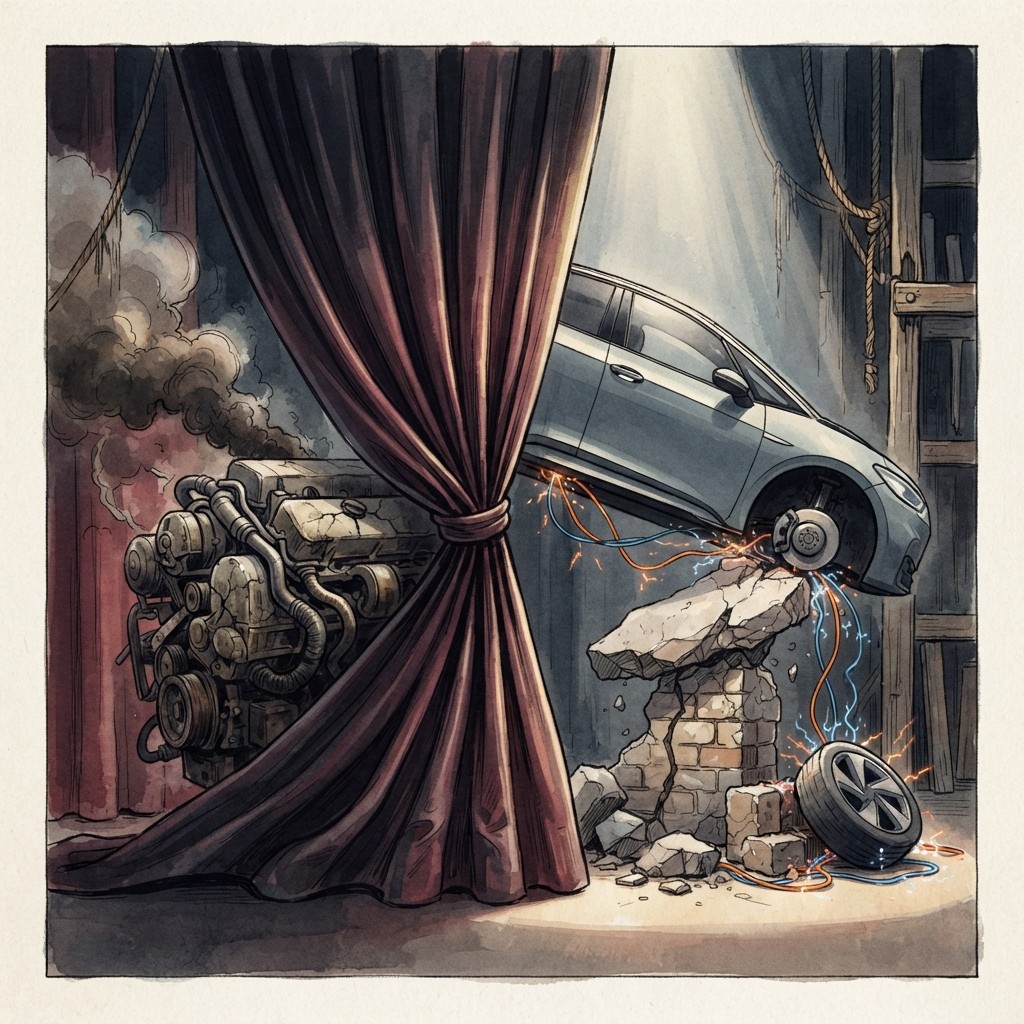
Volkswagen spent a decade and tens of billions of dollars learning a lesson it should have taken from the road test in West Virginia: you cannot software your way past what's actually true. The defeat device hid the emissions. The tax credit hid the demand. Both worked beautifully right up until someone pulled the cover off — and both left VW standing where it had been trying not to be. The clean reinvention turned out to be the diesel cheat in a different costume: a strategy designed to pass a test it could not pass honestly, brittle the instant the test went away.
When the official story and the real one diverge
Adjacency / Synergy Map
A one-page canvas for an adjacency play: the new business next door, the shared assets that justify entering it, the synergies that actually transfer versus the ones that evaporate on contact, and the dis-synergies nobody put on the deck. Blank to test your own expansion; filled as the worked example showing where the story's 'natural adjacency' was real and where it was wishful.
Included, filled and blank, in the The Adjacency Expansion Casebook. See the set → · Preview the blank →
Sources
Where this comes from — the filings, records, and reporting behind it.
- 1On September 18, 2015, EPA issued a Notice of Violation of the Clean Air Act to Volkswagen AG, Audi AG, and Volkswagen Group of America for model year 2009–2015 2.0L diesel vehicles equipped with defeat-device software that caused NOx emissions up to 40 times legal limits.
- 2VW's own 2015 Annual Report states the defeat device was disclosed to EPA/CARB on September 3, 2015 — two weeks before the public NoV — and that VW's board initially expected the matter to be resolved quietly, consistent with how similar past cases had been handled; the public NoV on September 18 'came as a surprise to the company.'
- 3On January 11, 2017, Volkswagen agreed to plead guilty to three criminal felony counts and pay a $2.8 billion criminal penalty; in a separate civil resolution, VW agreed to pay an additional $1.5 billion, for a total DOJ/EPA resolution of $4.3 billion.
- 4The DOJ filed a civil complaint on January 4, 2016 against Volkswagen AG, Audi AG, Porsche AG and related entities for Clean Air Act violations, consistent with the September 18, 2015 (2.0L) and November 2, 2015 (3.0L) Notices of Violation.
- 5VW's stock dropped approximately 23% on September 21, 2015 in Frankfurt, losing over €15 billion in market capitalization in a single session; the cumulative loss since the September 17 pre-announcement date was approximately 28.64% within the first trading days.
- 6The ICCT/West Virginia University research project (2013–2014) found real-world NOx from the VW Jetta exceeded EPA Tier 2 Bin 5 standard by 15–35×, and from the Passat by 5–20×; these findings were reported to CARB/EPA and initiated the regulatory chain leading to the NoV.
- 7Volkswagen halted U.S. production of the ID.4 at its Chattanooga, Tennessee plant in mid-April 2026, shifting the facility to the gas-powered 2027 Atlas; the Trump administration's withdrawal of the $7,500 EV tax credit effective September 30, 2025 was identified as the proximate demand-side cause.
- 8VW Group delivered 771,100 fully electric vehicles worldwide in 2023 (+34.7% YoY); the VW ID.4/ID.5 were the top-selling Group BEV models globally at 223,100 units, while U.S. ID.4 sales reached ~37,700–38,000 for the full year.
- 9Beginning in about 2006, VW engineer James Liang and co-conspirators started to design the EA 189 diesel engine for sale in the US; when they realized it could not meet stricter US emissions standards, they designed and implemented the defeat-device software — per Liang's September 2016 DOJ plea agreement.
- 10VW's 'TOGETHER – Strategy 2025' was launched in June 2016, defining a comprehensive transformation process for the Volkswagen Group including electrification.
- 11Post-2015, multiple European cities announced restrictions or bans on diesel vehicles: Paris announced it would ban diesel vehicles by 2025, Madrid announced a similar ban, and monthly diesel shares in France and Spain plunged after several cities announced bans in late 2016 and early 2017.
- 12In 2024, Volkswagen sold 11,857 ID.4 units in the US.
- 13The federal $7,500 EV tax credit expired on September 30, 2025, following President Trump's signing of the 'One Big Beautiful Bill Act' on July 4, 2025.Kiplinger, How the EV Tax Credit Works for 2025 ↗ · 2025-09-03
- 14VW ID.4 sales rebounded sharply in early 2025 after the stop-sale was lifted in January 2025, with 4,979 units sold in January 2025 alone — a 653% increase year-over-year — making it the third best-selling EV in the US that month.
- 15The federal $7,500 EV tax credit expired on September 30, 2025, following President Trump's signing of the One Big Beautiful Bill Act on July 4, 2025.
More like this — beyond Volkswagen
New Strategically analyses as they publish: the defining moves in business, checked against the record. No noise, and one click to leave.