Pairs with the Adjacency / Synergy Map — a ready-to-use strategy tool. Included in the The Adjacency Expansion Casebook →
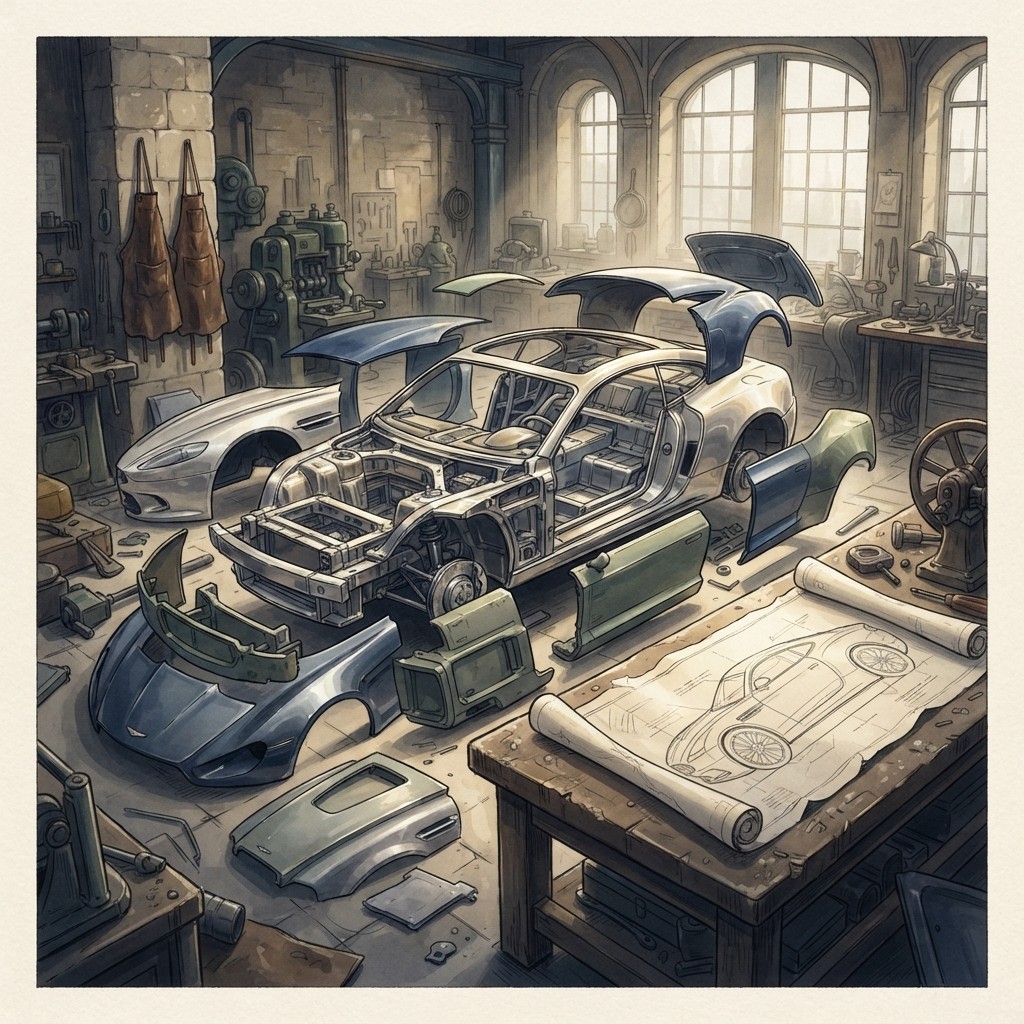
Walk a single VW Group factory floor and you can watch a budget Škoda and a £200,000 Bentley grow from the same skeleton — shared floorpans, shared electronics, shared engines, dressed up or down. From the outside, the Volkswagen brand stable looks like a strategist's dream: a clean ladder from cheap to sublime, Škoda at the bottom, Porsche and Bentley at the top, every rung a deliberate step into the next adjacent market.1 It is one of the most complete portfolios in the automotive world. And almost none of it was planned the way the org chart now implies.
The official story is that VW climbed the price ladder by design, acquiring each brand to occupy the next segment up. The real story is messier and more interesting: a string of opportunistic deals — a joint venture that crept to full control over a decade, a bidding war that left VW holding the wrong prize, and a luxury sports-car maker that VW only swallowed after surviving the sports-car maker's attempt to swallow VW first.
Škoda: the acquisition that took nine years to finish
Start with the brand everyone calls the textbook win. The story is usually told as 'VW acquired Škoda in 1994.' It didn't. VW signed a joint-venture contract on 28 March 1991 and took an initial 31% stake on 16 April 1991 for 620 million Deutschmarks — a foothold in a post-communist Czech carmaker, not a takeover.2 The controlling 60.3% stake came on 19 December 1994, 70% in December 1995, and full 100% ownership only on 30 May 2000.2 Nine years from handshake to outright control. That is not the cadence of a confident segment-grab; it is the cadence of a partnership being de-risked one tranche at a time. And it worked precisely because VW didn't reposition Škoda's market so much as plug it into VW's machine: by 2025 Škoda was the third best-selling brand in Europe, delivering more than 1,040,000 vehicles.3
The £430 million prize that came without its name
If Škoda shows the slow version of how this portfolio was assembled, the 1998 Rolls-Royce affair shows the chaotic one. VW paid £430 million to acquire Rolls-Royce Motors from Vickers, outbidding BMW's £340 million.4 On paper, VW had just bought one of the most luminous names in luxury. In reality, it had bought a factory and a mascot. The Rolls-Royce name and the RR logo weren't Vickers' to sell — they belonged to the separate aero-engine company, Rolls-Royce plc. BMW quietly licensed those marks for £40 million.4 So VW won the auction and lost the brand: it used the Rolls-Royce name under a temporary license until 31 December 2002, after which BMW became the sole maker of Rolls-Royce cars.4 What VW was left holding was Bentley — the consolation prize that turned out to be the real one. You don't outbid a rival by £90 million for an asset whose crown jewel you forgot to check the title on. That is not adjacency logic. That is a bidding war won badly and salvaged well.
“VW gained the Crewe factory, vehicle designs, and the Spirit of Ecstasy mascot — but not the rights to the Rolls-Royce name or logo.”4
Porsche: the brand that tried to eat VW first
Then there is the crown jewel that arrived through outright reversal. The popular shorthand — 'VW acquired Porsche in 2009' — collapses a far stranger sequence. VW bought 49.9% of Porsche's holding company in December 2009, and only completed full ownership of Porsche AG on 1 August 2012.5 What the tidy timeline omits is that this followed Porsche's own attempt to take over the vastly larger Volkswagen — a leveraged gambit that buckled and flipped, leaving the predator absorbed by the prey.9 VW didn't reach up the ladder to acquire a sports-car maker for segment coverage; it ended up owning Porsche because the deal of the decade inverted. VW later floated 25% of Porsche AG in a 2022 IPO5 — and the asset earns its keep: in 2024 Porsche Automotive posted €36.4 billion in revenue and a €5.3 billion operating result, the fattest margin in the Group.8
| Brand | How it really entered the Group | When VW had full control |
|---|---|---|
| Škoda | Joint venture (31% in 1991), staged buy-up | 100% on 30 May 2000 |
| Bentley | Consolation prize of the Rolls-Royce bid | From the 1998 Vickers deal |
| Porsche | Reversal of Porsche's own VW takeover attempt | 100% of Porsche AG on 1 Aug 2012 |
If the deals were messy, why does the portfolio work?
Here is the thesis: VW's brand stable is not a coherent adjacency strategy. It is a series of opportunistic, often messy acquisitions whose synergy is architectural, not market-segmentational. The brands don't fit because someone drew a price ladder and shopped for each rung. They fit because, once inside, they all bolt onto the same modular platforms, engines, and electronics — and that shared spine lets a Škoda and a Bentley amortize the same R&D across wildly different price points. The segmentation people admire is the output of the platform, discovered after the fact, not the reason for the purchases. VW didn't buy brands to cover segments; it bought brands it could feed through one industrial chassis, and the segment coverage fell out as a happy consequence.
The post-hoc tidying is visible in the org chart itself. Bentley sat in the Volkswagen brand group from its 1998 acquisition and only moved into the Audi-led Progressive brand group in January 20226 — a brand shuffled between houses two decades after it arrived, because the family tree keeps being redrawn to look intentional. The Progressive group (Audi, Bentley, Lamborghini, Ducati) now posts €64.5 billion in revenue; Škoda alone turned in a €2.3 billion operating result in 2024, up 30% and its best year ever, while the flagship VW Passenger Cars brand's own operating result fell 27% to €2.59 billion.8 The 'budget' acquisition out-earns the brand it was bought to support — which is exactly what you'd expect if the logic were industrial leverage rather than a neat march upmarket.
The fair objection is that this is too cynical: a strategy doesn't have to be planned in advance to be a strategy, and VW has clearly governed the portfolio with intent for years now — the brand groups, the platform sharing, the IPO timing. True. But intent applied after the deal is not the same as the adjacency logic textbooks credit. The honest counter cuts the other way too: opportunism that compounds into a coherent estate is itself a kind of skill — knowing which messy bargain to grab, and having an industrial base capable of digesting almost anything you point it at. The portfolio is impressive. It just wasn't drawn before it was built. And it isn't fixed: as of April 2026, Porsche agreed to sell its Bugatti Rimac stake out of the Group entirely10 — proof that even the crown jewels come and go with the deal flow, not a master plan.
The seductive way to build a portfolio is to draw the segment map first and shop for each missing box. VW's record suggests the opposite discipline pays better: build one industrial chassis — shared platforms, engines, electronics — strong enough to amortize R&D across any brand you bolt onto it, then be opportunistic about which brands come up for sale. Segment coverage then emerges as a by-product of the architecture, not a precondition of the deal. The caution: this only works if the spine is genuinely shared. Acquisitions that can't plug into the common platform stay expensive orphans, and the 'synergy' stays a slide. Test the architectural fit before the strategic story — because the story can always be rewritten afterward, but the platform can't.
VW's brand stable is taught as a ladder somebody climbed on purpose, rung by deliberate rung. Look closely and you see something both less elegant and more durable: a joint venture that took nine years to finish, an auction won for the wrong asset, a takeover that ran in reverse — all held together not by a market map but by a shared floorpan. The genius wasn't choosing the rungs. It was owning a machine that could turn a Czech bargain and a British grande-dame into the same set of parts, and let the price ladder write itself.
How sprawling portfolios actually hold together
Adjacency / Synergy Map
A one-page canvas for an adjacency play: the new business next door, the shared assets that justify entering it, the synergies that actually transfer versus the ones that evaporate on contact, and the dis-synergies nobody put on the deck. Blank to test your own expansion; filled as the worked example showing where the story's 'natural adjacency' was real and where it was wishful.
Included, filled and blank, in the The Adjacency Expansion Casebook. See the set → · Preview the blank →
Sources
Where this comes from — the filings, records, and reporting behind it.
- 1The VW Group's current brand architecture: the Progressive brand group comprises Audi, Bentley, Lamborghini, and Ducati; the Sport Luxury brand group is Porsche Automotive; the Core brand group is VW Passenger Cars, Škoda, SEAT/CUPRA, and VW Commercial Vehicles; TRATON covers commercial vehicles (Scania, MAN, VW Truck & Bus, International Motors).
- 2VW signed a joint-venture contract with Škoda on 28 March 1991 (signed by Czech Minister of Industry Jan Vrba and VW Chairman Carl Hahn); VW acquired an initial 31% stake on 16 April 1991 for 620 million Deutschmarks, raised it to 60.3% on 19 December 1994, to 70% on 11 December 1995, and reached 100% ownership on 30 May 2000.
- 3VW's joint venture contract with Škoda was signed on 28 March 1991; VW acquired an initial 31% stake on 16 April 1991, subsequently increased to 100% by 30 May 2000. In 2025, Škoda became the third best-selling brand in Europe, delivering more than 1,040,000 vehicles.
- 4VW paid £430 million to acquire Rolls-Royce Motors from Vickers in 1998, outbidding BMW (£340 million). VW gained the Crewe factory, vehicle designs, Spirit of Ecstasy mascot, and Rolls-Royce grille shape trademarks — but NOT the Rolls-Royce name or RR logo, which were controlled by Rolls-Royce plc (the aero-engine company). BMW paid £40 million to license those marks. VW used the Rolls-Royce name under a temporary license until 31 December 2002; BMW became the sole Rolls-Royce car maker from 2003. VW retained Bentley.
- 5VW purchased 49.9% of Porsche Zwischenholding GmbH in December 2009; full 100% ownership of Porsche AG (via Porsche Zwischenholding GmbH) was completed on 1 August 2012. Separately, 25% of Porsche AG shares were sold in an IPO in 2022.
- 6Bentley joined the Audi Group (Progressive brand group) only in January 2022, not at the time of its 1998 acquisition by VW.
- 7As of 24 April 2026, Porsche AG sold Bugatti Rimac to HOF Capital, meaning Bugatti is no longer part of the VW Group portfolio.
- 8VW's official 2024 Annual Report confirms the Group's financial structure: Škoda reported an operating result of €2.3 billion (up 30% YoY, its best-ever year); the Progressive brand group (Audi, Bentley, Lamborghini, Ducati) posted sales revenue of €64.5 billion and an operating result of €3.9 billion; Porsche Automotive posted revenue of €36.4 billion and operating result of €5.3 billion; VW Passenger Cars posted revenue of €88.26 billion and operating result of €2.59 billion (down 27%).
- 9Porsche attempted to take over Volkswagen starting around 2005–2008 by accumulating VW shares and options to ~74%; the leveraged gambit collapsed under ~$13 billion in debt when banks stopped lending during the 2008 financial crisis, and in a stunning reversal Volkswagen ended up acquiring Porsche.
- 10Porsche AG signed agreements on 24 April 2026 to sell its 45% stake in Bugatti Rimac and its 20.6% stake in Rimac Group to a consortium led by HOF Capital; completion remains subject to regulatory clearances expected before end of 2026.
- 11VW Group brands share modular platforms across very different price points: the MLB platform underpins vehicles from the VW Touareg through the Audi Q7, Porsche Cayenne, and Bentley Bentayga; the MSB platform was jointly developed by Porsche and Bentley and underpins the Porsche Panamera and Bentley Continental GT and Flying Spur; the MQB platform underpins mass-market models across Škoda, SEAT, VW, and Audi.CarExpert, Platform sharing: The many faces of MQB ↗ · 2025-09-12
More like this — beyond Volkswagen
New Strategically analyses as they publish: the defining moves in business, checked against the record. No noise, and one click to leave.