Pairs with the Adjacency / Synergy Map — a ready-to-use strategy tool. Included in the The Adjacency Expansion Casebook →
Amazon did not begin in a garage in Seattle. It was incorporated on July 5, 1994 — first under the name Cadabra — and run out of a rented home in Bellevue, Washington, before it sold a single book on July 16, 1995.1 Even the founding location was a compromise: Bezos picked the Seattle area partly for engineering talent near Microsoft, and partly to dodge California's sales tax on a large slice of early customers.8 The romance was thinner than the legend. So was the originality — Amazon wasn't even the first to sell books online; a Silicon Valley shop called Computer Literacy had been doing it since 1991.7 None of this is a takedown. It's the first clue to how Amazon actually works.
The official story is a sequence of brave leaps: a bookstore that became the everything store, then somehow conquered enterprise computing. Strike that. The real pattern is not leaps at all. It is a company that kept being forced to build expensive internal machinery to survive its own growth — and then, each time, turned around and sold access to the machine.
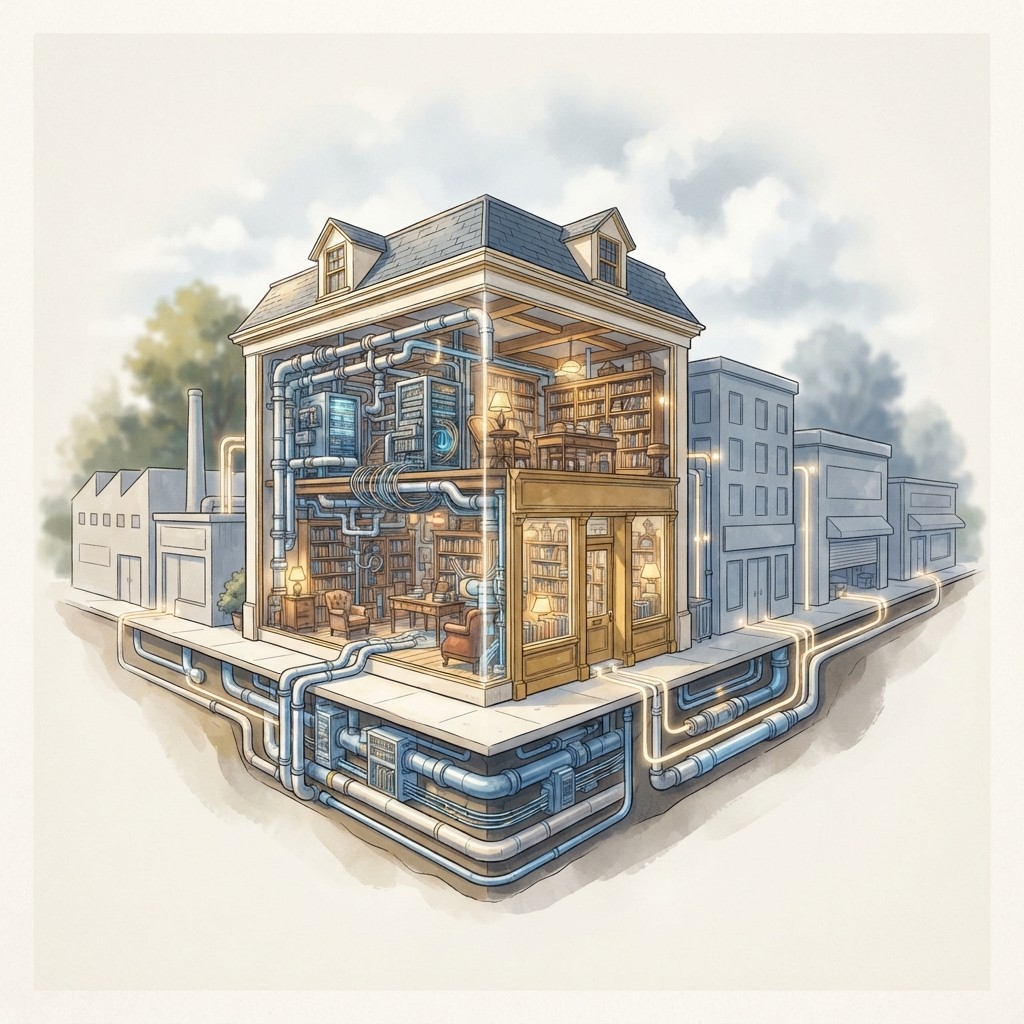
Here is the thesis a smart friend could repeat at dinner: Amazon didn't expand into new industries. It rented out the plumbing it had already been forced to build for itself. Marketplace, Prime, AWS — each one started as a cost center inside retail and was reframed as a product. The everything-store story is the marketing. The infrastructure-arbitrage story is the business.
The cost center that became the cloud
Consider the move everyone treats as the great leap: AWS. The conventional telling is that a retailer woke up one day and decided to compete with IBM and Microsoft. But to run a retail operation that handled spikes, catalogs, and traffic at scale, Amazon had no choice but to build storage and compute infrastructure. The leap was not into a new market. The leap was recognizing that the infrastructure was itself a product. Amazon S3 — the first commercial cloud-infrastructure service — launched on March 14, 2006.2 Amazon EC2, the compute half, arrived as a public beta on August 24 of that year and didn't reach general availability until October 2008.3 Note the gap. This was not a single thunderclap labeled 'AWS launched in 2006.' It was capability shipped in pieces, each piece something Amazon already needed for itself.
Don't ask 'what new market should we enter?' Ask 'what have we been forced to build for ourselves that someone else would pay to rent?' Amazon's storage and compute were sunk costs of being a retailer at scale. The genius move was not inventing them — it was noticing that the bill had already been paid, and that the marginal customer could be charged margin on top of cost Amazon was eating anyway. The most defensible new business is often the one already running inside the old one as overhead.
Prime was an economics experiment, not an ecosystem
The cleanest evidence that the leaps are retrofitted is Prime. Today it's described as a subscription ecosystem — the velvet rope around video, music, delivery, and lock-in. That framing is hindsight. When Prime launched in February 2005, it cost $79 a year and bought you one thing: unlimited two-day delivery on over a million in-stock items.4 No video. Prime Video wasn't added until 2011.4 What Prime actually was, in 2005, was a flat-rate bet on shipping economics — convert unpredictable per-order shipping costs into predictable annual revenue, and let heavy users subsidize the math. The 'ecosystem' was assembled later and the narrative wrapped around it afterward. Same pattern as AWS: a logistics problem solved internally, then sold as a product, then mythologized as strategy.
| Business | The popular narrative | What it actually was at the start |
|---|---|---|
| Marketplace | Amazon opened its store to rivals | Monetizing catalog and fulfillment capacity built for itself |
| Prime | A subscription ecosystem with video and lock-in | A flat-rate shipping experiment in 2005; video not added until 2011 |
| AWS | A bookstore conquers the cloud in 2006 | Internal storage and compute, shipped in pieces from S3 (2006) to EC2 GA (2008) |
There is a tell in the financials too. Amazon turned its first quarterly GAAP profit in Q4 2001 — a penny per share on revenue past a billion dollars.6 A penny. The company that the cloud would eventually fund was, at the moment it first scraped into the black, running so thin that the infrastructure it was building looked like pure expense. That is precisely why turning the expense into revenue was such leverage. You don't get a 65%-style margin business by entering a new market. You get it by discovering the market was already inside your cost structure.
Whole Foods looks like the exception — and proves the rule
The honest objection: Whole Foods. That one wasn't internal plumbing. Amazon paid for it — $42 a share, all cash, a transaction valued at roughly $13.7 billion including Whole Foods' net debt, announced June 16, 2017.5 You can't claim Amazon already owned a grocery chain as overhead. Fair. But look at what Amazon was buying, and the pattern reasserts itself: not a love of selling kale, but physical real estate and a cold-chain logistics network — infrastructure for groceries that Amazon would otherwise have had to build from scratch. The acquisition was a shortcut to the same destination, not a different one. Amazon bought the plumbing this time because building it would have been slower. The grammar of the move is identical: own the capability, then monetize the customers who flow through it.
The steelman cuts the other way too, and it deserves a real answer. If this is just an infrastructure-arbitrage playbook, why hasn't every retailer with a warehouse done it? Because the playbook only works when the internal capability was genuinely world-class — built to survive your own brutal scale, not your customers' modest one. A normal company's internal IT is a cost to be minimized. Amazon's was a system hardened by handling the worst-case load of the most demanding retailer on earth, which is exactly why it was sellable. The arbitrage isn't 'sell your overhead.' It's: be forced to build overhead so good that it becomes a product. Most companies never get forced that hard, or they minimize the cost instead of over-engineering it. Amazon over-built, on purpose, and then collected the bill twice.
“Amazon Web Services Launches 'Amazon S3' — simple storage for developers.”2
So strip away the everything-store romance and what's left is sturdier and more repeatable. Amazon didn't conquer new industries by being brave. It conquered them by being forced — to build storage, to build compute, to build a delivery network, to build a logistics chain — and then by asking, every single time, whether the thing it had just been made to build could be sold to someone else. The leap everyone admires was never the leap. It was the noticing. The most valuable real estate in the company was always the plumbing nobody else thought to charge for — and Amazon's whole expansion is the discipline of walking down to the basement, looking at the machine it had to build anyway, and turning on the meter.
Companies that monetized the machinery underneath
Adjacency / Synergy Map
A one-page canvas for an adjacency play: the new business next door, the shared assets that justify entering it, the synergies that actually transfer versus the ones that evaporate on contact, and the dis-synergies nobody put on the deck. Blank to test your own expansion; filled as the worked example showing where the story's 'natural adjacency' was real and where it was wishful.
Included, filled and blank, in the The Adjacency Expansion Casebook. See the set → · Preview the blank →
Sources
Where this comes from — the filings, records, and reporting behind it.
- 1Amazon was incorporated on July 5, 1994, originally as Cadabra, Inc., and initially operated out of Bezos' rented home in Bellevue, Washington (not Seattle). It opened as an online bookseller on July 16, 1995.
- 2Amazon S3 (the first commercial AWS cloud-infrastructure service) launched on March 14, 2006, per Amazon's own press release from press.aboutamazon.com.
- 3Amazon EC2 was announced as a public beta on August 24, 2006 — after S3. EC2 did not become generally available until October 2008. The 'AWS launched in 2006' shorthand collapses three distinct events (the 2002 brand, the 2006 S3 launch, and the 2006 EC2 beta).
- 4Amazon Prime was announced and launched in February 2005 at $79/year for unlimited 2-day delivery on over 1 million in-stock items. Prime Video was not added until 2011; the 'ecosystem' framing is retrospective.
- 5Amazon announced the acquisition of Whole Foods Market on June 16, 2017 at $42 per share in an all-cash transaction valued at approximately $13.7 billion including Whole Foods Market's net debt — per the Whole Foods 8-K filed with the SEC.
- 6Amazon turned its first GAAP quarterly profit in Q4 2001 — $0.01 per share on revenues exceeding $1 billion — not in 2002 as often generalized in secondary coverage.
- 7Amazon was not the first online book retailer: Computer Literacy, a Silicon Valley bookstore, sold books online as early as 1991, four years before Amazon.com launched in July 1995.
- 8Bezos chose Seattle over Silicon Valley partly to avoid California sales taxes, in addition to proximity to Microsoft-trained engineering talent — a rationale frequently omitted from the popular founding narrative.
More like this — beyond Amazon
New Strategically analyses as they publish: the defining moves in business, checked against the record. No noise, and one click to leave.