Everyone remembers the bold bet. Nobody remembers the two products Amazon quietly buried first — or that the model now reshaping its store was a third draft, not a plan.
Pairs with the Cannibalization Decision Tree — a ready-to-use strategy tool. Included in the Cannibalization Choice Casebook →
“Should you launch the thing that takes revenue from your best business?”
In March 1999, Amazon built an entire auction site from scratch in under three months and pointed it at eBay.5 Then it waited for the crowd. Years later, Jeff Bezos described the turnout with a number that has never improved with retelling: 'I think seven people came, if you count my parents and siblings.'2 That is not the opening line of a story about visionary self-disruption. It is the opening line of a story about failing, twice, in public, before getting it right.
The legend goes like this: Amazon boldly opened its store to outside sellers, inviting rivals to undercut its own shelves, because Bezos saw further than everyone else. Almost every beat of that is wrong. There was no single bold launch — there were three products across nearly two years. And the one that worked was not the one anyone planned. It was the one left standing after two had been quietly buried.
Two swings, two misses, before the one that counted: three products, three names, one survivor — and the survivor was the last draft, not the first vision
The sequence matters because the myth depends on collapsing it. Amazon Auctions arrived in March 1999, an explicit head-on assault on eBay.5 When it failed to draw buyers, it was reshaped into zShops in the autumn of 1999 — essentially the same idea at fixed prices, sellers in their own storefront tab. Same result. As Bezos put it: 'Again, no customers.'2 Only then, in November 2000, did the product we now call Marketplace appear.1 Three products, three names, one survivor — and the survivor was the third draft, not the first vision.
“We took two big swings and missed — with Auctions and zShops — before we launched Marketplace over 15 years ago. We learned from our failures and stayed stubborn on the vision.”3
Read that carefully and the cannibalization legend dissolves. Bezos is not describing a chess master sacrificing a piece. He is describing a company that swung, missed, swung again, missed again — and stayed stubborn long enough to find the version that held. The vision was real. The path to it was not a plan; it was a process of elimination. Here is the thesis, plainly: Amazon did not bravely choose to compete with itself. It iterated its way into a model where competing with itself happened to be the design — and only the third design figured out where to put the fight.
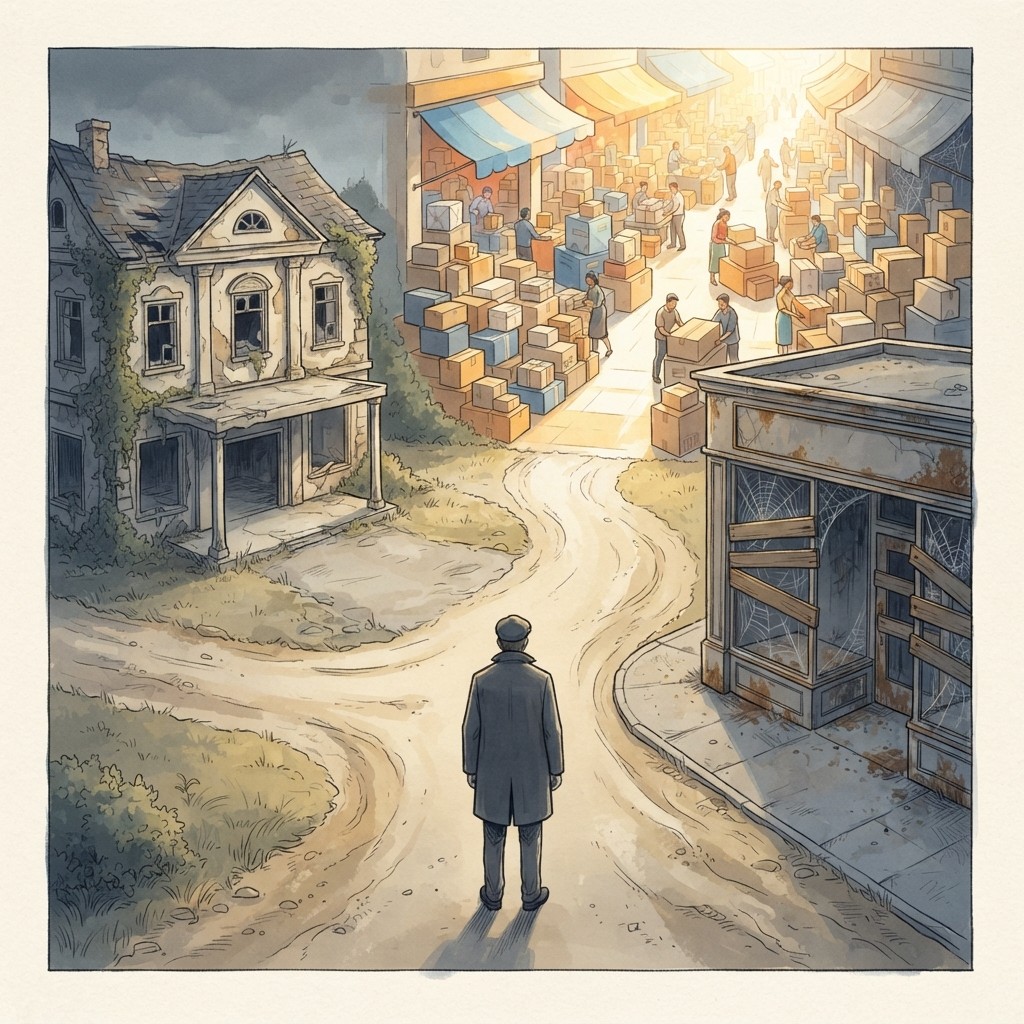
The whole difference was one page: the failure was never the third-party seller — it was sending the customer to a side room nobody visited
Auctions and zShops both made outside sellers go stand somewhere else — a separate auction site, a separate storefront tab. To buy from a third party you had to leave the place you already trusted and go shop in a side room nobody visited. Marketplace, internally called SDP for Single Detail Page, did the one thing the other two refused to do: it put the third-party listing right on Amazon's own product page, next to Amazon's own offer, on the same screen the customer was already looking at.6 Bezos's framing was not 'let outsiders undercut us.' It was, in effect, let third-party sellers compete against our own retail category managers on the very page the buyer has already opened.6
The failure in Auctions and zShops was never the third-party seller — it was the second destination. A separate tab asks the customer to do work and trust a stranger before any value appears, so they don't. The reframe that made Marketplace fly was geographic, not commercial: stop sending the competition somewhere else and let it appear inside the moment of intent, on the page that already has the customer's attention. The bring-your-own-buyer problem disappears when you stop making sellers find buyers and just hand them yours.
Once the fight moved onto the page the customer already trusted, the mechanism did the rest. More sellers meant more selection and sharper prices on the same listing; better selection pulled more buyers; more buyers pulled more sellers wanting a shot at them. The growth was fast but not instant: monthly gross merchandise sales in Marketplace more than tripled in its first four months,1 and Amazon's Services segment — which carried these efforts — went from $13 million in 1999 to $198 million in 2000 to $225 million in 2001.4 Within a year, Marketplace accounted for roughly 5% of units sold.2
| Auctions / zShops | Marketplace (SDP) | |
|---|---|---|
| Where the seller lived | A separate site or storefront tab | Amazon's own product detail page |
| What the buyer had to do | Leave and go shop a side room | Nothing — it was already on the page |
| Who it competed with | eBay, somewhere else | Amazon's own retail managers, in place |
| Result | 'No customers' | Tripled GMS in four months |
But didn't the vision part turn out to be true?: staying stubborn on a direction is real and rare, but it is not the same as having drawn the winning product in advance
The fair objection is that Bezos calls it a vision, and the numbers vindicate him: third-party sellers grew from about 5% of units to roughly 60% by 2026.7 If that isn't visionary self-disruption, what is? The honest answer is that vision and foresight are not the same thing. Staying stubborn on a belief — that letting outsiders sell could expand selection — is real and rare. But it is different from having drawn the winning product on a whiteboard in 1999. The record shows Amazon committed to a direction and then groped toward the working form through two failures it openly calls misses.3 That is a less romantic story, and a more useful one, because the romantic version teaches a lesson nobody can copy — be a genius — while the true version teaches one anybody can: hold the conviction loosely on form and tightly on direction, and survive your own bad drafts long enough to find the good one.
There is a tidier legend in which Amazon, fully formed, chose to compete with itself. The evidence is messier and better. Amazon wanted to compete with itself, tried it in a separate room twice, watched nobody show up, and finally discovered that the only place self-competition works is the one place it feels most dangerous — your own product page. The boldness was never the idea of inviting rivals in. It was refusing to quit after Auctions drew seven people and zShops drew none. The vision was stubborn. The strategy was a third draft. And the difference between those two sentences is the whole lesson.
When a company learns to eat its own lunch
Cannibalization Decision Tree
A decision tree for the moment the new thing threatens the cash cow: is the disruption real, will someone else do it if you don't, and can you afford to bleed your own margin to own the future? Blank to run on your own line; filled as the worked example tracing how the story's incumbent chose to cannibalize — or flinched and got cannibalized.
Included, filled and blank, in the Cannibalization Choice Casebook. See the set → · Preview the blank →
Sources
Where this comes from — the filings, records, and reporting behind it.
- 1Amazon Marketplace launched in November 2000, as Amazon's third and successful iteration of third-party selling, following Auctions (March 1999) and zShops (September 1999). Monthly gross merchandise sales in Marketplace more than tripled in its first four months.
- 2Bezos's own account: 'First, we launched Amazon Auctions. I think seven people came, if you count my parents and siblings. Auctions transformed into zShops, which was basically a fixed price version of Auctions. Again, no customers. But then we morphed zShops into Marketplace.' Marketplace was internally called SDP (Single Detail Page). Within a year it accounted for 5% of units.
- 3Bezos stated in his 2015 shareholder letter: 'We took two big swings and missed — with Auctions and zShops — before we launched Marketplace over 15 years ago. We learned from our failures and stayed stubborn on the vision, and today close to 50% of units sold on Amazon are sold by third-party sellers.'
- 4Amazon's Services segment (which included Auctions, zShops, Payments, and the Merchant Program comprising Marketplace) reported net sales of $13 million in 1999, $198 million in 2000, and $225 million in 2001, confirming rapid but not instant growth after Marketplace's November 2000 launch.
- 5Amazon Auctions launched in March 1999 as an explicit attempt to compete with eBay; the entire site was built from scratch in under three months. Internal debates at Amazon split between targeting medium/large businesses vs. dominating Amazon's core categories — the 'head-on assault' camp won, and then 'ultimately lost,' per a firsthand engineer's account.
- 6Marketplace's core strategic innovation was placing third-party listings on Amazon's own product detail pages — competing directly alongside Amazon's own retail managers on the same page — not in a separate storefront tab (as zShops had been), which had failed to attract buyers.
- 7As of Q1 2026, third-party sellers account for 60% of paid units on Amazon — stabilized around 60–62% since 2023 — up from roughly 5% within the first year of Marketplace in 2001, and 54% as of 2020.
- 8Amazon's own 1999 year-end marketplace services — Auctions (March 1999), zShops (October 1999), and sothebys.amazon.com (November 1999) — collectively surpassed 1 million registered users and 1.5 million listings by Q4 1999, per Amazon's contemporaneous SEC-referenced disclosures, confirming the pre-Marketplace experiments had user volume but not commercial traction.
Weighing outside help with a decision like this? Hiring a corporate strategy consultant
More like this — beyond Amazon
New Strategically analyses as they publish: the defining moves in business, checked against the record. No noise, and one click to leave.