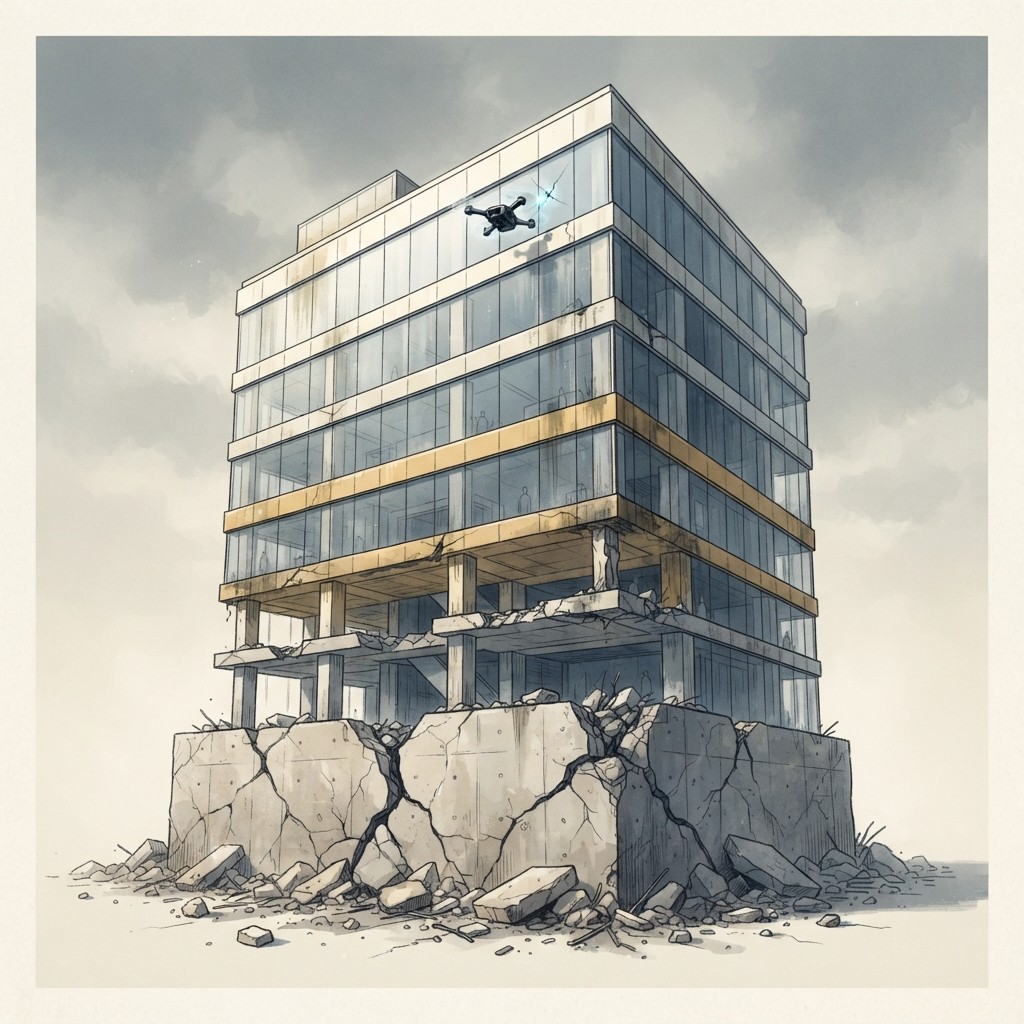
Pairs with the Disruption Vulnerability Assessment — a ready-to-use strategy tool. Included in the Fall Casebook →
“How much of your decline can the agreed explanation actually account for?”
On December 6, 2021, BuzzFeed rang the Nasdaq bell as a public company, merging into a blank-check vehicle at a reference price of about $10 a share.2 The optics were triumphant: a viral-media native that had just grown revenue 24% to $398 million and booked a second straight year of GAAP profit was finally cashing in.2 But read the deal terms instead of the headline and you see something stranger. The SPAC merger targeted a $1.5 billion valuation.3 The company's private peak — its 2016 NBCUniversal-led round — had valued it at roughly $1.7 billion.9 BuzzFeed didn't go public at the top. It went public at a discount to where it had already been, and then it kept falling. By March 2023 the stock sat at $1.05.8
The popular obituary blames the algorithm: Facebook turned off the traffic, and the listicle empire starved. Or it blames the AI pivot, the panicked late lurch toward machine-written quizzes. Both stories are tidy and both are wrong about the cause. The algorithm and the AI were weather. The thing that actually killed BuzzFeed was structural, and it was set in motion the day the company decided to grow by buying.
The roll-up that needed a growth that never came
BuzzFeed's strategic bet was a roll-up: get bigger by acquiring other distressed digital-media properties, stack their audiences, and sell the combined scale to advertisers. The SPAC was the financing engine for it — the $1.5 billion target valuation explicitly folded in the planned $300 million purchase of Complex Networks, $200 million in cash plus $100 million in equity.3 The logic only works if the combined entity grows into its cost base. Roll-ups are leveraged bets on scale. They assume the acquired audiences keep showing up and keep monetizing. BuzzFeed's didn't. Its entire revenue model depended on distribution it didn't own — and by the FY2023 filing, Time Spent on third-party platforms had fallen 32% in a single year.1 You cannot buy your way to scale while your borrowed traffic is collapsing underneath you. The company was acquiring assets that ran on the same fuel that was draining out of the original.
Why each 'strategic' move made it worse
Here is the autopsy's grim pattern: every major decision after the listing was the same decision wearing a different costume — a doubling-down on a distribution thesis that was already broken. The HuffPost acquisition10 and the Complex Networks buy added headcount, brands, and obligations, all monetized the same fragile way. BuzzFeed News, launched in late 2011 when Ben Smith joined as editor-in-chief, had grown to more than 100 journalists and earned a 2021 Pulitzer for its reporting on China's mass detention of Muslims5, with finalist nods on additional occasions.5 It was real journalism — and it was a fixed cost in a model that couldn't carry fixed costs anymore. When it closed in April 2023 as part of a 15% workforce cut, the CEO's own memo named the disease without diagnosing it: he had 'overinvested' in the newsroom, and 'the big platforms wouldn't provide the distribution or financial support required.'4 Read that twice. The admission isn't that journalism failed. It's that the entire company had been built assuming platforms would underwrite it — and they never agreed to.
“I made the decision to overinvest in BuzzFeed News because I love their work and mission so much... the big platforms wouldn't provide the distribution or financial support required to support premium, free journalism.”4
| Asset | What BuzzFeed put in | What it got back |
|---|---|---|
| Complex Networks | $300M (announced deal: $200M cash + $100M equity) | Sold to NTWRK for $108.6M + ~$5.7M costs |
| First We Feast | Retained out of the Complex deal | Later sold for $82.5M |
| The SPAC listing itself | Target $1.5B valuation, ~$10 reference price | Stock down ~98%, ~$8.5M cash left, going-concern warning |
The Complex line is the whole story in one row. BuzzFeed paid an announced $300 million for it,3 then sold it in February 2024 — minus First We Feast — to NTWRK for $108.6 million plus about $5.7 million in costs.6 Less than forty cents on the dollar, and a 16% staff cut to go with it. The roll-up wasn't compounding value. It was a furnace, and the acquisitions were the fuel being shoveled in to keep a public company technically alive.
The AI pivot was the last shovel, not the fire
By the time BuzzFeed announced it would lean into AI-generated content, the structure was already terminal. The spike in the stock on that announcement — shares surged from roughly $3 to above $1513 — made AI look like either the cause of the crisis or the cure for it. It was neither. It was a balance-sheet on life support reacting to a buzzword. The convertible notes alone, sitting in the FY2023 filing, were convertible into roughly 12 million Class A shares,1 a quiet reminder that the capital structure carried obligations the shrinking business had no realistic path to service. The going-concern warning eventually followed, alongside net losses of $57.3 million and only $8.5 million in unrestricted cash remaining.1412 AI didn't break BuzzFeed. AI was what a broken company reaches for when it has run out of audiences to buy.
When a company grows by acquisition into a fixed cost base, it's not buying revenue — it's borrowing against a future where the combined entity is bigger and more efficient. That bet pays only if scale actually shows up. If the underlying engine is borrowed distribution you don't control — a platform algorithm, a partner's traffic, a channel that can be switched off without your consent — then every acquisition multiplies your exposure to the one thing you can't fix. The tell isn't the deal price. It's the question: does this purchase reduce my dependence on something I don't own, or deepen it? BuzzFeed kept buying companies that ran on the exact fuel that was draining out of its own tank.
The fair counter: wasn't the algorithm genuinely fatal?
The honest objection is that platform dependence wasn't a choice BuzzFeed made — it was the air the entire digital-media generation breathed, and when Facebook deprioritized publishers, everyone built on that traffic got hit. That's true, and it matters. The 32% one-year decline in platform Time Spent was a real shock, not a self-inflicted wound.1 But the shock is exactly what separates a fragile structure from a robust one. A company that had used its profitable years — and 2021 was profitable, twice over2 — to lower its fixed costs and own more of its monetization would have shrunk and survived. BuzzFeed did the opposite. It used the good moment to go public at a discount, take on a roll-up's obligations, and add the most distribution-dependent assets it could find. The algorithm pulled the trigger. The capital structure loaded the gun and handed it over.
The viral king of the 2010s didn't die of a bad idea about content. It died of a good-sounding idea about finance: that you can outrun deteriorating unit economics by getting bigger, faster, on someone else's money. The SPAC promised scale and delivered a discount. The acquisitions promised audiences and delivered write-downs of sixty cents on the dollar. And the final pivot to AI promised a future to a company that had spent its last decade buying its own past. BuzzFeed didn't lose the internet. It lost the simpler thing — the part where the money you spend has to come back.
When the structure, not the strategy, does the killing
Disruption Vulnerability Assessment
An assessment that rates a company across the dimensions that predict disruption: how cheaply a challenger can serve the unsexy bottom of the market, how trapped you are by margins and a satisfied core. Blank to score your own position before the cliff; filled as the worked example showing where the story's incumbent was already exposed while the numbers still looked great.
Included, filled and blank, in the Fall Casebook. See the set → · Preview the blank →
Sources
Where this comes from — the filings, records, and reporting behind it.
- 1BuzzFeed, Inc. filed its FY2023 10-K with the SEC; as of December 31, 2023 the company had convertible notes convertible into approximately 12,000,000 shares of Class A common stock, and Time Spent on third-party platforms declined 32% year-over-year.
- 2BuzzFeed full-year 2021 revenue grew 24% year-over-year to $398 million; the company achieved a second consecutive year of GAAP profitability and completed its public listing on Nasdaq via SPAC merger with 890 5th Avenue Partners.
- 3BuzzFeed announced its SPAC merger with 890 Fifth Avenue Partners targeting a $1.5 billion valuation (inclusive of the planned Complex Networks acquisition for $300 million: $200 million cash + $100 million equity) on June 24, 2021.
- 4BuzzFeed News shut down April 20, 2023 as part of a 15% workforce reduction (~180 employees); CEO Jonah Peretti's memo acknowledged he 'overinvested in BuzzFeed News' and that 'the big platforms wouldn't provide the distribution or financial support required.'CNN Business, BuzzFeed News will shut down ↗ · 2023-04-20
- 5BuzzFeed News started in 2012, grew to more than 100 journalists worldwide, won the 2021 Pulitzer Prize for International Reporting (coverage of China's mass detention of Muslims), and was a Pulitzer finalist on at least two additional occasions.
- 6In February 2024, BuzzFeed cut another 16% of staff and sold Complex Networks to NTWRK for $108.6 million plus $5.7 million in office/severance costs, retaining First We Feast; the move represented a major step-down from the $300 million acquisition price.
- 7By early 2025/2026 BuzzFeed had issued a 'going concern' warning; the company reported net losses of $57.7 million, stock had lost ~98% of its value since the SPAC listing, and only ~$8.5 million in cash remained; First We Feast was sold for $82.5 million and Complex for $108.6 million.
- 8BuzzFeed was co-founded in November 2006 by Jonah Peretti and John S. Johnson III (with Kenneth Lerer as an early co-founder/investor); BuzzFeed's stock never sustained trading above its ~$10 SPAC reference price post-listing, and by March 2023 Class A shares were at $1.05.
- 9NBCUniversal's 2016 investment round valued BuzzFeed at approximately $1.7 billion
- 10BuzzFeed acquired HuffPost from Verizon Media in November 2020
- 11BuzzFeed's FY2025 net loss from continuing operations was $57.3 million; as of December 31, 2025 unrestricted cash and cash equivalents were $8.5 million; the company disclosed substantial doubt about its ability to continue as a going concern
- 12First We Feast was sold for $82.5 million in 2024; BuzzFeed ended 2025 with $8.5 million in cash; going-concern warning issued
- 13BuzzFeed's stock surged from approximately $3 to above $15 per share following the January 2023 announcement of its OpenAI/AI content partnership
- 14BuzzFeed FY2025 full-year net loss was $57.3 million (including a $30.2M non-cash goodwill impairment), cash fell to $8.5 million, and the company disclosed a going concern warning — per 8-K filed March 12, 2026
Weighing outside help with a decision like this? Hiring a turnaround or restructuring advisor
More like this — beyond BuzzFeed
New Strategically analyses as they publish: the defining moves in business, checked against the record. No noise, and one click to leave.