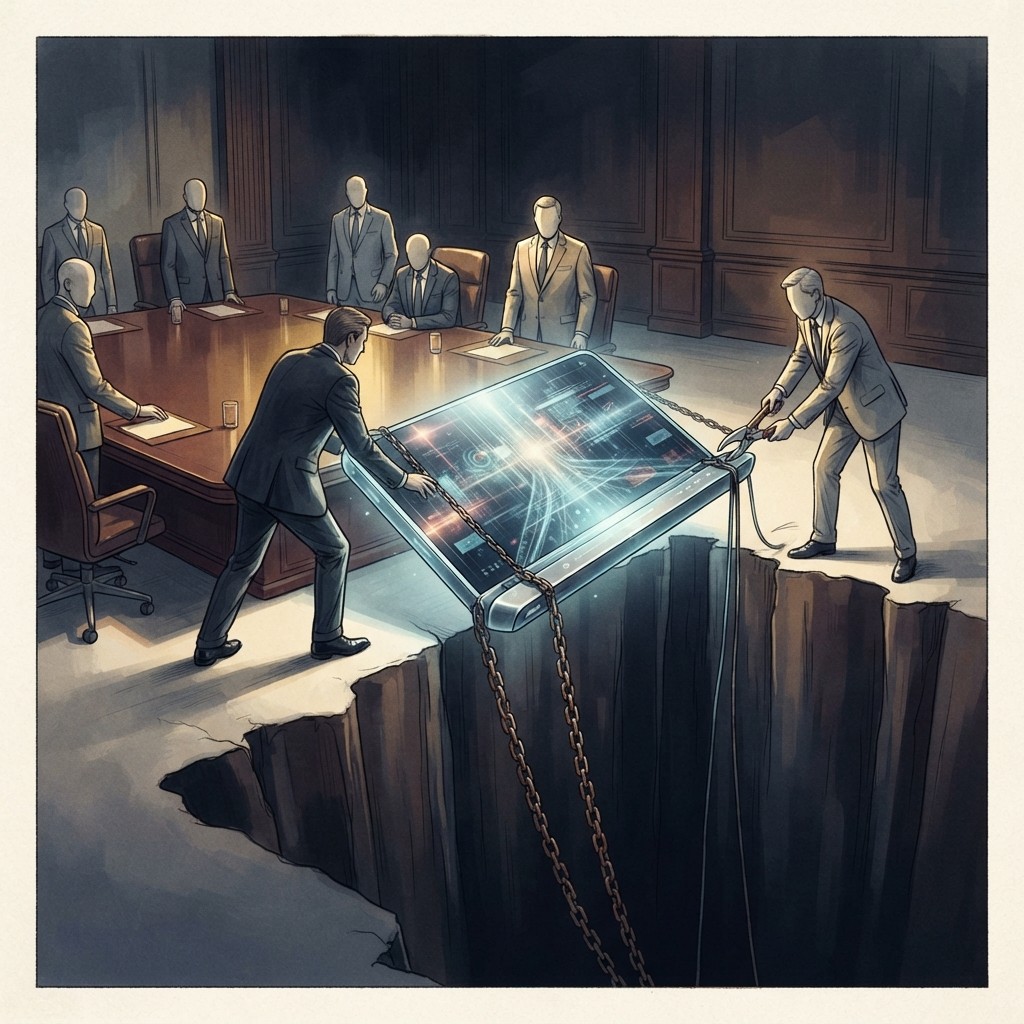
Pairs with the Disruption Vulnerability Assessment — a ready-to-use strategy tool, filled for Blockbuster. Included in the The Fall Casebook →
Everyone knows the scene. Around the year 2000, two scrappy founders from a tiny DVD-by-mail startup fly to Dallas, offer to sell their company to the giant, and get laughed out of the room. Twenty years later the giant is dead and the startup owns Hollywood. It's the most satisfying business parable of the century — and it's mostly literature. Reed Hastings himself, asked about that meeting in 2025, didn't describe a rejection. He described indifference: 'I think it was curiosity rather than anything else.'7 The famous $50 million price tag and the 'laughed out of the room' line come from the Netflix side's memoirs, not from any Blockbuster document.8 The meeting happened. The legend that hangs on it did not.
The official cause of death is arrogance: Blockbuster ignored streaming until streaming buried it. The real cause is stranger and far more instructive. Blockbuster didn't ignore the threat — it built a credible answer to it, then destroyed that answer from the inside, while a mountain of inherited debt made every wrong move unsurvivable.
Here is the thesis a smart friend can repeat at dinner: Blockbuster wasn't killed by a competitor it refused to buy. It was killed by a board coup that fired the executive funding its digital pivot, a successor who treated streaming as a fad, and a debt load that left no room for any of it to go wrong.
It actually built the Netflix-killer — and led with it
The story of pure inaction is false. In December 2004, Blockbuster did the boldest customer-facing thing in its history: it announced the end of late fees, effective January 1, 2005, across more than 4,500 U.S. stores. CEO John Antioco called it 'the biggest and most important customer benefit we've ever offered.'4 This was no defensive twitch. Late fees were a meaningful slice of revenue, and Antioco walked away from them to pull the rug out from under the exact grievance Netflix used to win customers — the punishment for keeping a movie too long. He paired it with a push into online DVD subscriptions, the direct frontal response to the mail-order model. For a stretch in 2006 and 2007, it worked well enough that Hastings later admitted the threat was real. The villain of the legend was, in the documented record, the one executive trying to save the company by becoming Netflix before Netflix could become Blockbuster.
The debt was poured into the foundation before the fight even started
To understand why a working pivot still ended in Chapter 11, start before the war. In October 2004, Blockbuster split off from Viacom and became fully independent; Viacom's officers, including Sumner Redstone, resigned from its board.3 But independence is not freedom when you leave home owing money. Blockbuster walked out of the Viacom era carrying a debt burden it would never escape — by the time it filed, the recapitalization plan was trying to crush nearly $1 billion of debt down to $100 million or less by swapping it for equity.2 That number is the whole story behind the story. A digital transformation costs cash and loses money for years before it pays. A debt-free company can absorb that. A company servicing nearly a billion dollars cannot afford a single misstep — and it was about to make several, on purpose.
The coup that fired the firefighter
By 2005, the activist investor Carl Icahn had taken a stake of nearly 10% and won three board seats. He and his allies opposed exactly the two moves that were Blockbuster's best shot: the elimination of late fees and the costly online expansion.5 From the perspective of a balance sheet groaning under debt, that opposition was not insane — every dollar Antioco spent fighting Netflix was a dollar not servicing the loan. But it was strategically fatal. The standoff finally broke not over strategy but over a paycheck: a dispute over Antioco's roughly $7.6 million bonus for 2006 became the wedge. In March 2007 Antioco agreed to step away, his departure announced on March 21, explicitly tied to that bonus fight with the Icahn-led board — the same Icahn who had already tried to oust him in 2005.56 The man championing the digital pivot was gone over a bonus, and the pivot lost its only patron at the top.
| The popular legend | What the documents say | |
|---|---|---|
| Cause of death | Refused to buy Netflix in 2000 | Debt, a board coup, and a successor who defunded the pivot |
| Antioco's role | The arrogant villain who said no | The champion of late-fee elimination and online expansion |
| The $50M offer | A formal deal Blockbuster rejected | A figure only in Netflix memoirs; Hastings calls it 'curiosity' |
| Blockbuster's response | Did nothing until too late | Built an online subscription rival and killed late fees |
“They didn't see us as a significant player. I think it was curiosity rather than anything else.”7
Wasn't passing on Netflix the original sin?
The honest objection: even if the $50 million scene is mythologized, Blockbuster still had the chance to absorb Netflix early and didn't — and that's the decision that doomed it. Steelman it fully. In 2000, Blockbuster was a roughly $6 billion company with around 9,000 stores; Hastings described it as 'a thousand times our size.'8 Passing on a curiosity-stage rival that small was not obviously irrational — it was the kind of call any incumbent makes a hundred times a year. The flaw in the legend is that it treats one early non-decision as load-bearing for a collapse that came a full decade later. By the documented timeline, the fatal moves were not in 2000. They were in 2007, when the board removed the executive funding the catch-up, and in the years after, when the strategy was starved of capital it never had to spare in the first place. A company can survive missing an acquisition. It struggles to survive firing the person trying to fix the miss — while owing a billion dollars.
The comforting version of the Blockbuster story is about a dumb company that didn't notice the future. The useful version is about a smart company that noticed, responded, and then dismantled its own response from the inside. Disruption is rarely a single missed deal — it's a slow squeeze in which prior debt, board politics, and a successor's misjudgment each remove a degree of freedom until the obvious right move is no longer affordable. When you study a fallen giant, distrust the tidy origin story. Ask instead: at the moment of decision, how much room did the balance sheet and the boardroom actually leave? Strategy is only as free as its financing and its governance let it be.
On September 23, 2010, Blockbuster filed for Chapter 11 in the Southern District of New York, case number 10-14997.1 By then the company that had once been a thousand times Netflix's size was trying to shed nearly a billion dollars of debt it had carried since before the fight began.2 The legend says it died because it couldn't see the future. The record says it saw the future clearly enough to build a defense against it — and then, under the weight of inherited debt and a boardroom at war with its own CEO, took that defense apart with its own hands. Blockbuster didn't fail to act. It out-financed and out-fought its own best instincts, and spent a decade discovering what that costs.
When the boardroom, not the market, writes the ending
Disruption Vulnerability Assessment
An assessment that rates a company across the dimensions that predict disruption: how cheaply a challenger can serve the unsexy bottom of the market, how trapped you are by margins and a satisfied core. Blank to score your own position before the cliff; filled as the worked example showing where the story's incumbent was already exposed while the numbers still looked great.
Included, filled and blank, in the The Fall Casebook. See the set → · Preview the blank →
Sources
Where this comes from — the filings, records, and reporting behind it.
- 1Blockbuster Inc. and its domestic subsidiaries filed voluntary Chapter 11 petitions in the U.S. Bankruptcy Court for the Southern District of New York on September 23, 2010, case number 10-14997, with a DIP revolving credit agreement executed the same day.
- 2The recapitalization plan aimed to reduce Blockbuster's debt from nearly $1 billion to an estimated $100 million or less by exchanging debt for equity.
- 3In October 2004, Blockbuster split off from Viacom and became a fully independent company; Viacom officers including Sumner Redstone resigned from the Blockbuster board effective October 16, 2004.
- 4Blockbuster announced the elimination of late fees effective January 1, 2005, across more than 4,500 U.S. company-operated and franchised stores; CEO Antioco called it 'the biggest and most important customer benefit we've ever offered.'
- 5By 2005, Carl Icahn had acquired a nearly 10% stake in Blockbuster, winning three board seats; he and his allies opposed Antioco's online expansion and late-fee elimination. After a bonus dispute over Antioco's $7.6M entitlement for 2006 performance, Antioco agreed to step away in March 2007.
- 6John Antioco's departure as Blockbuster chairman and CEO was announced March 21, 2007, explicitly tied to a bonus dispute with the board led by Carl Icahn, who had 'tried to oust Antioco in 2005.'
- 7Reed Hastings stated in 2025 that the 2000 Dallas meeting with Blockbuster was likely not a serious acquisition discussion: 'They didn't see us as a significant player. I think it was curiosity rather than anything else.' Other Netflix executives recall being 'laughed out of the room' — the facts of the meeting are disputed.
- 8Marc Randolph's 2019 memoir and Reed Hastings's 2020 book both describe a circa-2000 meeting at Blockbuster's Dallas headquarters where Netflix sought a $50M acquisition; the $50M figure and the 'laughed out of the room' framing originate solely from Netflix participants' memoirs, not Blockbuster primary sources. Hastings noted Blockbuster was then a ~$6 billion company with ~9,000 stores — 'a thousand times our size.'
More like this — beyond Blockbuster
New Strategically analyses as they publish: the defining moves in business, checked against the record. No noise, and one click to leave.