Pairs with the Disruption Vulnerability Assessment — a ready-to-use strategy tool, filled for 3M. Included in the The Fall Casebook →
On April 1, 2024, 3M did something a diversified conglomerate is supposed to never have to do: it cut off a healthy arm to pay for two of its own products. It spun out its health-care business as a separate public company called Solventum — $8.2 billion in annual sales, more than 20,000 employees — and loaded that new company with $8.6 billion in debt, partly so it could pay 3M for the privilege of leaving.7 The same day, 3M confirmed the resolution of the two lawsuits that made the surgery necessary.4 One was about a coating chemistry. The other was about an earplug.
The official story is that 3M is a diversified empire of tens of thousands of products, and diversification means no single failure can sink the ship. That story held for most of a century. It stopped holding when the failures stopped being product failures and started being liability events — and a liability tail does not respect the firewall between business segments.
The lawsuits cost more than the year's profit ever did
Look at the income statement and you would think the business had imploded. In 2023, 3M posted a net loss of roughly $7 billion, against net income of $5.8 billion the year before.1 But the operating business did not collapse. Net sales were $32.7 billion in 2023, down from $34.2 billion in 2022 and $35.4 billion in 2021 — a soft patch, not a crater.1 The crater is hiding in one line: selling, general, and administrative expense leapt to $21.5 billion in 2023 from $9.0 billion in 2022.1 That $12 billion swing is not the cost of running a worse company. It is the cost of settling two of its products.
This is the trap inside the diversification story. A conglomerate spreads operating risk beautifully — if abrasives have a bad year, adhesives carry the quarter. What it does not spread is liability risk, because a legal judgment attaches to the corporate parent, not to a single product line. When one product turns out to have a defect known for years, the courtroom does not care that 59,999 other products were fine. The thesis of diversification is that no one item can hurt the whole. The lesson of 2023 is that a single item, given enough time and enough plaintiffs, can demand the whole company's profit and then some.
The science platform monetized a liability it couldn't see
3M's genius was always its science platform: take a core chemistry and spin it into hundreds of products no competitor would think to make. PFAS — the family of fluorinated compounds behind coatings, stain repellents, and firefighting foams — was exactly that kind of platform chemistry, monetized across category after category. The problem is that the innovation cycle is fast and the liability cycle is slow. A coating reaches the market in a couple of years; the consequences of a 'forever chemical' that never breaks down in the environment surface over decades. By the time the bill arrived, it was enormous: a settlement with public water systems that 3M's own 10-K describes as a commitment of $10.5 billion to $12.5 billion, payable from 2023 all the way out to 2036.3
A platform that lets you launch a hundred products from one chemistry is a wonderful engine — right up until the chemistry has a long tail you priced at zero. The danger isn't a bad product; it's a product whose downside takes thirty years to show up while the upside books in eighteen months. When the time horizon of the harm is longer than the time horizon of the profit, every successful launch is quietly stacking a liability the income statement never recorded. The faster you monetize a platform, the more units of that hidden tail you ship before anyone can see it.
Worth keeping the numbers honest here. The widely repeated '$12.5 billion' is the nominal ceiling, not the certain payment — the present-value figure is closer to $10.3 billion, and the maximum depends on how many claimants come forward.34 But the precise number is almost beside the point. Whatever it lands at, it is a multiple of any single year's profit, owed by the parent, generated by a chemistry the company spent decades spreading as widely as it possibly could.
The earplug, and the firewall that didn't hold
The second product tells the same story in miniature, and it disposes of the most popular myth about how 3M tried to escape. The Combat Arms earplug — sold to the U.S. military, with a design defect a predecessor manufacturer knew about as early as 2000 — became the largest mass-tort multidistrict litigation in U.S. history, with over 200,000 plaintiffs; the Justice Department had already extracted a $9.1 million False Claims Act settlement back in 2018.8 In July 2022, 3M tried the structural move conglomerates reach for when a subsidiary's liability threatens the parent: it put the subsidiary, Aearo Technologies, into Chapter 11, committing $1 billion to a trust and hoping the bankruptcy would wall off the rest.6
It did not work. The bankruptcy court refused to extend Aearo's automatic stay to 3M itself, and the case was ultimately dismissed.6 The firewall the corporate structure was supposed to provide simply was not there. Thirteen months after the bankruptcy filing, 3M settled directly — $6.0 billion, $5.0 billion in cash and $1.0 billion in its own stock, payable through 2029.5 Add that to the PFAS commitment and you are looking at something on the order of $18.5 billion in legal exposure from two product lines, owed by the parent, no subsidiary able to absorb it.
| PFAS coatings | Combat Arms earplug | |
|---|---|---|
| What it was | A platform chemistry spun into hundreds of products | A single defective product sold to the military |
| When the defect was knowable | Decades of 'forever chemical' persistence | As early as 2000 |
| The settlement | $10.5B–$12.5B, payable to 2036 | $6.0B, payable to 2029 |
| Who ultimately paid | 3M, the parent | 3M, after the bankruptcy firewall failed |
So the company sold the part that still worked
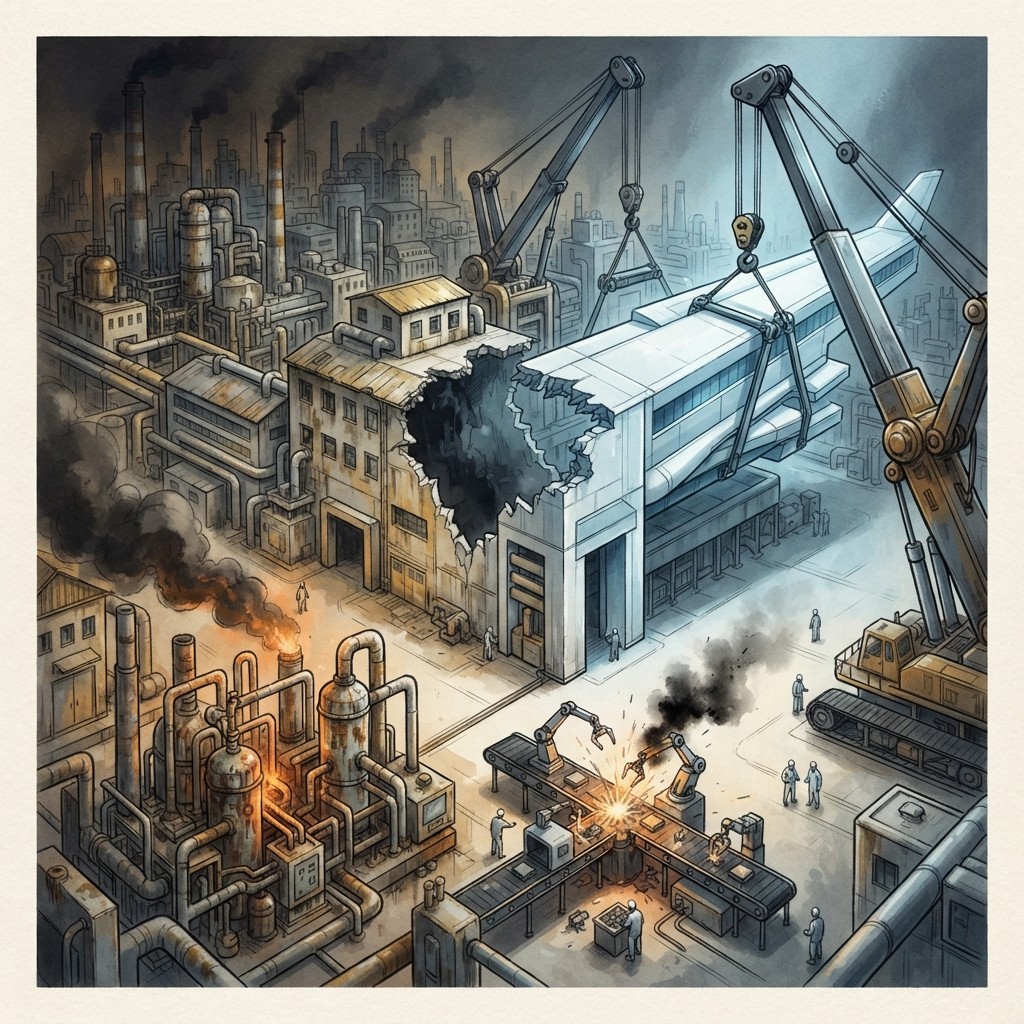
Now the spinoff makes sense. Solventum was not a struggling unit being shed — it was an $8.2 billion business in good health.7 And that is exactly why it was useful. 3M retained 19.9% of the shares to monetize within five years, and the new company carried $8.6 billion of debt partly to pay 3M for the transfer.7 Strip the language away and the transaction is plain: the conglomerate converted its healthiest diversification into cash and debt capacity at the precise moment it needed to fund the liabilities its other diversification had created. The empire that was supposed to be unbreakable because it was spread so wide was now narrowing itself to survive its own breadth.
“3M Completes Spin-off of Solventum… 3M Resolves Public Water Supplier and Combat Arms Earplugs Litigation.”4
Isn't this just bad luck with two products?
The fair objection is that this proves nothing about diversification — it is two unlucky products, decades of legal hindsight applied retroactively, and an operating business that frankly held up fine. And there is real truth there. Organic sales fell only modestly; the headline revenue 'collapse' some data services show is a reclassification artifact from moving health care into discontinued operations, not a real-time loss of customers.21 The factories still run. The bankruptcy gambit, not the business, is what failed.
But that defense is precisely the point, not the rebuttal. The whole promise of diversification was that no single bet could threaten the enterprise. If two products out of tens of thousands can force the company to liquidate its best growth business to pay the tab, then the model didn't spread the risk that actually mattered. Operating diversification was never the exposure. The exposure was that a science platform monetized into category after category multiplies not just revenue lines but liability lines — and those don't sit in tidy segments. They all roll up to the same balance sheet. The conglomerate discount investors had quietly priced in for years turned out to be measuring something real.
3M spent a century proving that breadth was strength. Then it spent one filing proving that breadth without a way to contain its own tail is just a larger surface for a lawsuit to attach to. The company that diversified so nothing could sink it ended up selling the part that floated best — to bail out the parts that didn't. That is not diversification failing at the margins. That is diversification eating itself, one settlement at a time.
When the model that built a company starts working against it
Disruption Vulnerability Assessment
An assessment that rates a company across the dimensions that predict disruption: how cheaply a challenger can serve the unsexy bottom of the market, how trapped you are by margins and a satisfied core. Blank to score your own position before the cliff; filled as the worked example showing where the story's incumbent was already exposed while the numbers still looked great.
Included, filled and blank, in the The Fall Casebook. See the set → · Preview the blank →
Sources
Where this comes from — the filings, records, and reporting behind it.
- 13M full-year 2023 net sales were $32,681 million; 2022 net sales were $34,229 million; 2021 net sales were $35,355 million. Full-year 2023 net loss was approximately $6,997 million (loss of consolidated group), versus net income of $5,780 million in 2022. SG&A ballooned to $21,526 million in 2023 from $9,049 million in 2022, reflecting litigation charges.
- 23M full-year 2022 net sales were $34.2 billion, down 3% year-on-year. Organic sales growth was 0.4%, with a 2.6 percentage point headwind from declining disposable respirator demand and the exit of Russia. Operating cash flow was $1.9 billion.
- 3On June 22, 2023, 3M reached a settlement with public water systems for PFAS contamination ranging from $10.3 billion (present value) to $12.5 billion (maximum nominal). The court granted final approval on March 29, 2024. 3M's own 10-K states the total commitment is '$10.5 billion to $12.5 billion' payable 2023–2036.
- 4Court final approval of the PFAS public water systems settlement was confirmed April 1, 2024. The pre-tax present-value commitment is up to $10.3 billion payable over 13 years.
- 5On August 29, 2023, 3M announced a $6.0 billion Combat Arms Earplug settlement ($5.0 billion cash + $1.0 billion in 3M common stock), payable 2023–2029, covering all claims in the MDL in Florida and coordinated Minnesota state court action.
- 6Aearo Technologies and related 3M subsidiaries voluntarily filed Chapter 11 in July 2022, with 3M committing $1 billion to fund a trust. As of June 30, 2022, there were approximately 115,000 filed claims and an additional 120,000 on an administrative docket. The bankruptcy court refused to extend the automatic stay to 3M itself, and the case was ultimately dismissed.
- 73M completed the spin-off of its health care business as Solventum Corporation on April 1, 2024. Solventum listed on NYSE as 'SOLV.' Solventum had 2023 sales of $8.2 billion and more than 20,000 employees. 3M retained 19.9% of Solventum shares, to be monetized within five years. Solventum took on $8.6 billion in debt partly to pay 3M for the business transfer.
- 8Aearo Technologies' original manufacturer knew of the Combat Arms earplug design defect as early as 2000. In July 2018, the DOJ announced 3M agreed to pay $9.1 million to settle a False Claims Act whistleblower suit over knowingly selling defective earplugs to the U.S. military. An MDL was established in April 2019 in federal court in Florida, eventually becoming the largest mass tort MDL in U.S. history with over 200,000 plaintiffs.
More like this — beyond 3M
New Strategically analyses as they publish: the defining moves in business, checked against the record. No noise, and one click to leave.