Pairs with the Disruption Vulnerability Assessment — a ready-to-use strategy tool, filled for Theranos. Included in the Fall Casebook →
“How much of your decline can the agreed explanation actually account for?”
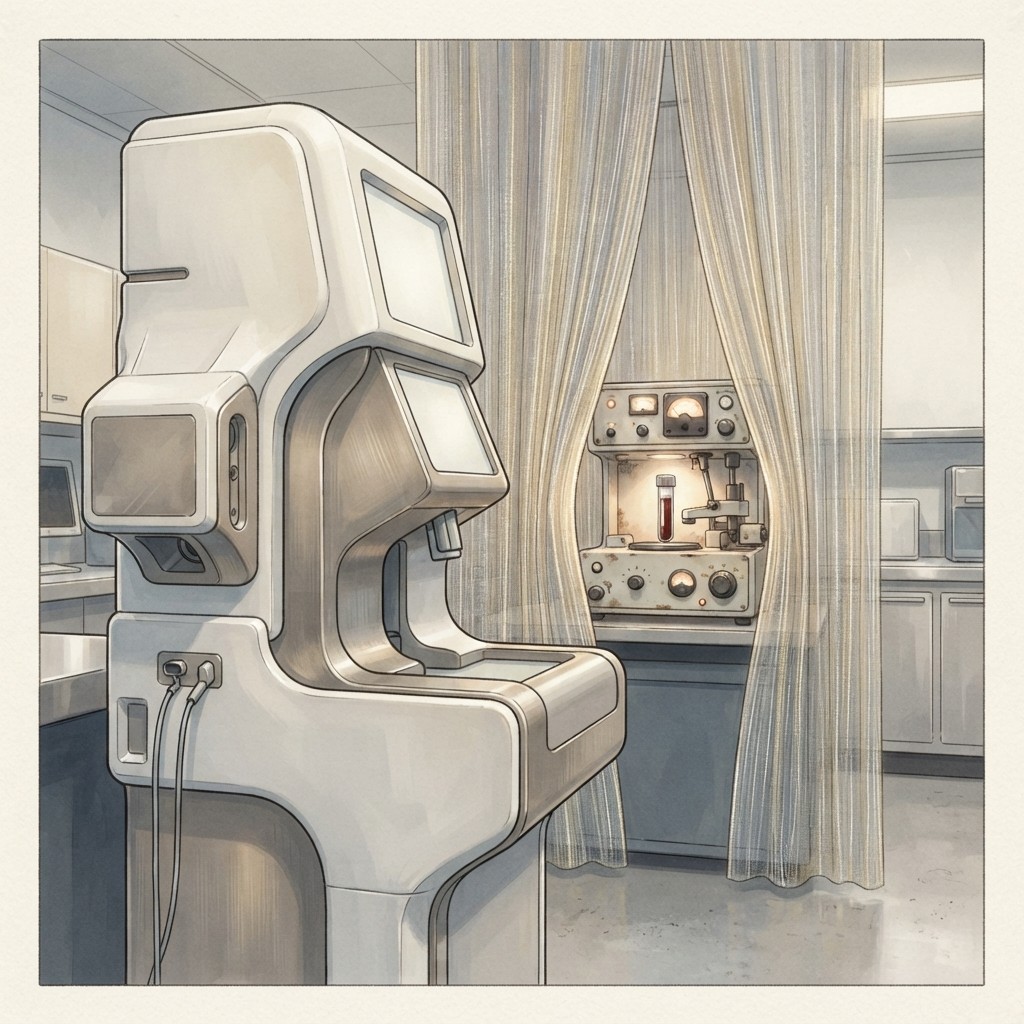
A patient walks into a Walgreens, gives a finger-prick of blood, and trusts that a small machine built by a Stanford prodigy will read it. What actually runs many of those tests is a Siemens analyzer — an ordinary, off-the-shelf commercial device — quietly doing the work that Theranos told its investors only the Theranos device could do.39 That single substitution is the whole story. Not a breakthrough that came up short. A swap, made on purpose, hidden on purpose, for years.
The official story is that Elizabeth Holmes was a believer who flew too close to the sun — a visionary undone by hype and her own conviction. The court record tells a colder story: Holmes and her partner Ramesh 'Sunny' Balwani knew the Edison device couldn't do what they claimed, and told the claim anyway, to people writing nine-figure checks. The fairy tale isn't the tragedy here. The fairy tale is part of the fraud.
The lie that does the most work is the smallest one
Strip away the black turtleneck and the magazine covers and the deception reduces to a few discrete, falsifiable lies — each one cheap to tell and devastating to verify. The DOJ indictment found that Holmes and Balwani knew Theranos used third-party commercial analyzers to run patient tests, while representing to investors that proprietary Theranos-built devices did the testing.3 The SEC found that Theranos told investors it would generate roughly $100 million in revenue from a U.S. Department of Defense deployment in 2014. The technology was never deployed by the Department of Defense at all. Real 2014 operating revenue was a little more than $100,000.2 That is not a forecast that missed. That is a claim of $100 million against a reality three orders of magnitude smaller, told to people who could not see the lab.
“Theranos' technology was never deployed by the U.S. Department of Defense... the company generated a little more than $100,000 in revenue from operations in 2014.”2
Why a blood-testing company is the perfect place to lie
Most frauds get caught because the customer experiences the gap directly — a car that won't start, a drug that doesn't work. Diagnostics breaks that feedback loop. A patient who gets a wrong potassium reading doesn't feel the machine fail; they feel fine, or they feel sick, and either way they blame their body, not the device. An investor evaluating the company can't sit in the lab and watch a test run start to finish. So the only people positioned to catch the substitution — the scientists inside — were precisely the people Theranos could silence with NDAs and a culture of fear. The mechanism wasn't a clever technology. It was a clever choice of arena: a business where the truth is invisible to everyone except the few you control. The Edison didn't need to work. It only needed to be unseeable while you said it did.
| Told to investors | On the record | |
|---|---|---|
| The device | Proprietary Theranos analyzer runs the tests | Third-party commercial analyzers ran patient tests |
| Military use | Deployed by the DoD on the battlefield | Never deployed by the DoD |
| 2014 revenue | ~$100 million | A little more than $100,000 |
| The narrative | Visionary believed too hard | Knowing, multi-year deception |
The board saw it, and folded anyway
Here is the detail the fairy tale needs you to forget. This was never a case of a lone genius fooling a roomful of helpless adults. According to John Carreyrou — the reporter who broke the story — two would-be whistleblowers warned the Theranos board that Holmes had exaggerated revenue projections, and the board actually considered replacing her with an experienced executive.10 She kept her seat by a structural trick: a voting-share arrangement that handed her roughly 99% of total voting rights.10 The governance check existed, raised its hand, and was overruled by design. That is why the $9 billion figure is so misleading — it was a number from venture press and Forbes, never audited, never confirmed by the company, and revised by Forbes itself down to about $800 million by 2016.7 The valuation wasn't real. The voting structure that protected the person inflating it was.
The fairest objection: maybe she really did believe
The honest counter is the one Holmes's defenders make, and the one the jury itself partly entertained: that she was a true believer who convinced herself the technology was a year away, and that founders routinely sell a future they haven't built yet. There's something to it. Holmes was acquitted on all four patient-related fraud counts, and the jury hung on three investor counts — a verdict that reads like genuine doubt, not a rubber stamp.411 But notice what the jury did convict on: one conspiracy count and three individual investor wire-fraud counts, tied to transfers totaling more than $140 million.4 You cannot 'believe too hard' that the Department of Defense deployed your device when it never did. Balwani, tried separately, was convicted on all twelve counts.5 The line between optimism and fraud is whether you knew the specific claim was false when you made it — and on the specific claims, the record is not ambiguous. Optimism doesn't fabricate a customer.
The most dangerous setup in any deal isn't a bad number — it's a structure where the only people who can verify the number are the people who profit from it staying unverified. Theranos chose a business where the customer can't feel the failure, silenced the insiders who could, and locked its founder in with roughly 99% of the voting rights so the board couldn't act on what it knew.10 Before you trust a story, ask a sharper question than 'is this true?' Ask: 'who is positioned to catch this if it isn't — and what happens to them if they try?' If the answer is 'no one, and they get fired,' the valuation is fiction no matter how many magazines printed it.
Theranos didn't fall because the science was hard, though it was. It fell because the thing being sold was never the device — it was the story of the device, and the story was engineered to be unfalsifiable for exactly as long as the checks kept clearing. Holmes's projected release date, per Bureau of Prisons records, is August 2032.12 The restitution order stands at $452 million.5 And the fairy tale — the believer who flew too close to the sun — turns out to be the last surviving product of the same machine the jury already saw through. The genius was never the blood test. It was choosing a place to lie where almost no one could prove it, and calling the choice a dream.
Disruption Vulnerability Assessment
An assessment that rates a company across the dimensions that predict disruption: how cheaply a challenger can serve the unsexy bottom of the market, how trapped you are by margins and a satisfied core. Blank to score your own position before the cliff; filled as the worked example showing where the story's incumbent was already exposed while the numbers still looked great.
Included, filled and blank, in the Fall Casebook. See the set → · Preview the blank →
Sources
Where this comes from — the filings, records, and reporting behind it.
- 1On March 14, 2018, the SEC charged Theranos, Holmes, and Balwani with raising more than $700 million from investors through an elaborate, years-long fraud involving false statements about the company's technology, business, and financial performance; Holmes settled by paying a $500,000 penalty, returning 18.9 million shares, relinquishing voting control, and accepting a 10-year bar from public-company officer/director roles.
- 2Theranos' technology was never deployed by the U.S. Department of Defense and generated a little more than $100,000 in revenue from operations in 2014, contrary to the $100 million revenue claim made to investors.
- 3On June 15, 2018, a federal grand jury indicted Holmes and Balwani on nine counts of wire fraud and two counts of conspiracy to commit wire fraud. The indictment alleged two schemes: one to defraud investors, one to defraud doctors and patients. Holmes and Balwani knew Theranos used third-party commercial analyzers for patient tests while representing to investors that proprietary Theranos-built devices were used.
- 4On January 3, 2022, a federal jury convicted Holmes of one count of conspiracy to commit fraud on investors and three counts of committing fraud on individual investors, involving wire transfers totaling more than $140 million. The jury acquitted Holmes of all patient-related fraud counts.
- 5Balwani was sentenced on December 7, 2022 to 155 months (12 years, 11 months) in federal prison after being convicted on all 12 counts. Holmes was sentenced on November 18, 2022 to 135 months (11 years, 3 months). The district court ordered both to pay $452 million in restitution.
- 6On February 24, 2025, a unanimous three-judge Ninth Circuit panel affirmed both convictions, the sentences, and the $452 million restitution order, rejecting Holmes's Confrontation Clause arguments and Balwani's constructive-amendment claims. On May 8, 2025, the same panel denied en banc rehearing; the U.S. Supreme Court remains Holmes's only remaining legal avenue.
- 7Theranos raised more than $700 million from venture capitalists and private investors, resulting in a peak valuation widely reported at $9 billion in 2013–2014; by 2016, Forbes revised that estimate to $800 million based on $724 million of capital actually raised.
- 8Holmes founded Theranos in 2003 at age 19 during her time at Stanford (she was in her first year of study), and formally dropped out in 2004; she used money her parents had saved for her education as seed capital. The company raised more than $6 million from investors at a $30 million valuation by end of 2004.
- 9Former Theranos lab director Adam Rosendorff testified at trial that the company modified FDA-approved Siemens machines to run small blood samples, and Holmes acknowledged swapping in Siemens commercial analyzers in place of the Edison device.
- 10When two would-be whistleblowers warned the Theranos board that Holmes had exaggerated revenue projections, the board considered replacing her with an experienced executive; Holmes prevented that by multiplying her share voting rights to give her 99% of total voting rights.
- 11The jury convicted Holmes on one conspiracy count and three individual investor wire-fraud counts; it could not reach a unanimous verdict on three additional individual investor fraud counts, and acquitted on all patient-related counts plus one patient conspiracy count — meaning there were seven investor-related counts in total (one conspiracy plus six individual wire-fraud counts).
- 12According to Bureau of Prisons records reported in May 2024, Holmes's projected release date is August 16, 2032, reflecting good-conduct and earned-time reductions from her 135-month sentence.
Weighing outside help with a decision like this? Hiring a turnaround or restructuring advisor
More like this — beyond Theranos
New Strategically analyses as they publish: the defining moves in business, checked against the record. No noise, and one click to leave.