Pairs with the Succession Readiness Scorecard — a ready-to-use strategy tool. Included in the Succession Question Casebook →
“How long does your next chief executive actually get?”
On January 1, 1939, two engineers formed a partnership with $538 of capital in a rented Palo Alto garage, and flipped a coin to decide whose name came first.1 Sixty years later, the company that grew out of that garage hired its first CEO who was not named Hewlett or Packard and had never worked there. Over the next sixteen years it would hand the founders' company to four outsiders in all - and force two of them out, watch a third last barely eleven months, and finally hand the last one a saw and tell her to cut the place in half. The headstone everyone reads says 'leadership instability.' The real cause of death is more interesting, and far more expensive.
The official story is that HP had a talent problem - a string of bad CEO picks, a board that kept hiring the wrong outsider, simple bad luck. The truth underneath is that HP had a structural problem, and every new CEO was hired to solve it the one way that could never work: by imposing a single transformational thesis on a company whose entire identity was the founders themselves.
Every successor was hired to overwrite the founders
Look at the sequence and a pattern jumps out that no single resignation explains. Carly Fiorina arrived in July 1999 as the first outsider, charged with dragging a slow consensus culture into the internet age. Mark Hurd came in April 2005 to run it like an operator and cut. Léo Apotheker arrived in September 2010 to pivot the whole company toward software. Meg Whitman took over in September 2011 to clean up the wreckage.2 Four CEOs, four wholesale reinventions, each one premised on the idea that what HP needed was a bold new direction. None of them was hired to be a custodian of what HP already was. And that was the tell, because what HP already was - the engineering-led, consensus-driven 'HP Way' - was not a strategy a CEO could swap out. It was the founders, still in the walls.
| CEO | The thesis they imported | How it ended |
|---|---|---|
| Carly Fiorina (1999) | Merge with Compaq; modernize a slow culture | Termination, Feb 2005 |
| Mark Hurd (2005) | Operate it hard; cut costs | Forced to resign, Aug 2010 |
| Léo Apotheker (2010) | Pivot the company to software | Asked to step down after 11 months |
| Meg Whitman (2011) | Stabilize, then separate | Split the company in two, 2015 |
The Compaq vote was a referendum on the founders, not the deal
Fiorina's defining bet - merging with Compaq in 2002 - is usually told as a near-run proxy fight she barely won. The vote was indeed close — reported at roughly 837.9 million shares for versus 792.6 million against, a margin of less than three percent. But that headline number hides the real story. Nearly half of the 'against' votes were tied to the Hewlett and Packard family foundations. Both founding families' institutional arms — not just Walter Hewlett's side, as the legend has it — went on record opposing the deal, and Walter Hewlett filed a formal proxy statement urging shareholders to reject it.5 Strip the families out and the independent institutions backed Fiorina by roughly two to one. So the market liked the strategy. The people whose name was on the building did not. That gap - capital on one side, lineage on the other - is the whole story of HP's succession in a single tally.
The severance agreement ending Fiorina's employment is dated February 8, 2005 — the day the board acted, before the news became public the following morning.3 Popular memory inflated the parting into a golden parachute many times larger than the documented figure and into a dramatic public firing. Both are embellishments. The SEC filing shows a cash severance of exactly $14 million — 2.5 times her base plus target bonus — and her roughly six million stock options vesting on the way out.3 There was no firing announcement; the board asked her to step down, and Fiorina later said on CBS's 60 Minutes that she had been blindsided by the decision.9 The amount and the manner were both smaller and quieter than the legend. What was large was the precedent: HP had now established that its CEO could be removed when the thesis and the institution stopped fitting.
“Léo Apotheker is asked to step down as president, CEO, and director, effective immediately; Meg Whitman is named CEO.”6
The pattern got faster, then it got terminal
Mark Hurd lasted five years by doing the one thing the institution could tolerate - operating, not reinventing - until he was forced to resign in August 2010 over inaccurate expense reports tied to a personal relationship with a contractor; HP's own investigation found the sexual-harassment allegation against him was not substantiated, but the expense irregularities were deemed a violation of its standards of business conduct. Then the board reached for the most radical thesis yet. Léo Apotheker, a software man hired to turn a hardware company into a software company, was asked to step down after eleven months.6 Eleven months. By that point the gap between hiring a savior and firing one had collapsed almost to nothing - which is what happens when an organization keeps prescribing surgery for a condition that is actually its skeleton.
The split that finally admitted what no CEO could fix
In 2015 Meg Whitman did the thing her four predecessors had been hired, implicitly, to avoid. She stopped trying to make one leader carry the whole legacy and divided it. The old Hewlett-Packard Company renamed itself HP Inc. and kept the PCs and printers; Hewlett Packard Enterprise spun out as a separate public company with the servers, storage, and services. Whitman ran HPE; Dion Weisler took HP Inc.7 This is celebrated as strategic clarity, and operationally it was. But read it as a succession outcome and it says something blunter: the founders had built a company that no single successor could run, because the 'HP Way' had to mean one thing and the two businesses needed it to mean two different things. The split was not the strategy finally arriving. It was the board conceding, after sixteen years and a graveyard of theses, that the original problem had no single-CEO answer.
When a defining leader leaves, boards reach for a transformational outsider - someone with a bold direction, because direction feels like the thing that's missing. But at a founder-shaped company the missing thing isn't a direction; it's an identity that the founders embodied and never wrote down. Every outside thesis collides with it, loses, and the CEO gets blamed for a fit problem the board created at the hiring table. The tell: if your last four CEOs were all hired to 'reinvent' and none to 'steward,' you don't have a talent problem - you have an institution that still belongs to people who left, and no successor can buy it back. Sometimes the only honest fix is to stop asking one person to be both founders at once.
The fair objection is that this is too tidy - that HP's troubles were ordinary corporate misfortune, not a curse written into its DNA. Fiorina's stock decline overlapped almost exactly with the dot-com bust that flattened every large-cap tech company, so blaming her for all of it ignores the macro collapse. Hurd left over an expense scandal, not a strategy failure. Apotheker may simply have been a poor pick. Each chapter has a mundane explanation, and each is partly true. But the steelman has a hole: mundane explanations don't repeat in a pattern this clean. One forced exit is bad luck; an eleven-month CEO and a company sawn in two is a system telling you something. The individual stories vary. The shape - outsider hired to overwrite the founders, outsider rejected by the founders' company - does not.
Two engineers flipped a coin in a garage to decide whose name came first, and for forty years it didn't matter, because they were both there. The moment they weren't, the question of whose company it really was became unanswerable - and HP spent sixteen years and four CEOs discovering that you cannot inherit a culture the way you inherit a balance sheet. In the end it didn't find the right successor. It found that the job, as built, could not be done by one - and split the name back in two.
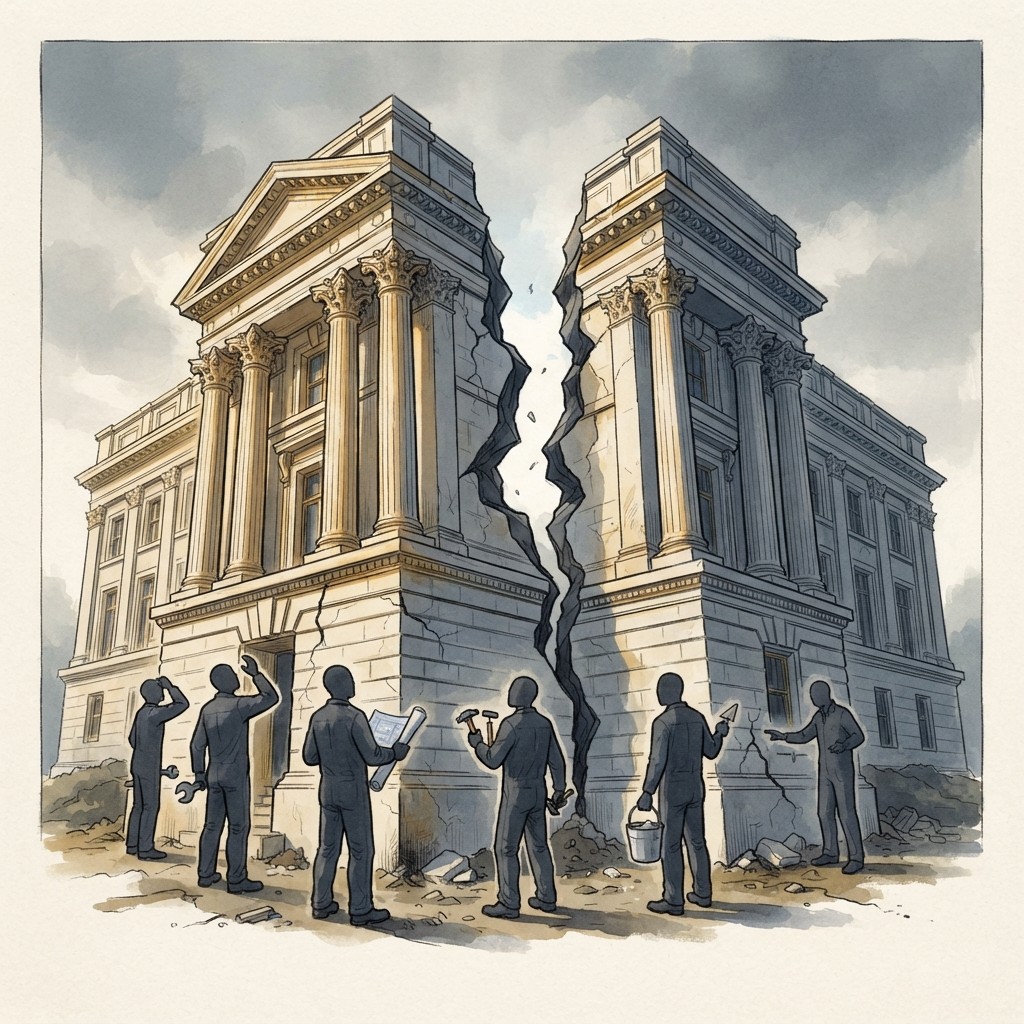
When the founder leaves and the company can't
Succession Readiness Scorecard
A scorecard that turns 'we'll figure out succession later' into a number you can argue with. It rates the four things that decide whether a handover lands — bench strength, board alignment, knowledge transfer, and whether the incumbent can actually let go. Blank to grade your own readiness honestly; filled as the worked example diagnosing why the story's company was (or wasn't) ready when the moment came.
Included, filled and blank, in the Succession Question Casebook. See the set → · Preview the blank →
Sources
Where this comes from — the filings, records, and reporting behind it.
- 1HP was formally founded as a partnership on January 1, 1939, by William R. Hewlett and David Packard, with initial capital of $538, in a Palo Alto garage at 367 Addison Avenue; a coin toss determined the order of names.
- 2HP CEO succession post-founders: Carly Fiorina (July 19, 1999–February 9, 2005); interim Robert Wayman (Feb–Mar 2005); Mark Hurd (April 1, 2005–August 6, 2010); interim Cathie Lesjak; Léo Apotheker (September 30, 2010–September 22, 2011); Meg Whitman (September 22, 2011–2015 split).
- 3Fiorina's termination date was February 8, 2005; her documented cash severance was $14,000,000 (2.5 × ($1,400,000 base + $4,200,000 target bonus)); all 6,065,852 non-qualified stock options were fully vested upon termination.
- 4The HP–Compaq merger proxy vote (March 2002) resulted in approximately 837.9 million shares FOR and 792.6 million shares AGAINST; almost half of the AGAINST votes were affiliated with the Hewlett and Packard families and foundations; independent (non-family) shareholders voted for the merger roughly 2:1.
- 5Both the William R. Hewlett Foundation AND the Packard Foundation opposed the HP–Compaq merger, meaning both founding families' institutional arms were on record against the deal; Walter Hewlett filed a formal proxy statement with the SEC urging shareholders to vote against.
- 6Leo Apotheker was formally asked to step down as president, CEO, and director of HP on September 22, 2011, after 11 months; Meg Whitman was named CEO effective immediately, per HP's own board announcement.
- 7The 2015 split was structured so that the former Hewlett-Packard Company renamed itself HP Inc. (retaining PCs and printers) and spun off Hewlett Packard Enterprise (servers, storage, services) as a new public company; Meg Whitman became CEO of HPE; Dion Weisler became CEO of HP Inc.
- 8Mark Hurd's forced resignation in August 2010 was over inaccurate expense reports connected to his relationship with contractor Jodie Fisher; HP's own investigation found the sexual harassment allegation was not substantiated, but the expense irregularities violated HP's standards of business conduct.
- 9Fiorina said on CBS's 60 Minutes that she had been expelled suddenly and felt blindsided by the board's decision.
More from Stratrix
Strategy Decision Cases
879 strategic decisions with dated outcomes, ranked by how often each kind holds.
24 decision typesSee which decisions hold →The Strategist’s Craft
The methods behind the job: the planning cycle, initiative charters, decision rights, the memo that gets a yes.
Methods and templatesStart with the craft →Weekly email
Stratonomics, every Tuesday
One data story every Tuesday: what happened, what it means, and the figures you can quote. Free.
More like this — beyond HP
New Strategically analyses as they publish: the defining moves in business, checked against the record. No noise, and one click to leave.