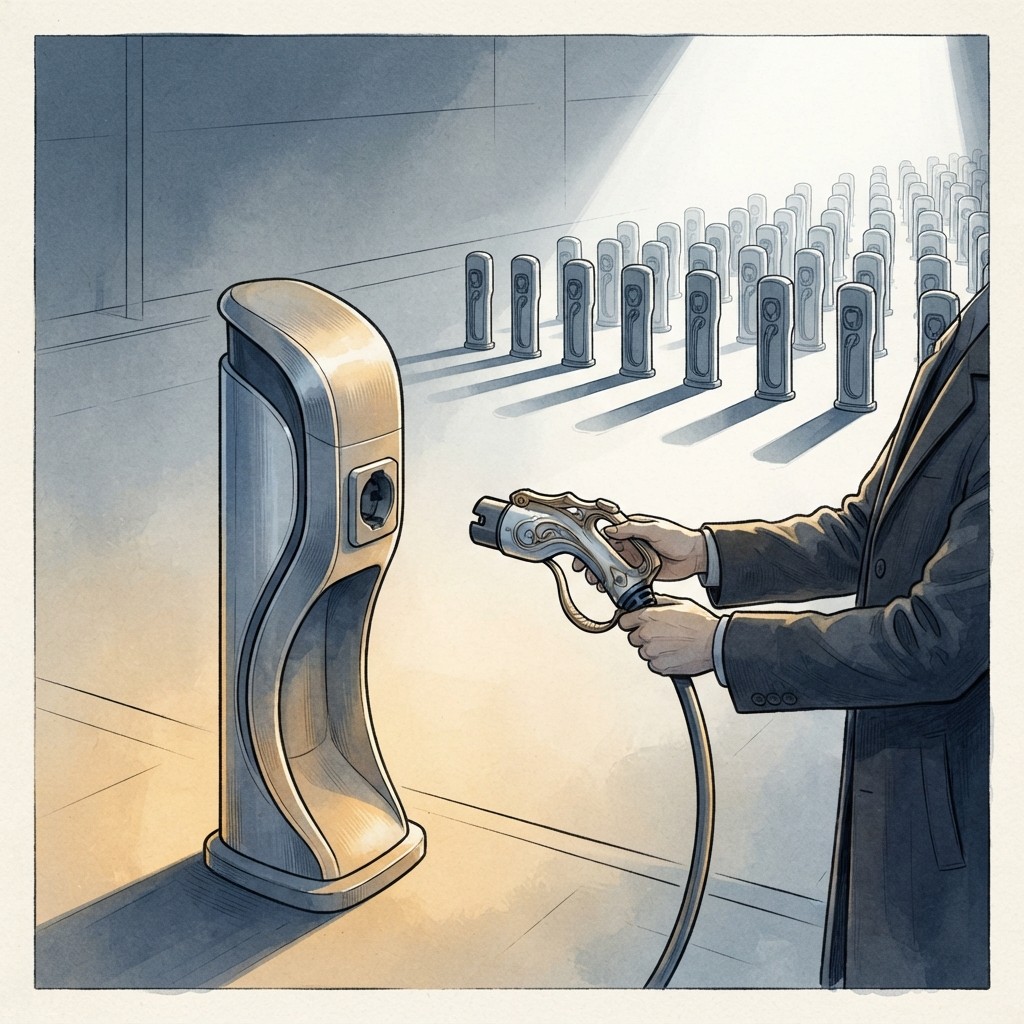
Pairs with the Standards-War Battle Map — a ready-to-use strategy tool, filled for Tesla. Included in the Standards War Casebook →
“What can you charge for your standard without losing the war to win it?”
When the Model S arrived in 2012, it came with a charging plug nobody else could use. Slim, single-port, elegant - and locked. Tesla introduced it simply as the 'Tesla charging connector,'8 and it did exactly what a proprietary connector is supposed to do: it made a Tesla a Tesla, and made every rival's car a tourist at Tesla's gas station. For a decade the connector was a wall. Then, in November 2022, Tesla published a blog post tearing it down - handing the design to its competitors and calling it, with a straight face, the North American Charging Standard.2 Generosity? The timing tells a different story.
The official version is that Tesla opened its connector to accelerate the electric transition for everyone. The truer version is that Tesla opened its connector because Washington was about to make keeping it shut very expensive. A proprietary moat is an asset right up until the federal government decides to fund the other side of the war.
First, build the wall that everyone wants in
The Supercharger moat was deliberate from the first six stations in California.1 Three things made it work, and none of them was charity. The connector was exclusive - a Tesla plug for Tesla cars. The network was real - chargers planted along the highways before anyone else had bothered. And the early carrot was free electricity: at launch, qualifying Model S owners were promised free long-distance charging powered by SolarCity solar carports.1 Notice the word qualifying. Free charging was never a universal gift; it was a switching-cost lever. Buy the car, get the fuel, and now leaving the ecosystem means leaving the cheapest, densest network on the continent. Once enough cars depended on it, the carrot could quietly go away - and it did, phased out beginning in late 2016 and effectively ended by 2018 on grounds Tesla called unsustainable.7 The free era was the down payment on lock-in, not a permanent policy.
| Brick | Looked like | Actually was |
|---|---|---|
| Exclusive connector | Good engineering | A wall rivals couldn't use |
| Free charging at launch | Generosity to early buyers | A switching cost that compounded7 |
| Highway network built first | Solving range anxiety | A scale lead no one could catch1 |
By the time Tesla decided to open the spec, the lead was structural. In its own November 2022 post the company claimed its connector outnumbered the rival CCS standard two-to-one among vehicles, and that the Supercharger network had 60% more posts than every CCS network combined.2 That is not the position of a company asking for help. It is the position of a company that has already won the part of the war that depends on building things.
Why a winner suddenly gave its winning plug away
Here is the move most people miss. A connector that no rival can use is a moat. A connector that no rival can use is also disqualified from federal money. The federal infrastructure program funneling billions into charging required publicly funded chargers to serve multiple brands - which initially shut Tesla's proprietary network out of the funding entirely, and pointed that money at CCS1 instead.8 Suddenly the moat had a downside: every taxpayer dollar was being spent entrenching the competitor's standard. Left alone, Tesla would have woken up a few years later as the largest network nobody was paying to expand, watching a government-subsidized rival catch up on someone else's dime.
So Tesla changed what it was selling. The November 2022 opening wasn't surrendering the moat - it was relocating it. Give away the connector, the cheap commodity piece of plastic and copper, and you become eligible for the federal funding. More importantly, you make your plug the thing every automaker designs around, which means every competitor's customer eventually pulls up to a Supercharger. The exclusivity that once kept rivals out becomes a tollbooth that lets them in - for a fee. Tesla traded a hardware monopoly it was about to lose for protocol control it could keep, plus a recurring revenue stream paid by its competitors' drivers.
“NACS vehicles outnumber CCS two-to-one, and Tesla's Supercharging network has 60% more NACS posts than all the CCS-equipped networks combined.”2
The cascade arrived fast. In May 2023 Ford became the first major automaker to commit to NACS - native ports from 2025, adapters for existing cars from 2024.4 Then nearly everyone followed. Between May 2023 and February 2024, most major automakers announced plans to adopt NACS in North America, with access to the Supercharger network - widely seen as the most reliable and extensive - named as a major reason.4 Mitsubishi was the lone major holdout.4 A decade-old wall had become the front door of the entire industry in roughly nine months.
A plug isn't a standard until someone else says so
Calling your own connector a 'standard' in a blog post is marketing, not standardization. The actual ratification came later, and in stages. SAE announced plans to standardize the connector as SAE J3400 in June 2023, published a precursor Technical Information Report in December 2023, and released the full standard across 2024.3 The US DOT called the pace 'unprecedented,' and the Federal Highway Administration moved to fold J3400 into the funding eligibility criteria3 - the same criteria that had threatened to lock Tesla out in the first place. The loop closed: the rule that pushed Tesla to open became the rule that crowned its plug.
The deeper change was invisible to drivers. The 2012 connector ran Tesla's proprietary communication; the standardized version switched the protocol to the industry-standard ISO 15118, which is what lets a non-Tesla car actually talk to a Supercharger through an adapter.8 That swap is the whole game in miniature. Tesla kept the physical shape it had spent a decade making ubiquitous and gave up the proprietary handshake underneath - keeping the part that locks in the network, releasing the part that kept rivals out.
A proprietary advantage has a shelf life - and the expiry date is often set by regulators or subsidy, not by competitors. The smart move isn't to defend exclusivity to the bitter end; it's to convert it on your own terms while it's still worth the most. Tesla didn't wait for the government to fund a rival standard into parity. It gave away the cheap layer (the connector) to lock in the expensive one (the network and the protocol), turning competitors into customers and a private wall into an industry toll road. The test: identify which layer of your moat the world can fund around, and hand it over before they do - keeping the layer they can't replicate. Open the commodity, monetize the network.
The honest objection: maybe it really was about adoption
The fair counter is that this reads too cynically - that Tesla genuinely wanted more EVs on the road, and a fragmented charging mess helps no one. That's partly true, and the two motives aren't in conflict; the best strategic moves usually do serve the mission and the moat at once. But intent shows up in timing, and the timing is damning: the connector sat closed for a decade and opened precisely as federal money began flowing to the rival standard.8 A second objection is that Tesla then undercut its own win - in May 2024 it laid off the entire Supercharger team, including its head, after she resisted deeper cuts, with former employees estimating a roughly 77% cut to the planned rate of new ports.6 For a quarter it looked like self-sabotage: new stall deployments fell 31% year-over-year in Q2 2024.6 But the disruption was transient, not terminal. Growth rebounded to 23% year-over-year stall growth the next quarter,6 and by mid-2025 the network had grown to 7,377 stations and over 70,000 connectors, with more than half its stalls in North America.5 You don't gut what doesn't matter - and a network throwing off 1.8 TWh in a single quarter, up 29% year-over-year,5 is now charging the whole industry's cars, not just Tesla's.
Tesla spent ten years building a wall, and the smartest thing it ever did with that wall was knock it down at the exact moment a wall stopped being an asset and started being a liability. The connector everyone now copies is the same one rivals couldn't touch in 2012 - same plastic, same shape, opposite math. The moat didn't disappear. It moved one layer down, where the government's money couldn't reach it, and started charging rent on every car that used to be the enemy.
When the smart move is to give it away
Standards-War Battle Map
A one-page canvas for a winner-take-most format war: who's fighting, which platforms and partners back each side, where the installed base sits today, and which forces will tip the market before it locks. Blank to map a standards fight you're entering; filled as the worked example charting the battle the story describes. Use it to spot which side has already won and which is still spending to lose.
Included, filled and blank, in the Standards War Casebook. See the set → · Preview the blank →
Sources
Where this comes from — the filings, records, and reporting behind it.
- 1Tesla launched the Supercharger network on September 24, 2012, with six stations in California, promising free long-distance travel powered by SolarCity solar carports for qualifying Model S owners. The technology was developed internally and leveraged existing Model S charging hardware.
- 2On November 11, 2022, Tesla opened its proprietary connector design to the world, renaming it the North American Charging Standard (NACS) and inviting charging network operators and vehicle manufacturers to adopt it. At the time, Tesla stated NACS vehicles outnumbered CCS two-to-one and the Supercharger network had 60% more NACS posts than all CCS-equipped networks combined.
- 3SAE International announced plans to standardize the NACS connector as SAE J3400 on June 27, 2023. The process began with a Technical Information Report (TIR) published in December 2023, followed by a Recommended Practice and then the full standard released August–October 2024. The US DOT noted the process occurred at 'unprecedented speed.' The Federal Highway Administration also announced plans to integrate SAE J3400 into federal charging infrastructure funding eligibility criteria.
- 4In May 2023, Ford Motor Company became the first major automaker to announce adoption of NACS, committing to native NACS ports in all new EVs from 2025 and adapters for existing CCS1 models from 2024. Ford's announcement triggered a cascade: between May 2023 and February 2024, most major automakers announced plans to adopt NACS for North American EVs. Access to the Tesla Supercharger network — regarded as more reliable and extensive — was cited as a major factor. Mitsubishi Motors is the only major automaker that has not announced NACS adoption.
- 5Tesla's Q2 2025 financial report showed 7,377 DC fast-charging stations (14% year-over-year growth) and 70,228 connectors (18% year-over-year growth) globally, with more than half of all stalls (over 35,000) in North America. Q3 2025 figures were 7,753 stations and 73,817 connectors, with network throughput of 1.8 TWh in Q3 2025 (up 29% year-over-year). Full-year 2025 throughput was 6.7 TWh.
- 6In May 2024, Tesla laid off its entire Supercharger team, including head Rebecca Tinucci, after she resisted demands for deeper cuts beyond an initial 15–20% reduction. Elon Musk promised $500M to expand the network, estimated by former employees as a ~77% reduction in the rate of charging port deployment versus original 2024 plans. This caused a 31% year-over-year decline in Q2 2024 new stall deployments, but the network rebounded to 23% year-over-year stall growth in Q3 2024.
- 7Free Supercharging was universal for qualifying new Model S buyers at launch (2012) but was phased out beginning in late 2016: cars had to be ordered in 2016 and delivered by end of March 2017 to qualify for transferable free unlimited Supercharging. Tesla removed fully transferable Free Unlimited Supercharging from new vehicle options in early 2017. Electrek reported Tesla formally ended the perk entirely in 2018 citing unsustainability, though it has periodically offered non-transferable free-charging promotions since.
- 8The physical NACS connector was introduced with the Tesla Model S in 2012 as the 'Tesla charging connector'; it was not until 2021 that Tesla vehicles began supporting the expanded communications protocol (ISO 15118) specified as part of NACS. The SAE J3400 standard crucially switched the communication protocol from Tesla's proprietary CAN bus to the industry-standard ISO 15118, enabling CCS1 vehicles to use NACS chargers via adapters. Some observers described Tesla's November 2022 NACS opening as a response to federal NEVI funding requirements that initially excluded the proprietary Tesla network.
More like this — beyond Tesla
New Strategically analyses as they publish: the defining moves in business, checked against the record. No noise, and one click to leave.