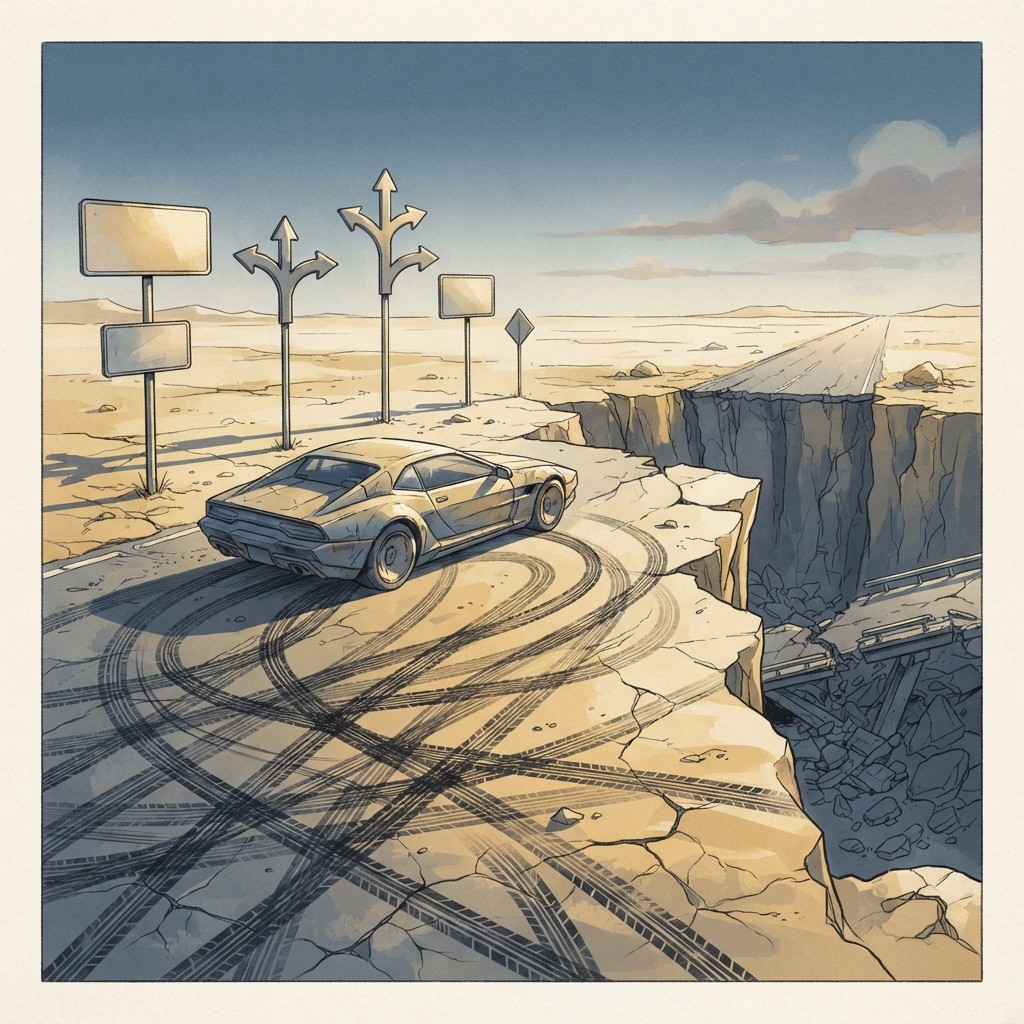
Pairs with the Reversal Readiness Checklist — a ready-to-use strategy tool. Included in the Reversal Casebook →
“When do you reverse a position, and what does a year of waiting cost?”
On July 8, 2022, the man who had agreed to buy Twitter filed paperwork trying to get out of buying Twitter.2 Three months earlier he had signed a definitive agreement to pay $54.20 a share - about $44 billion, a 38% premium to where the stock had been trading.1 Now he wanted out. Twitter sued him in Delaware to force him to honor his own signature, and by late October 2022 he closed the deal he had spent the summer trying to escape. That is the first reversal. It is also the template for everything that followed.
The official story is that Musk bought Twitter to transform it into 'X, the everything app' - a grand, deliberate vision executed at speed. The real story runs the other way. The everything-app thesis is not the cause of the moves. It is the narrative bolted on afterward to make a chain of reactive U-turns look like a strategy.
He closed the deal because a court was about to make him
Start with the foundational fact everyone forgets. Musk did not buy Twitter the way a strategist acquires a business he covets. He bought it the way a defendant settles a case he is losing. After agreeing to the $54.20 price, he attempted to terminate the merger; Twitter went to the Delaware Court of Chancery to compel specific performance - a legal order forcing him to complete the purchase on the agreed terms.2 Delaware courts have a strong record of enforcing merger agreements through specific performance, and facing a trial he showed every sign of wanting to avoid, he closed. The single most consequential decision of the saga - owning the company at all - was not a choice he made. It was a choice that was made for him. Hold that in mind, because it explains the improvisation that came next: a man who pays $44 billion for an asset he tried to abandon does not arrive with a plan. He arrives needing one.
“The company believed Musk's purported termination of the merger agreement was invalid and wrongful.”2
What a reversal looks like when it's the operating mode
Once you see the acquisition as a reversal, the rest of the tenure reads as variations on the same move - each one a flip from a prior position, dressed in the language of vision. Take verification. The blue checkmark had spent a decade meaning one thing: this account is who it says it is, vouched for as 'active, notable, and authentic.' Starting April 1, 2023, Twitter wound that program down and rebuilt the checkmark to mean something almost opposite - an active paid subscription. X's own help center says the new badge 'does not mean that the account has been ID verified.'5 Identity verification became a billing status. A symbol of trust became a symbol of payment. That is not an upgrade; it is a reversal of what the asset was for.
Then the rebrand. Here the improvisation is almost visible in the timeline. The legal entity Twitter, Inc. was folded into X Corp back in April 2023 - quietly, in court filings. The consumer-facing change, the one the world saw, did not come until July 23–24, 2023, when Musk announced it and the bird vanished overnight.6 A 17-year-old brand name - one of the rare brand names to become a common verb, as in 'I'll tweet it' - was retired with no everything-app product behind it to justify the swap. The vision was announced. The thing the vision required did not exist yet. You rebrand after you've built the new product, not three months before you've even told users it's coming.
| The move | The stated vision | What it actually reversed |
|---|---|---|
| Closing the deal | Buying the digital town square | His own July notice trying to terminate it |
| The verification flip | Democratizing the checkmark | The checkmark meaning verified identity |
| The X rebrand | The everything app | A 17-year-old brand, with no product yet built |
| Headcount | A leaner, faster company | The 'more than 7,500'-person org he inherited |
Even the celebrated cost-cutting fits the pattern more than the legend admits. Twitter walked in with 'more than 7,500 employees worldwide.'3 The viral claim is that Musk fired 75% to 80% of them on day one. He didn't. Twitter's own then-head of trust and safety, Yoel Roth, confirmed in real time that the initial November 2022 round cut headcount 'roughly 50%.'4 The larger figures accumulated over many months through further cuts and a wave of resignations - the slow consequence of an organization being run reactively, not a single decisive stroke. The myth wants a surgeon. The record shows someone improvising in public.
The bill arrived where it always does: in the revenue
Reactive improvisation has a cost, and at an advertising business the cost shows up fast, because advertisers buy predictability and flee from chaos. The numbers are not contested estimates anymore - they come from X's own UK regulatory filing. Global ad revenue fell from $4.5 billion in 2022 to $2.2 billion in 2023, a 46% drop, with further declines into 2024.7 The UK figures are starker still: $282.9 million in 2022, $95.2 million in 2023, $39.8 million in 2024.7 And X did not blame the economy or competition. Its own filing pinned the decline on 'a reduction in spend from large brand advertisers due to concerns about brand safety, reputation and/or content moderation.'7 The company, under oath to a regulator, named the chaos as the cause.
Isn't this just bold founder-mode, judged too early?
The fair objection is that this reads as anti-Musk hindsight - that bold transformations always look like chaos from inside the storm, that Amazon and Tesla were both written off mid-disruption, and that an 'everything app' is a decade-long bet you cannot fairly mark in year two. That objection has teeth, and it deserves a straight answer. Here it is: the test of a transformation isn't whether it's disruptive. It's whether the sequence makes sense. A strategist rebuilds the product, then rebrands. A strategist closes a deal he wants. A strategist's own regulatory filings don't name his decisions as the cause of a 46% revenue collapse. The pattern here isn't bold-then-vindicated; it's react-then-rationalize. The everything-app vision keeps arriving after each move to explain it, never before to direct it. Vision pulls the moves forward. Rationalization shows up afterward to clean up. This is the second kind.
And the receipts kept coming. In May 2026, the SEC settled its lawsuit over Musk's failure to timely disclose his original Twitter stake back in early 2022 - his trust paid a $1.5 million civil penalty.8 Even the entry into the story, the quiet accumulation of shares before the bid, ended in a settlement. The bookends match: a deal that began in a disclosure violation and was completed under court compulsion.
Changing your mind isn't a sin - Coca-Cola reversed New Coke within weeks and it was the right call. The tell isn't the U-turn; it's the order of operations. A genuine pivot moves in a coherent sequence: build the new thing, then retire the old name; decide what the asset is for, then change what its symbols mean. Reactive improvisation does it backwards - it makes the move, then invents the reason. When you find yourself explaining a decision after you've made it, with a vision that conveniently fits whatever just happened, you're not executing a strategy. You're narrating one into existence. The market can tell the difference, and it prices it - here, at roughly half the ad revenue.
Musk's defining reversal was not the rebrand or the checkmark or the layoffs. It was the first one: agreeing to buy a company, trying to escape it, and being marched back to the altar by a Delaware court. Everything after carries that DNA - the look of decisiveness laid over the reality of a man reacting to a situation he didn't choose, narrating a vision to fit the wreckage as he went. The everything app may yet arrive. But it will not have explained the path that got here. It will only have been recruited, after the fact, to justify it - and a strategy you can only see in the rearview mirror was never steering.
Reversal Readiness Checklist
Reversing a public commitment is the hardest decision a leader makes — and the easiest to botch by doing it too late or too messily. This checklist gates the U-turn: is the evidence in, is the old logic genuinely dead, can you absorb the credibility hit, and is the new path actually ready. Blank, it keeps you from flip-flopping on a whim; filled, it scores the story's reversal against what a clean one demands.
Included, filled and blank, in the Reversal Casebook. See the set → · Preview the blank →
Sources
Where this comes from — the filings, records, and reporting behind it.
- 1On April 25, 2022, Twitter entered a definitive merger agreement for Elon Musk to acquire the company at $54.20 per share in cash, in a transaction valued at approximately $44 billion; the purchase price represented a 38% premium to Twitter's April 1, 2022 closing stock price.
- 2On July 8, 2022, Musk filed notice purporting to terminate the merger; Twitter sued him July 12 to compel specific performance; Twitter's Q2 2022 earnings 8-K confirms both events and that the company believed the purported termination was 'invalid and wrongful.'
- 3Twitter's own Q4 2021 SEC filing reported 'more than 7,500 employees worldwide, up 35% year over year,' establishing the pre-Musk headcount baseline from which layoff percentages should be calculated.
- 4Twitter's then-Head of Trust & Safety Yoel Roth confirmed on November 4, 2022 that overall headcount was cut 'roughly 50%' in the initial post-acquisition layoff, and that the trust and safety team was reduced by 15%.
- 5Starting April 1, 2023, Twitter wound down its legacy verification program; the blue checkmark thereafter signifies only an active paid X Premium subscription and 'does not mean that the account has been ID verified.' Legacy accounts verified as 'active, notable, and authentic' lost their checkmarks unless they subscribed.X Corp (help.x.com), About X Blue Checkmark ↗ · 2023-04-01
- 6Twitter, Inc. was legally merged into X Corp in April 2023 per court filings, approximately three months before the public-facing rebrand; the consumer-visible logo swap occurred July 23–24, 2023 when Musk announced the change and the bird logo was replaced with 'X.'
- 7X's own UK regulatory filing (for year ending December 31, 2024) attributed revenue decline to 'a reduction in spend from large brand advertisers due to concerns about brand safety, reputation and/or content moderation'; UK revenue fell from $282.9M (2022) to $95.2M (2023) to $39.8M (2024). Global ad revenue fell from $4.5B (2022) to $2.2B (2023), a 46% decline, with further declines estimated in 2024.
- 8The SEC filed a civil lawsuit against Musk over his alleged failure to timely disclose his >5% Twitter stake in early 2022; in May 2026, the SEC and Musk agreed to settle, with Musk's revocable trust paying a $1.5 million civil penalty.
Weighing outside help with a decision like this? Hiring a turnaround or restructuring advisor
More like this — beyond X (Twitter)
New Strategically analyses as they publish: the defining moves in business, checked against the record. No noise, and one click to leave.