Pairs with the Moat Anatomy Canvas — a ready-to-use strategy tool, filled for Airbus. Included in the The Moat Anatomy Casebook →
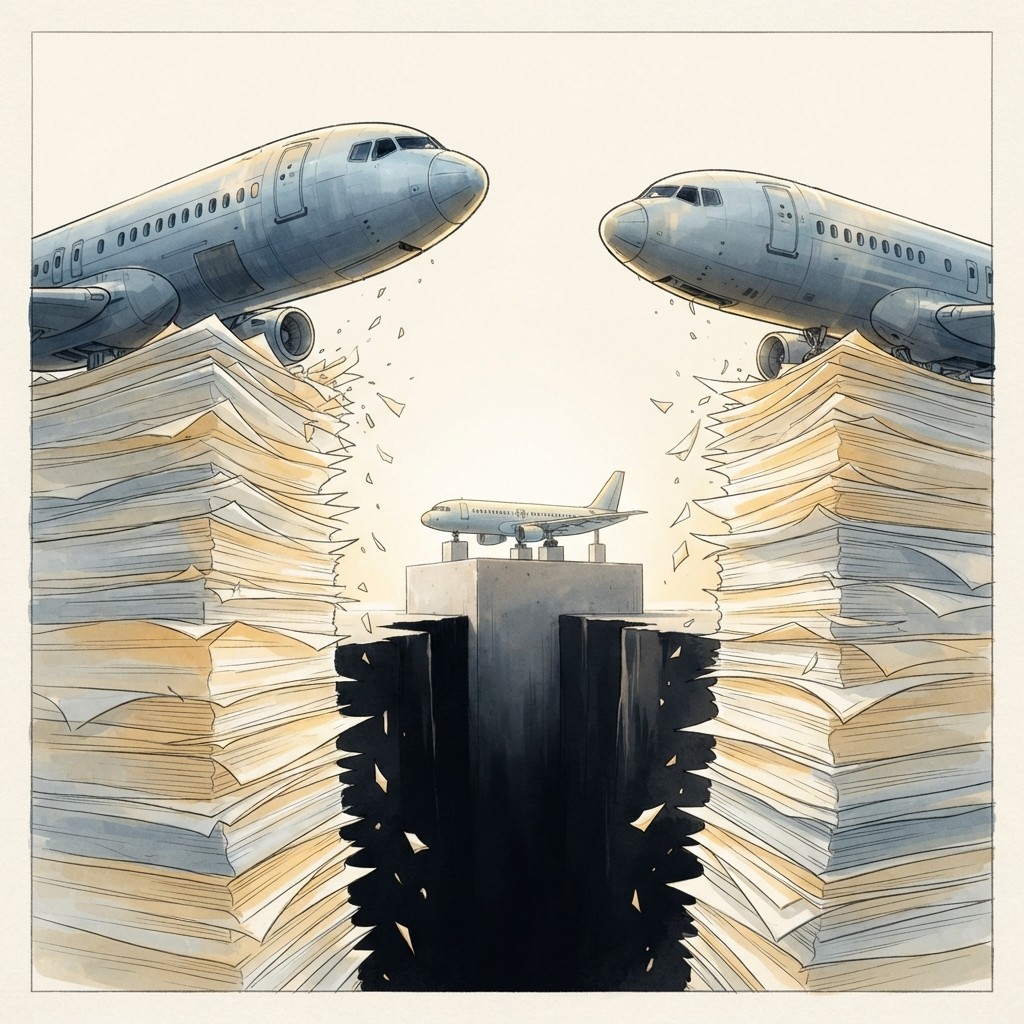
There are roughly two hundred countries on earth, thousands of airlines, and millions of engineers - and exactly two companies that can sell you a brand-new large commercial jet. If you run an airline and you need a hundred narrow-bodies, your shortlist has two names on it, and they both know it. That is not a market. It is a corridor with a door at each end, and Airbus and Boeing own both doors.
The popular story right now is tidy: Boeing is in crisis, Airbus is running away with it, and the duopoly is about to become a monopoly or get cracked open by China. The truth is stranger and more useful. The moat is real - in 2024 Airbus delivered 766 commercial aircraft and Boeing delivered 34812 - but it was never built the way a moat is supposed to be built. It was built on government money that an international court ruled illegal. On both sides.
How two doors got built where there used to be six
The duopoly is often pinned on a single event - Boeing absorbing McDonnell Douglas in 1997. That accelerated it, but it didn't create it. The corridor was already narrowing from both ends. In the United States, Lockheed and Convair walked away from the large-jet business; in Europe, Fokker withdrew.4 One by one, the players who could build a wide-body jet decided they couldn't afford to keep losing the bet - and a clean-sheet aircraft is the most expensive bet in industrial manufacturing, a decade of capital sunk before a single fare is collected. The economics did the culling. By the time McDonnell Douglas folded into Boeing, there were only two firms left with the scale to play, and the merger simply made the math official.
Airbus exists at all because four governments refused to let the math win. It was created on 18 December 1970 as Airbus Industrie - a consortium, not a company - with founding equity split between France's state-owned Aérospatiale at 37.9%, West Germany's Deutsche Airbus at 37.9%, British Aerospace at 20%, and Spain's CASA at 4.2%.5 No private board would have funded a head-on challenge to Boeing on commercial terms. Four treasuries did. The 'private European champion' that today out-delivers Boeing began life as a public-works project, and it took until 2015 to finish becoming the ordinary listed company - Airbus SE - that people now mistake it for having always been.5
Here is the part that defenders of the moat prefer to skip. The way both firms financed their way into this corridor was, in the eyes of the world's trade court, against the rules. The WTO's appellate body upheld that EU member states - France, Germany, Spain, and the UK - had given Airbus illegal Launch Aid across programs from the A300 through the A380.6 And in a parallel case, the EU won the same finding against Boeing: illegal U.S. subsidies of its own. The dispute ran so large that the U.S. eventually imposed countermeasures on roughly $7.5 billion of EU exports - the biggest dispute in WTO history.6 Both moats were dug, in part, with public money no court would sign off on.
“Certain EU and member-state subsidies covering the A300 through A380 programs were incompatible with the Agreement on Subsidies and Countervailing Measures - and Boeing, in a separate ruling, was found to have received illegal U.S. subsidies of its own.”6
The moat that pays its own way: a backlog measured in years
Subsidies got the door built. They don't keep it shut. What keeps a challenger out today is the brutal physics of the order book. Airbus closed 2024 with a backlog of 8,658 commercial aircraft worth €629 billion1 - years of guaranteed production at full rate. That backlog is the real moat, and it compounds: every airline that orders an Airbus locks itself into Airbus pilots, Airbus maintenance, Airbus spares, and a delivery slot it waited years to get. Switching isn't a procurement decision; it's a fleet-wide religious conversion. The over-1,200 orders sitting on COMAC's books look impressive until you notice the same dynamic working against them - they're all from one country's airlines.7
The mechanism of the last decade is a slow-motion divergence. From 2015 to 2024, Airbus took orders for 8,950 aircraft and delivered 7,043, while Boeing's net orders trailed significantly.8 That gap is not just a scoreboard - it is pricing power. When one supplier has the slots and the other has a crisis, the airline negotiating a fleet renewal has fewer cards. The 2024 split makes the divergence concrete: 766 Airbus deliveries to 348 for Boeing means Airbus shipped more than twice as many planes as its only real competitor.12 And it shows in the books - Boeing's Commercial Airplanes segment posted a roughly $8 billion operating loss for the year.3
| Airbus | Boeing | |
|---|---|---|
| Commercial deliveries | 766 | 348 |
| Net orders | 826 | 279 |
| Order backlog | 8,658 aircraft (€629B) | $521B (total company) |
| Commercial unit result | Profitable | ~$8B operating loss |
Doesn't Boeing's crisis - or China's C919 - end this thing?
The honest counter comes in two flavors, and both deserve a real answer. The first: if Boeing is bleeding - $66.5 billion in revenue down from $77.8 billion, net debt near $54 billion2 - isn't the duopoly collapsing into a near-monopoly? Not for the reason people think. A wounded Boeing doesn't disappear; airlines and regulators have every incentive to keep two suppliers alive precisely so neither becomes the only door. Boeing's weakness widens Airbus's lead without dissolving the structure. The corridor still has two ends; one of them just has a longer line.
The second counter is China. COMAC's C919 flew its first commercial flight in May 2023 after fifteen years of development - a genuine national achievement.7 But the numbers puncture the 'duopoly is ending' narrative on contact. In 2024, COMAC delivered roughly 12 aircraft. Airbus delivered 766; Boeing, 348.712 More decisive than the count is the geography: every confirmed C919 order comes from Chinese carriers, lessors, or government-linked entities, and the aircraft holds no FAA or EASA certification - the two stamps that let a jet fly almost anywhere in the world.7 COMAC is aiming for European certification only around 2028 to 2029. Until then the C919 is a real threat to the duopoly inside China and a zero outside it. Same airplane. Opposite map.
The Airbus-Boeing moat is two things at once, and most takes pick only the one they like. Near-term, it is wider than the 'Boeing crisis = duopoly over' crowd believes: a multi-year backlog, fleet lock-in, and a regulatory certification wall keep COMAC penned inside one country. Long-term, it is shakier than its defenders admit: the foundation was poured with subsidies a court ruled illegal on both sides, and a state willing to build an industry from a treasury - as Europe once did for Airbus - can do it again. China is running the exact playbook that created Airbus in 1970. The lesson for any duopoly: if your barrier to entry is capital and certification, the one competitor who can ignore the cost of capital and is patient about certification is the only one you should actually fear.
So the duopoly is neither the unbreakable fortress its scale suggests nor the crumbling relic the Boeing headlines imply. It is a corridor with two doors, built partly on money no court would approve, defended now by a backlog measured in years and a certification wall measured in decades. Airbus is winning the corridor it shares - decisively, for now. The thing worth watching is not whether Boeing recovers. It's whether the only entity patient and rich enough to dig a third door is the same kind of entity that dug the first two: not a company at all, but a government that has decided the math is allowed to lose.
Moat Anatomy Canvas
A one-page canvas that dissects a moat instead of asserting it: where the advantage comes from, how much of the market it covers, how long it would take to copy, and what keeps it from eroding. Blank to dissect your own claimed edge; filled as the worked example tracing the structure of the story's defensible advantage. Use it to tell a real moat from a head start.
Included, filled and blank, in the The Moat Anatomy Casebook. See the set → · Preview the blank →
Sources
Where this comes from — the filings, records, and reporting behind it.
- 1Airbus delivered 766 commercial aircraft in FY2024 (comprising 75 A220s, 602 A320 Family, 32 A330s, and 57 A350s); consolidated revenues were €69.2 billion; net orders were 826 aircraft; order backlog stood at 8,658 commercial aircraft valued at €629 billion.
- 2Boeing delivered 348 commercial airplanes in full-year 2024, recorded 279 net orders, and total company backlog was $521 billion; FY2024 total revenues were $66.5 billion, down from $77.8 billion in 2023; Commercial Airplanes segment revenue was $22.9 billion, down from $33.9 billion in 2023; Boeing's net debt was approximately $53.9 billion.
- 3Boeing's FY2024 10-K filed with the SEC shows total revenues of $66,517 million and a loss from operations of $(10,707) million; Commercial Airplanes segment posted an operating loss of $(7,969) million.
- 4The duopoly resulted from a series of industry mergers; Airbus began as a pan-European consortium while Boeing absorbed McDonnell Douglas in 1997; other prior competitors such as Lockheed Martin and Convair in the U.S. and Fokker in Europe withdrew from the large-jet market.
- 5Airbus originated as Airbus Industrie GIE, a consortium established on 18 December 1970; founding equity was: Aérospatiale (France, state-owned) 37.9%, Deutsche Airbus (West Germany) 37.9%, British Aerospace 20%, CASA (Spain) 4.2%; EADS was formed in 2000 by merging Aérospatiale-Matra, DASA, and CASA; EADS rebranded as Airbus SE in 2015.
- 6The WTO Appellate Body upheld (DS316) that certain EU and member-state subsidies (Launch Aid/Member State Financing) covering the A300 through A380 programs provided by France, Germany, Spain, and the UK were incompatible with Article 5(c) of the SCM Agreement; in a separate ruling (DS353), the WTO found Boeing also received illegal U.S. subsidies. The US had imposed countermeasures on ~$7.5 billion of EU exports in 2019, making it the largest dispute in WTO history.
- 7COMAC's C919 made its first commercial flight in May 2023 after 15 years of development; as of end-2024 only approximately 12 aircraft were delivered; COMAC had over 1,200 orders on its books, all from Chinese carriers, lessors, or government-linked entities; the C919 has no FAA or EASA certification, limiting it to China's domestic market; COMAC aims for EASA certification by 2028–2029.
- 8In the 10 years from 2015 to 2024, Airbus received orders for 8,950 aircraft and delivered 7,043, while Boeing's net orders significantly trailed; by July 2021, Airbus held a 62% share of the global airliner backlog vs. 38% for Boeing.
More like this — beyond Airbus
New Strategically analyses as they publish: the defining moves in business, checked against the record. No noise, and one click to leave.