Pairs with the Moat Anatomy Canvas — a ready-to-use strategy tool. Included in the Moat Anatomy Casebook →
“What would it actually cost a challenger to take your customer?”
A small embroidered horseman, mid-swing on a cuff, was the opening move of one of the most valuable acts of self-invention in business. It did not first appear where everyone thinks. The pony showed up in 1971, not on the now-famous polo shirt but on the cuff of a women's tailored shirt; the shirt the whole world associates with it came a year later, in 1972.6 A man born Ralph Lifshitz had borrowed the name of a sport he'd never seen played — choosing it, as he once told TIME, because basketball wouldn't do — and stitched it onto cotton.9 Today that fantasy generates $7,079.0 million in annual revenue at a 68.6% gross margin.1 The horseman never financed it, never wove it, never lent a cent of risk. It only ever did one thing: it told you which world the shirt came from.
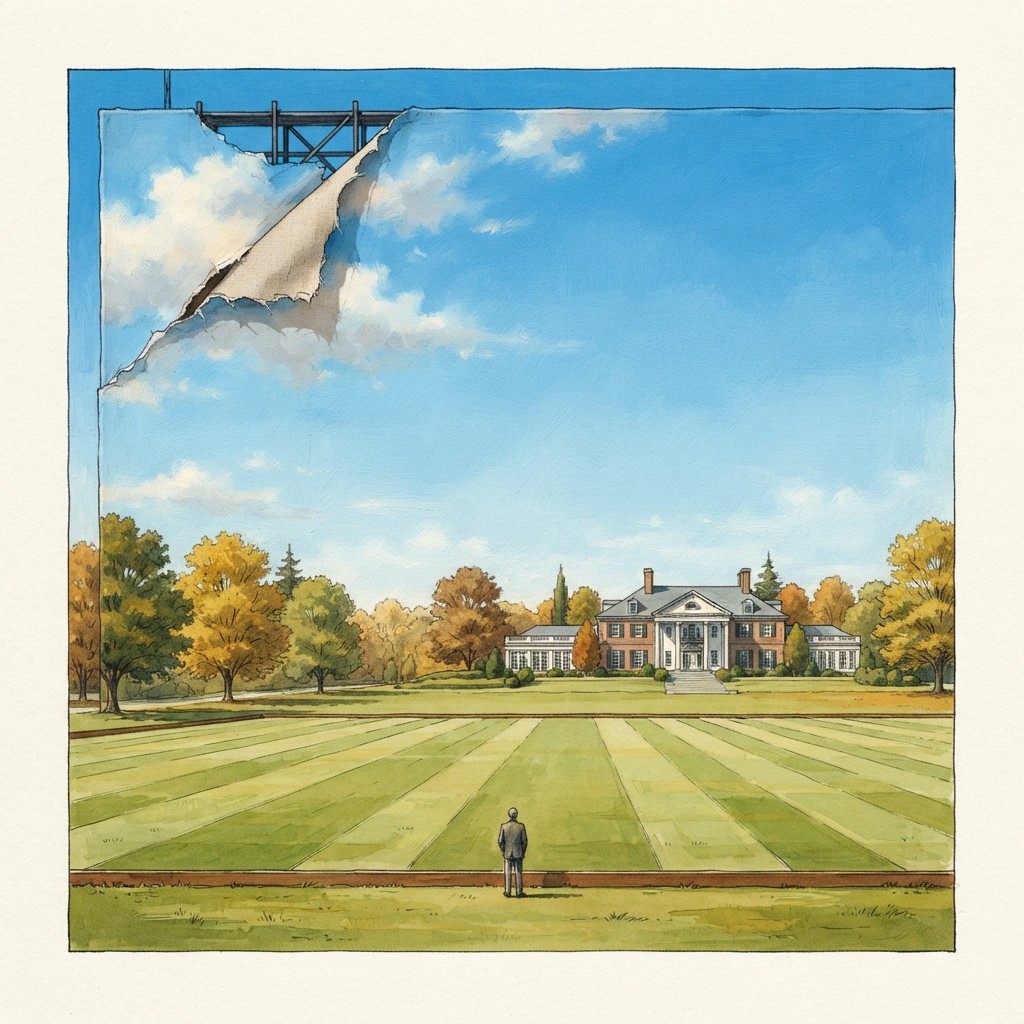
The official story is that Ralph Lauren is a heritage American luxury house. It isn't, in the sense the word usually means. There is no aristocratic estate, no centuries-old atelier, no genuine lineage in the sport on the emblem. What Lauren built was something stranger and far more defensible: a heritage that was authored, not inherited - and that authorship is the entire moat.
He didn't sell clothes. He sold the room they belonged in.
Most apparel companies sell garments and hope a brand accretes around them. Lauren ran it backwards. He started with a feeling - a particular, cinematic idea of old-money American ease - and then manufactured the objects that would let you buy your way into it. The company tells you this in its own filings, describing itself not as an apparel maker but as a 'global leader in the design, marketing, and distribution of luxury lifestyle products in five categories: apparel, footwear & accessories, home, fragrances, and hospitality.'8 Read that list again. Hospitality. A clothing brand sells you a restaurant. That is not category creep; it is the whole strategy. Once the product is a world rather than a wardrobe, every new category is just another room in the same house - and each room makes the others feel more real.
This is why the moat is so much deeper than the polo shirt suggests. A competitor can knock off the shirt by Tuesday; the fabric was interlock cotton, not some proprietary alchemy.6 What the competitor cannot knock off is the accumulated coherence - decades of imagery, stores built like estates, a name that has become a shorthand for a kind of life. The thesis, plainly: Ralph Lauren is not a clothing company with strong branding. It is a manufactured world that happens to fund itself by selling admission tickets, most of them shaped like shirts.
“A global leader in the design, marketing, and distribution of luxury lifestyle products in five categories: apparel, footwear & accessories, home, fragrances, and hospitality.”8
Why a manufactured world out-scales a real one
Here is the counterintuitive payoff of authoring your heritage rather than inheriting it: it scales in a way a genuine pedigree never could. A house built on a real family estate is anchored to that estate's authenticity, and authenticity resists mass production - the more units you ship, the thinner the claim gets. Lauren's world has no such anchor, because it was always a fiction the customer agreed to participate in. The fantasy doesn't dilute when you sell more of it; it spreads. That is how the same brand can sell a $20 fragrance and a luxury hotel experience without breaking, and how it now distributes that fiction across North America, Europe, and Asia with no single region above roughly 45% of revenue.8 A manufactured world is portable. A real one is stuck where it was born.
| Inherited heritage | Ralph Lauren's authored heritage | |
|---|---|---|
| Source of authenticity | A real estate, family, or craft | A consistent, invented narrative |
| What scaling does to it | Dilutes the claim | Spreads the fantasy |
| Hardest thing to copy | The provenance | The accumulated coherence |
| Single point of failure | Loss of the estate or craft | Loss of the author |
The crack the architecture can't close
Every strength here has the same root, which means so does the weakness. The world was authored by one person, and the customer knows it. The brand's name is the founder's name; the taste is the founder's taste; the myth - a Bronx kid who renamed himself and willed an aristocracy into being - is inseparable from the man. This is the part no brand architecture has solved. You can professionalize operations, build a global retail network, run the supply chain like a machine. You cannot professionalize a personal myth. When the author is gone, the question every authored heritage eventually faces arrives at the door: was this a world, or was it just one man's imagination, rented to us for a while?
Note how different this risk is from an ordinary succession problem. A manufacturer worries about losing operational know-how; that is replaceable. Ralph Lauren risks losing the only thing that justified the margin - the felt sense that the fantasy is authentic because its author believes it. The same self-invention that made the moat impossible to copy makes it impossible to fully hand over.
Isn't this just a strong brand with good marketing?
The fair objection is that 'manufactured world' is a grandiose label for what every consumer brand does - and that plenty of fashion houses scale, run lifestyle extensions, and outlive their founders without collapsing. True, up to a point. The honest counter is that Ralph Lauren's specific durability is unusually well-evidenced: it grew net revenues 6.8% in FY2025 to over $7 billion while holding a 13.2% operating margin,1 and it has survived a public-market transition once already - the 1997 IPO that recapitalized the company with $268.8 million in net proceeds, separate from the founder's own share sale.3 So this is not a fragile thing. But notice what the successful IPO actually transferred: ownership, governance, capital structure - the replaceable parts. It did not, and could not, transfer authorship. The structure is durable precisely because the myth is intact, which is also why the structure has never been tested on the day the myth has to stand alone. A moat can be both deep and dependent. This one is.
The most defensible consumer moats aren't products - they're coherent worlds a customer pays to belong to, and the surest way to make one un-copyable is to author it from a single point of view. But that same single point of view is the load-bearing wall. If the whole edifice rests on a founder's myth, the real strategic work isn't scaling distribution or extending categories - it's the unglamorous, decades-long task of migrating the meaning off the person and into the institution before you have to. Most lifestyle brands win the first battle (becoming a world) and lose the second (surviving without the one who imagined it). Plan for the day the author can't sign the work, because that is the day the moat is finally graded.
Ralph Lauren took a borrowed sport, a renamed self, and an embroidered horseman, and out of them built a world solid enough to charge luxury prices and broad enough to reach three reportable geographic segments — North America, Europe, and Asia — and five categories. The genius was never the shirt. It was understanding that people don't buy clothes - they buy the room the clothes belong to, and they will pay a 68.6% margin for a convincing one.1 He authored a heritage instead of inheriting one, and that choice gave him a moat no rival can dig and no founder can fully bequeath. The world is real for as long as we believe its author meant it. The only test that matters hasn't been run yet.
Moat Anatomy Canvas
A one-page canvas that dissects a moat instead of asserting it: where the advantage comes from, how much of the market it covers, how long it would take to copy, and what keeps it from eroding. Blank to dissect your own claimed edge; filled as the worked example tracing the structure of the story's defensible advantage. Use it to tell a real moat from a head start.
Included, filled and blank, in the Moat Anatomy Casebook. See the set → · Preview the blank →
Sources
Where this comes from — the filings, records, and reporting behind it.
- 1Ralph Lauren Corporation FY2025 (ended March 29, 2025) net revenues were $7,079.0 million, up 6.8% year-over-year; gross margin was 68.6%; operating income was $932.1 million (13.2% operating margin).
- 2Ralph Lauren Corporation FY2024 total net revenues were $6,631.4 million, up 2.9% year-over-year; gross profit as a percentage of net revenues was 66.8%; North America, Europe, and Asia were the three reportable segments.
- 3The IPO of Polo Ralph Lauren Corporation closed June 17, 1997 at $26.00 per share; net proceeds to the company (after underwriting discounts and expenses) were $268.8 million, used primarily to repay debt. Ralph Lauren as selling stockholder received separate proceeds.
- 4The IPO prospectus (424B1) shows that if overallotment options were exercised in full, total IPO price across U.S. and international offerings would be $882 million; proceeds to the company (primary shares) and proceeds to selling stockholders (Lauren's personal shares) were separate line items.
- 5Ralph Lauren (born Ralph Lifshitz) launched his Polo tie collection in 1967 as a division of Beau Brummel; his first full menswear line was named Polo in 1968; the iconic Polo player emblem debuted in 1971 on the cuff of a women's tailored shirt (not on the polo shirt); the signature cotton mesh polo shirt with the emblem at the chest launched in 1972; the company went public on June 13, 1997.Wikipedia, Ralph Lauren ↗ · 2025
- 6Ralph Lauren's own corporate editorial confirms: 'In 1967, Polo debuted as a tie-making brand in New York City. By 1971, Ralph Lauren was designing clothes, and had introduced the now-iconic Pony insignia—not on a Polo shirt, but on the cuff of a women's tailored shirt.' The polo shirt launched in 1972 from interlock (not cotton piqué) fabric.
- 7In 1967, Lauren first proposed a tie line to his employer Abe Rivetz (who refused), then convinced Beau Brummel to manufacture his Polo neckwear. In 1968, backed by a loan from Norman Hilton, Lauren left Beau Brummel and formed Polo Fashions as an independent company. Lauren's first year of sales under the Polo name generated $500,000 in neckwear revenue.
- 8Ralph Lauren Corporation describes itself as 'a global leader in the design, marketing, and distribution of luxury lifestyle products in five categories: apparel, footwear & accessories, home, fragrances, and hospitality,' founded in 1967. North America represented ~43%, Europe ~31%, and Asia ~24% of FY2025 net revenues.
- 9Lauren chose the name 'polo' for his brand though he'd never seen the sport played, because it evoked the lifestyle he admired; he joked he couldn't call it 'Basketball.'
Weighing outside help with a decision like this? Hiring a commercial due diligence provider
More like this — beyond Ralph Lauren
New Strategically analyses as they publish: the defining moves in business, checked against the record. No noise, and one click to leave.