Pairs with the Moat Anatomy Canvas — a ready-to-use strategy tool, filled for Crocs. Included in the Moat Anatomy Casebook →
“What would it actually cost a challenger to take your customer?”
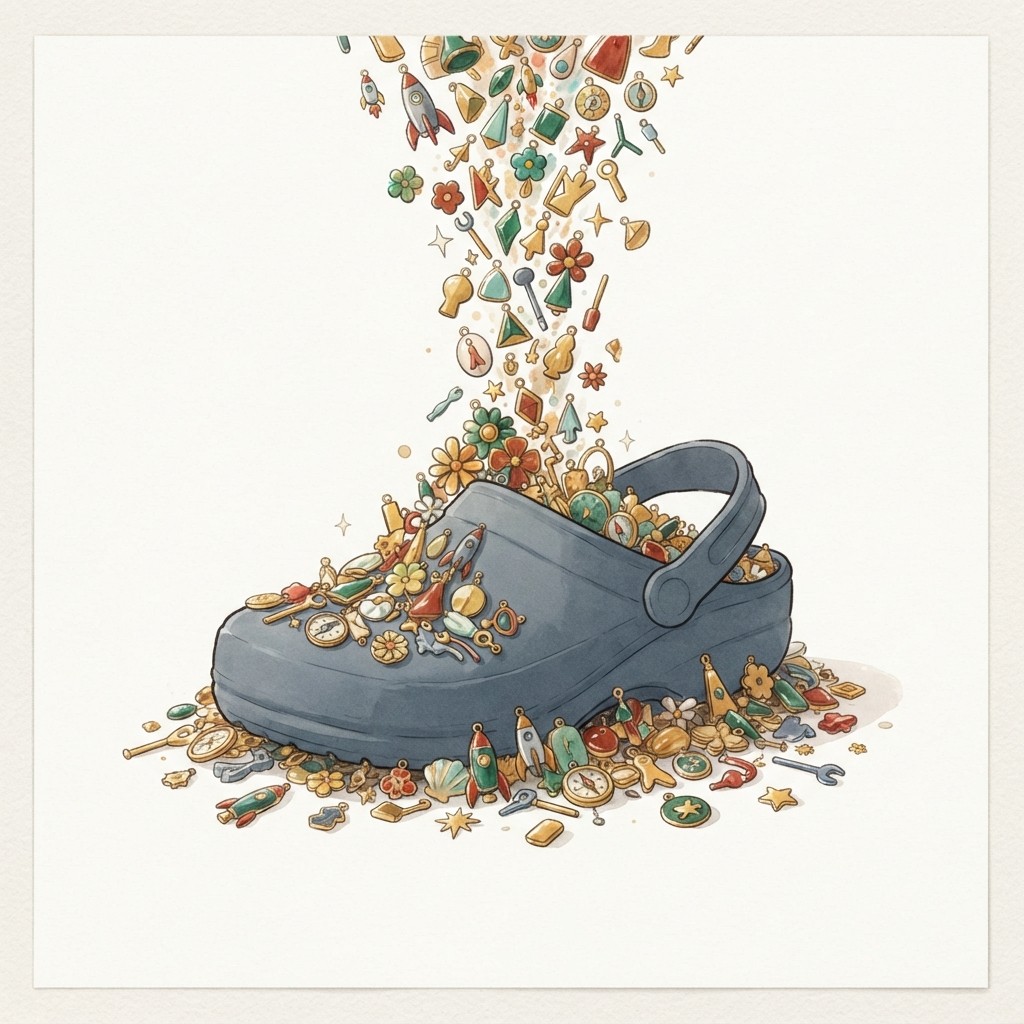
In the summer of 2005, a stay-at-home mother in Boulder named Sheri Schmelzer pushed a silk flower from her daughter's sewing kit into one of the holes on a Crocs clog.6 It was an act of small domestic boredom. It also accidentally located the most valuable thing about the ugliest shoe in America — and it wasn't the shoe. Within a year the family business she and her husband built around plugging little charms into those holes was clearing more than a million dollars a month and reaching 3,000 retail outlets.6 A year after that, Crocs bought it.1 The company had been selling the holes for free. The Schmelzers worked out that the holes were the product.
The official story of why Crocs is hard to beat is that it owns a magic foam. Croslite — proprietary, patented, exclusive. It's repeated in nearly every write-up of the company. It is also, on the record, contested by a federal court. The durable moat is somewhere else entirely: in a $10 million acquisition of a charm business and a relentless machine for putting other people's logos on a clog.
The foam everyone calls the moat isn't one
Start with what Crocs itself says, and doesn't say. In its 2023 annual report, the company protects its Croslite formulations as trade secrets — not through active patents — and spends real effort fighting counterfeits worldwide.8 That distinction matters. A trade secret protects a recipe only as long as nobody else figures out a recipe that works as well. It is not a fence; it is a hope that the fence-building stays hard. And competitors say the fence isn't there at all. In federal appellate proceedings, the rival brand Dawgs argued — and district court findings noted — that Crocs leaned on advertising words like 'patented,' 'proprietary,' and 'exclusive' to manufacture a false impression of Croslite's superiority. The brief is blunt about the material itself.9
“Croslite is a generic material with properties that competitors can and do replicate.”9
Hold that next to the obvious physical truth of the shoe. A molded foam clog has almost no switching cost. There is no account to close, no data to migrate, no network of friends to abandon. If a rival makes a comfortable foam clog for less, nothing in the material stops you from walking away in it. By the textbook, this is exactly the kind of product that should be trapped in a discount knife-fight forever. So the interesting question is not why Crocs is comfortable. It's why a structurally undefendable product sells at full price and grew into $4.1 billion in revenue.5
The thesis: Crocs sells a canvas, then sells you the paint
Here is the spine of the whole thing. Crocs isn't a shoe company defending a material; it's a platform company that turned its product into a perpetual blank canvas and then monetized the decoration. The holes are not a quirk. They are sockets. And once a shoe has sockets, two businesses bolt on that a plain clog can never run: a recurring accessories stream — Jibbitz — and a culture machine of limited collaborations that gives people a reason to keep buying the same shoe again. The genius of buying Jibbitz wasn't acquiring a charm factory. It was acquiring the realization that the customer would happily keep paying after the shoe was sold.
Note the deal terms, because almost everyone gets them wrong. Crocs did not pay $20 million for Jibbitz. It paid $10 million in cash at closing, paid off roughly $3.2 million of accrued Jibbitz liabilities, and dangled up to $10 million more in earn-out — money the Schmelzers would only see if the business hit escalating EBIT targets of $10M, then $12.5M, then $15.625M over the three years after close.12 That structure tells you Crocs wasn't buying a finished asset; it was buying a bet on a flywheel and asking the founders to prove it kept spinning. The founding legend — a co-founder spotting a Schmelzer kid's charms at a Boulder pool — is probably apocryphal; the duller, truer version runs through a Las Vegas trade show.7 The myth is cuter. The mechanism is what matters.
How the charm and the collab feed each other
Walk the loop. A customer buys one clog — a low-margin, low-loyalty transaction. The instant the clog has empty sockets, it creates demand for charms, and charms are the opposite of the shoe: tiny, cheap to make, bought repeatedly, and increasingly licensed against IP people already love. That's recurring revenue with no new shoe sold. Now layer the collaborations on top. Crocs put the clog on a luxury runway when Christopher Kane decorated it with mineral-stone Jibbitz at London Fashion Week for the S/S 2017 collection, shown in September 2016; the next year Balenciaga sent ten-centimeter platform Crocs, charms and all, down the SS18 runway.10 Each drop reframes the shoe as a cultural object worth lining up for at full price — and every drop also sells another reason to buy more charms. The collab supplies the desire; the charms harvest it again and again.
| The 'magic foam' story | The canvas-and-charms story | |
|---|---|---|
| What's defended | A proprietary material | An ecosystem and a drop cadence |
| Durability | A trade secret rivals can replicate | A habit and a culture rivals can't buy |
| Revenue shape | One sale per shoe | Shoe, then charms, then the next drop |
| Pricing power | Erodes to commodity foam | Sustains full-price sell-through |
When your core product has low switching costs and a material rivals can replicate, stop defending the molecule and start owning the things that attach to it. Build a socket — a deliberate point of customization — and then own the ecosystem of what plugs in. The shoe is sold once and easily knocked off; the recurring stream of charms, the licensed IP, and the rhythm of limited drops are a habit and a cultural position competitors can't simply pour into a mold. The moat isn't the thing you sell. It's the reason customers keep coming back to decorate it.
Isn't this just a fad with good merchandising?
The honest objection is that a flywheel built on cultural heat is the flimsiest moat of all — fashion is fickle, and a hype machine can stall overnight. There's a real warning sign right inside the company's own numbers: HEYDUDE, the other brand under the Crocs roof, fell 13.2% in 2024 to $824 million.5 Owning a footwear brand is plainly no guarantee the heat lasts. So the skeptic has a point — but notice what it concedes. HEYDUDE is a casual shoe without sockets, without a charm ecosystem, without a collaboration cadence. It is the control group. And while it fell, the Crocs Brand kept growing, with international revenue up 17.0% as the company posted record results.5 The canvas-and-charms machine isn't immune to fashion — but it converts fashion's volatility into something more durable: a reason to re-buy that doesn't depend on the next viral moment, because the charms outlive any single drop. A fad sells you one shoe. A platform sells you the right to keep changing it.
Crocs spent $10 million to learn the lesson it had been giving away for free. The holes were never a flaw in the design or a gimmick on the side — they were the part of the shoe that could be sold twice, then a third time, then on a Paris runway. A rival can copy the foam tomorrow; the appellate record says as much.9 What it can't copy as easily is the habit of decorating, the catalog of licensed charms, and a brand people now expect to drop something worth chasing. The most defended thing Crocs owns is the emptiness in the shoe — and the whole world it lets you fill.
When the moat isn't where everyone points
Moat Anatomy Canvas
A one-page canvas that dissects a moat instead of asserting it: where the advantage comes from, how much of the market it covers, how long it would take to copy, and what keeps it from eroding. Blank to dissect your own claimed edge; filled as the worked example tracing the structure of the story's defensible advantage. Use it to tell a real moat from a head start.
Included, filled and blank, in the Moat Anatomy Casebook. See the set → · Preview the blank →
Sources
Where this comes from — the filings, records, and reporting behind it.
- 1On December 1, 2006, Crocs completed its acquisition of 100% of Jibbitz LLC for $10 million in cash, plus payoff of ~$3.2 million in Jibbitz accrued liabilities, plus up to $10 million earn-out based on EBIT over three years post-close.
- 2On September 29, 2006, Crocs entered into the Jibbitz membership interest purchase agreement for $10 million cash plus up to $10 million earn-out; minimum EBIT targets were $10M / $12.5M / $15.625M in years 1–3.
- 3Crocs, Inc. official press release confirms acquisition completion on December 5, 2006: $10M cash at closing, up to $10M additional earn-out — not a flat $20M price.
- 4Crocs FY2023 total revenues were $3,962,347 thousand (~$3.96B); FY2022 revenues were $3,554,985 thousand (~$3.55B). Gross profit FY2023 was $2,210,010 thousand.
- 5Crocs FY2024 revenues were $4.1 billion, growing 4% over FY2023; Crocs Brand international revenues grew 17.0%; HEYDUDE revenues fell 13.2% to $824M.
- 6Jibbitz was invented in summer 2005 by Sheri Schmelzer, a Boulder stay-at-home mother, who stuck a silk flower from her daughter's sewing kit into a Crocs hole; the website launched August 9, 2005; by August 2006 monthly sales exceeded $1M+ and the company had grown from basement to 3,000 retail outlets.
- 7The 'pool encounter' origin story — Crocs co-founder Duke Hanson spotting Lexi Schmelzer's Jibbitz at a Boulder pool — is flagged as likely apocryphal; the more probable origin of the business relationship is a Las Vegas trade show meeting.
- 8Crocs' 2023 10-K describes Croslite material formulations as a 'key competitive advantage' protected as trade secrets, not through active patents; the company actively combats counterfeiting globally.
- 9In federal appellate proceedings, competitor Dawgs argued and district court findings noted that Crocs used terms 'patented,' 'proprietary,' and 'exclusive' in advertising to create a false impression of Croslite's superiority; the brief states 'Croslite is a generic material with properties that competitors can and do replicate.'
- 10Crocs' first designer collaboration was with Christopher Kane at London Fashion Week for the S/S 2017 collection (shown September 2016), featuring mineral stone Jibbitz; Balenciaga debuted 10cm platform Crocs with Jibbitz on the Paris Fashion Week SS18 runway in 2017.
Weighing outside help with a decision like this? Hiring a commercial due diligence provider
More like this — beyond Crocs
New Strategically analyses as they publish: the defining moves in business, checked against the record. No noise, and one click to leave.