Pairs with the Switching-Cost Ledger — a ready-to-use strategy tool, filled for ServiceNow. Included in the Ecosystem Lock-In Casebook →
“How hard can you press on lock-in you already have?”
On November 5, 2003, a 49-year-old engineer sat down at a desk in his own house with a single laptop and started writing code, because his fiftieth birthday was nineteen days away and he had decided he was running out of time.6 Fred Luddy had just watched his net worth — roughly $35 million in company stock — go to zero when Peregrine Systems, where he was CTO, collapsed into bankruptcy amid an accounting fraud.9 What he built next, first incorporated as Glidesoft, would become ServiceNow.5 Two decades later that home-desk experiment books $10.98 billion in annual revenue,1 and the more interesting number is the one it hasn't earned yet.
The official story is that ServiceNow is an IT help-desk company — the place where you file a ticket when your laptop dies. That description was roughly true around 2011 and is now actively misleading. ServiceNow stopped being a tool a long time ago. It became the layer that work itself runs on, and it is now trying to become something larger and far more expensive.
The $22 billion the customers haven't paid yet
The cleanest way to read a lock-in is to look at what customers have already committed to but not yet spent. As of December 31, 2024, ServiceNow carried $22.3 billion in remaining performance obligations — contracted revenue, signed, sitting in the backlog waiting to be recognized — up 23% in a single year.2 That figure is twice its entire annual revenue. It is the sound of an enterprise that has decided, for years in advance, that it is not going anywhere. And it concentrates upward: 2,109 customers now pay ServiceNow more than $1 million a year, and nearly 500 pay more than $5 million.2 You do not write a $5 million annual check for a ticketing system. You write it for the nervous system of your operations.
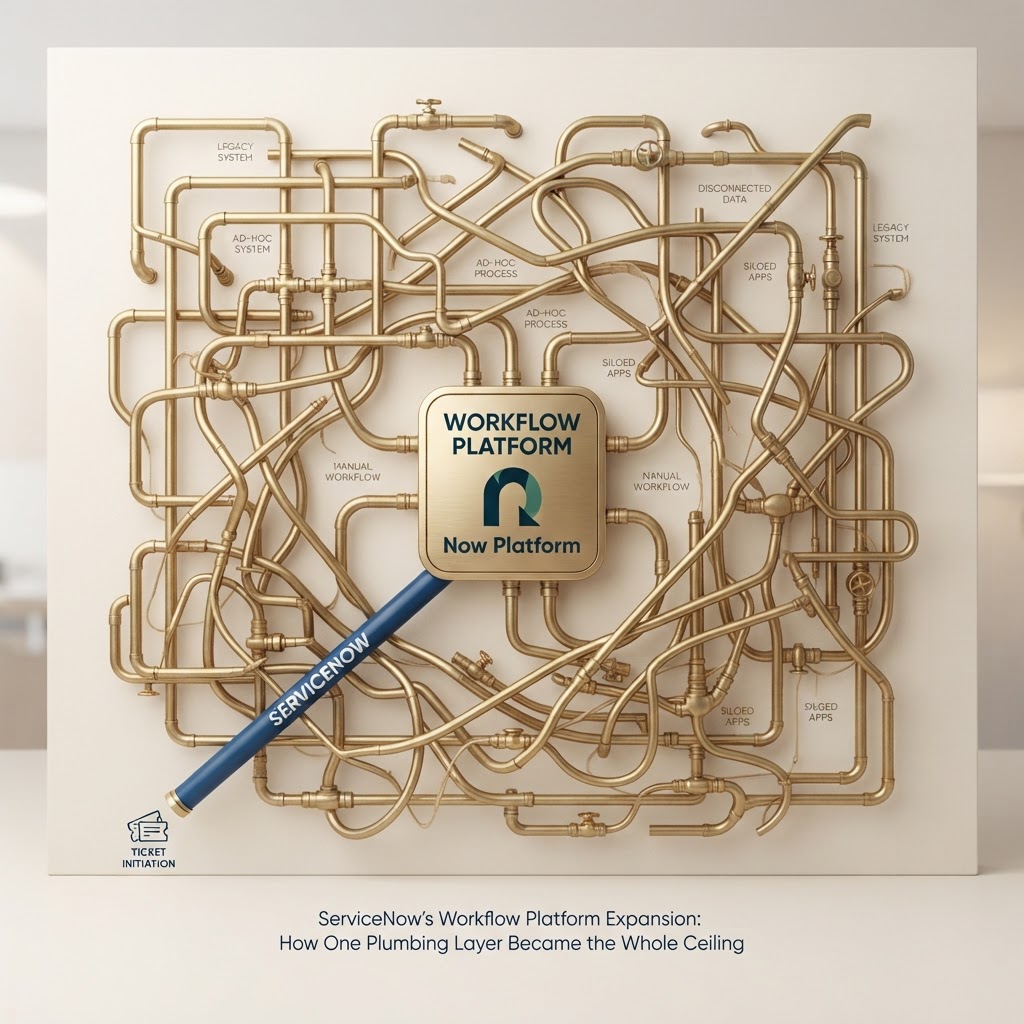
Here is the mechanism, worked down. ServiceNow's stickiness has nothing to do with screens being nice. It comes from the platform becoming the system of record for how work happens — the approval chains, the escalation paths, the SLAs, the integrations across IT, HR, security, and customer service. A company can switch a CRM the way it switches a phone plan: painful, but bounded. It cannot switch the layer where every department's process logic is encoded without re-engineering the company itself. The cost of leaving is not the software license. It is the operational re-architecture, and that cost rises every quarter the platform absorbs another workflow. That is the whole engine: ServiceNow doesn't lock you in by being indispensable; it locks you in by becoming the place your indispensability is defined.
| A typical SaaS app | ServiceNow's workflow layer | |
|---|---|---|
| What the customer buys | A feature set | The system of record for how work runs |
| What switching costs | Migrate the data | Re-engineer the operating processes |
| Where it sits | Beside the workflow | Underneath the workflow |
| Commitment signal | Monthly seats | $22.3B in multi-year backlog |
Buying the AI layer before it eats the platform
A moat this real should let a company relax. ServiceNow is doing the opposite. In March 2025 it agreed to acquire Moveworks for $2.85 billion in cash and stock.3 The logic is defensive in the most aggressive way: Moveworks had built an agentic, conversational AI front end that reached nearly 5 million employee users in about eighteen months, with roughly 90% of customers rolling it out to every employee — and the two companies already shared about 250 customers.8 Both companies frame Moveworks as a complementary front-end AI assistant rather than a captured rival — but the strategic logic is plain: ServiceNow moved to own the conversational layer sitting on top of its own platform, the interaction point that increasingly mediates between the user and the workflows underneath.11
“Any cloud, any model, and any data source.”7
Read that line carefully, because it contains the bet. ServiceNow's thesis is that raw intelligence — the language models everyone is racing to train — is commoditizing, and that the durable advantage lies one level up, in the autonomous workflows that decide what an AI agent is actually allowed to do inside a regulated enterprise.11 If that's right, ServiceNow doesn't need to win the model race. It needs to own the orchestration layer, the place where models get pointed at real processes with real permissions. The moat widens from 'where work is recorded' to 'where AI is allowed to act.' That is a much bigger pond. It is also a much more crowded one.
The $2.85 billion Moveworks price is more than 20x its 2024 revenue — a premium that prices in a future, not a present.4 And the integration is not cosmetic: ServiceNow runs a structured data model, Moveworks an unstructured one, and ServiceNow still trails dedicated automation players like UiPath on robotic process automation.4 The lock-in is real and compounding. But it is now being widened with stock and steep premiums rather than retained cash, which means the cost of the moat is rising at exactly the moment the moat itself is.
The honest objection: maybe the moat is buying itself a problem
The fair counter is that none of this is fragile — that ServiceNow is simply a category leader making sensible tuck-in acquisitions, that 22% revenue growth on an $11 billion base with $1.43 billion of net income is a company executing, not flailing.1 That's true, and it's the strongest version of the bull case. But it sidesteps where the strategy actually strains. ServiceNow is doing two hard things at once. It is paying 20x revenue to graft on an AI layer whose data model fights its own,4 and it is pushing outward from IT workflows into the CRM market, taking direct aim at Salesforce and other incumbents entrenched in exactly that territory.10 A moat earns its keep when defending it is cheaper than the rent it collects. ServiceNow's rent is enormous — but the bill for defending it just moved from cash flow to stock dilution and integration debt, and that is a different kind of moat than the one the RPO number describes.
It's tempting to read ServiceNow's lock-in and its acquisition spree as one story: a dominant platform getting more dominant. They're two stories. The lock-in is paid for — it sits in $22.3 billion of backlog the customers already signed. The expansion into the AI layer is being paid for now, in stock and 20x-revenue premiums, against entrenched competitors and a data model that doesn't natively fit. When you see a company extend its moat, ask the second question the headline skips: is it extending it with the rent the moat already throws off, or is it borrowing against the future to widen the present? The answer tells you whether you're watching strength compound or strength being spent.
Fred Luddy started ServiceNow because he was about to turn fifty and couldn't stand the idea of not building one more thing.6 What he built turned out to be unusually hard to leave — a layer the enterprise records its own logic onto, then can't unwind without rewiring itself. That moat is genuine, and it is still widening. The open question is the one the backlog can't answer: ServiceNow is now spending real money and real equity to own the place where AI gets to act, on the bet that orchestration outlasts intelligence. It might. But for the first time since that desk in 2003, the moat is being widened on credit — and one of the most expensive ways to defend a fortress is to keep buying up the land outside its walls.
Other platforms nobody can quite leave
Switching-Cost Ledger
A worksheet that prices the exit. It itemizes every cost a customer eats to switch away — the contract penalties, the re-training, the data migration, the muscle memory — so you can see whether lock-in is real or just inertia waiting to break. Blank to audit your own stickiness; filled as the worked example tallying the switching costs the story's customers face.
Included, filled and blank, in the Ecosystem Lock-In Casebook. See the set → · Preview the blank →
Sources
Where this comes from — the filings, records, and reporting behind it.
- 1ServiceNow FY2024 total revenues were $10.98 billion, a 22% year-over-year increase; subscription revenues were $10.65 billion, up 23% YoY; net income was $1.43 billion.
- 2As of December 31, 2024, ServiceNow's remaining performance obligations (RPO) were $22.3 billion (up 23% YoY) and cRPO was $10.27 billion (up 19% YoY); 2,109 customers had >$1M ACV and nearly 500 had >$5M ACV.
- 3ServiceNow agreed to acquire Moveworks for $2.85 billion in a combination of cash and stock, announced March 10, 2025; the deal was structured as a merger agreement dated March 9, 2025.
- 4The $2.85 billion Moveworks price tag represents more than 20x Moveworks' 2024 revenue, signaling high premium expectations; integration risks include data governance complexity (ServiceNow's structured model vs. Moveworks' unstructured approach) and RPA gaps vs. UiPath/Blue Prism.
- 5Fred Luddy founded ServiceNow as Glidesoft, Inc. in 2003 (formal California incorporation 2004); he served as CEO from 2004 to 2011, then shifted to product development and an advisory role by 2016; he remains on the board.
- 6Luddy said: 'It was November 5th, 2003. I knew that we had to start a company before I became 50 … So, at 49—November 24th is my birthday—we started.' He began with a single laptop at a desk in his house.ServiceNow Workflow Blog, How ServiceNow Was Born ↗ · 2022-01-28
- 7ServiceNow's 2025 Annual Report to Shareholders articulates the platform strategy as 'any cloud, any model, any data source, any agent, any tool' and explicitly positions autonomous workflows—not LLMs—as the competitive differentiator as intelligence commoditizes.
- 8Moveworks' agentic platform had grown to nearly 5 million employee users in ~18 months, with ~90% of customers deploying to all employees; ServiceNow and Moveworks had ~250 mutual customers at deal announcement.
- 9Fred Luddy served as CTO of Peregrine Systems, which collapsed into bankruptcy from accounting fraud in 2002–2003, wiping out the roughly $35 million net worth he held in company stock.
- 10ServiceNow has pushed from IT workflows into the CRM market in direct competition with Salesforce and other entrenched incumbents, rolling out expanded CRM capabilities at its Knowledge 2025 conference.
- 11ServiceNow's platform positioning is to integrate with any cloud, any model, and any data source to orchestrate work across the enterprise, with autonomous workflows as the durable differentiator; Moveworks adds a front-end AI assistant the company describes as a complement to its back-end orchestration.
Weighing outside help with a decision like this? Hiring a digital strategy consultant
More like this — beyond ServiceNow
New Strategically analyses as they publish: the defining moves in business, checked against the record. No noise, and one click to leave.