Pairs with the Crisis Response Playbook — a ready-to-use strategy tool. Included in the Crisis Response Casebook →
“What is one more quarter of not acting worth?”
On August 22, 2023, Apple did something that made headlines around the world: it endorsed a right-to-repair bill. After years of fighting nearly identical legislation, the company that had become the symbol of the locked-down gadget came out in favor of California SB 244, saying it struck the right balance between 'consumer choice and reliable repairs.'5 The press wrote it up as a conversion. Six months later, an Apple employee sat down in front of Oregon lawmakers and testified against a right-to-repair bill.6 Both things were true. Both were exactly on strategy.
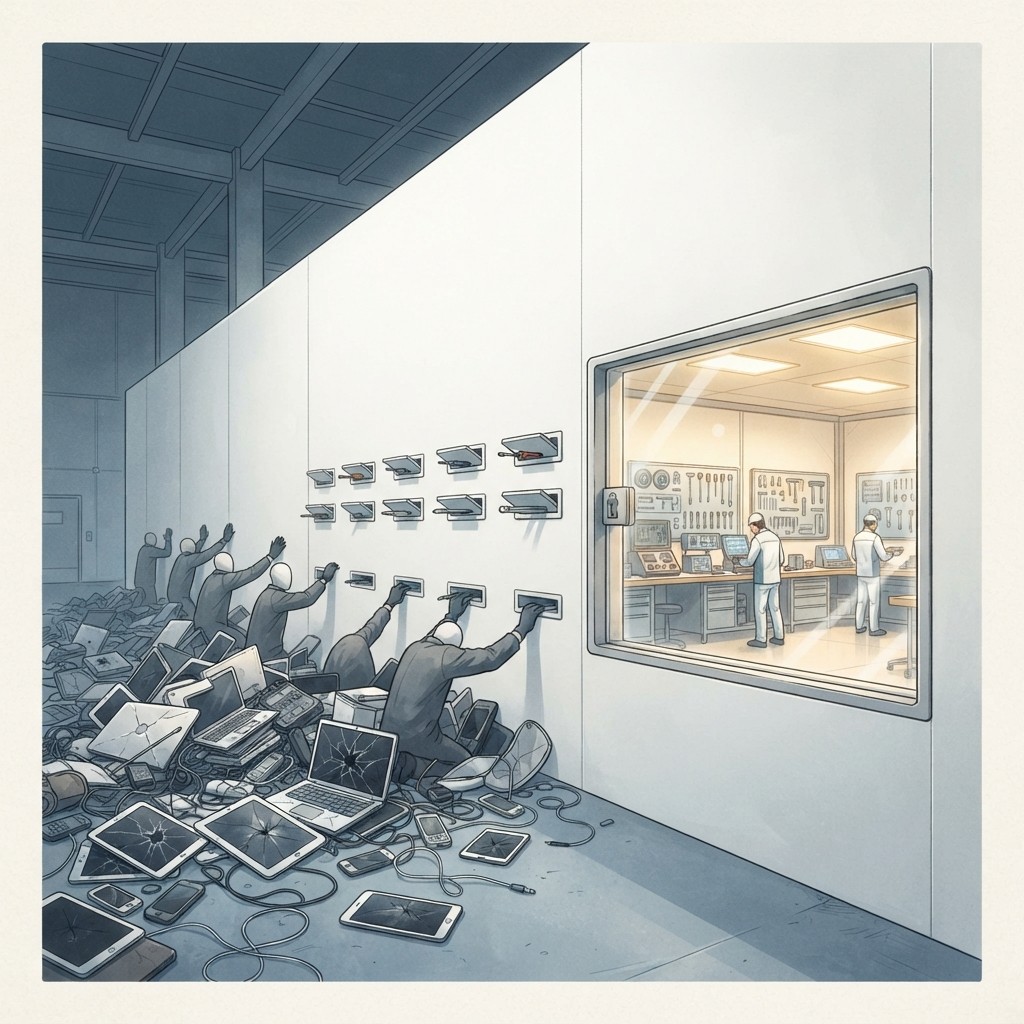
The official story is that Apple changed its mind on repair. It didn't. What Apple changed was its minimum—the smallest concession it could make to clear each obstacle as the obstacle arrived. Read in order, the famous 'reversal' is not a road-to-Damascus moment. It's a five-year ladder of minimum-viable concessions, each rung built only when someone was about to force one.
The thesis: a reversal that never reversed
Here is the read worth arguing for: Apple's repair turnaround is not a policy change at all. It's a sequence of defensive maneuvers, each timed to a specific external shock, designed to release just enough pressure to make the threat go away while leaving the underlying machine running. That machine is parts pairing—the practice of binding a component to a specific phone in software, so that even a genuine part swapped in by a third party doesn't fully work. Every concession Apple made was carefully shaped to preserve it. The proof isn't in the announcements; it's in what Apple supported and what it still fought.
The first rung was a contract nobody would sign
The story starts in August 2019, when Apple launched its Independent Repair Provider program, opening genuine parts, tools, and manuals to outside shops.1 On paper, a concession. In practice, the door had a lock on it. Apple's own announcement limited the program to 'the most common out-of-warranty iPhone repairs,' not the full catalog.1 And the contract attached to it asked shops to hand over customer data and submit to audits in which Apple could inspect them for aftermarket parts. Repair-shop owners read the terms and walked away. One, Mitch Kramer of Fixco in Bellingham, called the program 'a P.R. stunt.'7 That is the template for everything that follows: the form of access, engineered to be used rarely.
“A P.R. stunt.”7
The second rung arrived the day a shareholder vote was due
If you want to see the mechanism cleanly, watch the calendar in late 2021. On September 13, an activist investor, Green Century Capital, filed a shareholder resolution demanding Apple reverse its 'anti-competitive repair policies.' On October 18, Apple filed a no-action request with the SEC to block the resolution from ever reaching a vote. Then the SEC issued new guidance that made that block likely to fail. On November 17—the very day Green Century's response was due—Apple announced Self Service Repair. Green Century withdrew its resolution.4 This is not a company that woke up wanting to let you fix your phone. It is a company that found the cheapest exit from a fight it was about to lose, and took it at the last possible hour.
And what was inside the exit? Self Service Repair launched in April 2022 with more than 200 parts and a tool-rental kit at $49 a week.32 Apple reserved it for 'customers who are experienced with the complexities of repairing electronic devices,'11 priced parts at the same level as those available to its authorized repair network,3 and required a post-repair System Configuration software step for many parts to function fully.11 The program shipped you a heavy crate of tools you had to mail back, to do a repair priced barely below just paying Apple. Access, again, engineered to be used rarely.
California vs. Oregon: the same Apple, six months apart
The cleanest evidence that nothing fundamental changed sits in the gap between two states. Apple endorsed California's SB 244 in August 2023, but only an amended version, after years of watching near-identical California bills die under industry lobbying.5 Its support was conditional on language that protected its intellectual property—and, crucially, did not ban parts pairing outright, requiring only that manufacturers make pairing software available on fair terms.56 Then, in February 2024, Apple's own Principal Secure Repair Architect, John Perry, traveled to Oregon and testified against SB 1596 in an open hearing—the first time Apple had ever sent an employee to argue its position out loud.6 The bills were cousins. The one difference that mattered: Oregon's banned parts pairing, and California's did not. Apple wasn't for repair in one state and against it in another. It was for repair that left its control intact, and against repair that didn't—everywhere, consistently.
| California SB 244 | Oregon SB 1596 | |
|---|---|---|
| Apple's position | Endorsed (amended version) | Testified against, in person |
| When | August 2023 | February 2024 (~6 months later) |
| Banned parts pairing? | No | Yes |
| What it protected | Apple's IP and pairing prerogatives | Nothing Apple wanted to keep |
When a company under pressure 'reverses' itself, the press reports the verb and ignores the fine print. The real signal is the condition attached to the concession. Apple didn't oppose right to repair as a slogan—it opposed any version that ended parts pairing, and supported any version that didn't. Map a firm's stated positions against a single underlying variable, and the apparent contradictions usually resolve into one quiet, unwavering interest. The thing they keep fighting for is the thing that actually pays.
And in the rooms with no cameras
The pattern didn't stop once Apple could claim a pro-repair record. In April 2024 Apple announced a used-parts policy—but it explicitly excluded aftermarket, non-Apple parts, the very components third-party shops rely on.910 Then in 2025, public-records emails showed Apple lobbying Florida lawmakers against a repair bill, SB 1132, through 15 paid lobbyists, without ever testifying publicly; the bill died after House leaders declined to hold a single hearing. Asked about it, Apple pointed to a position paper boasting that it 'was the first smartphone manufacturer to come out in support of federal regulation for repair in the US.'8 That is the whole strategy in one sentence: a public posture of leadership, a private effort to kill the laws with teeth.
The honest counter: at the end, you can buy the parts
The fair objection is that I'm too cynical. Whatever the motive, the result is real: Apple does now sell genuine parts, ship tools, and publish manuals it once locked away, and it endorsed a binding law it spent years fighting.25 A customer who wants to replace an iPhone battery has more legitimate options in 2024 than in 2018. Motive doesn't change the wrench in your hand. And it's true—the concessions are not nothing, and a company forced into the right behavior is still doing the right behavior. There's even a steelman that motive shouldn't matter at all: pressure that produces access is pressure that worked.
But motive matters here for one practical reason: it predicts the future. A company that genuinely converted would have stopped fighting. Apple kept fighting—openly in Oregon, quietly in Florida—precisely where the laws threatened parts pairing.68 The concessions Apple made are the floor regulators forced; the line it still defends is the ceiling it chose. So the right question isn't 'has Apple done some good?' It's 'what is Apple still willing to spend lobbyists to prevent?' The answer tells you where the next bill will be fought, and it isn't over selling you a battery.
Apple's repair story is usually told as a company that learned to listen. Look at the dates and it becomes something colder and more impressive: a company that learned exactly how much to give, and exactly when, to make each threat dissolve without conceding the one thing that mattered. It didn't reverse. It rationed. And the most telling fact in the whole saga is the smallest—that the day Apple announced its great pro-repair program was the day a shareholder vote was due.4 The conversion was never to repair. It was to whatever the room required.
When the public story and the strategy disagree
Crisis Response Playbook
A playbook for a crisis already in motion: who decides, which plays fire on which trigger, and what gets said to whom. It replaces panic and the all-hands meeting with a pre-agreed sequence each person can run alone. Blank to pre-load before a crisis hits; filled as the worked example reconstructing the plays the story's team ran — and the ones they should have.
Included, filled and blank, in the Crisis Response Casebook. See the set → · Preview the blank →
Sources
Where this comes from — the filings, records, and reporting behind it.
- 1Apple launched the Independent Repair Provider (IRP) program in the United States in August 2019, providing independent repair businesses access to genuine Apple parts, tools, training, repair manuals, and diagnostics for the most common out-of-warranty iPhone repairs.
- 2Apple announced Self Service Repair on November 17, 2021, covering iPhone 12 and 13 lineups first, with US availability planned for early 2022; the program was available for more than 200 individual parts and tools.
- 3Apple's Self Service Repair program went live on April 27, 2022, in the US for iPhone 12, iPhone 13, and iPhone SE (3rd generation), offering over 200 parts and tools; Apple offered a $49 weekly tool-rental kit.
- 4Green Century Capital Management filed a shareholder resolution with Apple on September 13, 2021, demanding Apple reverse 'anti-competitive repair policies'; Apple filed an SEC no-action request on October 18, 2021, to block the resolution; after new SEC guidance shifted the odds against Apple, Apple announced Self Service Repair on November 17, 2021—the same day Green Century's response was due—and Green Century withdrew the resolution.
- 5Apple publicly endorsed California SB 244 in an August 22, 2023 statement, after years of opposing similar California bills that had died repeatedly due to intense industry lobbying; Apple said the bill struck the right balance between 'consumer choice and reliable repairs' while protecting privacy, data security, and OEM intellectual property.
- 6In February 2024—approximately six months after supporting California SB 244—Apple's Principal Secure Repair Architect John Perry testified in an open Oregon legislative hearing against Oregon SB 1596, which would have banned parts pairing; this was the first time an Apple employee had openly argued the company's position at a legislative hearing. Google supported the same Oregon bill that Apple opposed.
- 7Independent repair shop owner Mitch Kramer (Fixco, Bellingham WA) and Chad Johansen (NH iPhone Repair) both declined to sign the IRP contract, citing Apple's demands for customer data and the right to audit shops for aftermarket parts; a leaked copy of the IRP contract corroborated the onerous terms. Kramer publicly called the program 'a P.R. stunt.'
- 8Emails obtained via public-records request showed Apple privately lobbied Florida lawmakers against SB 1132 (a right-to-repair bill) in 2025 through 15 Florida lobbyists on its payroll, without ever publicly testifying against the bill; the bill failed after Republican House leaders refused to hold a single hearing. Apple referred inquirers to a June 2024 position paper asserting it 'was the first smartphone manufacturer to come out in support of federal regulation for repair in the US.'
- 9Apple announced in April 2024 that it would allow used genuine Apple parts in iPhone repairs starting that fall, beginning with iPhone 15 or newer; the policy did not apply to aftermarket, non-Apple parts.
- 10Apple's April 2024 used-parts policy explicitly did not apply to aftermarket parts; iFixit stated Apple 'plan on continuing to ban aftermarket parts,' which are critical to the repair economy.
- 11Apple's Self Service Repair program is described on Apple's own support page as intended for those 'experienced with the complexities of repairing electronic devices'; certain repairs require a post-repair System Configuration software step to complete the repair for genuine Apple parts.
Weighing outside help with a decision like this? Hiring a supply chain strategy consultant
More like this — beyond Apple
New Strategically analyses as they publish: the defining moves in business, checked against the record. No noise, and one click to leave.