Pairs with the Crisis Response Playbook — a ready-to-use strategy tool. Included in the The Crisis Response Casebook →
On October 13, 2008, a Japanese bank wired $9 billion into Morgan Stanley and the world wrote the headline it had been waiting for: the white knight had arrived, the last great American investment bank had been saved at the brink.1 It is a clean story, and clean stories are usually rearranged. Because the part that actually kept Morgan Stanley breathing had happened more than three weeks earlier, in a quieter announcement that nobody turned into a legend — and it came not from Tokyo but from Washington.
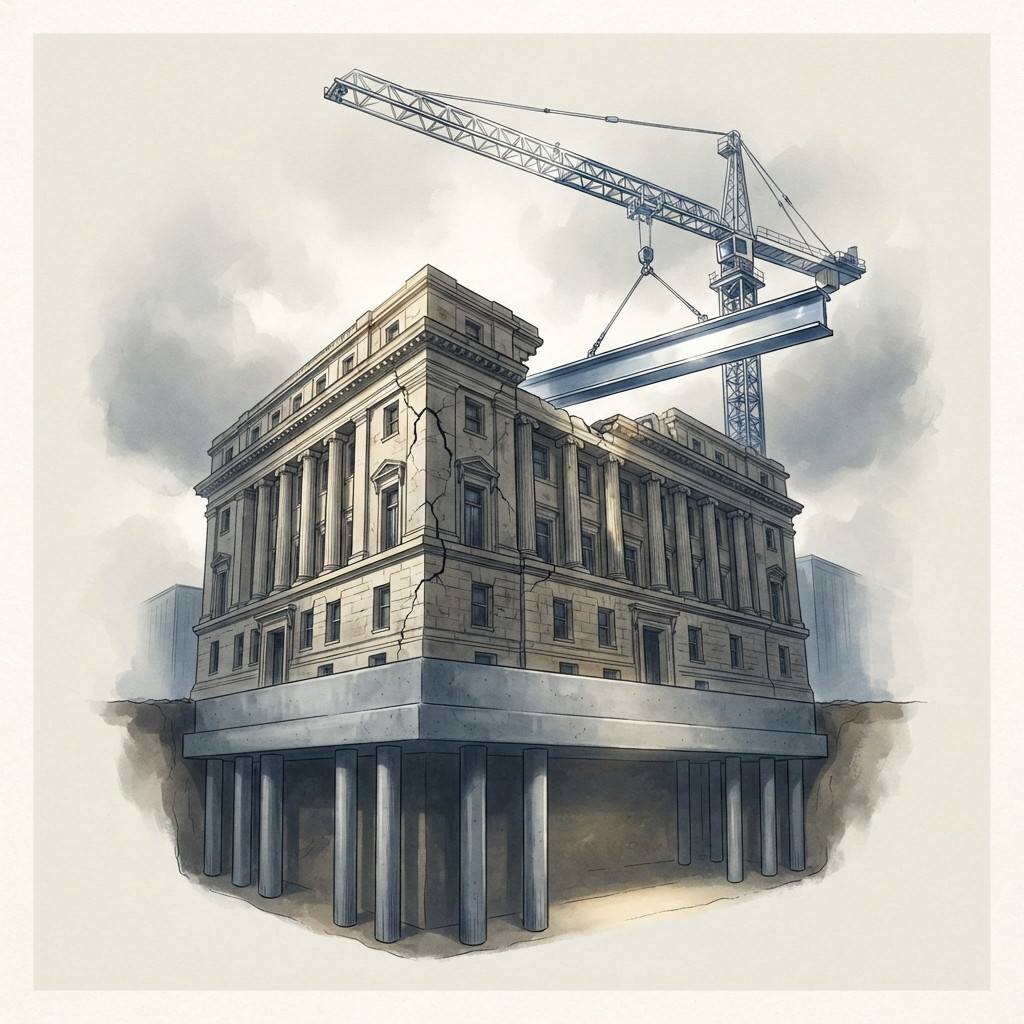
The popular version says MUFG's money rescued a failing firm. Almost every load-bearing word of that is out of order. The Federal Reserve had already changed what Morgan Stanley fundamentally was — and granted it the lifeline that mattered most — before the deal was announced, let alone closed. The Japanese capital arrived after the firm was already standing.
The rescue that came eight days before the rescue
On September 21, 2008, the Federal Reserve Board of Governors approved Morgan Stanley's application to become a bank holding company.3 That sentence sounds bureaucratic. It was the whole game. The conversion handed Morgan Stanley ongoing access to the Federal Reserve Discount Window — the central bank's emergency funding line — and with it the structural backstop that only a regulated bank holding company can access in a panic. The MUFG investment was not announced until September 29, and did not close until October 13.12 By the time the Japanese capital landed, the Fed's backstop had been in place for three weeks. The order matters: the government stabilized the firm first, and the private money came in second, on top of a foundation Washington had already poured.
Morgan Stanley's own filings are careful never to call this what it was. The 10-K frames the conversion as a move for 'maximum flexibility and stability' amid 'rapid and profound changes' — the language of a firm choosing an upgrade. It was nothing of the kind. You do not voluntarily re-charter a 73-year-old investment bank in the same week Lehman files for bankruptcy because you fancy more flexibility. You do it because the short-term funding markets have stopped trusting you and the only lender left who will not flinch is the Fed. The conversion was reactive, crisis-compelled, and dressed in the vocabulary of strategy.4
“...the support of the U.S. government, Congress and the Administration during this challenging period.”5
The $10 billion headline hides a $135 billion footnote
The number everyone remembers is the TARP figure: $10 billion, announced on October 14, 2008, alongside eight other large institutions, and later repaid in full.45 Repaid in full is the line Morgan Stanley likes, and it is true. But $10 billion is the part of the support you can see in a press release. Reports drawing on Federal Reserve disclosure data later put Morgan Stanley's peak borrowing through the Federal Reserve's emergency lending programs at tens of billions of dollars — a multiple of the TARP headline, and a number that never made the legend. The TARP capital was the visible deposit. The emergency lending was the invisible firehose. Both ran before MUFG's money was in the door.
| When | What it did | |
|---|---|---|
| Bank holding company status | Sep 21, 2008 | Opened the Fed Discount Window — the funding lifeline |
| Fed emergency lending | Through the crisis | Peaked at ~$135 billion in borrowing |
| TARP capital | Announced Oct 14, 2008 | $10 billion, later repaid in full |
| MUFG investment | Closed Oct 13, 2008 | $9 billion of preferred; bolstered an already-stabilized firm |
Even the MUFG deal itself quietly tells you how the bargaining power had shifted. As announced on September 29, the structure was roughly $6 billion of convertible preferred at $31.25 a share plus about $3 billion of common stock at $25.25.2 By the October 13 close, the common-stock piece had vanished. The final terms were $7.8 billion of convertible preferred and $1.2 billion of non-convertible preferred — both carrying a 10% dividend — for a 21% stake.1 MUFG ended up with preferred over common — preferred sits higher in the capital stack and pays a fat coupon: it is what a cautious investor demands when the patient's survival is not assured. That is not the deal you negotiate with a firm you are heroically rescuing out of generosity. It looks, structurally, like the deal you negotiate when a government backstop has already reduced the downside.
Why a firm this strong needed saving at all
Here is the awkward fact the rescue narrative skips: Morgan Stanley's exposure to the housing collapse was not a market-wide accident it merely shared. Inside the firm, Howie Hubler's trading group had sold roughly $16 billion of credit-default swaps on AAA-rated CDOs while hedging with only about $2 billion of swaps on riskier mortgages — a lopsided bet that produced losses of around $9 billion, described in published accounts as one of the largest single trading losses in Wall Street history. That is the mechanism the white-knight story cannot accommodate: the firm did not simply get caught in a storm, it had built part of the storm in-house. The government and MUFG were not rescuing an innocent bystander. They were stabilizing an institution whose own risk-taking had helped put it on the ledge.
When a company survives a crisis, the press anoints whoever wrote the most photogenic check. But survival is almost always a stack of supports, and the load-bearing one is rarely the visible one. Ask three questions before you believe the rescue story. First, what came first? A backstop that lands before the private capital is the thing that actually held the firm up — the later money is reacting to it. Second, what's the full number? A repaid $10 billion makes a clean press release; a peak $135 billion of emergency lending does not, which is exactly why you'll have to dig for it. Third, who got the better terms? Investors who demand preferred stock and a 10% coupon are pricing in risk the headline says was already gone. The narrative credits the white knight. The timeline usually credits the central bank.
Wasn't the MUFG money the thing that calmed the market?
The fair objection is that perception is its own kind of solvency. A run is a confidence problem, and a $9 billion vote of confidence from one of the world's largest banks plausibly did more to stop the panic than an abstract Fed credit line nobody could see. There is real truth in that — the MUFG capital was visible, it was private, and it signaled that a sophisticated outsider would put real money behind the franchise. But notice the terms it demanded, and notice what made those terms safe to offer. By the close, Morgan Stanley's pro-forma Tier 1 capital ratio was estimated at more than 15.5% — against a 6% requirement — with leverage cut to just under 20x and total assets under $900 billion.7 That balance sheet was rebuilt on government support that was already flowing. MUFG was confident because Washington had made it safe to be. The Japanese money calmed the market, yes — but it could only do so because the firm it was investing in had already been pulled back from the edge by a backstop that arrived first.
Morgan Stanley survived 2008, and it deserves credit for repaying every public dollar it could be seen to owe. But the story it lets you tell — proud independent firm, foreign white knight, narrow escape — is the story with the timeline scrambled. Strip the narrative away and the sequence is plain: the Fed changed what the firm was, opened the only door that still led to cash, and let tens of billions in emergency lending flow before a yen of private capital arrived. The white knight did not save Morgan Stanley. He invested in a firm the government had already caught.
When the official rescue story hides the real one
Crisis Response Playbook
A playbook for a crisis already in motion: who decides, which plays fire on which trigger, and what gets said to whom. It replaces panic and the all-hands meeting with a pre-agreed sequence each person can run alone. Blank to pre-load before a crisis hits; filled as the worked example reconstructing the plays the story's team ran — and the ones they should have.
Included, filled and blank, in the The Crisis Response Casebook. See the set → · Preview the blank →
Sources
Where this comes from — the filings, records, and reporting behind it.
- 1MUFG closed a $9 billion equity investment in Morgan Stanley on October 13, 2008, giving MUFG a 21% ownership interest on a fully diluted basis; the final structure was $7.8 billion of convertible preferred at $25.25/share and $1.2 billion of non-convertible preferred, both at 10% dividend — not the originally announced common-stock component.
- 2On September 29, 2008, Morgan Stanley announced the original definitive agreement with MUFG: approximately $6 billion of convertible preferred at $31.25/share plus approximately $3 billion of common stock at $25.25/share — terms that were subsequently renegotiated before the October 13 closing.
- 3Morgan Stanley's application to become a bank holding company was approved by the U.S. Federal Reserve Board of Governors on September 21, 2008 — eight days before the MUFG deal was announced — providing ongoing access to the Federal Reserve Discount Window and expanded funding opportunities.
- 4On October 14, 2008, the U.S. Treasury announced its intention to inject capital into nine large U.S. financial institutions including Morgan Stanley under the TARP Capital Purchase Program; Morgan Stanley received $10 billion and later repaid it in full.
- 5Morgan Stanley confirmed repayment of the $10 billion in TARP money to the U.S. Treasury in a press release, thanking 'the support of the U.S. government, Congress and the Administration during this challenging period.'
- 6Morgan Stanley received a peak of $135 billion through the Federal Reserve's emergency lending programs during the crisis — in addition to the $10 billion TARP capital injection — per the Congressional Oversight Panel for TARP's Final Report.
- 7After the MUFG investment closed, Morgan Stanley's Tier 1 Capital Ratio was estimated at more than 15.5% on a pro-forma basis as of August 31, 2008 — far in excess of the 6% required by the Federal Reserve — and the leverage ratio was reduced to just under 20x, with total assets under $900 billion.
- 8Howie Hubler's Global Principal Commodities Group at Morgan Stanley sold $16 billion in CDSs on AAA-rated CDOs while holding $2 billion in CDSs on risky mortgages; the group's total losses were approximately $9 billion, described in published accounts as the fourth-largest single trading loss in Wall Street history.
More like this — beyond Morgan Stanley
New Strategically analyses as they publish: the defining moves in business, checked against the record. No noise, and one click to leave.