Pairs with the Crisis Response Playbook — a ready-to-use strategy tool. Included in the The Crisis Response Casebook →
On July 19, 2024, a single CrowdStrike update knocked Windows machines into a boot loop across the planet at once - banks, hospitals, and nearly every major airline went dark together. By the next day, most of those airlines were flying again. Delta wasn't. It took roughly five days and canceled about 7,000 flights1 - long after United, American, and the rest had drained their backlogs and the DOT had noticed that everyone else was back to normal while Delta still wasn't.4 The same bug hit everyone. Only one carrier stayed grounded for the better part of a week. That gap is the whole story.
The official version, told loudly and lawyered carefully, is that Delta was the innocent victim of a reckless vendor's botched code. That's half true. What it conveniently skips is the reason the crisis lasted five days instead of one - and that reason had nothing to do with CrowdStrike's update at all.
The bug grounded the planes. Delta's own system kept them grounded.
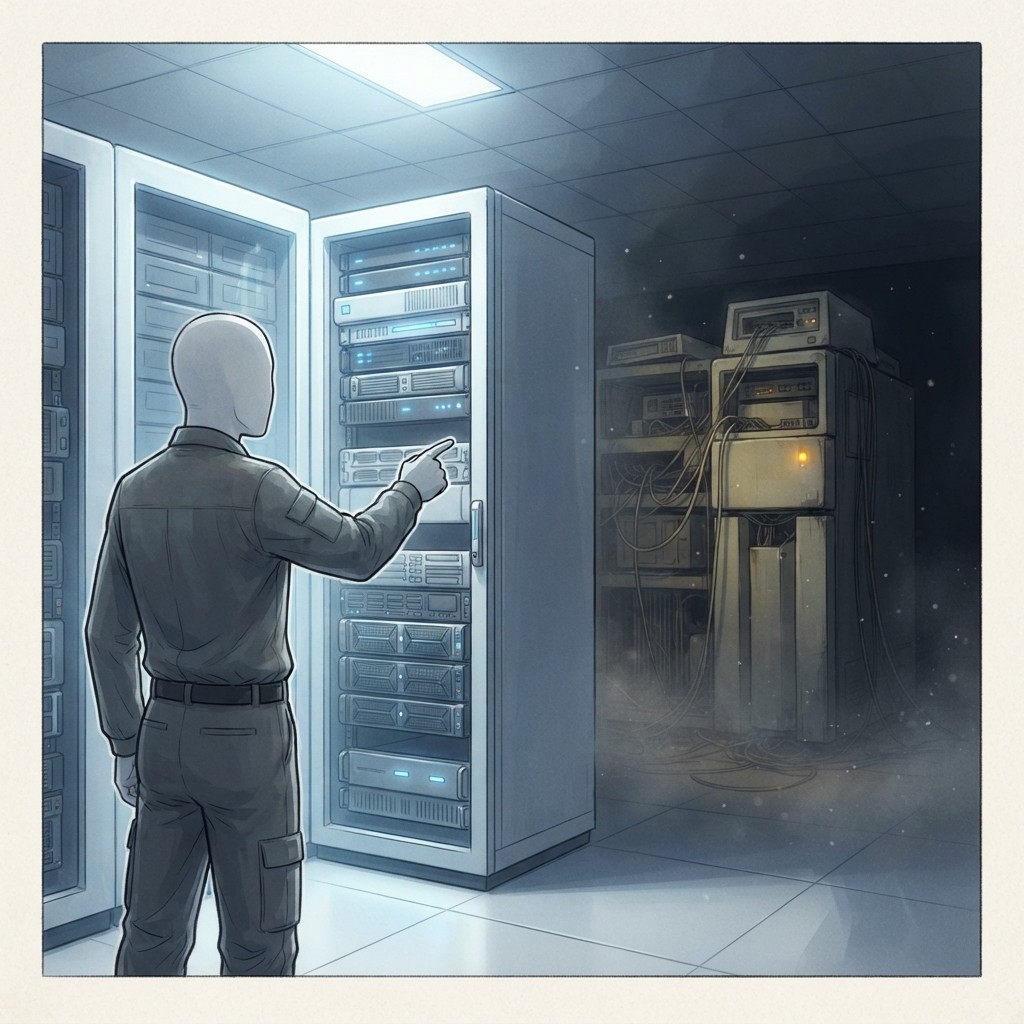
Here is the part the lawsuit doesn't lead with. Restarting an airline isn't about rebooting computers - it's about knowing where every pilot and flight attendant is, what they're legally allowed to fly next, and how to stitch them back onto aircraft scattered across the country. That job belongs to the crew-tracking and scheduling system. And according to Microsoft's August 2024 legal letter, corroborated by multiple outlets, Delta's crew-tracking and scheduling platform ran on IBM infrastructure - not on Microsoft Windows or Azure, the systems the CrowdStrike update actually broke.6 So even as Delta's Windows fleet came back online, the one system it needed to put crews back on planes stayed jammed. The CrowdStrike bug knocked the airline down. Delta's own legacy architecture is what kept it on the floor.
| The CrowdStrike trigger | The Delta recovery lag | |
|---|---|---|
| What broke | Windows machines, industry-wide | Crew-tracking on IBM infrastructure |
| Whose system | A third-party vendor's update | Delta's own architecture |
| How long it hurt | Roughly a day for most airlines | About five days for Delta |
| Who owns it | CrowdStrike | Delta |
What the '$500 million' really is
The headline number became its own myth. Bastian put '$500 million' into the air, and it got repeated everywhere as a clean loss figure. But Delta's own SEC 8-K cuts it into pieces that don't add up the simple way: about $380 million in direct revenue impact, plus $170 million in non-fuel expense, partly offset by $50 million the airline saved on fuel it never burned because the flights never flew.1 The $380 million revenue hit is the SEC-documented number. The '$500 million' is the legal-claim floor Bastian cited - the amount Delta said it intended to pursue, not a single audited loss line.1 One figure is accounting; the other is litigation posture. The press collapsed them into one, which is exactly what a company in a lawsuit would want.
And the litigation followed the framing. On October 25, 2024, Delta sued CrowdStrike in Fulton County for breach of contract, gross negligence, fraud, and computer trespass; the same day, CrowdStrike filed its own federal suit asking a court to declare its liability contractually capped.3 Delta's narrative wasn't just a press strategy - it was a complaint, drafted to put all the blame on the vendor and none on the architecture.
The help Delta says never came - and the help it reportedly turned away
Delta's most damning charge is abandonment: that CrowdStrike, through the first 65 hours, offered nothing but a public remediation website. That claim comes from a letter by David Boies, Delta's attorney - it's Delta's legal position, not an established fact.8 CrowdStrike's account is the mirror image: it says its CEO reached a Delta board member within four hours, and that its security chief was in direct technical contact with a Delta counterpart.8 Microsoft went further. Its attorney stated that Microsoft offered Delta free technical assistance every single day from July 19 to 23 and was turned down each time - and that Microsoft's CEO personally emailed Bastian on July 24 and got no reply.6 You don't have to believe either side wholesale to see the shape: the vendors say the help was there and refused; Delta says it wasn't there at all. Both cannot be true.
“Microsoft offered Delta free technical assistance every day from July 19 through July 23 - and was turned down each time. Delta's crew-tracking and scheduling system ran on IBM infrastructure, not Microsoft Windows or Azure.”6
But wasn't Delta genuinely wronged - and didn't a judge agree?
The honest objection is that none of this exonerates CrowdStrike, and it shouldn't. A vendor pushed an update that bricked machines worldwide, and a Fulton County judge let Delta's gross-negligence and computer-trespass claims proceed in May 2025 - pointing to evidence that testing the flaw on a single machine would have caught it, and to CrowdStrike's own president publicly admitting serious error.7 That's real. CrowdStrike lit the fire. But the same ruling narrowed Delta's case and flagged skepticism toward several of its broader theories7 - and 'the vendor was negligent' and 'Delta's recovery was its own failure' are not competing claims. They're both true, sitting on top of each other. The fire was arson; the building burned for five days because Delta hadn't built the exits. A peer carrier hit by the identical update and back flying in a day is the control group, and the control group says the difference was Delta.
Then came the part that looks like vindication and isn't. The DOT opened a 'controllable'-event investigation in July 2024 - the same classification that preceded Southwest's $140 million civil penalty (and more than $750 million in total obligations) after its 2022 holiday meltdown9 - and over 5,000 passenger complaints poured in.4 Everyone expected a fine. Instead, the Trump administration closed the probe on June 15, 2026 with zero penalties, finding that travelers got prompt refunds and adequate assistance.5 Delta escaped accountability. But escaping a fine under a friendlier regulator two years later is not the same as having handled the crisis well. The penalty never landed; the five days still happened.
When a crisis hits a complex system, the headline cause and the actual cause are rarely the same. The CrowdStrike update was the trigger every airline shared; the recovery time was set by each airline's weakest internal link. Delta's was a crew-scheduling platform on aging infrastructure the bug never even touched - which means the failure was invisible right up until it was load-bearing. The lesson for any operator: you don't measure resilience by your best-funded systems or your toughest vendor contracts. You measure it by the single legacy dependency you've quietly tolerated because it 'still works.' In a crisis, that's the one that decides how long you stay down. And blaming the vendor in public is the fastest way to avoid fixing the dependency in private.
Delta spent the months after July 2024 building a case that it was wronged. It was - CrowdStrike shipped a defective update, and a judge agreed there's a claim there. But the most expensive part of the meltdown wasn't the bug. It was the five days, and the five days were Delta's. The airline got grounded by a vendor and stayed grounded by itself, then told the story as if those were the same event. The real lesson is the one Delta has the least incentive to say out loud: when the whole industry trips over the same wire, the company that's still on the ground a week later isn't the unluckiest. It's the one that built the slowest way back up.
When the crisis exposes what was already broken
Crisis Response Playbook
A playbook for a crisis already in motion: who decides, which plays fire on which trigger, and what gets said to whom. It replaces panic and the all-hands meeting with a pre-agreed sequence each person can run alone. Blank to pre-load before a crisis hits; filled as the worked example reconstructing the plays the story's team ran — and the ones they should have.
Included, filled and blank, in the The Crisis Response Casebook. See the set → · Preview the blank →
Sources
Where this comes from — the filings, records, and reporting behind it.
- 1Delta's CrowdStrike outage caused approximately 7,000 flight cancellations over five days; direct Q3 revenue impact was $380 million; non-fuel expense impact was $170 million; fuel savings were $50 million. CEO Bastian stated Delta was pursuing legal claims totaling 'at least $500 million.'
- 2Delta's Q3 2024 earnings 8-K confirms: direct revenue impact of approximately $380 million; $170 million non-fuel expense; $50 million fuel savings from 7,000 cancellations; the outage reduced Q3 operating margin by 2.3 percentage points and EPS by $0.45.
- 3Delta Air Lines filed suit against CrowdStrike on October 25, 2024, in Fulton County Superior Court (Case No. 24CV013621), alleging breach of contract, gross negligence, fraud, and computer trespass. On the same day, CrowdStrike filed a separate federal suit (N.D. Ga. No. 24-cv-04904-TWT) seeking a court declaration that its liability is contractually capped.
- 4The DOT opened its investigation on July 23, 2024, citing 'continued widespread flight disruptions and reports of concerning customer service failures' while other carriers had returned to normal; DOT classified the cancellations as a 'controllable' event, placing responsibility on Delta. Over 5,000 passenger complaints were filed with DOT during the disruption.
- 5The Trump administration closed the DOT investigation on June 15, 2026, without penalties. DOT stated Delta's passengers 'received prompt refunds, adequate baggage assistance, and appropriate assistance for passengers with disabilities.' DOT directed Delta to provide timely refund notifications going forward.
- 6Microsoft's attorney Mark Cheffo stated in an August 2024 letter that Microsoft offered Delta free technical assistance every day from July 19–23 and was turned down each time; that Microsoft CEO Satya Nadella personally emailed Delta CEO Ed Bastian on July 24 with no response; and that Delta's biggest recovery problem—its crew-tracking and scheduling system—ran on IBM infrastructure, not Microsoft Windows or Azure.
- 7A Fulton County Superior Court judge (Kelly Lee Ellerbe) ruled in May 2025 that Delta's gross negligence and computer trespass claims against CrowdStrike could proceed, citing evidence that a test on a single machine would have revealed the flaw and citing CrowdStrike's president's public admission of serious error; the court narrowed the lawsuit and flagged skepticism toward several other legal theories, including fraud claims predating the incident.
- 8Delta's claim that CrowdStrike only offered a public remediation website for the first 65 hours is attributed to David Boies's letter; CrowdStrike disputed this, stating its CEO contacted Delta board member David DeWalt (safety/security committee) within four hours, and its CSO was in direct technical contact with Delta's counterpart. The '65-hour' claim is Delta's legal position, not independently verified fact.
- 9The DOT issued a $140 million civil penalty against Southwest Airlines for its 2022 holiday meltdown — the largest consumer-protection penalty in DOT history — following a 'controllable'-event classification; total Southwest obligations exceeded $750 million when refunds and reimbursements are included.
More like this — beyond Delta Air Lines
New Strategically analyses as they publish: the defining moves in business, checked against the record. No noise, and one click to leave.