Pairs with the Cannibalization Decision Tree — a ready-to-use strategy tool, filled for BlackBerry. Included in the Cannibalization Choice Casebook →
“Should you launch the thing that takes revenue from your best business?”
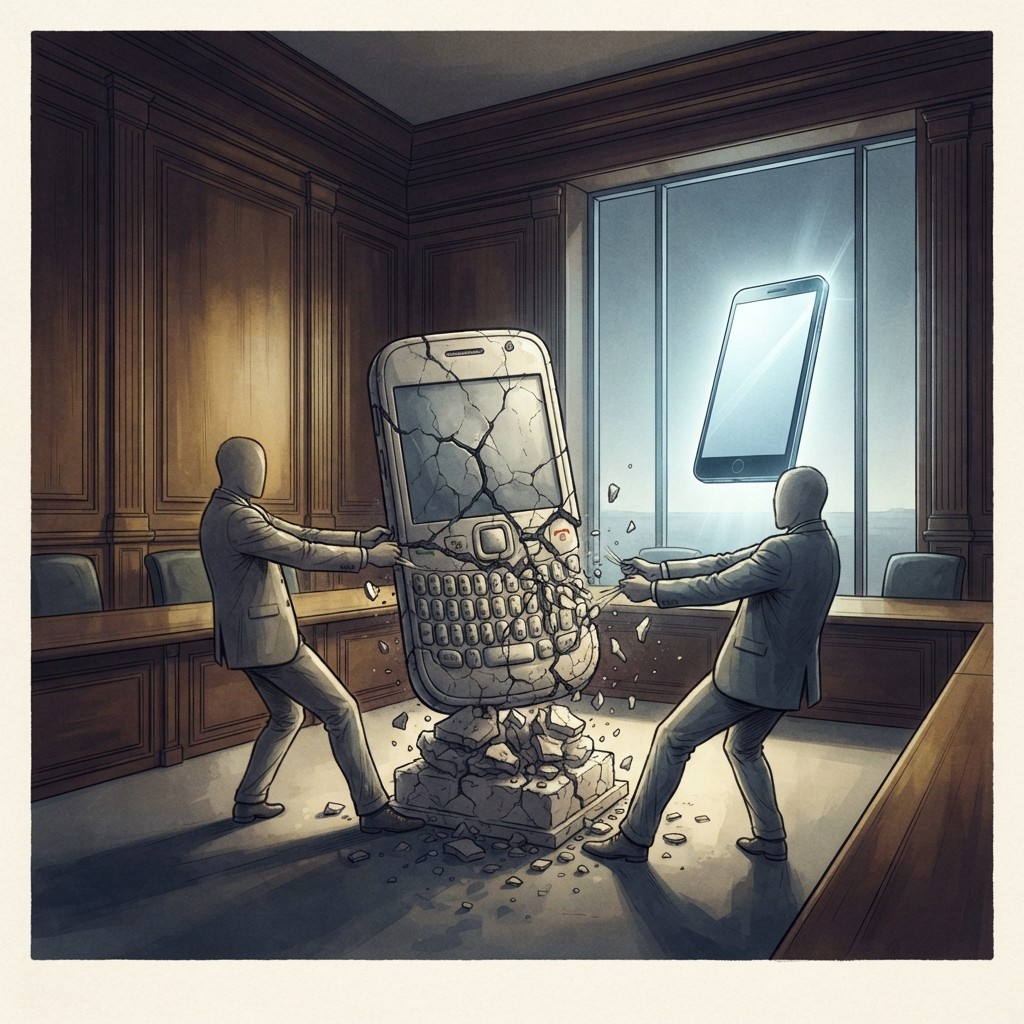
In 2007, after watching a video of Apple's new phone, Mike Lazaridis turned to his co-CEO and showed him the threat. Jim Balsillie's reply was two words: 'We'll be fine.'3 It is tempting to read that as arrogance - a keyboard company laughing off a slab of glass. It wasn't. Lazaridis was already telling his own engineers something very different in private: 'If that thing catches on, we're competing with a Mac, not a Nokia.'2 He saw it. He named it. And BlackBerry collapsed anyway.
The official story is that BlackBerry loved its physical keyboard to death - that it was the dinosaur too stubborn to make a touchscreen. Almost every part of that is wrong. BlackBerry wanted a touchscreen, built one fast, and understood the danger early. What it could not do was govern itself well enough to act on what it knew.
The keyboard wasn't a religion. It was a scapegoat.
Strip away the legend and the timeline is brutal in its competence. In June 2007 - mere months after the iPhone arrived - Verizon walked into RIM and asked for an iPhone killer: a touchscreen, no physical keyboard.2 BlackBerry said yes. The Storm shipped in November 2008, roughly 18 months after the iPhone.8 That is not the behavior of a company in denial. That is a company sprinting at the threat.
And here is where the keyboard story curdles into something more interesting. The Storm's signature feature, 'SurePress,' made the entire screen physically depress like a single giant button - an attempt to give glass the tactile click of a real keyboard.8 So even when BlackBerry built a touchscreen, it tried to smuggle the keyboard's feel back in. But the device wasn't ruined by keyboard nostalgia. It was ruined by execution: buggy, clunky, and shipped with half-baked software.8 The dogma you can argue with. The bugs you cannot ship.
“If that thing catches on, we're competing with a Mac, not a Nokia.”2
The public dismissals were theater. Balsillie's line about 'one more entrant into an already very busy space' was the company positioning its strengths against a rival's weaknesses, not a confession of blindness.1 The real, defensible read is this: BlackBerry's keyboard loyalty was a symptom, never the disease. The disease was an inability to convert private clarity into a coordinated bet - and the structure that made that conversion almost impossible was two CEOs who answered to no one but each other.
| The legend | The record | |
|---|---|---|
| Did they make a touchscreen? | Refused to | Storm shipped Nov 2008, ~18 months after iPhone |
| Did they see the threat? | Thought it was a joke | Lazaridis: 'competing with a Mac, not a Nokia' |
| What sank the Storm? | Keyboard worship | Buggy hardware, half-baked software |
| The fatal flaw | Product dogma | Co-CEO and boardroom dysfunction |
The cannibalization they refused was software, not glass
The decision that actually defines BlackBerry as a cautionary tale was never about hardware. It was about BBM, its messaging service - the sticky social glue that kept BlackBerry users locked in. Balsillie wanted to take BBM cross-platform, onto iPhones and Android, turning a hardware feature into a standalone software franchise. That move would have cannibalized the only reason some people still bought the device. His partners refused. Heins and Lazaridis killed the strategy, and in March 2012 Balsillie resigned from the board over exactly that.7
This is the mechanism worked all the way down. An incumbent's hardest move is to let a new product eat an old one before a competitor does it for you. BlackBerry's leadership couldn't stomach loosening BBM from the handset, because the handset was the empire. So they protected the device and lost the franchise - the worst of both. The keyboard was the visible loyalty. The invisible one, the loyalty to the integrated hardware model itself, is what actually closed the only exit ramp that might have saved the company.
When the boardroom finally chose, it chose the worst of both worlds
By the time BlackBerry built its real answer - BB10, a modern touch-first operating system - the governance rot decided its fate. Lazaridis argued strongly to lead with keyboard devices. The new CEO, Thorsten Heins, overruled him and launched the all-touch Z10 first.7 The Z10 then failed commercially. And the cruelest part is that the failure handed the keyboard loyalists a posthumous vindication: the all-touch bet flopped, just as they'd feared. But the lesson was never 'keyboard good, touch bad.' It was that an organization fighting itself will pick a direction badly no matter which direction it picks.
The numbers tell the rest. In the quarter ending June 2012, RIM booked a $518 million loss on $2.8 billion in revenue - its first quarterly loss in years - as shipments fell 41% and BB10 slipped into 2013.6 A year and a half later the Z10's failure came due in the accounts: a single-quarter GAAP loss of $965 million, including a roughly $934 million non-cash write-off against unsold Z10 inventory and supply commitments, on revenue that had collapsed 45% to about $1.6 billion.5 The all-touch flagship that was supposed to be the comeback became, instead, a billion-dollar pile of unsellable glass.
But the keyboard mattered - didn't it?
The honest objection is that this argument lets the keyboard off too easily. The keyboard was BlackBerry's identity; surely a company that defined itself by physical keys was, on some level, blinded by them. There's truth in that - the SurePress screen is literally a touchscreen designed by people who couldn't let go of the click. But identity-as-blindness only kills you if you can't act despite it, and BlackBerry proved it could act: it built touchscreens, it built a modern OS, it had a founder who diagnosed the threat with surgical clarity. The keyboard shaped its instincts. It was the governance structure - two kings, then a successor overruling a founder, then a board too divided to take the one cannibalizing bet that mattered - that turned instinct into paralysis. A company can survive a bad instinct. It rarely survives an inability to choose.
BlackBerry's leadership saw the iPhone for exactly what it was - Lazaridis called it years early - and still lost. That should unsettle every incumbent that believes clear-sightedness is the hard part. It isn't. The hard part is having a decision structure that can convert private clarity into a single, committed, self-cannibalizing bet before the market makes the bet for you. Two co-CEOs, a divided board, and a founder being overruled is not a strategy disagreement - it is a guarantee that whatever you decide, you'll decide it too slowly and defend it too weakly. Fix who decides before you debate what to decide. The org chart is the strategy.
BlackBerry didn't die because it loved a keyboard. It died because it could see the future plainly and still couldn't agree, as one company, on what to do about it. The keyboard is the souvenir everyone remembers - the obvious anchor, easy to point at. The real anchor was invisible: a way of running the company that made the one move it needed, cannibalizing itself before Apple did, structurally impossible to make. It out-saw its competitors and out-governed nobody. And in the end, a $934 million warehouse of touchscreens it had been afraid to build was proof that the threat was never the glass. It was the room where the decision was supposed to get made.
Cannibalization Decision Tree
A decision tree for the moment the new thing threatens the cash cow: is the disruption real, will someone else do it if you don't, and can you afford to bleed your own margin to own the future? Blank to run on your own line; filled as the worked example tracing how the story's incumbent chose to cannibalize — or flinched and got cannibalized.
Included, filled and blank, in the Cannibalization Choice Casebook. See the set → · Preview the blank →
Sources
Where this comes from — the filings, records, and reporting behind it.
- 1Jim Balsillie's documented public reaction to the iPhone in February 2007 was that it was 'kind of one more entrant into an already very busy space'—not that he thought it was a joke, as later retellings claim.
- 2Lazaridis publicly belittled the iPhone's shortcomings but privately told staff: 'If that thing catches on, we're competing with a Mac, not a Nokia.' Verizon approached RIM in June 2007 to build an iPhone killer with a touchscreen and no physical keyboard, resulting in the Storm.
- 3When Lazaridis showed Balsillie the iPhone video in 2007, Balsillie's response was 'We'll be fine.' RIM leadership knew the iPhone was a huge threat but assumed carriers could not support its bandwidth demands quickly enough to matter.
- 4BlackBerry's US smartphone platform share peaked at approximately 43% in early 2010 according to ComScore data, not 50%+ in 2007 as is commonly repeated. Device sales peaked in 2011.
- 5BlackBerry's Q2 FY2014 GAAP loss from continuing operations was $965 million, including a ~$934 million non-cash charge against Z10 inventory and supply commitments, and pre-tax restructuring charges of ~$72 million. Revenue fell 45% year-over-year to ~$1.6 billion in that quarter.
- 6In Q1 FY2013 (ending June 2012), RIM reported its first net quarterly loss since fiscal 2004—$518 million on revenue of $2.8 billion—and shipped 7.8 million BlackBerrys, down 41% year-over-year. BB10 launch was pushed to Q1 calendar 2013.
- 7Inside the BB10 launch, Lazaridis 'argued strongly in favour of emphasising keyboard devices'; CEO Heins overruled him and launched the touchscreen Z10 first. Balsillie resigned from the board in March 2012 specifically because Heins and Lazaridis killed his BBM cross-platform strategy.
- 8The BlackBerry Storm (November 2008) featured a 'SurePress' clickable touchscreen—its entire screen physically depressed like a button—designed to replicate tactile keyboard feedback. It was panned as buggy and clunky; the OS shipped with half-baked software.
Weighing outside help with a decision like this? Hiring a corporate strategy consultant
More from Stratrix
Strategic Decisions
The big calls companies keep facing, told through the 819 companies on record that made them.
24 decisionsFind your decision →The Strategist’s Craft
The methods behind the job: the planning cycle, initiative charters, decision rights, the memo that gets a yes.
Methods and templatesStart with the craft →Weekly email
Stratonomics, every Tuesday
One data story every Tuesday: what happened, what it means, and the figures you can quote. Free.
More like this — beyond BlackBerry
New Strategically analyses as they publish: the defining moves in business, checked against the record. No noise, and one click to leave.